

The Transformation of the European Chemical Industry Can Only Succeed Through Joint Efforts
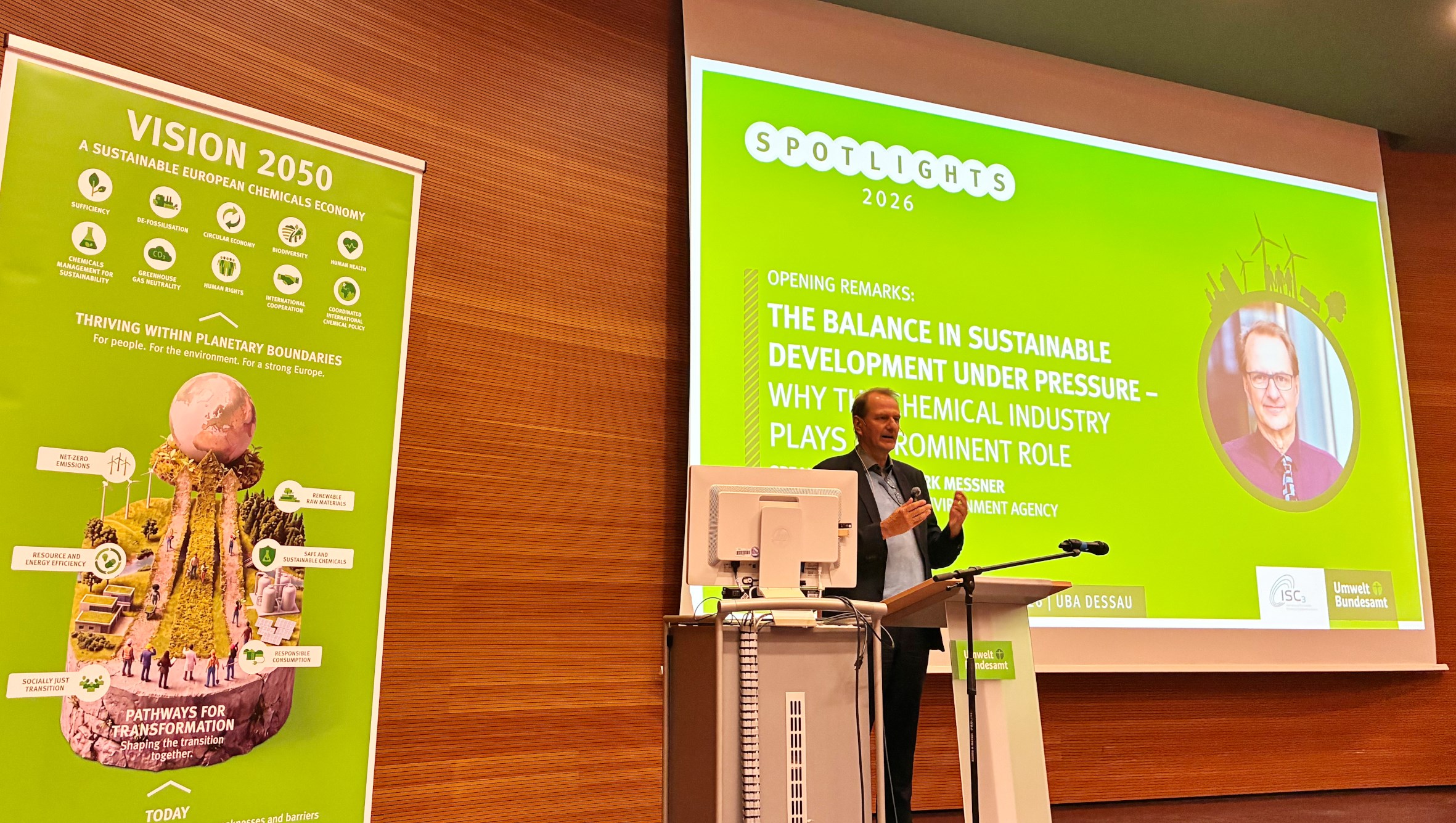
Spotlights 2026: UBA and ISC3 discussed with 150 invited experts how competitiveness, industrial jobs and sustainability can be reconciled
The transformation of the chemical industry is a shared European challenge that requires a systemic approach. It calls not only for technological innovations, but also for competitive production conditions, investment, effective regulation and public support. This was one of the key findings of “Spotlights 2026: Shaping the Chemical Transition Together”. At the joint conference organised by the German Environment Agency (UBA) and the International Sustainable Chemistry Collaborative Centre (ISC3), 150 experts from industry, government, academia, the financial sector, trade unions and civil society gathered in Dessau-Roßlau last week to discuss a vision and pathways towards a sustainable chemicals economy in Europe by 2050. While participants largely agreed that the transformation of the chemical industry is inevitable, it also became clear that different views remain on how best to achieve it.
“The European chemical industry is indispensable to our economic future and the ecological transformation. However, climate protection, resource conservation and protection against chemicals that harm the environment must not be played off against one another. We need a common transformation pathway that respects planetary boundaries, enables industrial value creation and is supported by as many stakeholders across society as possible,” says Prof. Dr Dirk Messner, President of the German Environment Agency.
Balancing Industrial Competitiveness and Ecological Transformation
Contributions from speakers including Prof. Dirk Messner (UBA), Ilka Hirt (BMUKN), Marco Mensink (CEFIC), Dr Christoph Gürtler (Covestro, VAA), Alexander Bercht (IGBCE), Veronica Manfredi and Kristin Schreiber (European Commission), and Prof. Peter H. Seeberger (MPI, CTC), highlighted the challenges facing Europe's chemical industry: high energy and investment costs, international competitive pressure and the risk of industrial value creation relocating elsewhere. At the same time, the industry must replace fossil-based raw materials, reduce emissions and develop sustainable, resource-efficient chemicals that can be kept in circulation and used as feedstocks for the chemical industry at the end of their life cycle.
The speakers also highlighted different approaches to industrial policy. While safeguarding existing production sites and jobs played a central role, they also stimulated debate on how innovative start-ups and smaller companies developing new technologies could receive greater support and become better integrated into industrial value chains.
A Sustainable Chemicals Economy Requires Innovation, Investment and Well-Functioning Lead Markets
“The future of the European chemical industry will depend on whether we succeed in consistently combining competitiveness, innovative strength and sustainability. Sustainable Chemistry offers a holistic approach to achieving this: rather than focusing solely on individual technologies or products, it considers entire value chains. Europe has the scientific and industrial expertise to actively shape this transformation. The priority now is to bring innovations into industrial practice more quickly and establish the right partnerships to make this possible,” explains Dr Thomas Wanner, Managing Director of ISC3.
Alongside discussions on alternative feedstocks, bio-based materials, circular technologies and the substitution of chemicals of concern, a key economic challenge came into focus: How can sufficient demand for more sustainable chemicals and materials be generated, and how can the resulting revenues reach the companies that need to invest in new production processes and facilities? The discussions demonstrated that public and private financing, regulatory incentives and the development of corresponding lead markets must be considered together, and that companies need planning certainty. Transparent information on the sustainability of products and supply chains can also help make investments more economically attractive.
Addressing Climate, the Circular Economy and Chemical Safety Together
The conference emphasised that the transformation must not be limited to reducing CO₂ emissions. Biodiversity, resource use, pollution prevention, and social and health impacts must also be considered together from the outset. When developing new materials in particular, it is essential to avoid unintended trade-offs, for example when substances classified as problematic are replaced with alternatives that pose similar risks.
In six parallel working groups, participants explored key areas for action in greater depth, including innovation and financing, the circular economy, safe consumer products in the electronics sector, regulatory frameworks and the implementation of European environmental objectives.
From a Shared Vision to Concrete Transformation Pathways
The concluding discussions made one thing clear: there is a willingness to engage in dialogue, but implementation requires collaboration across stakeholder groups and concrete decisions. Action must be taken now.
Participants emphasised the importance of continuous cross-sector dialogue to bring together different perspectives and further develop joint approaches to transforming the chemical industry. They also discussed ways to strengthen long-term cooperation between industry, academia, policymakers, trade unions and civil society. Spotlights 2026 provided important insights and impetus for these efforts.
Christian Ruth-Strauß
Director Communications ISC3
christian.ruth-strauss@isc3.org
René Sutthoff
Konsequent PR
sutthoff@konsequent-pr.de
About the German Environment Agency (UBA)
"For our environment″ is the UBA's motto and sums up what we are there for. As Germany's main environmental protection agency, we ensure that there is a healthy environment in Germany in which people can live as far as possible protected from harmful environmental impacts.
About the International Sustainable Chemistry Collaborative Centre (ISC3)
Chemistry is everywhere: it is embedded in everyday products, materials and technologies, and plays a key role in solutions for health, food, energy and mobility. Chemical products and processes shape nearly all aspects of modern life and the global economy. ISC3 promotes a holistic approach to sustainability by supporting the integration of sustainable technologies, processes and products across supply chains, taking environmental, economic and social factors into account. As a global platform, ISC3 connects stakeholders from policy, the public and private sectors, industry, academia and civil society worldwide. The Centre was established in 2017 on the initiative of the German Federal Ministry for the Environment and the German Environment Agency, is hosted by GIZ, and supported by DECHEMA. www.isc3.org