

Gelion PLC
26 August 2026

Gelion plc
("Gelion", "Company" or the "Group")
Successful completion of drone mission testing
APC ARMD4 programme with QinetiQ provides independent validation of Gelion's NES™ sulfur cathode technology in high-power, drone mission profiles
Gelion is seeking to replace the critical minerals in current lithium-ion battery cathodes with its Nano-Encapsulated Sulfur (NES™), a low-cost cathode active material made from abundantly available sulfur, that can be deployed within existing global manufacturing lines.
Gelion plc (AIM: GELN), the sulfur battery technology company, is pleased to announce the successful completion of the Advanced Propulsion Centre UK ("APC") funded Advanced Route to Market Demonstrator 4 ("ARMD4") programme, titled "Advanced Li-S Battery for Mobile Applications".
Under the programme, Gelion's NES™ Cathode Active Material (CAM) was incorporated into lithium-sulfur pouch cells (Li-S batteries) independently built and evaluated by QinetiQ plc (LON: QQ), the UK headquartered defence, security and aerospace company. The cells successfully completed representative drone mission profiles, including repeated high-power take-off and landing events, demonstrating stable cycling, high-power and application-relevant performance in representative unmanned system use cases.
Highlights
· APC-funded ARMD4 programme completed on time and within budget, with independent pouch cell build and testing undertaken by QinetiQ.
· Gelion's NES™ sulfur cathode material paired with lithium metal anodes, delivered stable cycling, high-power performance and successful completion of realistic drone mission profiles.
· Testing included repeated high-power take-off and landing events, supporting the relevance of NES™ for lightweight, high-power applications where energy density, power delivery and weight are critical.
· Results support continued engagement with defence, aerospace, drone and unmanned systems partners.
Strategic significance
The results show NES™ performing in real-world conditions relevant to drone applications. This supports Gelion's engagement with potential partners in defence, aerospace, unmanned systems and other lightweight mobility markets where high energy density, high power and supply-chain resilience are increasingly important.
Programme results
The testing assessed whether Gelion's NES™ sulfur cathode material could perform reliably in lithium-sulfur pouch cells under laboratory conditions relevant to real-world mobile applications. This included repeated charge and discharge cycling, high-power discharge testing, drone mission simulation and voltage stability analysis.
The independently tested cells demonstrated stable operation over 200 cycles at 1C discharge (representative power requirement for EV operation), reproducible voltage-profile behaviour across multiple cells, strong continuous 3C high-power performance (representative power requirement for quadcopter drone cruise operation), and successful completion of drone-representative duty cycles incorporating repeated 6C pulses (representative power requirement for vertical take-off and landing - VTOL). Importantly, the testing also showed stable voltage behaviour and no evidence of significant polysulfide shuttle effects, suggesting that NES™ has resolved the key technical challenge for lithium-sulfur batteries and supporting NES™ as a credible pathway for high-performance sulfur battery applications.
Drone Mission Duty Cycle
The below chart (right panel) confirms that the Li-S battery performs almost the same way on Cycle 50 as it did on Cycle 1, despite repeated and aggressive drone-style high-power missions showing encouraging durability under a demanding drone-like operating regime.
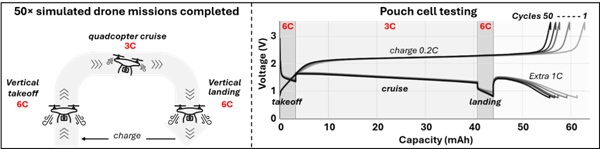
The pseudo-drone drive cycle testing demonstrated highly consistent performance over 50 cycles, with voltage profiles remaining closely aligned throughout repeated high-power take-off (6C), cruise (3C) and landing (6C) phases. The results indicate stable power delivery, successful completion of the mission profile and limited performance degradation under demanding drone-representative operating conditions
Matt Wood, Gelion CEO, commented: "The successful completion of this programme is an important milestone for Gelion. It validates the performance of our cathode materials across the multiple and complex performance requirements of drones and other lightweight mobility applications, both for defence and commercial markets.
"We will be discussing next steps with QinetiQ as we evaluate the potentially very large addressable markets for defence and commercial markets for next-generation lightweight mobility."
Gary Mepsted, Capability Lead for Power Sources at QinetiQ, commented: "We were pleased to support the ARMD4 programme through independent cell build and testing of pouch cells incorporating Gelion's NES™ sulfur cathode material. The programme demonstrated the performance of Gelion's lithium-sulfur technology under representative drone mission profiles and highlights its potential as a lightweight, high-power battery solution for demanding mobile applications.".
For more information, please visit Next-Generation Sulfur Battery Technologies | Gelion or contact:
|
Gelion plc |
via Tavistock |
|
Strand Hanson Limited (Nominated and Financial Adviser) |
+44 (0) 20 7409 3494 |
|
Oberon Capital (Joint Broker) Nick Lovering / Mike Seabrook / Adam Pollock |
+44 (0) 20 3179 5300 |
|
Allenby Capital Limited (Joint Broker) Jos Pinnington / Lauren Wright (Sales and Corporate Broking) Alex Brearley / Ashur Joseph (Corporate Finance)
|
+44 (0) 20 3328 5656 |
|
Tavistock (Financial & Corporate PR) |
+44 20 7920 3150 |
Market Abuse Regulation
This announcement contains inside information for the purposes of Article 7 of EU Regulation No. 596/2014, which forms part of United Kingdom domestic law by virtue of the European Union (Withdrawal) Act 2018, as amended.
About Gelion
Gelion plc (AIM: GELN) is an advanced battery materials company developing next-generation cathode technologies for lithium-ion and lithium-sulfur batteries. Its proprietary Nano-Encapsulated Sulfur (NES™) cathode active material is designed to replace conventional critical-mineral cathodes with abundant sulfur, delivering higher energy density while remaining compatible with existing battery manufacturing infrastructure.
The Company's strategy is to commercialise NES™ through partnerships with leading industrial companies and battery manufacturers, enabling adoption within established global supply chains across automotive, defence, device and other high-performance applications. Gelion works with Tier One industrial partners including TDK & Mitsui Kinzoku (Japan), QinetiQ and Nissan (UK), National Laboratory of the Rockies (NLR) (US), and Max Planck Institute of Colloids and Interfaces (MPI) (Germany).
-ends-
This information is provided by RNS, the news service of the London Stock Exchange. RNS is approved by the Financial Conduct Authority to act as a Primary Information Provider in the United Kingdom. Terms and conditions relating to the use and distribution of this information may apply. For further information, please contact rns@lseg.com or visit www.rns.com.
RNS may use your IP address to confirm compliance with the terms and conditions, to analyse how you engage with the information contained in this communication, and to share such analysis on an anonymised basis with others as part of our commercial services. For further information about how RNS and the London Stock Exchange use the personal data you provide us, please see our Privacy Policy.
ENDRNS may use your IP address to confirm compliance with the terms and conditions, to analyse how you engage with the information contained in this communication, and to share such analysis on an anonymised basis with others as part of our commercial services. For further information about how RNS and the London Stock Exchange use the personal data you provide us, please see our Privacy Policy.