

Panthera Resources PLC
08 October 2026
8 October 2026
Panthera Resources Plc
("Panthera" or "the Company")
Significant Gold Intersections and Maiden Exploration Target at Bido
Gold exploration and development company Panthera Resources Plc (AIM:PAT), with assets in West Africa and India, is pleased to announce that positive results have been returned from Reverse Circulation ("RC") drilling at the Bido Project in Burkina Faso. The RC drilling took place in the second half of 2026 and represented follow-up exploration of mineralisation identified during the 2025 programme at the Kwademen prospect.
Highlights
· Significant intersections of gold returned at the Kwademen Prospect:
- KWD26-RC-035 : 56 m @ 1.16 g/t Au from 76 m incl. 28 m @ 2.04 g/t Au from 88 m
- KWD26-RC-018 : 40 m @ 0.59 g/t Au from 10 m incl. 18 m @ 1.02 g/t Au from 14 m
· Exploration Target defined: an Exploration Target of between 0.7 and 1.6 million ounces (Moz) of gold has been estimated at Kwademen#. # Cautionary Statement: The potential quantity and grade of this Exploration Target is conceptual in nature. There has been insufficient exploration to estimate a Mineral Resource in respect of the Exploration Target, and it is uncertain whether further exploration will result in the estimation of a Mineral Resource.
Commenting on the results, Mark Bolton, Managing Director of Panthera said:
"Our maiden programme at Kwademen in 2025 confirmed the general tenor of gold mineralisation reported from historical BUVOGMI intercepts. This year's follow-up holes have demonstrated that these zones occur within a mineralised system, running over some 1400 metres of strike and between approximately 100 m to 330 m in width, with several holes ending in mineralisation.
KWD26-RC-035 returned 56 m @ 1.16 g/t Au from 76 m, including 28 m @ 2.04 g/t Au from 88 m, and KWD26-RC-018 returned 40 m @ 0.59 g/t Au from just 10 m. Taken with the broad, lower-grade intersections returned from a further 22 holes across the western zone of Kwademen (the "Kwademen West Zone"), these results have allowed us to define an Exploration Target of between 0.7 Moz and 1.6 Moz of gold (note cautionary statement).
While the drill density remains wide spaced and is not sufficient to define a Mineral Resource, it frames the scale of what we are dealing with at Kwademen. Our focus now turns to infill drilling on the higher-grade core of the western zone, with the objective of converting a first portion of that target into a MRE that can be reported in accordance with the Guidelines of the JORC Code, 2012. Potential broad zones defined by soil and geophysical anomalies, so far untested by drilling, may represent sub-surface gold mineralisation that could become future additions to the Exploration Targets already defined."
About the Bido Project
The Bido permit in Burkina Faso (Figure 1) is located some 125 km WSW of the capital Ouagadougou. The tenement lies within the Boromo greenstone belt which is principally composed of Paleoproterozoic Birimian terrain within the West African Man Craton. This belt also hosts the Poura gold deposit (1 to 2 Moz), situated about 50 km to the SSW of the area, as well as numerous gold occurrences. The Perkoa VMS deposit is located about 35 km to the north of the area.
The Kwademen prospect (Figure 1) was originally identified from an analysis of historical data from exploration undertaken in the 1980s, culminating in trenching and diamond drilling. This work was undertaken by BUVOGMI, the national geological service of Haute Volta (former name of Burkina Faso) under financing of the United Nations Development Program (UNDP). It targeted base metals and gold.
The Company's experienced in-country and international geological team have completed systematic geological mapping, data compilation, geochemical and geophysical surveys and interpretation of the database to identify drill targets and have now identified an exploration target (the "Exploration Target"), which represents a priority target at Kwademen.
The Company holds an 80% interest in the project, having completed its earn-in obligations. In accordance with the agreement with the vendor, the Company may acquire the remaining 20% by expenditure of a further US$1,000,000 on exploration and development, subject to the vendor's buy-back right of 1% for US$1,000,000 and a 1% net smelter returns ("NSR") royalty capped at US$3 million in total.
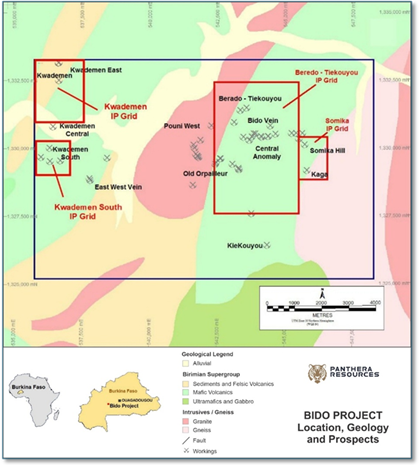
Figure 1: Bido Project Location, Prospects and Geophysical Survey Grid Locations
2026 Drilling Programme
An RC drilling programme targeting the Kwademen prospect has been completed with 34 holes completed for 4086 metres advance.
Exploration work by the Company on the area has included:
· data gathering and geological compilation work;
· soil sampling in 2018 on east-west lines spaced 200 m apart, with samples collected at 50 m intervals along each line;
· geological mapping and sampling;
· an Induced Polarisation ("IP") survey was conducted in 2023 and consisted of a gradient array survey exploring the ground at a relatively constant depth of 50m followed by a Pole-dipole survey on some selected lines to help determine the depth of the anomalies identified by the gradient array survey and the dip of the chargeable structures;
· more recently a programme of systematic mapping of all orpailleurs shafts and areas of eluvial workings was completed; and
· a first phase of RC drilling was completed with positive results during the 2025 field season.
The 2026 drill programme was designed to follow up significant intersections identified in the south of the zone by earlier programmes, including historical BUVOGMI holes that returned 24 m @ 1.38 g/t Au from 143 m, 9 m @ 0.51 g/t Au and 10 m @ 0.57 g/t Au.
In 2025, holes KWD25-RC-001 and KWD25-RC-017 started directly within gold mineralisation, indicating that the mineralised system may extend further to the east.
In the northern part of the zone the 2025 drilling tested the combined geophysical (IP) target, soil anomalies and coincident historical BUVOGMI drill results (such as 16 m @ 1.07 g/t Au, 11 m @ 0.40 g/t Au and 13 m @ 0.53 g/t Au) in the area where hole KWD25-RC-003 intersected 24 m @ 0.61 g/t Au from 18 m including 12 m @ 1.0 g/t Au from 26 m.
Drilling results for the 2026 programme have been positive, with two holes returning significant gold intersections.
Hole KWD26-RC-018 - 40 m @ 0.59 g/t Au from 10 m incl. 18 m @ 1.02 g/t Au from 14 m
Hole KWD26-RC-035 - 56 m @ 1.16 g/t Au from 76 m incl. 28 m @ 2.04 g/t Au from 88 m
A minor intersection in the same hole returned 20 m @ 0.27 g/t Au from 164 m.
The location of the drill holes is shown on Figure 2 while hole KWD26-RC-035 is shown in more detail on Figure 3. A section showing KWD26-RC-035 is provided as Figure 4 while Figure 5 shows the association of the KWD26-RC-035 intersection with imagery depicting the chargeability response to the Pole-dipole IP geophysical survey from 2023.
The KWD26-RC-018 intersection is presented as a section in Figure 6.
Wide zones of lower grade gold intersections were reported for a further 22 drill holes in the Kwademen West Zone (Table 1). The distribution of gold at a plus 0.1 g/t Au cut is shown on the plan provided as Figure 7 and as the long section of the Kwademen West Zone (plus/minus 200m) showing plus 0.1 g/t Au intersections (Figure 8).
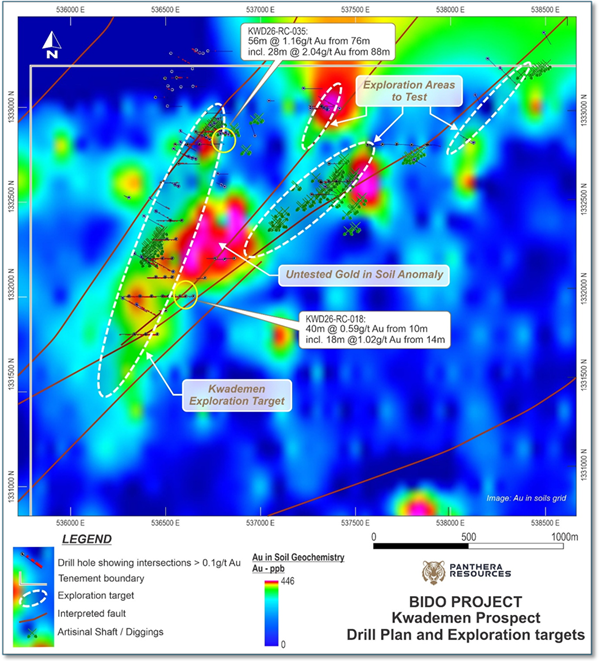
Figure 2: Plan View of the drilling at the Kwademen prospect location of drill holes with significant intersections, background thematic representation of gold in soil survey completed by Panthera
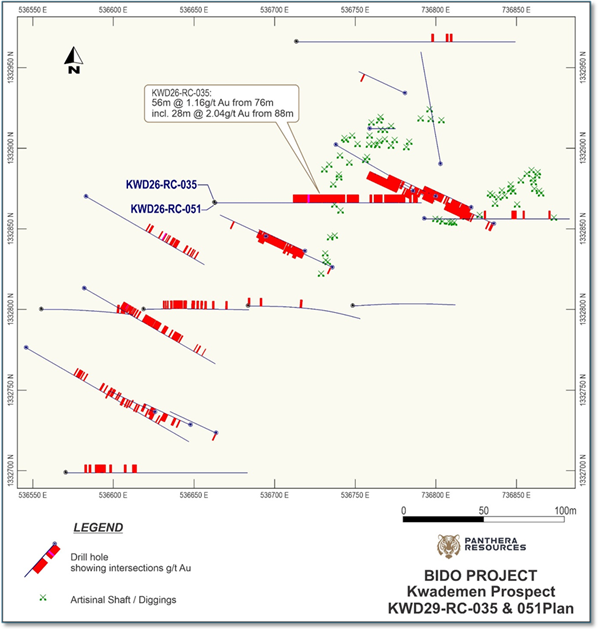
Figure 3: Hole KWD26-RC-035 plan
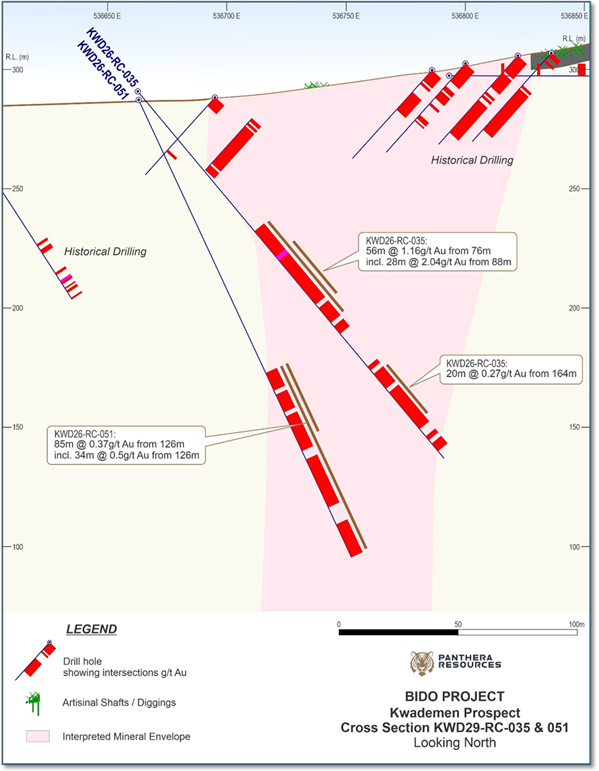
Figure 4: Hole KWD26-RC-035 and KWD26-RC-051 section +/- 20m. Section B - B1
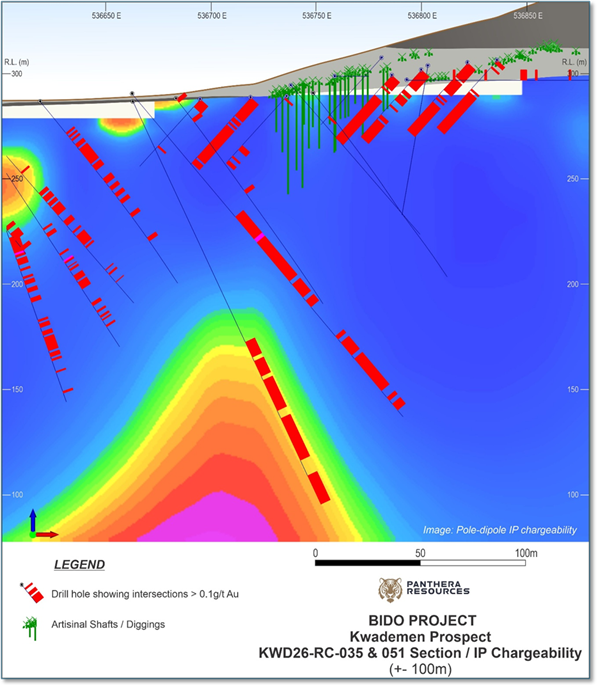
Figure 5: Hole KWD26-RC-035 and KWD26-RC-051 section +/- 100m to include nearby Pole-dipole IP chargeability profile, red assay bars are assays greater than 0.1 g/t Au. Section B - B1
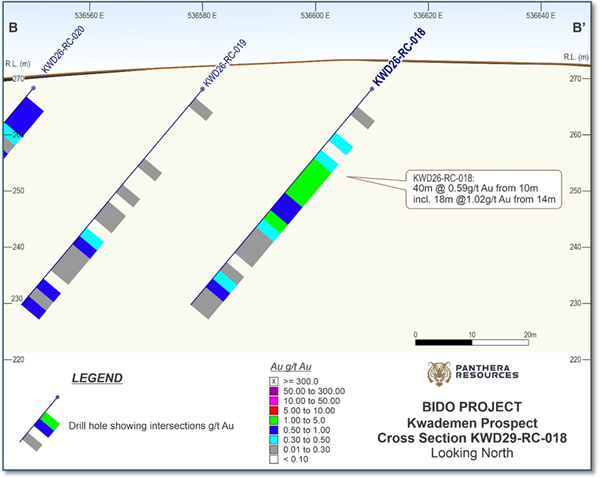
Figure 6: Hole KWD26-RC-018 intersection. Section C - C1
Kwademen Exploration Target
Within the western zone of mineralisation identified at Kwademen by some 35 drill holes (4195 metres advance), a mineralised system has been identified over a north-north-easterly trending strike length of some 1400 metres with widths of mineralisation ranging from approximately 100 m to 330 metres (Figure 7) (note cautionary statement). The distribution of gold is also shown as a long section (plus/minus 200m) showing plus 0.1 g/t Au intersections in Figure 8.
Using a rule of thumb method an Exploration Target of between 0.7 million ounces of gold to 1.6 million ounces of gold has been estimated (note cautionary statement).
As a check of the target size potential estimated by rule of thumb as detailed above, a wireframe was constructed over the drilling data, and a simulation of the target was run. The exercise provided an exploration target of between 820,000 oz and 1,846,000 oz of gold based on the parameters set out in Table 1 below:
Table 1: Wireframe simulation parameters used to check the Exploration Target range
|
Volume |
34,665,147 |
|
Average SG (Fresh and Saprolite) |
2.30 |
|
Tonnage |
79,729,838 |
|
Average gold grade in solid with no cut-off |
0.32 |
|
Ounces using grades without cut-off |
820,371 |
|
Average gold grade using a 0.1 g/t Au cut-off |
0.72 |
|
Ounces using a 0.1 g/t Au cut-off in grades |
1,845,835 |
The wireframe solids are shown in plan view as Figure 9 (note cautionary statement).
Kwademen Soil and Geophysical Exploration extensions
In addition, it is noted that potential extensions of mineralisation are indicated by soil geochemistry (Figures 2 and 7) and geophysical testing (see RNS 11 August 2023) but have not been subjected to drill testing. These target extensions have the potential to materially expand the exploration target at Kwademen.
Bido Tenement Exploration Prospects
Additional prospects of interest occur in the tenement (Figure 1). As previously reported (RNS November 2024) highlights of previous drilling included:
• At Somika Hill, Kaga vein system, significant intersections included:
BD24-RC-051 13 m to 27 m (14 metres) @ 0.91 g/t Au; incl. 10 m @ 1.15 g/t from 17 m
BD24-RC-054 23 m to 35 m (12 metres) @ 0.56 g/t Au
BD24-RC-057 19 m to 28 m (9 metres) @ 0.79 g/t Au; incl. 6 m @ 1.0 g/t from 19 m
• At Beredo-Kiekouyou prospect, significant intersections included:
BD24-RC-004 2 m to 4 m (2 metres) at 4.45g/t Au
BD24-RC-034 17 m to 20 m (3 metres) @ 1.17 g/t Au
BD24-RC-043 48 m to 53 m (5 metres) @ 1.79 g/t Au
BD24-RC-044 64 m to 66 m (2 metres) @ 2.16 g/t Au
An advanced grass roots prospect, the "Central Anomaly" (Fig 1), has been highlighted as a semi-circular geochemical anomaly (see the technical expert report in the Panthera listing document).
A gold in soil geochemical anomaly has been identified south of Kwademen at a new prospect called the South Kwademen prospect (Fig 1).
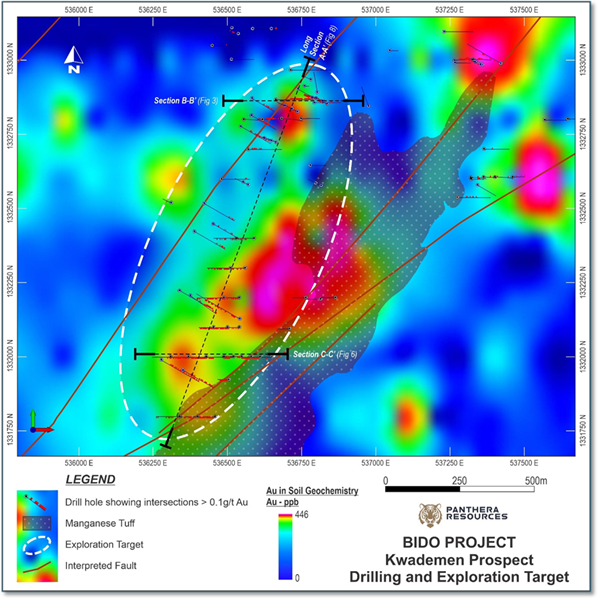
Figure 7: Plan View of all the drilling at the Kwademen prospect and Exploration Target area, note the red bars are plus 0.1 g/t Au. Background thematic gold in soil image, warm colour higher values
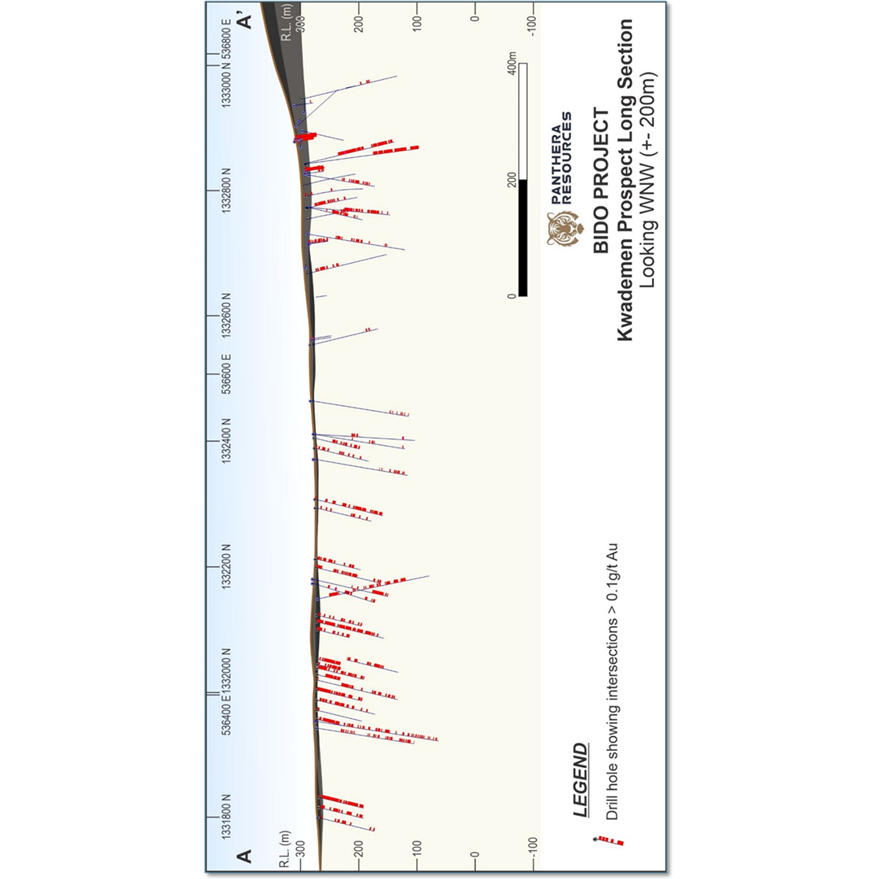
Figure 8: Kwademen West Zone Long section, looking to the WNW (plus/minus 200m) showing plus 0.1 g/t Au intersection.
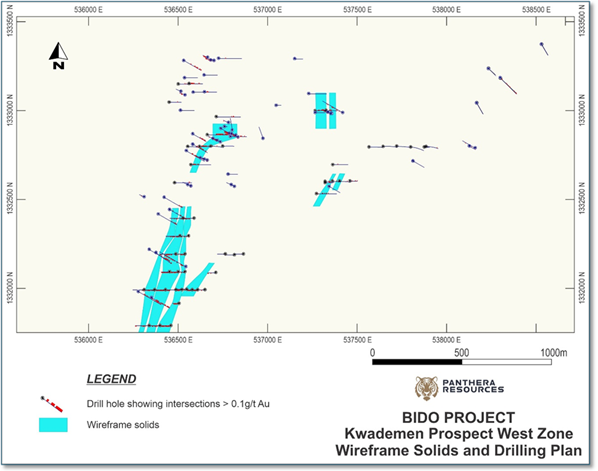 |
Figure 9: Plan View of wireframe solids and drilling at the Kwademen West Zone and Exploration Target area, note that the wireframe solids have been constructed on geological criteria with no cut-off grade applied.
Drilling Results
The best results of the 2025 and 2026 drilling programmes are summarised in Table 2 below. All samples were 2 m splits analysed at SGS Laboratory in Ouagadougou by fire assay on a 50g aliquot.
Table 2: Gold intersections from the 2025 and 2026 RC drilling programmes, Kwademen West Zone (2m splits - fire assay), with average grades of mineralisation. The drilling programme for 2025 comprised 17 holes completed for 1859 metres advance and for 2026 comprised 34 holes completed for 4086 metres advance, only significant intersections are provided in this table.
|
2025 Drilling |
|
|
KWD25-RC-001 |
12 m @ 0.2 g/t Au from 0 m |
|
KWD25-RC-001 |
8 m @ 0.15 g/t Au from 36 m |
|
KWD25-RC-001 |
6 m @ 0.27 g/t Au from 56 m |
|
KWD25-RC-001 |
18 m @ 0.54 g/t Au from 72 m No chips recovery between 78 m and 80 m. 0 g/t assumed for this interval here although it is in the richer part of the mineralisation |
|
KWD25-RC-001 |
4 m @ 0.96 g/t Au from 126 m |
|
KWD25-RC-003 |
24 m @ 0.61 g/t Au from 18 m incl. 12 m @ 1.0 g/t Au from 26 m |
|
KWD25-RC-006 |
4 m @ 0.19 g/t Au from 24 m |
|
KWD25-RC-006 |
6 m @ 0.13 g/t Au from 34 m |
|
KWD25-RC-006 |
2 m @ 1.58 g/t Au from 46 m |
|
KWD25-RC-006 |
22 m @ 0.33 g/t Au from 62 m |
|
KWD25-RC-007 |
6 m @ 0.28 g/t Au from 32 m |
|
KWD25-RC-007 |
4 m @ 0.43 g/t Au from 44 m |
|
KWD25-RC-013 |
14 m @ 0.53 g/t Au from 32 m |
|
KWD25-RC-014A |
4 m @ 2.52 g/t Au from 34 m incl. 2 m @ 4.73 g/t Au from 34 m |
|
KWD25-RC-017 |
10 m @ 0.72 g/t Au from 0 m |
|
KWD25-RC-017 |
8 m @ 0.68 g/t Au from 34 m |
|
KWD25-RC-017 |
4 m @ 0.24 g/t Au from 56 m |
|
KWD25-RC-017 |
6 m @ 0.31 g/t Au from 66 m (hole stopped at 72 m within mineralisation) |
|
2026 Drilling |
|
|
KWD26-RC-018 |
40 m @ 0.59 g/t Au from 10 m incl. 18 m @ 1.02 g/t Au from 14 m |
|
KWD26-RC-019 |
28 m @ 0.26 g/t Au from 22 m |
|
KWD26-RC-020 |
18 m @ 0.39 g/t Au from 2 m incl. 6 m @ 0.59 g/t Au from 2 m AND 12 m @ 0.24 g/t Au from 68 m |
|
KWD26-RC-021 |
32 m @ 0.31 g/t Au from 18 m incl. 14 m @ 0.49 g/t Au from 26 m |
|
KWD26-RC-022 |
26 m @ 0.2 g/t Au from 54 m |
|
KWD26-RC-023 |
78 m @ 0.28 g/t Au from 0 m INCLUDES 22 m @ 0.61 g/t Au from 2 m incl. 6 m @ 1.22 g/t Au from 16 m AND 10 m @ 0.27 g/t Au from 42 m AND 4 m @ 0.14 g/t Au from 54 m AND 8 m @ 0.17 g/t Au from 70 m |
|
KWD26-RC-024 |
16 m @ 0.18 g/t Au from 6 m AND 20 m @ 0.13 g/t Au from 40 m AND 4 m @ 2.11 g/t Au from 78 m |
|
KWD26-RC-027 |
102 m @ 0.23 g/t Au from 0 m INCLUDES 14 m @ 0.25 g/t Au from 0 m AND 22 m @ 0.44 g/t Au from 18 m incl. 12 m @ 0.56 g/t Au from 20 m AND 22 m @ 0.22 g/t Au from 80 m AND 12 m @ 0.32 g/t Au from 112 m |
|
KWD26-RC-028 |
6 m @ 0.38 g/t Au from 16 m |
|
KWD26-RC-029 |
8 m @ 0.35 g/t Au from 60 m AND 28 m @ 0.15 g/t Au from 84 m |
|
KWD26-RC-030 |
2 m @ 0.59 g/t Au from 96 m |
|
KWD26-RC-031 |
6 m @ 0.54 g/t Au from 40 m AND 8 m @ 0.7 g/t Au from 64 m incl. 4 m @ 1.36 g/t Au from 68 m AND 6 m @ 0.32 g/t Au from 88 m |
|
KWD26-RC-032 |
6 m @ 0.3 g/t Au from 54 m |
|
KWD26-RC-034 |
10 m @ 0.28 g/t Au from 28 m |
|
KWD26-RC-035 |
56 m @ 1.16 g/t Au from 76 m incl. 28 m @ 2.04 g/t Au from 88 m AND 20 m @ 0.27 g/t Au from 164 m |
|
KWD26-RC-038 |
22 m @ 0.2 g/t Au from 14 m |
|
KWD26-RC-040 |
8 m @ 0.2 g/t Au from 0 m |
|
KWD26-RC-042 |
50 m @ 0.49 g/t Au from 0 m incl. 16 m @ 0.91 g/t Au from 12 m AND 28 m @ 0.44 g/t Au from 58 m |
|
KWD26-RC-043 |
8 m @ 0.28 g/t Au from 4 m AND 14 m @ 0.57 g/t Au from 32 m AND 10 m @ 0.31 g/t Au from 62 m AND 6 m @ 0.59 g/t Au from 90 m |
|
KWD26-RC-044 |
8 m @ 0.37 g/t Au from 52 m |
|
KWD26-RC-045 |
26 m @ 0.5 g/t Au incl. 12 m @ 0.79 g/t Au from 12 m |
|
KWD26-RC-046 |
12 m @ 0.25 g/t Au from 126 m |
|
KWD26-RC-047 |
6 m @ 1.09 g/t Au from 64 m (Hole stopped within mineralisation) |
|
KWD26-RC-051 |
85 m @ 0.37 g/t Au from 126 m INCLUDES 34 m @ 0.5 g/t Au from 126 m AND 22 m @ 0.46 g/t Au from 166 m AND 16 m @ 0.2 g/t Au from 196 m |
Contacts
Panthera Resources PLC
Mark Bolton (Managing Director) +61 411 220 942
contact@pantheraresources.com
Allenby Capital Limited (Nominated Adviser) +44 (0) 20 3328 5656
John Depasquale / Vivek Bhardwaj (Corporate Finance)
VSA Capital Limited (Joint Broker) +44 (0) 20 3005 5000
Andrew Monk / Andrew Raca
AlbR Capital Limited (Joint Broker) +44 (0) 20 7399 9400
Colin Rowbury
Subscribe for Regular Updates
Follow the Company on Twitter at @PantheraPLC
For more information and to subscribe to updates visit: pantheraresources.com
Qualified Person
The technical information contained in this disclosure has been read and approved by Ian S Cooper (BSc, ARSM, FAusIMM, FGS), who is a qualified geologist and acts as the Qualified Person under the AIM Rules - Note for Mining and Oil & Gas Companies. Mr Cooper is a geological consultant to Panthera Resources PLC.
Glossary
|
Au: |
The chemical element for Gold |
|
Diamond Core |
Diamond core drilling uses a diamond cutting bit, which rotates at the end of a steel rod (tube) allowing for a solid column of rock to be recovered from the tube at the surface. |
|
Fire Assay or FA: |
Fire assay method has been practised since ancient times and remains the industry-standard technique for determining gold content in all sample types. This well-understood technique provides accurate results across geological sample types. However, practised skill is essential to achieving a successful fire assay. A range of fire assay methods are available with 30g or 50g sample aliquots taken after a larger representative sample has been crushed and pulverised for homogenisation. Multiple options for detection ranges to suit the needs of the project. |
|
g/t: |
Grammes per Tonne (Metric) |
|
IP: |
Induced polarisation (IP) is a geophysical imaging technique used to identify the electrical chargeability of subsurface materials |
|
JORC or JORC Code: |
Australasian Code for Reporting of Mineral Resources and Ore Reserves of December 2012 ("JORC Code") as prepared by the Joint Ore Reserves Committee of the Australasian Institute of Mining and Metallurgy. Terms including Measured, Indicated and Inferred Resources as defined therein
|
|
JORC Code definition of an Exploration Target: |
The JORC Code states that; An Exploration Target is a statement or estimate of the exploration potential of a mineral deposit in a defined geological setting where the statement or estimate, quoted as a range of tonnes and a range of grade (or quality), relates to mineralisation for which there has been insufficient exploration to estimate a Mineral Resource. |
|
RC Drilling: |
Reverse Circulation drilling, or RC drilling, uses rods with inner and outer tubes, the drill cuttings are returned to surface inside the rods. The drilling mechanism is a pneumatic reciprocating piston known as a hammer driving a tungsten-steel drill bit. |
Forward-looking Statements
This news release contains forward-looking statements that are based on the Company's current expectations and estimates. Forward-looking statements are frequently characterised by words such as "plan", "expect", "project", "intend", "believe", "anticipate", "estimate", "suggest", "indicate" and other similar words or statements that certain events or conditions "may" or "will" occur. Such forward-looking statements involve known and unknown risks, uncertainties and other factors that could cause actual events or results to differ materially from estimated or anticipated events or results implied or expressed in such forward-looking statements. Such factors include, among others: the actual results of current exploration activities; conclusions of economic evaluations; changes in project parameters as plans continue to be refined; possible variations in ore grade or recovery rates; accidents, labour disputes and other risks of the mining industry; delays in obtaining governmental approvals or financing; and fluctuations in metal prices. There may be other factors that cause actions, events or results not to be as anticipated, estimated or intended. Any forward-looking statement speaks only as of the date on which it is made and, except as may be required by applicable securities laws, the Company disclaims any intent or obligation to update any forward-looking statement, whether as a result of new information, future events or results or otherwise. Forward-looking statements are not guarantees of future performance and accordingly, undue reliance should not be put on such statements due to the inherent uncertainty therein.
**ENDS**
This information is provided by RNS, the news service of the London Stock Exchange. RNS is approved by the Financial Conduct Authority to act as a Primary Information Provider in the United Kingdom. Terms and conditions relating to the use and distribution of this information may apply. For further information, please contact rns@lseg.com or visit www.rns.com.
RNS may use your IP address to confirm compliance with the terms and conditions, to analyse how you engage with the information contained in this communication, and to share such analysis on an anonymised basis with others as part of our commercial services. For further information about how RNS and the London Stock Exchange use the personal data you provide us, please see our Privacy Policy.
ENDRNS may use your IP address to confirm compliance with the terms and conditions, to analyse how you engage with the information contained in this communication, and to share such analysis on an anonymised basis with others as part of our commercial services. For further information about how RNS and the London Stock Exchange use the personal data you provide us, please see our Privacy Policy.