

Great Southern Copper PLC
08 July 2026
THIS ANNOUNCEMENT CONTAINS INSIDE INFORMATION AS STIPULATED UNDER THE UK VERSION OF THE MARKET ABUSE REGULATION NO 596/2014 WHICH IS PART OF ENGLISH LAW BY VIRTUE OF THE EUROPEAN (WITHDRAWAL) ACT 2018, AS AMENDED. ON PUBLICATION OF THIS ANNOUNCEMENT VIA A REGULATORY INFORMATION SERVICE, THIS INFORMATION IS CONSIDERED TO BE IN THE PUBLIC DOMAIN.
08 July 2026
Great Southern Copper plc
("GSC" or the "Company")
Scout RC Drilling Campaign Completed at Especularita
Exploration Update
Great Southern Copper plc (LSE: GSCU), the company focused on copper-gold-silver exploration in Chile, is pleased to announce that it has completed its first scout RC drilling programme at the Especularita Project targeting large-scale porphyry copper systems.
Highlights:
· Seventeen scout RC holes completed for a total of 2,474 metres ("m") drilled
· The La Colorada advanced argillic lithocap is vast in size and interpreted to represent the upper high-sulphidation levels of an alteration system that is potentially overlying porphyry-related copper mineralisation
· Drilling designed to assist with geological interpretation in areas surrounding the advanced argillic lithocap where the Company believes the lithocap has been eroded potentially exposing underlying porphyry-style alteration at surface
· Porphyry copper type alteration is evidenced in the drilling at Piedras Blancas, Artemisa North and Victoria
· First assay results are expected within the next 2-4 weeks
· GSC holds rights to own 100% of the Especularita project
· Prospect located at low elevation with excellent access to infrastructure and mining services and along trend of more than 85 million tonnes of contained copper hosted in major deposits including Los Pelambres, Altar and El Pachon
Sam Garrett, Chief Executive Officer of Great Southern Copper, said: "We are pleased to have completed our first drilling test of the flanking margins of the giant lithocap alteration system at Especularita. This programme is important because it will allow us to vector future drilling within the lithocap to target areas that have the most potential to host copper and gold mineralisation. The lithocap covers a vast area of over 75km2, however, we suspect that it was originally much larger and has since been eroded - potentially exposing porphyry copper style alteration at the present surface.
"The RC drilling has proven highly effective in efficiently testing four prospect targets, and the results from this programme already suggest that we are seeing porphyry-related phyllic alteration at surface at Piedras Blancas and Artemisa North and, more importantly, potassic alteration at shallow depths below that.
"Elsewhere, exploration is continuing on multiple fronts across the project to enable the momentum of drilling work to continue. In particular, mapping and sampling at both the Cerro Negro and Viuda prospects is ongoing and aimed to assist with planning for the next phases of exploration drilling in those locations."
Scout RC Drilling at Especularita:
The scout RC drilling programme at Especularita targeted prospects along the western and southern margins of the La Colorada lithocap (Figure 1). The Especularita project is situated at low altitude within the Cretaceous-age coastal metallogenic belt, within a northwest-southeast trending structural lineament that links the project with notable large-scale porphyry Cu-Au mines and projects, including Los Pelambres, Altar and El Pachon (Figure 1).
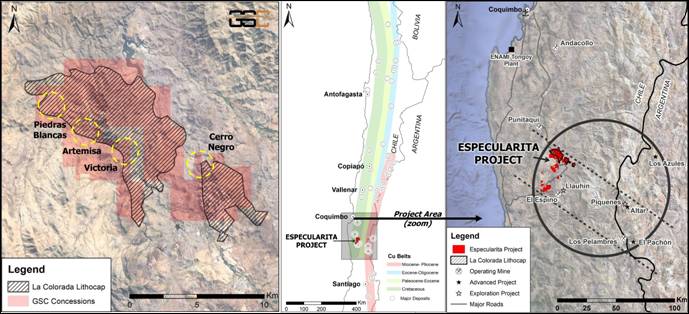
Figure 1: GSC's Especularita project is located at low altitude within the coastal metallogenic belt of northern Chile and within 50km radius of over 50 million tonnes of contained copper metal defined in mines and advanced projects.
A total of 17 drill holes (comprising 2,474m) have been completed across four target areas on the western and southern flanks of the advanced argillic lithocap alteration including Piedras Blancas1, Artemisa North2, Victoria3 and Artemisa South4 (Figure 2).
Drillholes at Piedras Blancas and Artemisa North (RC001 - RC009) intersected a complex of diorites and locally porphyritic microdiorites with widespread strong to intense magnetite-biotite-pyrite alteration overprinted by zones of strong to intense chlorite-sericite alteration with over 10% disseminated pyrite and local quartz and pyrite stockwork veinlets. Importantly, this alteration is consistent with the outer phyllic alteration zone (or shell) in a porphyry copper type system (Figure 3). Of special note is the occurrence of porphyry-copper style potassic alteration, defined by hydrothermal biotite with over 10% disseminated pyrite and minor chalcopyrite and quartz veinlets, intersected in the bottoms of holes RC001 at Piedras Blancas and RC008 at Artemisa North. These two holes lie furthest to the east and were drilled directed towards the lithocap, beneath zones of outcropping quartz-sericite stockwork veining, suggesting the system may be improving in this direction. Importantly, this potassic alteration was intercepted within a hundred metres of surface suggesting that the system may be telescoped and the porphyry centre could potentially be close to surface.
Drilling at Victoria and Artemisa South (RC010 to RC017) was also dominated by variable magnetite-biotite alteration developed in hornfelsed volcanics (Victoria) and diorites to granodiorites (Artemisa South). However, phyllic-style pyrite-sericite-chlorite alteration is less intense than the northern areas and seems to be more structurally controlled, which is consistent with the mineralisation observed at surface as vein swarms of carbonate-quartz-sulphide and/or quartz-sericite-chlorite plus sulphides. The intensity of veining and presence of Cu-oxide occurrences increases generally northwards towards the lithocap, further suggesting that the source of the fluids lies to the north and beneath the advanced argillic alteration that defines the La Colorada lithocap.
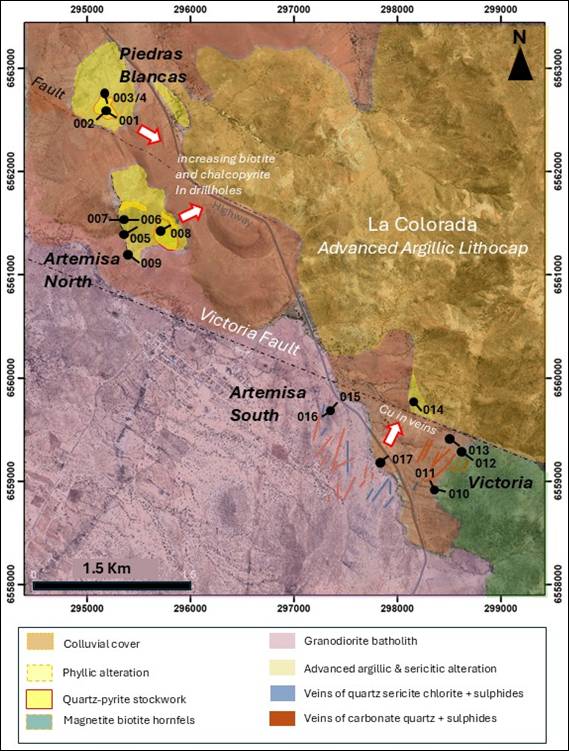
Figure 2: Geology and summary drill hole plan map for the scout RC programme, Especularita Project.
La Colorada Lithocap:
Where preserved, lithocaps overlie and conceal the location and source of potential porphyry Cu mineralisation at depth (Figure 3). They are formed by hot acidic fluids ascending to the surface from the porphyry intrusion below and the subsequent interactions of those fluids with the enclosing wall rocks. Interaction of the rising fluids with porous volcanic rocks, for example, typically results in a laterally extensive, flat-lying "blanket" of silica-mica-clay-pyrite alteration (defined as advanced argillic alteration) above the porphyry system below. Uplift, weathering and exposure of the pyritic-rich alteration to oxidising surface waters creates highly acidic fluid conditions which then acts to strip (or "leach") metals and other minerals from the altered rock resulting in a hard, silica-dominant and highly resistive cap-rock overlying the porphyry alteration system.
The lithocap may also itself be mineralised - with gold-silver-copper deposits not uncommon within the advanced argillic alteration zones. However, due to acid-leaching, the oxidised surface areas of the silica-rich lithocaps are typically barren and chemically inert to depths of up to several hundreds of meters depending upon the weathering and erosion profile which, as a result, can mask the presence of underlying high-sulphidation and porphyry copper mineralisation.
Figure 3 below is a summary model of an idealised porphyry copper system that incorporates features that the GSC exploration team believes are significant to the Especularita project and, specifically, where the Company's prospects may occur within the system. Surrounding the vertically-continuous porphyry intrusion(s) the alteration system forms typically as overlapping shell-like carapaces zoning outward from the mineralising porphyry intrusion as;
· Potassic (magnetite-Kspar) -> phyllic (sericite-chlorite-pyrite) -> propylitic (epidote) alteration shells
· Advanced argillic (qtz-al-kaol-pyro-dic) forms near-surface blanket. High pyrite produces acid leaching
· High sulphidation Au-Ag+Cu can occur at base of lithocap below the acid-leached weathering zone
· Intermediate sulphidation Cu-Pb-Zn-Ag related to late dacitic domes
· Porphyry copper grades increase inwards towards the potassic core
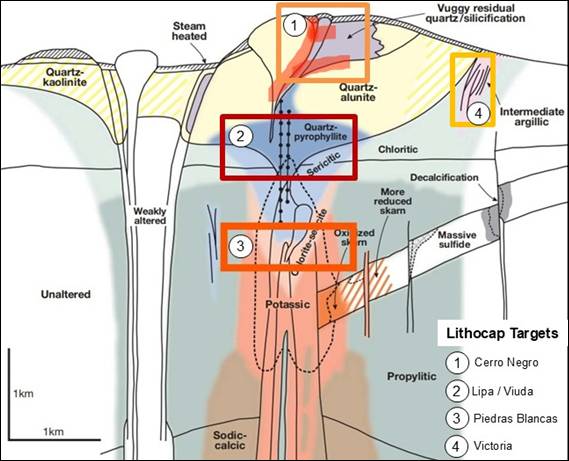
Figure 3: Geology model illustrating typical Chilean type porphyry copper systems such as Especularita (Modified from: Sillitoe, 2010, Porphyry Copper Systems: Economic Geology, v. 105 p. 3-41). GSC's main prospects are referenced relative to their interpreted respective locations within the broader porphyry system.
GSC's La Colorada advanced argillic lithocap alteration system is vast, measuring over 75km2 in area, and to date the Company has explored less than 25% of the total prospective area. In order to efficiently vector exploration focus towards the hidden porphyry copper zones the Company is undertaking extensive and detailed spectral and low-detection geochemistry surveys to map the temperature-pH mineralogy of the alteration minerals which provides clues to the hot acidic fluid pathways leading down-ward to the porphyry copper mineralisation below the lithocap. This work, combined with the recent AMT surveys and scout RC drilling results will be critical in planning the next phase of exploration drilling of the lithocap to target both high-sulphidation Au-Ag-Cu and porphyry Cu mineralisation.
Scout RC Drill Programme and Sampling:
The RC drilling method employed at Especularita collects samples on two-metre intervals. Representative samples for each sample of the cuttings are collected in large, individually numbered plastic bags, which are then weighed and transferred to a riffle splitter where they are separated (or split), and homogenised, three times into two duplicate samples of approximately 5kg each. GSC personnel then ticket and label one of the ±5kg samples using preprinted ticket books.
Finally, standard reference materials ("SRM's" or "Standards"), blanks, and duplicate samples are inserted into the sample sequence for the purpose of quality assurance / quality control ("QAQC"). The second ±5kg sample is used for geological description and stored for reference. An additional reference selection of cuttings for each two-metre sample is also retained in labelled boxes as a record of the geology of the drill hole.
At the completion of each hole, the representative 5kg samples are transported as a batch from the field and delivered by Company employees to ALS Laboratories in Santago or La Serena where they are prepared for analysis (weighed, dried, crushed and pulverised). A subsequent 200g split of each sample pulp is then forwarded to the ALS geochemical laboratory in Lima, Peru, where samples are assayed for gold (30g fire assay with ICP-AES finish, ALS code AU-ICP21) and 48 major, base and trace elements by ICP-MS following a four-acid digest (ALS code ME-MS61).
RC drilling was selected for this initial proof-of-concept stage as it is faster and cheaper than diamond drilling and allows for the rapid testing of more targets for the same cost.
Exploration Update:
Geology and geochemical assay results for the scout RC drilling programme will be used to vector the next phase of exploration drilling at the La Colorada lithocap. First assay results are expected within the next 2-4 weeks.
Final leach test results are pending from the Mostaza metallurgical test work conducted on Phase I and II high-grade drill core samples.
Planning for extensions to the Cerro Negro IP survey is also underway and anticipated to commence during July-August 2026. Results of the IP survey will guide targeting for Phase IV drilling at Cerro Negro, including Mostaza.
Detailed prospect-scale mapping and sampling are continuing at both the Viuda and Cerro Negro prospects. New results from this ongoing work, together with results of the planned geophysics surveys, will direct targeting for the next phase of drilling at both Viuda and Cerro Negro.
References:
1. RNS 0949B (20 April 2026): Drilling Commences with First Test of Porphyry Copper Targets at Especularita
2. RNS 1366E (13 May 2026): Scout RC Drilling Commences at Artemisa North Porphyry Copper Target
3. RNS 5465G (02 June 2026): Scout RC drilling commences at Victoria target
4. RNS 3799I (16 June 2026): Scout RC drilling commences at Artemisa South copper-gold target
Engage with the GSC management team directly by asking questions, watching video summaries and seeing what other shareholders have to say. Navigate to our Interactive Investor hub here: https://gscplc.com/
Enquiries:
|
Great Southern Copper plc |
|
|
Sam Garrett, Chief Executive Officer |
+44 (0) 20 7138 3204 |
|
SI Capital Limited |
|
|
Nick Emerson |
+44 (0) 1483 413500 |
|
BlytheRay |
|
|
Tim Blythe / Megan Ray |
+44 (0) 20 7138 3204 GSC@blytheray.com |
Subscribe to our news alert service: https://gscplc.com/auth/signup
Notes for Editors:
About Great Southern Copper
Great Southern Copper PLC is a UK-listed mineral exploration company focused on the discovery of copper-gold-silver deposits in Chile. The Company has the option to acquire mining rights to 100% of Especularita project in the under-explored coastal belt of Chile that is prospective for large scale copper-gold-silver deposits. Chile is a globally significant mining jurisdiction being the world's largest producer and exporter of copper.
The Especularita Project is located in the coastal metallogenic belt of Chile which hosts significant copper mines and deposits, including Teck's Carmen de Andacollo copper mine, and boasts excellent access to infrastructure such as roads, power and ports. Significant historical small-scale and artisanal workings for both copper and gold are readily evident in the exploration project area. The coastal belt offers deposit type optionality for copper including porphyry and IOCG style deposits as well as newly recognised intrusive-related copper and gold deposits.
Great Southern Copper is strategically positioned to support the global market for copper - a critical battery metal in the clean energy transition around the world. The Company is actively engaged in exploration and evaluation work programmes targeting both large tonnage, low to medium grade Cu-Au as well as high-grade Cu-Ag-Au deposits.
Further information on the Company is available on the Company's website: https://gscplc.com
Competent Person Statement
The information in this announcement that relates to exploration results is based on and fairly represents information reviewed or compiled by Mr Sam Garrett, a Competent Person who is a Member of the Australian Institute of Geoscientists and a Fellow of the Society of Economic Geologists. Mr Garrett is the CEO and a shareholder of Great Southern Copper PLC. Mr Garrett has sufficient experience that is relevant to the styles of mineralisation and types of deposit under consideration and to the activity being undertaken to qualify as a Competent Person as defined in the 2012 Edition of the "Australasian Code for Reporting of Exploration Results, Mineral Resources and Ore Reserves". Mr Garrett has provided his prior written consent to the inclusion in this announcement of the matters based on information in the form and context in which it appears.
This announcement includes information that relates to Exploration Results prepared and first disclosed under the JORC Code (2012) and extracted from the Company's previous LSE announcements as noted, and the Company's Prospectus dated 20 December 2021. Copies of these announcements are available from the LSE Announcements page of the Company's website: www.gscplc.com.
The Company confirms that it is not aware of any new information or data that materially affects the information included within the Prospectus dated 20 December 2021.
Forward Looking and Cautionary Statements
Some statements in this announcement regarding estimates or future events are forward-looking statements. They include indications of, and guidance on, future earnings, cash flow, costs and financial performance. Forward-looking statements include, but are not limited to, statements preceded by words such as "planned", "expected", "projected", "estimated", "may", "scheduled", "intends", "anticipates", "believes", "potential", "predict", "foresee", "proposed", "aim", "target", "opportunity", "could", "nominal", "conceptual" and similar expressions. Forward-looking statements, opinions and estimates included in this report are based on assumptions and contingencies which are subject to change without notice, as are statements about market and industry trends, which are based on interpretations of current market conditions. Forward-looking statements are provided as a general guide only and should not be relied on as a guarantee of future performance. Forward-looking statements may be affected by a range of variables that could cause actual results to differ from estimated or anticipated results and may cause the Company's actual performance and financial results in future periods to materially differ from any projections of future performance or results expressed or implied by such forward-looking statements. So, there can be no assurance that actual outcomes will not materially differ from these forward-looking statements.
This information is provided by RNS, the news service of the London Stock Exchange. RNS is approved by the Financial Conduct Authority to act as a Primary Information Provider in the United Kingdom. Terms and conditions relating to the use and distribution of this information may apply. For further information, please contact rns@lseg.com or visit www.rns.com.
RNS may use your IP address to confirm compliance with the terms and conditions, to analyse how you engage with the information contained in this communication, and to share such analysis on an anonymised basis with others as part of our commercial services. For further information about how RNS and the London Stock Exchange use the personal data you provide us, please see our Privacy Policy.
ENDRNS may use your IP address to confirm compliance with the terms and conditions, to analyse how you engage with the information contained in this communication, and to share such analysis on an anonymised basis with others as part of our commercial services. For further information about how RNS and the London Stock Exchange use the personal data you provide us, please see our Privacy Policy.