

Scania is addressing one of the transport industry’s biggest electrification challenges: how to make electric trucks work for long-haul operations. The solution combines expanded battery capacity, MCS charging and practical vehicle configuration, enabling up to 720 kilometres of range while helping operators balance payload, charging and productivity.
For transport operators, the question is whether an electric truck can cover demanding routes, carry the required load and charge in a way that fits real transport schedules.
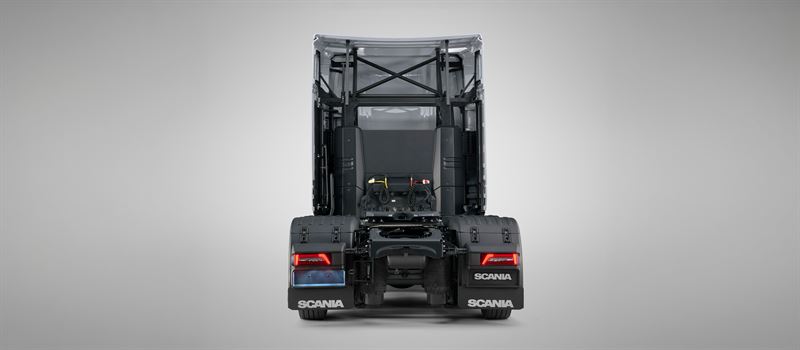
Scania’s solution brings those elements together. By adding battery capacity behind the cab, in combination with chassis-mounted batteries and megawatt charging, the vehicle can be configured for longer electric range while retaining the operational flexibility needed for European long-haul assignments.
In combination with Scania’s protruding IVD (Increased Vehicle Dimension) front, the battery-behind-cab layout enables a 6x2*4 European trailer combination with maximum range, even when the total vehicle length exceeds 16.5 metres. This allows customers to combine long electric range with practical trailer compatibility and maintained turning performance.
When combined with the new front, the vehicle can reduce energy consumption by up to 3 percent, depending on specification and operation, as wind resistance accounts for a larger share of total energy use in electric trucks.
“Electric trucks are already part of the transport system, but long-haul operations place very different demands on range, payload and charging. With this solution, Scania is showing how those pieces can come together in a practical way for customers who want to electrify demanding long-distance routes,” says Lars Gustafsson, Senior Vice President, Head of Solutions Management, Scania.
Long distances, heavy loads, trailer compatibility, charging strategy and bodywork requirements all influence whether an electric truck works in daily operation. By placing additional battery packs behind the cab, Scania can increase installed battery capacity without relying only on chassis-mounted batteries, making it possible to build long-haul configurations with up to 720 kilometres of range while giving operators more room to balance range and payload.
In a typical configuration, two MP20 battery packs can be mounted behind the cab, adding approximately 356 kWh of installed capacity in addition to the batteries on the chassis and under the cab. Together with MCS charging, this expanded energy capacity supports electric long-haul tractor configurations using standard European trailer combinations.
“This is not only about placing batteries in a new position on the vehicle. The larger point is what it enables: electric transport over distances that have traditionally been among the hardest to electrify, with range, payload and charging considered together from the start,” Gustafsson concludes.
FACTS:
- Electric range of up to 720 kilometres, depending on configuration and operating conditions
- Up to 3 percent lower energy consumption on battery-electric vehicles when combined with the new front, depending on specification and operation
- Expanded installed battery capacity, including two MP20 battery packs mounted behind the cab in a typical configuration
- Adds approximately 356 kWh installed capacity behind the cab, depending on configuration
- Designed to support MCS charging for shorter and more productive charging stops in long-haul operations
- Supports selected long-haul 6x2*4 tractor configurations with standard European trailer combinations
- Works together with Scania’s IVD front to enable total vehicle length above 16.5 metres
Explore Scania’s electric solutions here.
For further information, please contact:
Alexandra Österplan
Marketing Communications Manager
Phone: +46 735 667 121
E-mail: alexandra.osterplan@scania.com
Scania is a world-leading provider of premium transport solutions. Together with our partners and customers, we are driving the shift towards a sustainable transport system. Founded in Sweden in 1891, Scania now operates in more than 100 countries and employs around 53,000 people. Production takes place in Europe, Latin America and Asia. Research and development is carried out globally with our main site in Södertälje, Sweden. As part of the TRATON Group, we are empowered by shared industrial strength, scale and expertise to accelerate innovation and the shift towards a sustainable transport system. In 2025, Scania delivered 87,600 trucks, 6,500 buses and coaches as well as 9,200 industrial and marine power systems to our customers. Net sales totalled over SEK 198 billion, of which about 20 percent were services related. For more information visit: www.scania.com