

Sunrise Resources Plc
06 August 2026
6 August 2026
SUNRISE RESOURCES PLC
("Sunrise" or the "Company")
Reese Ridge Zinc-Lead-Silver (-Gallium) Project
High-Grade Surface Results Continue as Geological Model Advances Towards Drill Targeting
Sunrise Resources plc is pleased to announce further encouraging high-grade zinc, lead and silver assay results from its Reese Ridge Zinc-Lead-Silver (-Gallium) Project in Nevada, USA, where recent geological mapping and sampling have strengthened the Company's confidence in the exploration potential of the Project and are assisting with the definition of drill targets.
Highlights
· Geological mapping and sampling programme successfully completed to refine the structural interpretation and support drill hole planning.
· Very high-grade results returned from the Ridge Top Prospect, including:
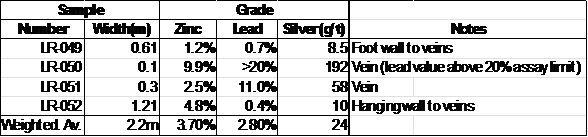
· Narrow vein samples grading up to 9.9% zinc, greater than 20% lead and 192g/t silver.
· Mineralisation confirmed in both the hanging wall and footwall surrounding the high-grade veins, demonstrating encouraging widths of economically significant mineralisation:
Hanging wall: 0.6m chip sample grading 4.8% zinc, 0.4% lead and 10g/t silver.
Footwall: 3.3m chip sample grading 5.8% zinc, 1.0% lead and 17g/t silver.
· Development of a three-dimensional geological model is underway to integrate geological, structural and geophysical data and optimise drill targeting.
Detailed information and field illustrations follow text.
"The progression of the Reese Ridge Project aligns with the Company's updated strategy announced on 14 July and its renewed focus on its base and precious metals projects.
"Reese Ridge continues to deliver impressive surface sampling results, with very high-grade zinc, lead and silver mineralisation now complemented by economically significant grades extending into both the hanging wall and footwall of the mineralised structures. These results continue to enhance our understanding of what we believe to be an extensive mineralised system.
"The integration of recent mapping with historical geophysical data into a new three-dimensional structural model will enable us to prioritise drill targets with greater confidence.
"Our objective, is not only to drill test the down-dip continuity of the high-grade surface mineralisation but also the large conductive geophysical anomaly at depth, which we believe could represent a large sulphide system.
"The project exhibits many of the characteristics associated with Carbonate Replacement Deposit ("CRD") systems. These deposits can host substantial high-grade mineralisation, as demonstrated by recent discoveries at Ruby Hill in Nevada and by the Taylor Deposit at the Hermosa Project in Arizona, now being developed by South32."
Patrick Cheetham, Executive Chairman
Further information:
|
Sunrise Resources plc Patrick Cheetham, Executive Chairman |
Tel: +44 (0)1625 838 884 |
|
Beaumont Cornish Limited Nominated Adviser James Biddle/Roland Cornish |
Tel: +44 (0)207 628 3396 |
|
AlbR Capital Limited Broker Lucy Williams/Duncan Vasey
|
Tel: +44 (0)207 469 0930
|
Shares in the Company trade on AIM. EPIC: "SRES".
Website: www.sunriseresourcesplc.com
Detailed Information
The Company's wholly owned Reese Ridge Project is situated on the southern margin of the highly prospective Humboldt Structural Zone, approximately 52 miles south-southwest of Battle Mountain, Nevada.
The Project covers a fault-bounded limestone horst block that is juxtaposed against younger sedimentary rocks and flanked to the east and west by Tertiary volcano-sedimentary basins. This geological setting is considered by the Company to be highly prospective for CRD style mineralisation.
Numerous iron-rich gossans developed from massive and semi-massive sulphides occur throughout the property and first attracted both historical prospectors and the Company. Sampling of these gossans has consistently returned anomalous zinc, lead and silver values, with assays of up to 6.8% zinc, 3.3% lead and 51g/t silver, while forty-three samples collected from gossans and historical workings averaged 0.86% zinc.
Subsequent exploration identified a different style of mineralisation hosted within altered limestone containing only sparse visible galena. Initial sampling returned an exceptional assay of 15.9% zinc, despite the subdued visual appearance of the rock. Follow-up work subsequently identified assays of up to 29.6% zinc, together with 68ppm gallium.
Unlike the iron-rich gossans, these zinc-rich zones contain oxide and carbonate minerals that are difficult to recognise visually in the field, suggesting that significant mineralisation may previously have been overlooked.
Most recently, the Company's Nevada-based geological consultant, Ivan Johnston, completed a programme of reconnaissance mapping and sampling over the area first reported by the Company on 26 September 2024 and which is now designated the Ridge Top Prospect.
The work has confirmed the presence of narrow but exceptionally high-grade mineralised structures containing relic sulphide minerals and has substantially improved the Company's understanding of the local structural controls on mineralisation.
Sampling across mineralised exposures within historic prospecting pits returned the following results (see also Photo 1 following):
In addition, a separate 3m chip sample collected several metres along strike within the interpreted footwall returned:
· Sample LR-056: 3.0m grading 5.8% zinc, 1.0% lead and 17g/t silver.
Importantly, the full width of this footwall mineralisation has yet to be exposed (see Photos 2 following).
Previous work at Reese Ridge also demonstrated elevated gallium values of up to 69ppm. Gallium is classified as a critical mineral owing to its importance in semiconductors, high-frequency electronics and solar technologies. The Company intends to continue assessing the gallium potential of the project in future programmes.
As previously announced on 31 October 2023, modelling of historical airborne geophysical data identified a resistive core, a possible granitic intrusion, with a surrounding annular zone of low resistivity (high conductivity) extending from near surface to almost 1,000m depth.
Significantly, all high-grade mineralisation identified to date occurs directly above this conductive zone, providing additional support for the Company's interpretation that the low resistivity zone may represent a substantial sulphide-bearing system at depth.
The geological setting, alteration style, structural controls and geophysical signature are all consistent with a CRD model. CRD deposits are capable of hosting large, high-grade mineral systems. Examples include the Taylor Deposit within South32's Hermosa Project in Arizona, containing a Mineral Resource of 138 million tonnes at a zinc-equivalent grade of 8.61%, and the recent high-grade CRD discoveries reported by i-80 Gold at the Ruby Hill Project in Nevada.
The Company believes that the encouraging results obtained to date warrant the next phase of exploration, which, subject to funding, is expected to include additional ground geophysics followed by drill testing of the priority targets generated by the developing three-dimensional geological model.
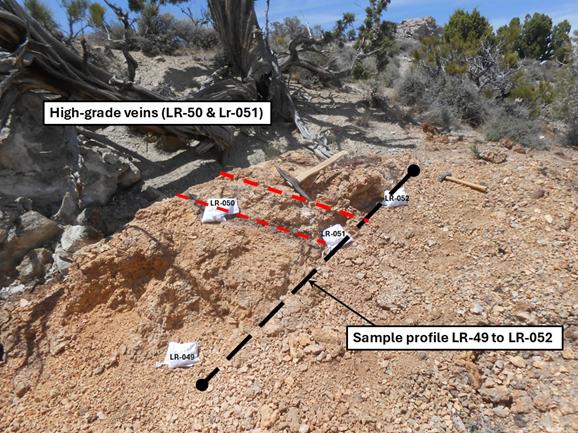
Photo 1. Sample Profile, LR-049 to LR-052: High-grade veins and altered wall rocks
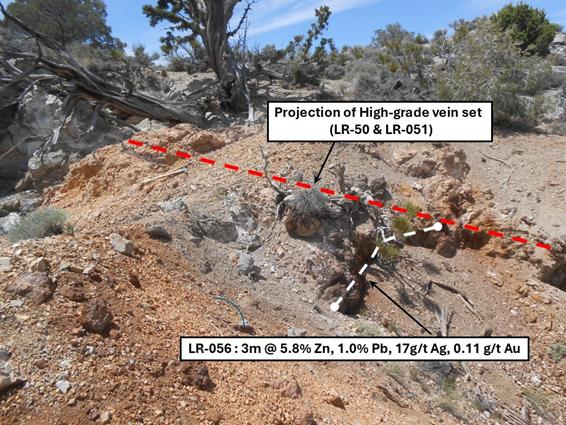
Photo 2. Sample Profile, LR-056: Footwall sample.
Nominated Adviser
Beaumont Cornish Limited ("Beaumont Cornish") is the Company's Nominated Adviser and is authorised and regulated by the FCA. Beaumont Cornish's responsibilities as the Company's Nominated Adviser, including a responsibility to advise and guide the Company on its responsibilities under the AIM Rules for Companies and AIM Rules for Nominated Advisers, are owed solely to the London Stock Exchange. Beaumont Cornish is not acting for and will not be responsible to any other persons for providing protections afforded to customers of Beaumont Cornish nor for advising them in relation to the proposed arrangements described in this announcement or any matter referred to in it.
Market Abuse Regulation (MAR) Disclosure
The information contained within this announcement is deemed by the Company to constitute inside information as stipulated under the Market Abuse Regulations (EU) No. 596/2014 which forms part of UK domestic law by virtue of the European Union (Withdrawal) Act 2018 ('MAR'). Upon the publication of this announcement via Regulatory Information Service ('RIS'), this inside information is now considered to be in the public domain.
Note:
The information in this release has been compiled and reviewed by Mr. Patrick Cheetham (MIMMM, MAusIMM) who is a qualified person for the purposes of the AIM Note for Mining and Oil & Gas Companies. Mr. Cheetham is a Member of the Institute of Materials, Minerals & Mining and also a member of the Australasian Institute of Mining & Metallurgy.
Glossary:
Carbonate Replacement Deposit (CRD): A high-temperature carbonate (limestone)-hosted silver-lead-zinc deposit formed by the replacement of carbonate rock, by metal-bearing solutions in the vicinity of igneous intrusions.
Gossan: An iron rich rock, the residual product of oxidation by weathering and leaching of rocks originally containing high levels of sulphide minerals and often representing the exposed upper part of a mineral deposit or mineral vein.
Horst: A raised fault block bounded by normal faults.
This information is provided by RNS, the news service of the London Stock Exchange. RNS is approved by the Financial Conduct Authority to act as a Primary Information Provider in the United Kingdom. Terms and conditions relating to the use and distribution of this information may apply. For further information, please contact rns@lseg.com or visit www.rns.com.
RNS may use your IP address to confirm compliance with the terms and conditions, to analyse how you engage with the information contained in this communication, and to share such analysis on an anonymised basis with others as part of our commercial services. For further information about how RNS and the London Stock Exchange use the personal data you provide us, please see our Privacy Policy.
ENDRNS may use your IP address to confirm compliance with the terms and conditions, to analyse how you engage with the information contained in this communication, and to share such analysis on an anonymised basis with others as part of our commercial services. For further information about how RNS and the London Stock Exchange use the personal data you provide us, please see our Privacy Policy.