

New Hyperfine Swoop® Portable MRI for Easier and Faster Stroke Visualization
The portable MRI scanner, Hyperfine Swoop®, has received new AI-supported software for better stroke visualization.
Today, Lioness Medtech AB announced the release of a new CE-marked software version for the Hyperfine Swoop® portable MR Imaging® system. The update introduces a new advanced multi-directional diffusion-weighted sequence (Multi-directional DWI).
The enhanced DWI sequence uses a multi-direction image acquisition approach, similar to techniques used in high-field MRI, gives quicker and better visibility into smaller strokes, all done at the patient's bedside.
Since Hyperfine's earliest prototype scans in 2016, the image quality of the Hyperfine Swoop® System has improved continuously. Lioness Medtech has been the distributor of the Hyperfine Swoop® system across the Nordics since 2024, witnessing firsthand the evolution of Optive AI™ along with an ongoing series of software, firmware and hardware refinements. Optive AI™ continues to evolve, delivering progressively better image quality over time. This progress is visible directly in side-by-side scan comparisons across software versions, from the earliest images from 2016, to today's Optive AI™-powered performance.
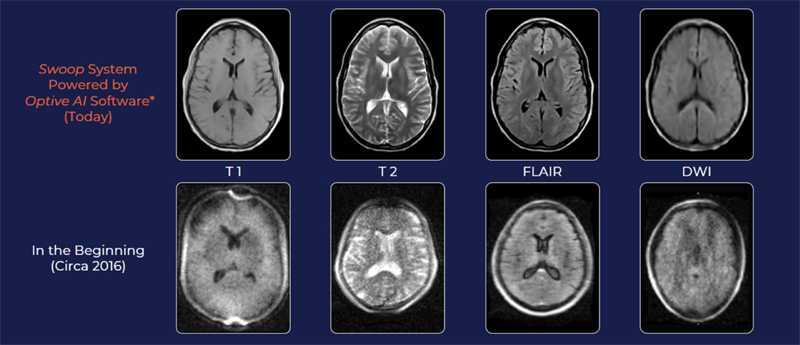
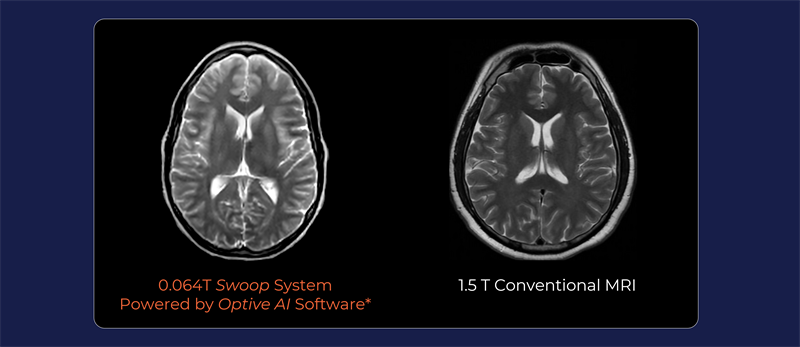

The Evolution of AI-Powered Portable MRI Image Quality
Source: Hyperfine Inc
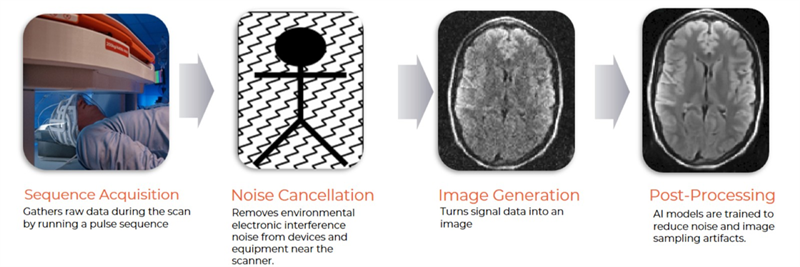
Swoop® Image Acquisition Process Illustration
Source: Hyperfine Inc.
The imaging processing moves through a multi-stage pipeline: Spanning Sequence Acquisition → Noise Cancellation → Image Generation → AI-driven post-processing; and continues to improve with each software release.
On the hardware side, according to Hyperfine Inc., Swoop model 2 features improvements in the design of the head coil, resulting in increased signal-to-noise ratio at the base of the brain by 20%, expanding the anatomy for which Swoop® delivers diagnostic-quality images.
More importantly, the work-horse sequences, T1, T2, FLAIR, and DWI, including all but FLAIR's fast acquisition variants, remain available across existing systems, meaning existing users of Swoop® continue to benefit from the platform's ongoing software improvements.
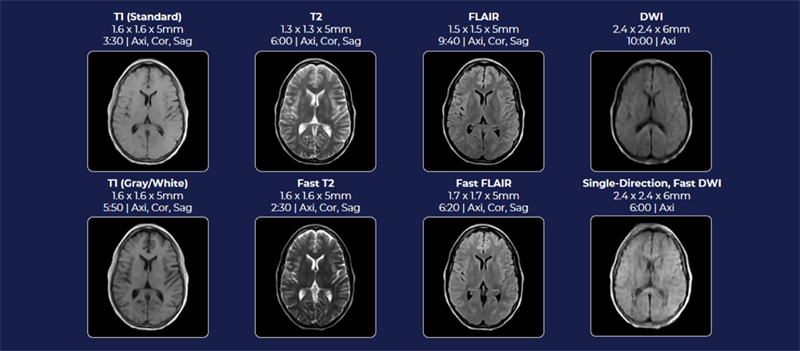
Available Sequences on Swoop® System V2
Source: Hyperfine Inc
Note: Sequence specifications are subject to change with future software updates (Model 2 hardware, 10.1 software shown above). Scan time is nominal and can slightly change depending on the acquisition plane (Axi/Cor/Sag). The nominal scan times reported are for axial plane acquisition.
One highlight of the recent software update is that the advanced DWI sequence that delivers enhanced diagnostic image quality by a multi-direction image acquisition approach, similar to high-field MRIs, supporting more confident identification of smaller strokes.*
Swoop®'s user experience is built around a user-friendly tablet-based interface. The entire MR brain scan, from setup through scan preview, is easily accessible and can be performed on an iPad®, allowing operators to view images in real time as the exam progresses. The system integrates securely with hospital IT infrastructure and can receive software updates via remote download, ensuring Swoop® systems can stay up to date with the latest image quality improvements, without requiring on-site visits.
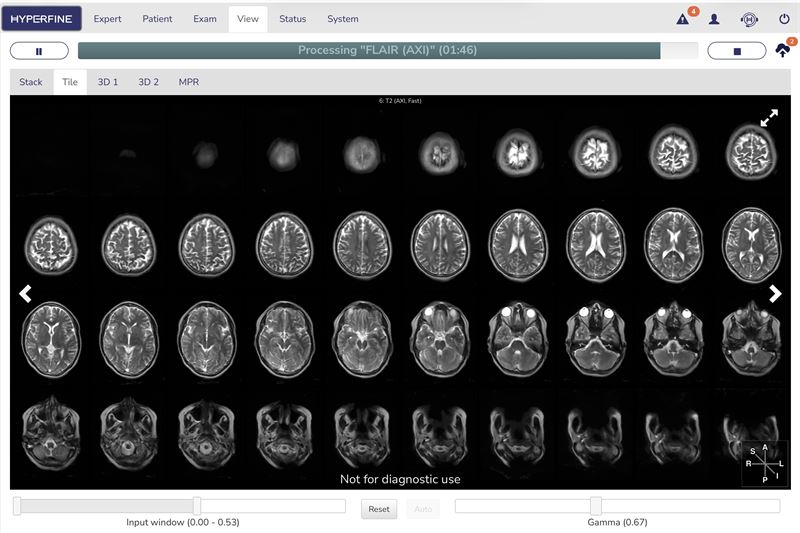
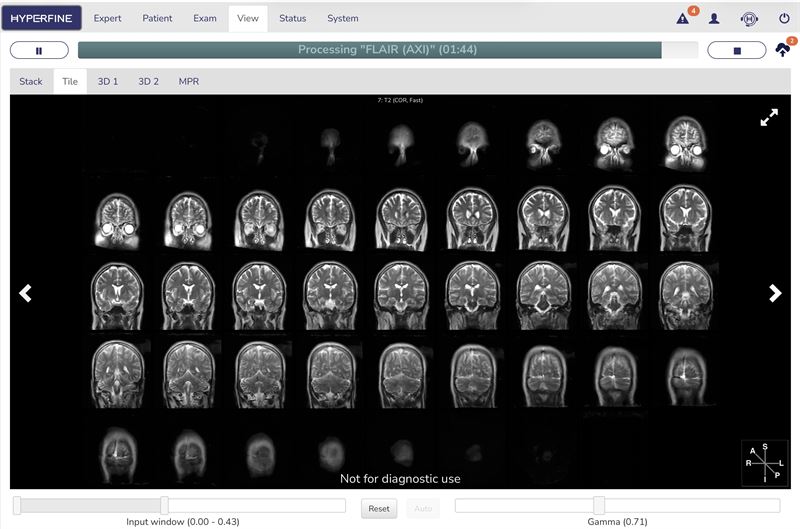
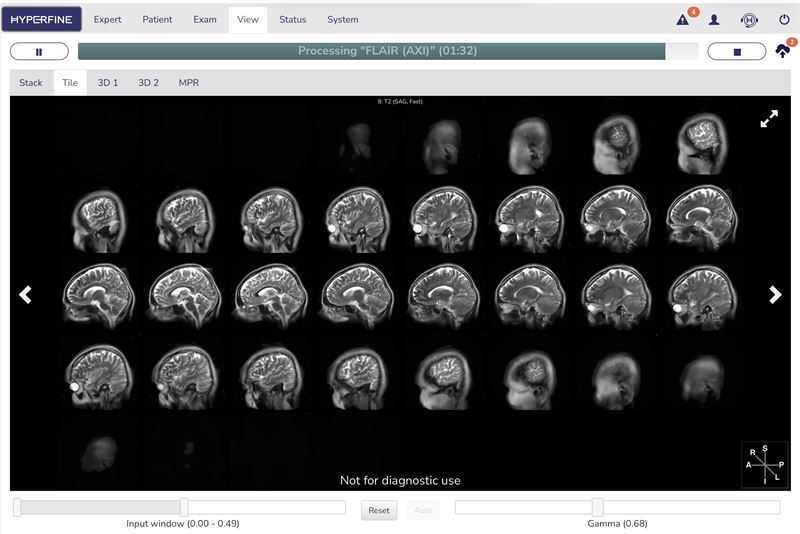
Hyperfine Swoop® Interface on iPad
Source: Screenshots of preview scans of Lioness Medtech employee using software 9.0.1
Note: iPad Interface showing FLAIR(AXI) acquired with Model 1.8 (V1) software 9.0.1 Swoop® system by a Lioness Medtech employee. Image shown on iPad are for illustrative purposes only and is not for diagnostic use.
Beyond image quality alone, this evolution reflects a broader shift toward more sustainable, accessible imaging. Swoop® remains significantly more energy- and infrastructure-efficient than conventional high-field MRI: it uses roughly 97% less energy per scan, requires no helium or specialized cooling, and runs on a standard wall outlet, making it deployable at the bedside rather than requiring patient transport to a dedicated MRI enviroment.
|
|
The Swoop® System |
High-Field MRI |
|
Energy per Scan |
~675 watt-hours (97% less) |
~19,900 watt-hours |
|
Magnet Type |
Permanent magnet |
Superconducting |
|
Magnet Field |
0.064T |
1.5T |
|
Power Requirements |
Standard wall outlet 120VAC |
480 VAC and high-power electronics |
|
Magnet Cooling |
No specialized cooling |
Complex supercooling: liquid helium and cooling pumps |
|
Weight |
~635 kg |
~5990 kg |
|
Access |
Bedside |
Patient transport required |
|
Installation |
Ship to Customer |
Significant infrastructure project |
Hyperfine's recently announced Model 2 hardware with shortened scan times for existing sequences and improved ease of use for both transport and scanning. As Hyperfine continues to invest in software and hardware innovation, Swoop® is expected to keep advancing, bringing higher image quality, broader clinical utility, and more sustainable imaging to the point of care.
*Sorby-Adams A, Guo J, Laso P, et al. Diffusion-weighted imaging–fluid-attenuated inversion recovery mismatch on portable, low-field MRI among acute stroke patients. Ann Neurol. 2024;96(2):321-331. doi:10.1002/ana.26954
About Lioness Medtech AB
Lioness Medtech AB is a European medical technology integrator and value-added reseller (VAR) for leading innovations in medical imaging and therapy. Lioness represents and services world-leading solutions across medical imaging, radiotherapy, and quality assurance in the Nordics and select European markets.
Contact
Bernt Nordin
Managing Director
Lioness Medtech AB (publ)
Tel: +46 70 996 0445
Email: bernt.nordin@lionessmedtech.com
Website: www.lionessmedtech.com