

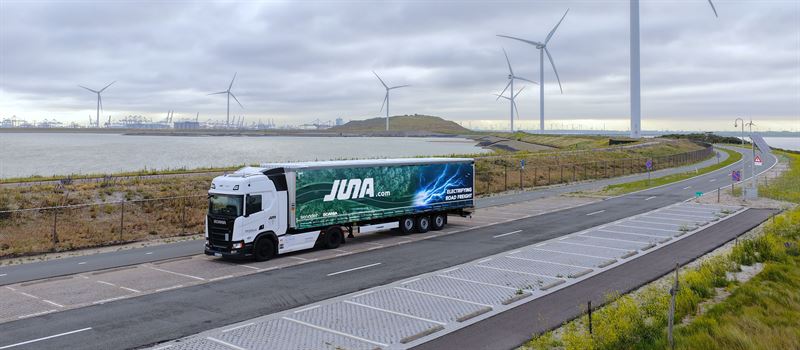
In just over two years, JUNA has built one of Europe’s largest electric truck fleets, with vehicles now operating across four markets. By matching the needs of shippers and freight forwarders with the operational realities of carriers, JUNA is helping decarbonise transport networks and make electric transport more accessible.
JUNA, the electric-truck-as-a-service joint venture between Scania and sennder, has surpassed 100 electric trucks in operation on European roads. The fleet currently comprises around 110 vehicles across Germany, Italy, Poland and the Netherlands, with JUNA expecting to reach approximately 150 by the end of the year.
The milestone shows that the transition to electric heavy-duty transport can be made commercially viable when the right capabilities and partnerships are brought together. JUNA works with shippers and freight forwarders to understand their transport needs, identify suitable routes and integrate electric trucks into their networks. It then supports the carriers operating those routes with vehicles, route and usage analysis, technical expertise and a flexible pay-per-use model.
This approach enables transport buyers to reduce emissions in the transport networks they rely on, while helping carriers adopt electric trucks without purchasing or financing them outright. It also helps make electric heavy-duty transport work in everyday logistics.
Electric trucks can cost two to three times more than comparable diesel vehicles. At the same time, around 70 percent of Europe’s trucks are operated by carriers with fewer than ten vehicles, often as subcontractors for larger freight forwarders. JUNA’s model is designed to address both challenges by reducing the need for capital investment and enabling more carriers to participate in the transition.
“When we set out to build JUNA with sennder, our goal was to show that electric trucks could work commercially for carriers while helping shippers decarbonise the transport networks they rely on. Reaching 100 trucks across four markets shows that this proof point is real and gives us a strong foundation for continued growth,” says Gustaf Sundell, Executive Vice President and Head of Ventures and New Business at Scania Group.
“The transition to electric road freight requires solutions that fit real transport networks and can be deployed across carrier and subcontractor operations. JUNA connects shipper demand with the operational reality of carriers, helping integrate electric trucks into everyday logistics at scale,” says David Nothacker, Co-founder and CEO of sennder.
“From day one, our goal has been to build a solution that carriers and customers can trust. By combining route analysis, technical expertise and a flexible commercial model, we are helping carriers of all sizes integrate electric trucks into their everyday operations in a way that is both economically viable and sustainable,” says Matteo Oberto, Managing Director and CEO of JUNA.
JUNA’s model is already being used by major shippers and their carrier networks. The company has partnered with Nestlé to help reduce CO₂ emissions on its routes and supports regional logistics for Beiersdorf in Hamburg.
Since its first electric trucks took to the road just over two years ago, JUNA’s fleet has travelled 3.9 million kilometres – equivalent to about 100 trips around the equator. Its routes include international transport across several countries as well as shorter daily shuttle operations, demonstrating the range of applications already being served by electric trucks.
JUNA plans to continue expanding its fleet and supporting the transition to more sustainable road transport across Europe.
Learn more about Scania’s venture-building activities and portfolio companies: Venture building and startup acceleration.
About JUNA
JUNA is a joint venture between Scania and sennder and a provider of electric-truck-as-a-service for logistics, road freight transport and supply chain management. JUNA provides companies with a flexible, low-risk solution for incorporating zero-emission heavy-duty transport into their operations. Its model combines route and cost analysis, electric vehicles, charging infrastructure, operations and maintenance, and usage-based financing to enable scalable electric transport with cost stability and measurable CO₂ reduction.
For further information, please contact:
Veronica Nilsson
Public and Media Relations Manager
Phone: +46 72 084 98 43
E-mail: veronica.nilsson@scania.com
Scania is a world-leading provider of premium transport solutions. Together with our partners and customers, we are driving the shift towards a sustainable transport system. Founded in Sweden in 1891, Scania now operates in more than 100 countries and employs around 53,000 people. Production takes place in Europe, Latin America and Asia. Research and development is carried out globally with our main site in Södertälje, Sweden. As part of the TRATON Group, we are empowered by shared industrial strength, scale and expertise to accelerate innovation and the shift towards a sustainable transport system. In 2025, Scania delivered 87,600 trucks, 6,500 buses and coaches as well as 9,200 industrial and marine power systems to our customers. Net sales totalled over SEK 198 billion, of which about 20 percent were services related. For more information visit: www.scania.com