

Ferrexpo PLC
25 September 2026
25 September 2026
Ferrexpo plc
(“Ferrexpo”, the “Group” or the “Company”)
Interim Results for the six months ended 30 June 2026
Ferrexpo plc (LSE: FXPO), a producer and exporter of premium iron ore products to the global steel industry, is pleased to report interim results for the six months ended 30 June 2026 (“the period” or “first half” or “first six months” or “1H 2026”).
Commenting on the results, Lucio Genovese, Interim Executive Chair, said:
“The first six months of 2026 have been another exceptionally difficult period for Ferrexpo, during which the business and its people demonstrated a continued ability to adapt and respond to a series of operational, financial and legal challenges that were outside its control.
The year began with waves of intensive attacks on Ukraine’s electricity generation and transmission infrastructure, which forced us to temporarily suspend operations. Following some improvements in the availability and price of electricity, we were able to restart limited production by bringing one of the Group’s four pellet lines back online.
Reflecting the constraints on power, liquidity and working capital, total commercial production for the first six months was 1.6 million tonnes, comprising 1.4 million tonnes of premium iron ore pellets (including 163 thousand tonnes of premium DR pellets) and 171 thousand tonnes of finished high-grade iron ore concentrate.
We continued to take all the necessary actions we could to preserve cash and protect the integrity of the business and our assets. This included reducing working time for employees, maintaining tight controls over procurement, continuing the suspension of all non-essential maintenance and capital expenditure, overheads, corporate social responsibility spending, and by focusing production on the products and customers that generated the optimal short-term value. We recognise that these actions have had direct and challenging impacts on colleagues, suppliers and the communities where we operate. They were however necessary, to preserve liquidity and maintain the business as a going concern while operating at reduced levels and progressing the Group’s funding plans.
The continued suspension of VAT refunds by the Ukrainian tax authorities remains a significant financial issue. As at 30 June 2026, the Group’s net VAT receivable balance in Ukraine was US$82.7 million. The continued withholding of VAT refunds constrained liquidity during the period, contributing to the further downscaling of production and knock-on effects, such as reductions in salaries, procurement, and fiscal contributions. As at the date of approval of these interim condensed consolidated financial statements, VAT refunds in the aggregate amount of UAH3,885 million (US$86.9 million at this date) were suspended by the State Tax Service (“STS”).
During the period, the Board took a number of steps to manage its liquidity constraints. This included an agreement in April to sell its transhipping vessel ‘Iron Destiny’, for total net cash consideration of US$7.7 million. Given the vessel’s age, the restrictions on its use since the start of the war and the ongoing costs to maintain the vessel in a seaworthy condition, the Board concluded that a sale was in the best interests of the Group. The proceeds provided some additional liquidity while the Board progressed a longer-term funding solution for the Group.
Sales volumes for the first six months of 2026 totalled 1.5 million tonnes, comprising 1.3 million tonnes of pellets and just over 200 thousand tonnes of commercial concentrate. Revenue for the period was US$196 million and underlying EBITDA was negative US$4 million, reflecting lower production and sales volumes, constrained operating conditions, elevated energy and logistics costs and the continuing impact of VAT refunds not being received.
At the end of June 2026, the Group cash position was approximately US$30 million compared to US$58 million at the end of December 2025. Throughout the first six months and into the third quarter of 2026, the Board progressed an equity fundraise to strengthen the Group’s financial position and provide sufficient liquidity to meet ongoing obligations, fund short-term working capital requirements and support operations.
I am pleased that in early September, post period end, we were able to announce a successful US$100 million equity raise which was overwhelmingly approved by shareholders at the subsequent General Meeting of the Company. I am grateful for the support shown by existing shareholders, and indeed new shareholders, whom we welcome.
The equity fund raise has materially strengthened the Group’s liquidity position, providing additional financial resilience and greater flexibility to manage the continuing operational and financial pressures facing the business. The additional capital does not however remove the underlying challenges as a result of the continued withholding of VAT refunds, the war in Ukraine, constraints on logistics and energy infrastructure, and the need to maintain disciplined management of cash and working capital.
As a result of the fundraising the Company and its auditors were able to finalise the going concern assessment and publish the audited financial statements and annual report for the year ended 31 December 2025, in turn enabling the lifting of the suspension of trading in the Company’s shares on the London Stock Exchange on 7 September.
Following the end of the first six months reporting period, it was regrettable to announce logistics disruption and a shipping incident in which a sailor employed by a chartered shipping company lost his life after that company’s vessel was attacked and damaged. This tragedy serves to remind us of the broader impacts of war beyond Ukraine’s shores. At our own operations, safety remains our first priority. At the end of June 2026, the Group achieved an improvement in its rolling six-month LTIFR to 0.20, below the historic five-year trailing average of 0.44, with zero workplace fatalities for more than five years. Maintaining this performance in wartime conditions is a significant achievement, but it is not a reason for complacency. Air raid alerts, power interruptions, disrupted transport and the psychological pressure of living and working through war continue to make safety discipline, emergency preparedness and practical support for employees essential.
It is with great sadness that during the first six months of 2026 we received notice that a further 11 colleagues serving in the Armed Forces of Ukraine had been killed, bringing the total number of colleagues killed since the start of the full-scale invasion to 67. Our thoughts are with their families, friends and colleagues during this extremely difficult period. At the end of June 2026, 804 colleagues were serving in the Armed Forces of Ukraine, while 218 colleagues had been demobilised since the start of the full-scale invasion. We continue to support colleagues serving in the Armed Forces, those returning to civilian life and the families of those affected by the war.
Since the full-scale invasion of Ukraine in February 2022, Ferrexpo has continued to operate and export its products despite immense challenges. By remaining operational, the Group has continued to sustain employment, serve customers, maintain the integrity of its assets and make a meaningful contribution to Ukraine. The successful equity fundraise represents an important step in strengthening the Group’s financial position and providing the resilience required to navigate the current operating environment. Significant challenges nevertheless remain, particularly the continued suspension of VAT refunds and war-related disruption.
The fact that Ferrexpo has continued to operate through these conditions reflects the resilience, professionalism and determination shown by our people across the Group. Ferrexpo has world-class assets, skilled people, strong customer relationships and premium iron ore products that have an important role to play in the transition towards lower-carbon steelmaking. The additional capital raised provides the Group with greater financial resilience to manage the challenges ahead, and positioning the business for recovery when conditions permit.”
Production and financial summary
- Due to the ongoing suspension of VAT refunds and the resulting reduction in financial liquidity, the Group was forced to downscale operations to one pelletising line.
- Total commercial production for the first six months of 1,556 thousand tonnes, a 40% decrease compared to the previous six months to 31 December 2025 and 54% lower compared to the first six months of 2025.
- Production mix comprised 89% pellets and 11% commercial concentrate in 1H 2026, compared with 64% and 36% respectively in 1H 2025, when the higher proportion of concentrate production provided additional market options during a period of weaker pellet demand and premiums.
Summary production statistics
|
|
Fe Grade |
1H 2026 |
1H 2025 |
Change |
FY2025 |
|
Direct Reduction Pellets (“FDP”) |
67% |
163,171 |
81,787 |
100% |
81,787 |
|
Premium Pellets |
65% |
1,221,968 |
2,087,844 |
-41% |
3,139,674 |
|
Total pellet production |
|
1,385,139 |
2,169,631 |
-36% |
3,221,461 |
|
Commercial concentrate |
67% |
171,021 |
1,223,504
|
-86% |
2,920,298 |
|
Total commercial production |
|
1,556,160 |
3,393,135 |
-54% |
6,141,759 |
- Revenue decreased by 57% to US$196 million (1H 2025: US$453 million) due to lower sales volumes.
- C1 Cash Cost of Production (“C1 costs”) increased to US$81.3 per tonne in the half year (1H 2025: US$77.1 per tonne), due to increased mining and maintenance activities, the effects from higher electricity and fuel prices and higher personnel costs.
- Underlying EBITDA loss was US$4 million (1H 2025: positive US$4 million), reflecting the net effects of lower sales volumes and realised prices and higher production costs.
- No impairment loss in 1H 2026 (1H 2025: US$154 million).
- Loss after tax of US$14.9 million (1H 2025: loss US$196 million).
- The Group ended the period with US$30 million of cash and cash equivalents, and net cash of US$21 million after deducting US$9 million of lease liabilities (31 December 2025: US$47 million). The Group otherwise had no interest-bearing loans or borrowings.
- CapEx was deliberately reduced by limiting spend on development projects and only funding necessary sustaining capital projects. Total CapEx reduced to US$10 million (1H 2025: US$28 million), comprising 88% in sustaining and 12% development capital.
- Formal written notifications of decisions not to refund VAT from the Ukrainian tax authorities are being received on a monthly basis, typically two months after the reporting month. For the period since the suspension in March 2025 until the end of June 2026, the cumulative gross VAT receivable amount outstanding is US$102.2 million of which US$86.9 million relates to refund claims from March 2025 to June 2026 that have been refused as at the date of approval of this report.
- The Group has worked extensively to lower its costs to remain financially viable. This includes reducing working time for employees, cuts in the procurement of goods and services and a suspension of all non-essential capital expenditure, overheads and Corporate & Social Responsibility (“CSR”) spending.
Summary financial performance
|
US$ million (unless otherwise stated) |
1H 2026 |
2H 2025 |
Change |
1H 2025 |
Change |
FY 2025 |
|
Total commercial production (kt) |
1,556 |
2,749 |
-43% |
3,393 |
-54% |
6,142 |
|
Total pellet production (kt) |
1,385 |
1,051 |
32% |
2,170 |
-36% |
3,221 |
|
Total commercial concentrate production (kt) |
171 |
1,696 |
-90% |
1,224 |
-86% |
2,920 |
|
Total sales volumes (pellets and concentrates) (kt) |
1,455 |
2,746 |
-47% |
3,807 |
-62% |
6,553 |
|
Average 65% Fe iron ore fines price (US$/t) |
121 |
118 |
3% |
113 |
8% |
115 |
|
Revenue |
196 |
335 |
-41% |
453 |
-57% |
787 |
|
C1 Cash Cost of production (US$/t) |
81.3 |
74.7 |
9% |
77.1 |
5% |
76.3 |
|
Underlying EBITDA |
(4) |
24 |
n.m. |
4 |
n.m. |
28 |
|
Net cash flow from operating activities |
(24) |
27 |
n.m. |
(24) |
0% |
3 |
|
Capital investment |
10 |
21 |
-53% |
28 |
-66% |
49 |
|
Closing Net Cash |
21 |
47 |
-55% |
50 |
-57% |
47 |
Commenting on the financial results, Nikolay Kladiev, CFO, said:
“The financial results for the first half of 2026 reflect the exceptionally challenging conditions in which the Group has continued to operate. The suspension of VAT refunds remains the most significant pressure on our working capital. At 30 June 2026, our gross VAT receivable in Ukraine had increased to US$102.2 million, compared with US$84.5 million at the end of 2025, with US$80.8 million relating to refund claims from March 2025 to June 2026 that have not been received. The absence of these refunds materially constrained the cash available to the business during the period and was a significant factor in the decision to continue operating at reduced levels.
Revenue declined to US$196 million, compared with US$453 million in the first half of 2025, principally reflecting the 62% reduction in sales volumes. Underlying EBITDA was negative US$4.0 million compared with positive US$3.9 million in the comparative period. C1 cash costs increased to US$81.3 per tonne, reflecting the impact of lower operating volumes together with higher electricity and fuel prices, increased mining, maintenance and personnel costs. Despite these pressures, the Group continued to exercise strict control over expenditure, reducing capital investment to US$9.8 million compared with US$28.5 million in the first half of 2025.
Net cash used in operating activities was US$24.0 million during the period. Before giving effect to the subsequent equity fundraise, the Group ended June 2026 with cash and cash equivalents of US$30.4 million and net cash of US$21.4 million, with no interest-bearing loans or borrowings other than lease liabilities. This position includes the benefit of US$7.7 million of net proceeds from the sale of the Iron Destiny, while approximately US$3.0 million held with MBaer Merchant Bank at the period end was subsequently released to the Group in September 2026.
Following the period end, the successful equity fundraise has materially strengthened the Group’s financial position and provides considerably greater resilience in managing the uncertainties facing the business. Nevertheless, the continued suspension of VAT refunds, the war and associated disruption to energy and logistics infrastructure mean that disciplined management of cash, working capital and capital expenditure remains essential. Our priority is to use the additional financial flexibility prudently to support ongoing operations and preserve the Group’s ability to increase production when operating conditions allow.”
Health, safety and wellbeing
- The safety and wellbeing of the Group’s workforce is the highest priority, and the Group continues to take extensive measures to protect its workforce, their families and local communities.
- During the first half, the Group reported a Lost Time Injury Frequency Rate (“LTIFR”) of 0.20, significantly below the Group’s historic five-year trailing average of 0.44. The Group is proud to report zero fatalities for more than five years.
Iron ore markets
- The benchmark 65% Fe iron ore fines price remained firm during the first half of 2026, averaging approximately US$121 per tonne, compared with US$113 per tonne in 1H 2025, before closing the period at approximately US$116 per tonne.
- With continued access to Ukrainian Black Sea ports during the reporting period, three vessels were loaded in the first half representing 12% of all sales to seaborne customers, with the balance of sales transported 75% by rail and 13% by river barge.
- Ongoing geopolitical disruption in the Middle East however has kept freight rates both volatile and high.
Operations and marketing
- During the first half of the year, the Group operated one of its four pelletising lines following the resumption of production in February, together with a dedicated concentrate line.
- Focus on higher-grade iron ore production continued during the first half, with all pellets and concentrates grading 65% iron ore content or above. Production and sales of FDP pellets also resumed.
- Total commercial production of 1.6 million tonnes was achieved, 43% lower than the preceding six months and 54% lower than the same period last year.
- The combined production of a range of Ferrexpo pellets totalled 1.4 million tonnes, combined with concentrate production of 171 thousand tonnes, the majority of which was produced in the second quarter.
- Sales volumes totalled 1.5 million tonnes, comprising 1.2 million tonnes of pellets and 206 thousand tonnes of commercial concentrate. This represents a 47% decrease compared to the previous six months to December 2025 and a decrease of 62% compared to the first six months of 2025.
Sales by region
|
Market regions |
1H 2026 |
2H 2025 |
1H 2025 |
FY2025 |
|
Europe, including Turkey |
93% |
50% |
46% |
48% |
|
MENA |
7% |
- |
4% |
2% |
|
Asia |
- |
50% |
50% |
50% |
Environment, social and governance
- During the first half, the Group was forced to cut back further on its humanitarian and CSR activities due to limited funds. The Group does however continue to keep employment open for returning veterans.
- Scope 1 and Scope 2 emissions intensity increased year-on-year in 1H 2026, reflecting a higher proportion of pellets in the Group’s commercial production mix and a more carbon-intensive electricity supply mix. Absolute emissions nevertheless decreased year-on-year, principally as a result of lower overall production volumes during 1H 2026, caused by electricity supply issues in early 1Q 2026.
Corporate governance
On 29 June 2026, Ferrexpo held its 2026 Annual General Meeting (“AGM”), at which all resolutions put to shareholders were passed. As previously announced, given the delay to the publication of the Group’s 2025 Annual Report and Accounts, certain resolutions relating to the Annual Report and Accounts, the re-appointment and remuneration of the Group’s auditor, and the Directors’ Remuneration Report did not form part of the business of the AGM. The Company has announced that it will convene a separate shareholder meeting on 9 October 2026 at which these resolutions will be tabled.
The AGM was therefore held to cover certain routine business, including the re-election of directors, the renewal of the Company’s authority to make market purchases of its own shares, and the authority to call general meetings on not less than 14 clear days’ notice. Vitalii Lisovenko, having served on the Board for more than nine years, did not stand for re-election and retired from the Board at the conclusion of the AGM. The Board would like to thank Vitalii for his service to the Company and for the valuable contribution he has made throughout his tenure, including as an Independent Non-executive Director and as the Company’s designated Non-executive Director for workforce engagement.
As a result of Mr Lisovenko’s retirement, the Board is undertaking a search for an additional Independent Non-executive Director, and this process is now well advanced. As part of this search, the Board has continued to consider the skills, experience, independence, gender and ethnic diversity needed to support the Company’s governance arrangements. The Company expects to make an appointment soon, which would increase the number of independent directors on the Board.
For further information please contact:
|
Ferrexpo: | ||
|
Nick Bias |
+44 (0)7733 177 831 | |
|
|
|
|
|
Tavistock: |
|
|
|
Jos Simson |
+44 (0)20 7920 3150 | |
|
Gareth Tredway |
|
+44 (0)7785 974 264 |
About Ferrexpo:
Ferrexpo is a Swiss headquartered iron ore company with assets in Ukraine and a listing in the equity shares commercial companies category on the London Stock Exchange (ticker FXPO). The Group produces high grade iron ore products, which are premium products for the global steel industry and enable reduced carbon emissions and increased productivity for steelmakers when converted into steel, compared to more commonly traded forms of iron ore. Ferrexpo’s operations have been supplying the global steel industry for over 50 years. Before Russia’s full-scale invasion of Ukraine in February 2022, the Group was the world’s third largest exporter of pellets. The Group has a global customer base comprising premium steel mills around the world. For further information, please visit www.ferrexpo.com.
Notes:
Please note that numbers may not add up due to rounding. In reporting financial performance, financial position and cash flows, reference is made to Alternative Performance Measures (“APMs”) that are not defined or specified under International Financial Reporting Standards (“IFRSs”). APMs are not uniformly defined by all companies, including those in the Group’s industry. Accordingly, the APMs used by the Group may not be comparable with similarly titled measures and disclosures made by other companies. APMs should be considered in addition to, and not as a substitute for or as superior to, measures of financial performance, financial position or cash flows reported in accordance with IFRSs. Ferrexpo refers to the following APMs in the Group’s Interim Results: C1 Cash cost of production, Underlying EBITDA, Net cash/(debt), Capital investment, and Total Liquidity. Full definitions of the Company’s APMs can be found in the Annual Report & Accounts.
Introduction
The war in Ukraine, now in its fifth year, continues to dominate Ferrexpo’s workforce, operations and financial position. During the first half of 2026, the operating environment deteriorated further, with renewed attacks on Ukraine’s electricity generation and transmission infrastructure leading to the temporary suspension of operations in January. Production restarted in February, following improvements in the availability and cost of electricity, enabling the Group to operate one of its four pellet lines during the period.
At the end of June 2026, 804 colleagues were serving in the Armed Forces of Ukraine. Tragically, as at the end of June 2026, 67 of our colleagues had been killed while serving in the Armed Forces since the start of the full-scale invasion in February 2022. We mourn their passing and honour their courage and sacrifice. As at the end of June 2026, 218 colleagues had been demobilised from the Armed Forces, of whom 137 completed the veteran rehabilitation programme with 110 returning to work.
It is important to recognise that our workforce is operating in extremely challenging conditions. Loved ones, friends and colleagues are serving in the Armed Forces, while employees continue to live and work under the constant threat of aerial attack. The number and intensity of attacks on Ukraine's energy, transport and port infrastructure increased towards the end of 2025 and continued to affect the Group in 2026. These attacks disrupted power supplies, restricted production and increased operating costs.
The health and safety of our workforce is paramount, as is the social contribution that the Group can offer to its communities and to Ukraine as a whole. Sustaining employment in as safe a manner as possible supports livelihoods and helps foster more resilient communities better able to withstand the challenges of a prolonged war. Given the Group's liquidity constraints, support has had to be focused on the most critical areas, including practical safety measures, emergency preparedness and psychological and psychosocial support for employees, veterans and their families.
Since the full-scale invasion of Ukraine in February 2022, Ferrexpo has significantly changed the way it operates. The business has had to adapt to logistics disruption, conscription, interruptions to energy supplies, alternative procurement channels, changes in customer demand and, since 2025, the suspension of VAT refunds to the Group's Ukrainian subsidiaries. Rising to these challenges has resulted in a business that is adaptive and flexible, but the combination of war-related disruption, legal proceedings, constrained liquidity and the continued withholding of VAT refunds has placed the Group under severe pressure.
Sales volumes totalled 1.455 million tonnes during the first half of 2026, comprised of 1.248 million tonnes of pellets and 206 thousand tonnes of commercial concentrate. This represents a 47% decrease compared to the previous six months to December 2025 and 62% lower than the first six months to June 2025. The Group continued to focus on products and customers that generated the best short-term value, while operating at a materially reduced level and preserving cash.
The Group’s logistics during the period were constrained by the operating environment. Following the resumption of production in February, Ferrexpo used its own fleet of rail wagons to export products to customers in Eastern and Central Europe. However, congestion at border crossings delayed the return of wagons and affected the availability of rolling stock for further shipments. As a result, the Group incurred additional cost to also procure third-party wagons during the period to support the continued delivery of products to customers. Total seaborne sales during the period were 175 thousand tonnes, representing 12% of total sales, compared with 60% in the first half of 2025. In total, three vessels were loaded with Ferrexpo cargoes from Ukrainian ports during the period under review. Of total sales, 93% were to European customers, and 7% to customers in the Middle East and North Africa.
The Group generated revenue of US$196 million in the first half of 2026, compared with US$453 million in the first half of 2025. Underlying EBITDA for the period was negative US$4 million and the Group's result for the first half of 2026 amounted to a loss of US$15 million. The financial performance reflects the lower production base, the continued suspension of VAT refunds, elevated power and logistics costs, constrained customer and product mix options, and the cost-control measures implemented to preserve cash.
As at 30 June 2026, the Group had a net cash position of US$21 million, with no outstanding interest-bearing loans and borrowings other than lease liabilities. This amount includes the proceeds received from the sale of the Iron Destiny but excludes approximately US$3 million of funds that were held with MBaer Merchant Bank at the period end. These funds were subsequently released to the Group in September 2026. Following completion of the successful equity fundraise, the Group’s liquidity position has been materially strengthened, and the Board considers that the Group has sufficient financial resources to meet its obligations and support its operations on a reduced basis for the next 18 months, subject to operating and market conditions and ongoing legal matters.
For a detailed review of iron ore markets, see the section "Sales and Marketing Review" below and for the Group financials, see the "Financial Review" section.
Outlook
Following the successful completion of the equity fundraise, the Group’s liquidity position has been materially strengthened, providing the financial resources and working capital required to support ongoing operations and meet its obligations. The Board will continue to maintain a prudent approach to capital allocation and working capital management given the continuing uncertainty of the operating environment.
The Group’s ability to restore production capacity however, will continue to depend principally on the availability and price of electricity, the security and viability of logistics routes, the resumption of VAT refunds and the outcome of legal proceedings in Ukraine.
Should VAT refunds resume and operating conditions improve, the Group’s ambition is to stabilise operations, add back production capacity where conditions allow, return colleagues on reduced hours or furlough to the workplace and increase its social and economic contribution to Ukraine. Until there is greater certainty around these factors, the Group will continue to exercise strict control over costs, procurement, capital expenditure and working capital while retaining the flexibility to increase activity when conditions permit.
Shareholder returns
Notwithstanding the successful completion of the equity fundraise and the resulting strengthening of the Group’s liquidity position, the Board does not consider it appropriate to declare an interim dividend for 2026. In reaching this decision, the Board has considered the continuing uncertainties facing the business, including the ongoing war in Ukraine, the suspension of VAT refunds and wider operational and legal risks. The Board will continue to keep the Group’s capital allocation framework under review, with the current priority being to preserve financial flexibility, support ongoing operations and strengthen the long-term resilience of the business.
Sales and Marketing Review
Iron ore market review
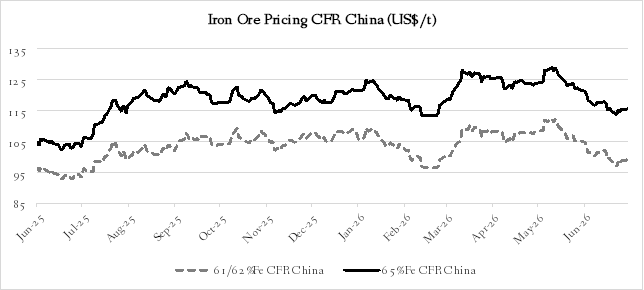
Seaborne supply from the major iron ore exporting countries, Australia and Brazil, remained robust through late 2025 and into early 2026, with limited weather-related disruption to exports. This contributed to a significant build-up of port inventories in China and placed downward pressure on iron ore benchmark prices. Pricing was also affected by the seasonal slowdown in Chinese steelmaking activity around the Lunar New Year. As a result, the 65% Fe index declined from a peak of approximately US$125 per tonne in January 2026 to around US$113 per tonne in February. Prices recovered modestly towards the end of February as steelmaking activity resumed following the holiday period.
In late February 2026, escalating geopolitical tensions in the Middle East contributed to a sharp increase in global energy prices. In particular, bunker fuel costs rose significantly during March, increasing ocean freight costs and providing support to iron ore prices, given that benchmark prices are quoted on a CFR China basis and therefore include freight. The 65% Fe index subsequently reached a peak of approximately US$128 per tonne in March 2026.
Higher energy prices continued to support the iron ore cost curve during the second quarter of 2026, although market conditions remained volatile and closely linked to seasonal movements in Chinese steel demand. Restrictions on coking coal supply during the quarter also increased steelmaking costs in China, placing further pressure on steel producer margins and contributing to softer iron ore prices in June. The 65% Fe index ended the first half of 2026 at approximately US$116 per tonne, around US$6 per tonne below the level at the end of 2025. Looking ahead, export volumes from the major producers are expected to remain robust, while the direction of iron ore prices during the remainder of the year will continue to depend principally on downstream steel demand in China.
Pellet premiums
The ongoing conflict in the Middle East has disrupted regional pellet supply, particularly in the direct-reduction (“DR”) grade segment, and has provided support to pellet premiums. Heightened security risks and uncertainty affecting Gulf maritime routes have constrained the operations of regional pelletising plants that depend heavily on imported pellet feed. Steel mills in the region have also been exploring alternative, more costly logistics routes to maintain supplies of DR-grade feedstock as inventories have declined. Against this backdrop, the spread between DR pellet premiums and Atlantic blast furnace pellet premiums widened during the first half of 2026, increasing by more than US$6 per tonne compared with the average level recorded in 2025. Continued supply constraints and disruption to regional trade flows are expected to provide further support to pellet premiums during the remainder of the year.
In Europe, the introduction of additional trade protection measures during 2026 has supported regional steel prices and improved the competitiveness of European producers relative to imported steel. This was particularly evident during the second quarter, when a seasonal improvement in steel demand provided further support to pricing. Together with environmental measures, including the Carbon Border Adjustment Mechanism (“CBAM”), these factors contributed to steel prices remaining at comparatively higher levels during the period. European steel production consequently increased, supporting stronger demand for high-grade iron ore pellets, including FPP pellets.
Customer development
The Group continued to export through Ukrainian Black Sea ports during the first half of 2026, following the restoration of access in late 202,3 however, access has become severely restricted again subsequent to the period end. This route is an important part of the Group’s logistics network and its ability to serve international customers. During the period, the Group loaded three seaborne shipments, comprising two cargoes destined for the MENA region and one for Europe.
The Group also adjusted its sales mix during the first half of 2026, redirecting volumes away from Asia towards the MENA and European markets, where stronger regional demand and geographical proximity provided more attractive commercial opportunities. This shift was accompanied by a greater emphasis on pellet sales relative to pellet feed. It also helped mitigate the impact of higher long-haul freight rates to Asia following global energy market disruption, which placed pressure on the economics of potential sales into that market.
The Group continued to adapt its marketing and logistics arrangements in response to disruption associated with the ongoing conflict in the Middle East. During the period, two shipments of Ferrexpo Direct Reduction pellets (“FDP”) were delivered to customers in the MENA region. Following disruption to traditional trade routes, these cargoes were routed through alternative discharge ports using smaller-sized vessels, which were better suited to the operating requirements of those ports. The Group’s marketing and logistics teams remained in close contact with regional customers to support continuity of supply during a period of heightened geopolitical uncertainty. Reflecting the increased focus on FDP sales, FDP represented 7% of the Group’s total sales volumes in 1H 2026, compared with 2% in 2025.
Seaborne shipments to Europe also continued during the period, supported by stronger regional demand as customers increased utilisation in response to more favourable steel market conditions. Sales to the Group’s traditional customers in Central and Eastern Europe through established rail and barge routes also remained resilient and continued to make an important contribution to overall sales volumes.
Freight
The C3 freight rate, representing the Capesize freight rate from Brazil to China, is used as a reference in determining the Group’s realised pricing, as a deduction from the 65% Fe iron ore benchmark quoted on a CFR China basis. C3 rates averaged approximately US$23 per tonne during the first two months of 2026, broadly in line with seasonal off-peak levels.
Following the increase in global energy prices associated with the conflict in the Middle East in March 2026, higher bunker fuel costs drove a sharp increase in C3 freight rates. This was compounded during the second quarter by the seasonal strengthening in Capesize shipping demand, with C3 rates reaching a peak of approximately US$37 per tonne in May.
Towards the end of the second quarter, an easing in vessel supply constraints, together with some moderation in bunker prices, contributed to softer freight rates. C3 rates declined to approximately US$28–29 per tonne by the end of June 2026, although they remained above levels seen before the escalation of the Middle East conflict.
Freight rates are expected to remain elevated during the remainder of 2026, reflecting continued uncertainty in global energy markets and the potential for further disruption arising from the conflict in the Middle East. Rates are nevertheless likely to remain volatile and influenced by seasonal changes in shipping demand and vessel availability.
FINANCIAL REVIEW
Summary
The environment in Ukraine continued to be unpredictably challenging during the first half of 2026, affecting the Group’s operations and consequently, profitability and cash flow generation. The start of the first half of 2026 was marked by the temporary suspension of the Group’s operations in January, due to the strained electricity supply situation and high electricity costs because of attacks on Ukraine’s electricity generation and transmission infrastructure in late 2025. The Group was able to restart production in February, following improvements in the availability and cost of electricity, enabling the Group to keep at least one of its four pellet lines in operation for the remainder of the period up to 30 June 2026.
In view of the challenging business and operating environment due to the ongoing war and the legal proceedings brought against the Group in Ukraine, in April 2026 the Board concluded that an equity fundraise of US$100 million was the only viable solution in the timeframe required for the Group to continue as a going concern.
The time needed to complete the equity fundraise meant that the Group was unable to announce its 2025 year-end results before 30 April 2026, which led to the suspension of trading in Ferrexpo plc shares on the London Stock Exchange. A full US$100 million funding solution was announced by the Group on 3 September 2026, comprising:
- A non-pre-emptive conditional placing of new Ordinary Shares raising gross proceeds of approximately US$60 million.
- A conditional subscription by the Company's largest shareholder for new Ordinary Shares pursuant to a subscription agreement, raising gross proceeds of approximately US$40 million.
At the General Meeting of the Company’s shareholders on 21 September 2026 the resolutions in connection with the fundraise were approved. The fundraise strengthened the Group's liquidity position and provides working capital to sustain operations during a period of ongoing operational and financial constraints caused by the ongoing war and legal actions against the Group.
The Group’s operations continue to be affected by the suspension of VAT refunds in Ukraine. As at 30 June 2026, the total outstanding gross VAT receivable balance in Ukraine had increased to US$102.2 million. Following the receipt of negative decisions from the court of appeal in July, August and September for seven court cases, the Group recorded allowances of US$13 million as at 31 December 2025 and additional allowances of US$5 million as at 30 June 2026, both allowances being reported as adjusting events following the respective reporting periods.
Despite ongoing efforts to reduce costs, as a result of the suspended VAT refunds, the Group’s available cash balance decreased from US$58 million as at 31 December 2025 to US$30 million as at 30 June 2026. The reduction in available cash necessitated a further adjustment to the production plan, which led to a fall in total production volumes of iron ore pellets and concentrates to 1.6 million tonnes, compared with 3.4 million tonnes in the first half of 2025.
With significantly lower production and sales volumes, the Group reported a loss for the first half of 2026 of US$15 million, compared to a loss of US$196 million in the comparative period (which included an impairment in the amount of US$154 million on the Group’s non-current operating assets).
Capital expenditure reduced to US$10 million in the first half of 2026, significantly lower than US$28 million in the first half of 2025. The Group ended the first half of 2026 with a net cash position of US$21 million, compared to US$47 million as at 31 December 2025.
Key Financial Performance Indicators
|
US$ million (unless stated otherwise) |
1H 2026 |
1H 2025 |
Change* |
FY 2025 |
|
Pellet production (kt) |
1,385 |
2,170 |
(36%) |
3,221 |
|
Concentrate production (kt) |
171 |
1,224 |
(86%) |
2,920 |
|
Total pellet and concentrate production (kt) |
1,556 |
3,393 |
(54%) |
6,141 |
|
Total sales volumes (kt) |
1,455 |
3,807 |
(62%) |
6,553 |
|
Iron ore price (65% Fe Index, US$/t)1 |
121.3 |
112.6 |
8% |
115.4 |
|
Revenue |
196 |
453 |
(57%) |
787 |
|
C1 cash cost of production (US$/t) |
81.3 |
77.1 |
5% |
76.3 |
|
C4 cash cost of production (US$/t) |
59.9 |
51.9 |
15% |
50.3 |
|
Underlying EBITDAA |
(4) |
4 |
(202%) |
28 |
|
Underlying EBITDAA margin |
-2% |
1% |
(3pp) |
3% |
|
Capital investmentA |
10 |
28 |
(66%) |
49 |
|
Closing cash |
30 |
52 |
(42%) |
58 |
|
Closing net cash |
21 |
50 |
(57%) |
47 |
* Percentages are computed on changes on balances in US$’000s
Revenue
Total revenue decreased by 57% to US$196 million in the first half of 2026, compared to US$453 million in the same period in 2025. This was mainly due to a significant decline in sales volumes, reflecting lower production due to power constraints, lower liquidity and working capital.
Total sales volumes decreased by 62% to 1.5 million tonnes, compared to 3.8 million tonnes in the same period in 2025. The Group production plan continues to be affected by the suspension of VAT refunds in Ukraine. Following the suspension of the VAT refunds in March 2025, the Group was able to shift the ratio of pellets to concentrates sold to benefit from strong demand for its high-grade low-alumina iron ore concentrate in China. However, as a result of the reduced total production in the first half of 2026, the Group also had to scale back concentrate production to ensure the pellet production volumes required to guarantee supplies to its European customers. Consequently, the sales volume of concentrate reduced to 0.2 million tonnes, representing 14% of the Group’s sales in the first half of 2026, compared to 1.2 million tonnes or 32% in the same period in 2025. Revenue of sales from pellets and concentrate was affected by an 8% increase in the average benchmark iron ore price (65% Fe China) and a 4% increase in the average Atlantic blast furnace pellet premium.
The average benchmark C3 freight index rates (Brazil to China) increased by 46% to US$29.4 per tonne in the first six months of 2026 compared to US$20.1 per tonne in the first half of 2025. Additional geopolitical issues, such as war in the Middle East and climate shocks added additional strain to the dry bulk seaborne market, which further tightened due to expanding tonne-miles and increased seasonal demand. Rates temporarily softened towards the end of the period as vessel supply constraints eased and bunker prices declined. In some instances, smaller vessels were also required to discharge at ports less affected by the war in the Middle East. The net effect of changes in index prices, pellet premiums and freight rates impacts the Group’s net back realised prices for sales under the International Commercial Terms (“Incoterms”) of FOB (“Free on Board”) and consequently profitability and cash flow generation.
Following attacks on the Ukrainian energy infrastructure in late 2025, the supply of power to operations was temporarily restricted affecting production activities and sales volumes during the first months of 2026. The Group continued to benefit from the availability of the Ukrainian Black Sea ports during the reporting period, although seaborne sales decreased to 0.2 million tonnes in the first half of 2026, compared to 2.3 million tonnes in the same period in 2025.
Iron ore prices
|
US$ per tonne |
1H 2026 |
1H 2025 |
Change |
FY 2025 |
Change |
|
Average 62% Fe iron ore fines price |
104.5 |
100.8 |
4% |
102.4 |
2% |
|
Average 65% Fe iron ore fines price |
121.3 |
112.6 |
8% |
115.4 |
5% |
|
Average 62%/65% spread |
16.8 |
11.8 |
42% |
13.0 |
29% |
For more information on the market factors influencing pricing of the Group’s products and logistics, please see the Market Review section.
Cost of sales and cost of production
Cost of sales in the first half of 2026 totalled US$132 million, compared to US$311 million in the same period in 2025. The lower amount is primarily a consequence of lower production of pellets and concentrates, which decreased by 54% to 1.6 million tonnes, compared to 3.4 million tonnes in the first half of 2025. In addition to the effects of significantly lower production, costs of sales did benefit from a decrease in production costs, relating in part to a decrease in the proportion of the concentrate production in the first half of 2026, which was 11% of the total production, compared to 36% in the same period in 2025.
Pellet production decreased by 36% to 1.4 million tonnes, compared to 2.2 million tonnes in the first half of 2025. At the same time, concentrate production dropped from 1.2 million tonnes in the first half of 2025 to 0.2 million tonnes for the six-month period ended 30 June 2026. The significantly lower total production volume reflects the constraints on power availability, liquidity and working capital during the first half of 2026. In the comparative period in 2025, there was a sharp increase in the proportion of the concentrate production because of a strong realisable demand for Group’s high-grade low-alumina iron ore concentrate in China, resulting in an adjustment of the Group’s production plan. The Group’s cash flow generation is still affected by the suspension of VAT refunds in Ukraine, affecting also the potential production volume. Although the production of concentrate generally results in a lower balance of outstanding VAT claims, the Group had to prioritise the pellet production to guarantee pellet supplies to its main customers.
The Group’s C1 and C4 cash cost of production (“C1 costs” and “C4 costs”) per tonne represent the cash cost of the production of iron ore pellets and concentrate, divided by the respective production volumes. The C1 and C4 costs exclude non-cash costs such as depreciation, pension costs and inventory movements.
The C1 cash costs per tonne for pellets increased to US$81.3 per tonne in the first half of 2026, compared to US$77.1 per tonne in the same period in 2025. The increase is primarily driven by the lower production volume, which was offset by lower fuel costs because of reduced mining activities, a reduction in maintenance and repair programmes and the devaluation of the local currency in Ukraine. At the same time, the C4 cash costs for concentrate increased to US$59.9 per tonne, compared to US$51.9 per tonne in the same period in 2025, primarily for the same reasons as the C1 cash costs.
Considering the challenging environment in which the Group operates, costs are continuously reassessed, undergoing multiple rounds of cost-cutting measures. This has included placing up to 40% of employees in Ukraine on reduced working hours or furlough at any one time during the first half of 2026, compared to 36% in the same period in 2025. Given the extensive cost-cutting measures implemented in 2025 and the first half of 2026, the scope for further future cost-cutting measures is limited.
In response to the suspension of the VAT refunds in Ukraine since March 2025, production activities have been downscaled. Furthermore, production volumes in January and February 2026 were affected by the limited availability of electricity. As a result, the average number of the Group’s pelletising lines in operation decreased to a single line at most during the first half of 2026 which in turn had an impact on the absorption of fixed costs and, consequently, production costs per tonne.
The Group’s operating costs are predominantly denominated in Ukrainian hryvnia (“UAH”), accounting for approximately two-thirds of the Group’s C1 and C4 costs. Consequently, changes in the hryvnia to US dollar exchange rate can affect the Group’s operating costs, including the C1 and C4 cash costs. The Group’s operating costs generally benefit from the devaluation of the UAH against the US dollar. In the first half of 2026, the UAH devalued by 6% to the US dollar, compared to a slight appreciation of 1% in the same period in 2025.
The Group’s operating activities are energy-intensive and depend on a stable supply of energy. The main costs components include electricity, natural gas and diesel fuel, which collectively represent 58% (1H 2025: 49%) of the total cost base for pellet production and 51% (1H 2025: 50%) for concentrate production. Due to the ongoing war in Ukraine, the Group’s production costs continue to be influenced by higher prices for energy such as gas and electricity. Further to that, the continued Russian attacks on the Ukrainian energy infrastructure continue to affect the transmission and availability of electricity to the Group’s operations. Following attacks towards the end of 2025, the supply of power was interrupted and production temporarily suspended during the first two months of 2026, negatively affecting the Group’s production volumes.
The C1 and C4 cash cost of production (US dollars per tonne) are regarded as Alternative Performance Measures.
For more information on the breakdown ofthe C1 and C4 cash cost of production and the relevant cost drivers, please see the Operational Review section.
Cost of sales in the first half of 2026 include costs related to the Group’s logistics and bunker business of US$18 million, compared to US$14 million in the same period in 2025.
Selling and distribution costs
Total selling and distribution costs decreased to US$46 million in first half of 2026, down from US$133 million in the same period in 2025, primarily due to significantly lower seaborne sales, which generally remain the most cost-effective way to deliver the Group’s products to customers.
The Group’s seaborne sales, mainly under CFR (“Cost and Freight”) and CIF (“Cost, Insurance and Freight”) Incoterms, decreased to 0.2 million tonnes in the first half of 2026, compared to 2.3 million tonnes in the same period in 2025, despite the fact that the Group still benefited from access to Ukrainian Black Sea ports during the reporting period. The reduction was initially due to the production stoppage at the start of the year, followed by less favourable market conditions for seaborne sales.
The Group’s selling and distribution costs are also dependent on the relevant freight indices, affecting its international freight costs. The Group’s international freight costs decreased to US$7 million in the first half of 2026, compared to US$58 million in the same period in 2025. The decrease by 87% is driven by the significantly lower seaborne sales, which decreased by approximately 91% as detailed above. The higher seaborne sales volume in the first half of the comparative period ended 30 June 2025 was also the result of a threefold increase in sales to China during this period.
For the first half of 2026, index rates for international freight averaged 46% higher at US$29.4 per tonne compared to US$20.1 per tonne in the same period in 2025. The rise in the first half of 2026 is primarily attributable to the conflict in the Middle East, affecting the availability of vessels and bunker fuel prices.
In addition to international freight costs, the Group’s selling and distribution costs are also dependent on domestic Ukrainian logistics costs, notably rail tariffs and port charges. The Ukrainian rail network is essential to delivering the Group’s products to Black Sea ports and to the Western border of Ukraine. Following war-related congestions in 2022 and 2023, access to the network continued to improve in the following years, with rail tariffs in Ukraine remaining unchanged during 2025 and the first half of 2026.A 70% increase in rail freight tariffs was imposed in July 2022, and a new average increase of approximately 36% became effective on 1 August 2026. The average applicable rail tariffs depend on the proportion of third-party rail wagons used, as well as the journey distance and routes. The proportion of leased third-party rail wagons used by the Group may increase in case of attacks on the Ukrainian rail network, for example, rail bridges, which may lead to diversions in the transport of the Group’s iron ore products, resulting in longer return journey times. Furthermore, attacks on domestic power generation and transmission infrastructure may affect electric locomotives and rail routes, requiring the substitution of diesel-powered locomotives which are slower and more expensive to operate.
Selling and distribution costs in the first half of 2026 include costs related to the Group’s logistics and bunker business of US$7 million, basically broadly in line with the same period in 2025.
General and administrative expenses
General and administrative expenses in the first half of 2026 decreased to US$27 million, compared to US$31 million in the same period in 2025 resulting from ongoing cost-cutting measures. Following the suspension of the VAT refunds in March 2025, the Group worked extensively throughout 2025 to lower its cost base, which continued into the first half of 2026. Measures taken include placing up to40% of employees on reduced working hours or furlough, compared to 36% in the same period in 2025. General and administrative expenses are significantly affected by the ongoing legal proceedings against the Group in Ukraine, including professional fees of US$7 million in the first half of 2026, compared to US$8 million during the same period in 2025.
See Note 21 Commitments, contingencies and legal disputes to these Interim Condensed Consolidated Financial Statements for the current environment in Ukraine facing the Group, and further information on the ongoing legal challenges and disputes of the Group in Ukraine.
Write-offs and Impairments
For the comparative six-month period to the end of June 2025, write-offs and impairments totalled US$154 million. This was predominantly due to a total non-cash impairment loss of US$154 million on the Group’s non-current operating assets, which was recorded as at 30 June 2025. Based on an updated long-term model used for the Group’s impairment test, no such impairment loss was recorded for the six months ending 30 June 2026. The long-term model was updated based on management’s current assumptions regarding possible production and sales volumes, considering the latest developments in Ukraine, realised prices, and forecast energy and key consumables prices. Although the continued suspension of VAT refunds in conjunction with expected lower realised prices and higher costs, mainly for electricity, has a negative impact on the forecast cash flow generation, this did not result in an additional impairment loss as at 30 June 2026.
The impairment loss recorded as at the end of the comparative period ended 30 June 2025 was to be expected due to a non-adjusting post balance sheet event as at 31 December 2024 in relation to the potential suspension of VAT refunds in Ukraine. In response to the suspension of VAT refunds in March 2025, the Group adjusted its production plan to mitigate the effect from VAT-related working capital outflows and to minimise the impact on its available cash balance, affecting the Group’s expected cash flow generation for the years covered in the long-term model, which formed the basis of the Group’s impairment testing as at this date.
See Note 10 Property, plant and equipment for further information on the critical estimates and judgements required by management.
Currency
The Group prepares and reports its accounts in US dollars whereas the functional currency of the Group’s subsidiaries in Ukraine is the Ukrainian hryvnia, as approximately two-thirds of the Group’s operating costs are historically denominated in local currency. The Group’s revenue is priced and realised in US dollars. Further, the majority of capital expenditure investments and third-party debt have historically been denominated in US dollars.
Over the first six months of 2026, the Ukrainian hryvnia depreciated by approximately 6% against the US dollar, from 42.388 at the beginning of 2026 to 44.848 as at 30 June 2026, averaging at 43.740 in the first half of 2026, compared to 41.631 during the same period in 2025.
With the continuation of martial law in 2026, the National Bank of Ukraine (“NBU”) has continued to maintain significant currency and capital controls to manage the local currency. As a result, there are limitations to converting balances in local currency into US dollars, and to transferring US dollars between onshore and offshore accounts of the Group.
|
Ukrainian hryvnia: US dollar[1] |
|
Spot 22.09.26 44.707 |
|
Opening rate 01.01.26 42.388 |
|
Closing rate 30.06.26 44.848 |
|
Average 1H 2026 43.740 |
|
Average 1H 2025 41.631 |
See Note 6 Foreign Currency exchange gains and losses
Operating and non-operating foreign exchange losses/gains
As noted above, the functional currency of the Ukrainian subsidiaries is the hryvnia. In the past, any devaluation of the hryvnia against the US dollar has resulted in foreign exchange gains on the Group’s Ukrainian subsidiaries’ US dollar denominated receivable balances from the sale of iron ore products, with an opposite effect on these subsidiaries’ US dollar denominated loan payable balances, which could be significant depending on outstanding balances and the change of the local currency to the US dollar. In the first half of 2026, the local currency in Ukraine depreciated by approximately 6% against the US dollar resulting in operating foreign exchange gains of US$38 million, compared to losses of US$7 million during the same period in 2025, due to the appreciation of the local currency. At the same time, the change of the local currency resulted in non-operating foreign exchange losses of US$25 million, compared to gains of US$8 million during the same period in 2025. The non-operating foreign exchange losses and gains are also affected by the change of the Euro compared to the US dollar, whereas the operating foreign exchange gains and losses are predominantly affected by the change of the hryvnia compared to the US dollar.
For further information on the operating foreign exchange gains and the non-operating foreign exchange losses, please see Note 6 Foreign exchange gainsand losses to these Interim Condensed Consolidated Financial Statements.
Underlying EBITDA
Due to the significant reduction of the Group’s operation in the first half of 2026, the underlying EBITDA is negative at US$4 million, compared to positive underlying EBITDA of US$4 million for the same period in 2025, and a loss of US$196 million during this period, compared to a loss of US$15 million as at 30 June 2026. The significantly higher loss in the comparative period ended 30 June 2025 was primarily attributable to write-offs and impairments totalling US$154 million, which was treated as an adjusting item in the Group’s underlying EBITDA. The underlying EBITDA as at 30 June 2026 is net of operating foreign exchange gains of US$38 million, compared to net of foreign exchange losses of US$7 million as at 30 June 2025. In addition, due to negative decisions from a court of appeal on outstanding VAT claims, the Group recorded an additional allowance of US$5 millionas at 30 June 2026. No such allowance was recorded as at 30 June 2025, but in the amount of US$13 million as at 31 December 2025. The effects from these allowances are excluded from the Group’s underlying EBITDA.
Underlying EBITDA is an Alternative Performance Measure.
Net finance expense
The Group’s net finance expenses during the first half of 2026 increased to US$2 million, compared to US$1 million in the same period in 2025. The increase of the net finance expenses is due to the decrease in financial income, whereas financial expenses remained stable at US$2 million, both compared to the same period in 2025.
With the exception of lease liabilities, the Group does not have any outstanding interest-bearing loans and borrowings, therefore no interest expense on finance facilities was incurred. As in the prior year, the majority of finance expenses relate to the calculated interest on the Group’s pension scheme, without any cash outflow effects, and to bank charges. Interest income is derived from the available funds invested in deposits and depends on interest rates on global financial markets and the funds invested.
Further details on finance expense are disclosed in Note 7 Net finance expense to these Interim Condensed Consolidated Financial Statements.
Income tax
The Group’s income tax expense decreased to US$4 million, compared to US$9 million in the same period in 2025. The income tax expense as at 30 June 2026 is net of a refund of US$1 million received following the final taxation of a prior year in Switzerland. The income tax expense also included the effects of top-up taxes totalling US$1 million as at 30 June 2026, which are related to top-up taxes expected to become payable in Switzerland and the United Arab Emirates. The final BEPS Pillar Two computation will only be performed at the end of the financial year 2026 and therefore this number may be subject to change.
The lower income tax expense is due to realised losses in the first half of 2026 for the Group's subsidiaries, as was the case for the same period in 2025. The Group’s overall loss position is due to significantly lower business activities in the first half of 2026, whereas the significant loss in the same period in 2025 was mainly due to the recording of a US$154 million impairment loss on the Group’s non-current assets, which is mainly allocated to the Group’s operations in Ukraine and due to the downscaling of the Group’s operations. The revised production plan, resulting from the suspension of VAT refunds in Ukraine, continues to adversely affect not only the Group’s cash flow generation, but also its profitability and that of its subsidiaries, particularly those in Ukraine.
The effective tax rate for the first half of 2026 is primarily influenced by the fact that no deferred tax assets have been recognised in respect of losses incurred by the Ukrainian subsidiaries in the current year, whereas the effective tax rate of the comparative periods was predominantly influenced by an additional impairment loss of US$154,323 thousand on the Group’s non-current operating assets. Because of these effects and because the overall loss position of the Group, the effective tax rate for the first half of the financial year 2026 is 35.8%, with the sign reversed, which is not meaningful in the context of a consolidated loss before tax and fact that the losses in some jurisdictions did not give rise to deferred tax assets. The effective tax rates for the comparative periods ended 30 June 2025 and 31 December 2025 were 4.9% and 5.3%, both also with the sign reversed for the same reasons.
The downscaling of the Group’s operational activities does also affect taxes to be paid in jurisdictions where the Group operates, including Ukraine. The income tax paid by the Group decreased to US$1 million, net of a refund of US$1 million, compared to US$3 million in the same period in 2025. The income tax paid in the first half of 2026 includes withholding tax payments on received intercompany interest payments and were approximately half of the US$1 million paid in the same period in 2025. These withholding tax payments are to be considered as income tax payments and paid in Ukraine.
Further detailson taxation are disclosed in Note 8 Taxation to these Interim Condensed Consolidated Financial Statements.
Items excluded from underlying earnings
The underlying EBITDA for the first half of 2025 was adjusted to include a non-cash US$154 million impairment loss. This was to be expected following a non-adjusting post balance sheet event as disclosed in ‘Note 35 Events after the reporting period included in the Group’s 2024 Annual Report & Accounts’. Operating foreign exchange gains totalling US$38 million are excluded from the underlying EBITDA as at 30 June 2026, compared to net foreign exchange losses of US$7 million as at 30 June 2025.
Following the suspension of VAT refunds by the Ukrainian tax authorities, the Group’s subsidiaries in Ukraine filed various court claims. In May, June and July 2026, the Group’s subsidiaries received five negative decisions from the court of appeal relating to legal proceedings about VAT refunds that were initiated in 2025. Because the consolidated financial statements for the financial year 2025 were not published at the time of receipt of these negative decisions, the allowances totalling US$13 million were recorded as an adjusting post balance sheet event as at 31 December 2025 and treated as items excluded from underlying earnings. Following the receipt of additional two negative decisions from the court of appeal in September 2026, additional allowances totalling US$5 million were recorded as adjusting events after the reporting period as at 30 June 2026.
See Note 13 Other taxes recoverable and payable to these Interim Condensed Consolidated Financial Statements for further details.
Loss for the half year
The Group result for the first half of 2026 is a loss of US$15 million, which compares to a loss of US$196 million (mostly attributable to the US$154 impairment loss) recorded as at the end of the comparative period ended 30 June 2025. The loss in the first half of 2026 is mainly attributable to a significantly lower sales volumes, but also higher prices for energy and key consumables due to the ongoing war in Ukraine. These two effects could not be fully offset by the higher realised prices during the first half of 2026.
Cash flows and cash equivalents
Operating cash flow before changes in working capital decreased by US$8 million to negative US$3 million, in the first half of 2026 compared to US$5 million in the same period in 2025. The Group’s cash flow generation continued to be affected by the adjusted production plan following the suspension of VAT refunds by the Ukrainian tax authorities.
For the first six months of 2026, the Group reported a working capital outflow of US$20 million, compared to US$24 million for the same period in 2025. The net outflow was largely driven by an increase in the balance of other tax recoverable because of the suspended VAT refunds. The balance of other taxes recoverable increased to US$86 million, compared to US$75 million as at 31 December 2025, net of allowances of US$5 million and US$13 million as at 30 June 2026 and 31 December 2025.
Since March 2025, the Group’s subsidiaries in Ukraine have not been receiving VAT refunds for the period since January 2025, resulting in a continued increase in the outstanding VAT balance as at 30 June 2026, with further increases expected until VAT refunds resume. In addition to the effect from other taxes recoverable, the working capital outflow as at 30 June 2026 also includes the net effects from increases in both trade and other receivables and trade and other payables, compared to equivalent increases and decreases for the comparative period ended 30 June 2025.
The net cash flow used in operating activities was US$24 million as at 30 June 2026 and 30 June 2025, both negative because of the negative or low operating cash flows, accentuated by the working capital outflows at end of both periods.
During the first half of 2026, the Group significantly reduced its capital expenditure programmes, with investments decreasing to US$10 million, compared to US$28 million in the same period in 2025.
See the Capital Investment section below for further information.
The significantly lower operating cash flow generation could only be partially offset by the initiated decrease of the Group’s capital expenditure programme. As a result, the closing balance of cash and cash equivalents decreased to US$30 million as at 30 June 2026, compared to US$58 million as at 31 December 2025.
The cash and cash equivalents balance held in Ukraine amounts to US$2 million as at 30 June 2026 (31 December 2025: US$1 million). Following the adoption of martial law in Ukraine, currency and capital control restrictions were introduced in Ukraine by the NBU, which remain in place. Although these measures were relaxed by the regulator in 2024, they continue to affect the Group’s ability to make cross-border payments, which may be approved only in exceptional cases.
For further information see Note 21 Commitments, contingencies and legal disputes to these Interim Condensed Consolidated Financial Statements.
Capital investment
Capital expenditure in the first half of 2026 totalled US$10 million, compared to US$28 million in the same period in 2025. Of the total amount spent in the first half of 2026, sustaining and modernisation capital expenditure totalled US$9 million (1H 2025: US$15 million), covering the activities of all of the Group’s major business units, and investments in strategic development projects totalled US$1 million (1H 2025: US$13 million). The significant decrease in capital expenditure reflects the Group’s extensive work to reduce all non-essential capital expenditures following the suspension of VAT refunds by the tax authorities in Ukraine since March 2025.
Since the beginning of the full-scale invasion of Ukraine, the Group has continuously reviewed the level and optimised the timing of its capital expenditure programme to ensure the reliability of operations in Ukraine. This is of crucial importance to the Group to avoid unexpected breakdowns at its operations. The suspension of VAT refunds required more extensive cuts, albeit primarily for strategic development projects, but the level of the Group’s sustaining and modernisation capital expenditures also had to be reduced, compared to the same period in 2025.
Sustaining and modernisation capital expenditure in the first half of 2026 focused on maintaining existing production capacity and ensuring the continuous and safe operation of production. The most significant items were funded at FPM, where investments in a new concentrate conveyor line along the established production circuit and in other activities totalled US$2 million and US$4 million, respectively. These other activities included tailings dam construction works, contractor services for the restoration of the main FPM substation following the Russian attack, and the replacement of critical equipment. The Group also funded US$1 million for rock excavation works at FPM, with the waste rock used for tailings dam construction.
The largest capital investments in strategic development projects in the first half of 2026 included the continued allocation of funds for the new press filtration complex, which totalled US$1 million. The purpose of this project is to increase the production and quality of premium grade iron ore products, enabling the business to build flexibility into its production mix, adapt more nimbly to short-term shifts in market demand for different products, and benefit from demand arbitrage and premiums to optimise margins.
Considering the current situation of the Group and the decline in cash flow generation, affected by the suspension of VAT refunds and the ongoing war in Ukraine, no ordinary dividends were declared or paid in 2025 and 2024. The Group has a shareholder returns policy outlining the Group’s intention to deliver up to 30% of free cash flows as dividends in respect of a given year. The Group’s ability to make dividend payments also depends, indirectly, on developments in respect of certain ongoing legal proceedings in Ukraine.
For further information see Note 21 Commitments, contingencies and legal disputes to these Interim Condensed Consolidated Financial Statements.
Debt and maturity profile
The Group is essentially debt free, with a net cash position of US$21 million as at 30 June 2026, compared to US$47 million as at 31 December 2025. Except for lease liabilities totalling US$10 million (31 December 2025: US$11 million), the Group does not have any outstanding interest-bearing loans and borrowings as of 30 June 2026 and 31 December 2025.
As of 30 June 2026, the credit rating agency Moody’s had a long-term corporate and debt rating for Ferrexpo of Caa3, with a negative outlook. While the credit rating of Ferrexpo is capped by the sovereign credit rating of Ukraine, the ceilings for the credit rating ascribed to Ferrexpo by Moody’s is higher than the Ukraine sovereign ‘CA’ rating. At the request of the Group, Fitch and S&P no longer provide ratings.
Related party transactions
The Group enters into arm’s length transactions with entities under the common control of Kostiantyn Zhevago and his associates. These transactions are considered to be in the ordinary course of business.
During 2025, the Group made a bail payment of UAH5 million or approximately US$120 thousand on behalf of a member of the senior management of one of the Group’s subsidiaries in Ukraine. The bail payment related to legal actions and proceedings initiated by certain governmental bodies against the Group’s subsidiaries and members of the senior management in Ukraine. In March 2026, the court cancelled the bail, which was then returned to the Group’s subsidiary. No such payments were made in the first six months of 2026.
See also section below, Note 21: Commitments, contingencies and legal disputes and Note 23 Related party disclosures to these Interim Condensed Consolidated Financial Statements for further details.
Contingent liabilities and legal disputes
The Group is exposed to risks associated with operating in a challenging environment in Ukraine during a time of war and due to the current circumstances surrounding Mr Zhevago. As a result, the Group is subject to various legal actions and ongoing court proceedings initiated by different government-related bodies and agencies in Ukraine. There is a continued risk that the independence of the judicial system, and its immunity from economic and political influences in Ukraine may not be upheld. Consequently, Ukrainian legislation might be applied inconsistently to resolve the same orsimilar disputes. As a result, the Group is exposed to a number of higher risk areas than those typically expected in a stable economy, which require a significant portion of critical judgements to be made by management.
In respect of the ongoing contested sureties claim before the Supreme Court of Ukraine, several court hearings took place in 2025 and 2026 without a final Supreme Court ruling. As at the date of the approval of these Interim Condensed Consolidated Financial Statements, the date of the next hearing is scheduled for 12 October 2026. If the final Supreme Court of Ukraine ruling is not in favour of Ferrexpo Poltava Mining (“FPM”), the claimant may take steps to appoint either a state or a private bailiff and request the commencement of enforcement procedures, which could have a material negative impact on the Group’s business activities and its ability to continue as agoingconcern, as the assets of FPM could be seized or besubject to a forced sale.
Inconnection with the contested sureties claim, the counterparty filed an application for bankruptcy of FPM. On 24 February 2026, a local court of first instance in Ukraine ruled to open bankruptcy proceedings against FPM and appointed an insolvency manager.The existing FPM management team remains in place and continues to operate the business during this period. FPM has appealed against the bankruptcy proceedings. However, the filing of an appeal does not suspend the ongoing bankruptcy proceedings. Several hearings regarding the FPM appeal took place in 2026 and the court of appeal confirmed on 18 August 2026 the verdict of the first court instance. The material of this case was subsequently returned to the court of first instance, and court hearings are scheduled for the period from 22 September 2026 to 24 November 2026, during which the claims filed by creditors are considered. On 21 August 2026, FPM filed a cassation appeal to the Supreme Court of Ukraine but the date of the hearing by the Supreme Court is still not scheduled. In the meantime, it is not possible to assess the potential impact of such bankruptcy proceedings and their timing, as these depend on further court proceedings, which may span over a considerable period.
As announced on 4 February 2025, the Group’s subsidiary FPM has been informed of a civil claim which was filed seeking joint liability of FPM and its General Director for damages amounting to UAH157 billion (approximately US$3.5 billion as at 30 June 2026) in favour of the Ukrainian state. This claim is related to an initial accusation of the illegal sale of waste products, as disclosed in the Group 2024 Annual Report and Accounts, which has evolved into accusations that FPM is illegally mining and selling subsoil (minerals other than iron ore), alleged to have caused environmental damage. FPM rejects these allegations in their entirety on the basis that there was no illegal extraction of the subsoil. Management is of the opinion that these accusations, as well as the claim, are without merit and FPM has started the vigorous defence of its position in the Ukrainian courts. Even if a court in Ukraine were to conclude that illegal mining and sale of subsoil occurred, the extent of this claim remains incomprehensible. The Group’s management maintains that no reliable estimate can be made as at the date of approval of these Interim Condensed Consolidated Financial Statements. As a result, and due to the absence of significant developments in 2025, no provisions were recognised as at 31 December 2025 in accordance with IAS 37 Provisions, Contingent Liabilities and Contingent Assets.
Following the personal sanctions imposed on Mr Zhevago by Ukrainian authorities on 12 February 2025, local subsidiaries of the Group in Ukraine have not been receiving VAT refunds since March 2025. Although these sanctions have not been imposed on any member of the Group, thepersonal sanctions on Mr Zhevago have implications for the Group’s operation and, consequently, on its profitability and cash flow generation as well as on the Group’s ability to continue as a going concern. In connection with the personal sanctions on Mr Zhevago, on 20 February 2025, the State Bureau of Investigation (the “SBI”) made a media announcement regarding a potential claim to the High Anti-Corruption Court of Ukraine (the “HACC”) to nationalise 49.5% of shares in FPM and certain of its assets.
In addition to the above cases, 49.5% of the corporate rights in Group subsidiaries in Ukraine were transferred to the Ukrainian Asset Recovery and Management Agency (“ARMA”) as part of ongoing proceedings against Mr Zhevago.
See Note 2 Summary of material accountingpolicies and Note 21 Commitments, contingencies and legal disputes to these Interim Condensed Consolidated Financial Statements as well as the Principal Risks section for further details.
Going concern
As at the date of the approval of these Interim Condensed Consolidated Financial Statements, both the war and legal actions against the Group in Ukraine are ongoing and continue to pose a significant threat to the Group’s mining, processing and logistics operations in Ukraine. These threats result in material uncertainties outside of the Group’s control.
In addition to the war-related material uncertainty, the Group is also exposed to the risks associated with operating in a challenging environment in Ukraine, which is exacerbated by the war and/or the current circumstances facing Mr Zhevago (see Ukraine country risk in the Update on Principal Risks section in the Annual Report and Accounts 2025).
As a result, the Group is exposed to a number of risk areas that are heightened compared to those expected in a stable economy, such as an environment of political, fiscal and legal uncertainties, which represents another material uncertainty as at the date of approval of these Interim Condensed Consolidated Financial Statements. As mentioned in the section Contingent Liabilities and Legal Disputes above, there are several legal actions against the Group in Ukraine, which had to be assessed by the management also in terms of the Group’s ability to continue as a going concern and required critical judgements.
The Group’s ability to continue as a going concern for the next 18 months is supported by the fundraise of US$100 million, as it strengthens the Group's liquidity position and provides working capital to support the continuation of operations during a period of ongoing operational and financial constraints caused by the ongoing war and legal actions against the Group.
However, many of the identified material uncertainties in respect of the ongoing war and legal disputes are outside of management’s control, and are unpredictable, which may cast significant doubt upon the Group’s ability to continue as a going concern. Detailed information on the Group’s ability to continue as a going concern and material uncertainties are disclosed in Note 2 Summary of material accounting policies to these Interim Condensed Consolidated Financial Statements.
Nikolay Kladiev
Chief Financial Officer, Ferrexpo plc
Operational review
Health and safety
Despite the ongoing war in Ukraine and the difficult operating environment, Ferrexpo continued to maintain a strong safety performance during the first half of 2026, with zero workplace fatalities reported for more than five years. At the end of June 2026, the Group’s rolling six-month Lost Time Injury Frequency Rate (“LTIFR”) improved to 0.20, below the historic five-year trailing average of 0.44.
This performance was achieved against a backdrop of continued wartime disruption, including air raid alerts, interruptions to electricity supply, transport constraints and the psychological pressure placed on employees and their families. The Group has continued to take extensive measures to protect employees, their families and local communities, while maintaining its focus on workforce engagement, safety training, emergency preparedness and the regular monitoring of leading and lagging safety indicators.
Maintaining a low incidence of safety incidents in these conditions remains a significant achievement. However, the Group recognises that the operating environment continues to present heightened risks, and safety discipline, practical controls and employee wellbeing remain central to the way Ferrexpo manages its operations.
Group and subsidiary six-month LTIFR
|
|
1H 2026 |
2H 2025 |
FY 2025 |
1H 2025 |
|
FPM |
0.30 |
0.50 |
0.56 |
0.77 |
|
FYM |
0 |
0.58 |
0 |
0 |
|
FBM |
0 |
0 |
0 |
0 |
|
Ukraine |
0.21 |
0.51 |
0.41 |
0.59 |
|
First-DDSG |
0 |
1.94 |
0 |
0 |
|
Group |
0.20 |
0.60 |
0.38 |
0.56 |
Pellet production and pellet quality
During the first six months of 2026, the Group’s production activities were materially affected by nationwide attacks on Ukraine’s electricity generation and transmission infrastructure. As previously announced, production was largely suspended in January and part of February 2026 as the supply of electricity was not assured on a sustainable basis in the volumes required. Production recommenced again in late February 2026 following improvements in the availability and price of electricity, with the Group operating one of its four pellet lines during the period.
Total commercial production for the first six months of 2026 was 1.556 million tonnes, comprising 1.385 million tonnes of pellets and 171 thousand tonnes of commercial concentrate, of which FDP pellets accounted for 163 thousand tonnes. Production comprised approximately 89% pellets and 11% commercial concentrate, compared with 64% and 36% respectively in the first half of 2025.
In the first quarter of 2026, total commercial production was 593 thousand tonnes, comprising 525 thousand tonnes of pellets and 68 thousand tonnes of commercial concentrate. Production increased materially in the second quarter as electricity supply conditions improved and operations stabilised, with pellet production increasing by 64% to approximately 860 thousand tonnes. During the period, the Group continued to manage working capital carefully and focus production on those products and customers offering the strongest short-term value.
The total production for the first half of 2026 was 54% lower than the same period last year, and 43% lower than the previous six months to the end of December 2025.
Iron ore products production
|
|
Fe Grade |
1H 2026 |
1H 2025 |
Change |
2H 2025 |
Change |
FY2025 |
|
Direct Reduction Pellets (“FDP”) |
67% |
163,171 |
81,787 |
100% |
- |
- |
81,787 |
|
Premium Pellets |
65% |
1,221,968 |
2,087,844 |
-41% |
1,051,830 |
16% |
3,139,674 |
|
Total pellet production |
|
1,385,139 |
2,169,631 |
-36% |
1,051,830 |
32% |
3,221,461 |
|
Commercial concentrate |
67% |
171,021 |
1,223,504 |
-86% |
1,696,794 |
-90% |
2,920,298 |
|
Total commercial production |
|
1,556,160 |
3,393,135 |
-54% |
2,748,624 |
-43% |
6,141,759 |
Cash cost of production
The Group monitors its cost of production using standard industry measures, termed ‘C1’ for iron ore pellets and ‘C4’ for concentrate. These are the cash costs of production per tonne (the total cash cost divided by the respective production volumes). The C1 and C4 costs exclude non-cash costs such as depreciation, pension costs and inventory movements. Both the C1 and C4 costs in US dollars per tonne are considered as Alternative Performance Measures.
The main drivers of both measures include the cost of electricity and diesel in Ukraine, which are outside of the Group's control. During the first half of 2026 the electricity price in Ukraine averaged US$174 per megawatt hour (“MWh”), an increase of 19% in US dollar terms compared with the first half of 2025. The price peaked at US$233 per MWh in February 2026. Higher prices reflect the attacks on domestic power generation and transmission infrastructure in Ukraine, and at the times, the requirement to import electricity at higher prices from neighbouring European countries. For these reasons, the proportion of electricity of total C1 costs increased in the first half of 2026, and in the case of C4 costs, represented the single largest component. Over the period, the average price of diesel fuel increased by 32% in US dollar terms, resulting in an increased cost in proportional terms for both C1 and C4 costs.
Other fuels also increased in price during the first six months of 2026: in US dollar terms, the average price of natural gas increased by 30% and the average price of sunflower husks by 29%. Natural gas and sunflower husks are used in the production of iron ore pellets and therefore affect the C1 costs, but not C4 costs.
Materials used in the production of iron ore products decreased to 6% of C1 costs (1H 2025: 17%, FY 2025: 13%), reflecting the absence of third-party concentrate purchases in the first half of 2026. In 2025, such purchases were used as additional feed for pellet production. As purchased concentrate is an input only used for pelletising, this does not affect the C4 cost breakdown.
The increase in the proportion of personnel costs is driven by negative effects from absorption of fixed costs per tonne of pellets produced due to lower production volumes.
Due to the factors described above which led to a decrease in production activities compared to the pre-war period, the Group further reduced its maintenance and repair programmes for mining and processing equipment during the first half of 2026 to save costs. This is reflected in a lower proportion of maintenance and repair costs for both C1 and C4 costs.
A breakdown of the C1 cost components is shown in the table below.
|
Breakdown of C1 costs |
1H 2026 |
1H 2025 |
Change |
FY 2025 |
Change |
|
Electricity |
39% |
34% |
5% |
34% |
5% |
|
Natural gas and sunflower husks |
11% |
9% |
2% |
10% |
1% |
|
Fuel (including diesel) |
8% |
6% |
2% |
6% |
2% |
|
Materials |
6% |
17% |
(11%) |
13% |
(7%) |
|
Personnel |
10% |
8% |
2% |
10% |
- |
|
Maintenance and repairs |
13% |
14% |
(1%) |
14% |
(1%) |
|
Grinding media |
4% |
5% |
(1%) |
5% |
(1%) |
|
Royalties |
8% |
6% |
2% |
7% |
1% |
|
Explosives |
1% |
1% |
- |
1% |
- |
The numbers above are rounded to full decimals.
The Group's average C1 costs increased to US$81.3 per tonne in 1H 2026, compared to US$77.1 per tonne in 1H 2025 and US$76.3 per tonne in FY 2025.
A breakdown of the C4 cost components is shown in the table below.
|
Breakdown of C4 costs |
1H 2026 |
1H 2025 |
Change |
FY 2025 |
Change |
|
Electricity |
40% |
40% |
- |
40% |
- |
|
Fuel (including diesel) |
11% |
10% |
1% |
10% |
1% |
|
Materials |
7% |
7% |
- |
6% |
1% |
|
Personnel |
12% |
9% |
3% |
10% |
2% |
|
Maintenance and repairs |
12% |
15% |
(3%) |
15% |
(3%) |
|
Grinding media |
6% |
8% |
(2%) |
7% |
(1%) |
|
Royalties |
10% |
9% |
1% |
10% |
- |
|
Explosives |
2% |
2% |
- |
2% |
- |
The numbers above are rounded to full decimals.
The Group's average C4 costs increased to US$59.9 per tonne in 1H 2026, compared to US$51.9 per tonne in 1H 2025 and US$50.3 per tonne in FY 2025.
Community support
Since the early stages of Russia’s full-scale invasion of Ukraine in February 2022, the Group has sought to utilise its position as a business in Ukraine to provide support to the communities where it operates. Through the Ferrexpo Humanitarian Fund and its regular corporate social responsibility activities, the Group has provided US$29.2 million in support of more than 100 humanitarian and CSR-related projects and initiatives.
In April 2025, following the suspension of VAT refunds and the resulting pressure on liquidity, the Group was forced to suspend all non-essential humanitarian and social activities to preserve cash. This has significantly reduced the support available to Horishni Plavni and other communities surrounding the Group’s operations. Since February 2022, the Group has contributed US$29.2 million to humanitarian and CSR activities; however, only US$1.2 million was contributed in 2025, with no additional funding provided in the first half of 2026, other than limited support for student sponsorships and special classes at certain local schools.
Pathway to low carbon production
Since 2023, the Group has completed an external assurance process on its Scope 1 and Scope 2 emissions. For 2024, the Group also completed the process for Scope 3 emissions. This was done to build confidence around the reporting of sustainability topics. In December 2024, the Group also published its second Climate Change Report. The report represented the culmination of extensive work conducted to map out the carbon footprint of Ferrexpo and its exposure to climate change risks and opportunities, as we strive to deliver Net Zero emissions production by 2050. Three potential war-ending scenarios were analysed: continuation of war, war ending and rapid or slow adoption. The modelling identified that under the first two scenarios absolute emissions reductions exceeded SBTi requirements and our own targets, whereas the scenario of slow adoption identified that Ferrexpo would fall short of SBTi requirements but surpass our internal goals.
The Group remains committed to its long-term ambition to achieve Net Zero emissions production by 2050. However, during the first half of 2026, the Group’s immediate focus was necessarily on preserving cash, maintaining asset integrity, operating safely and supporting the business while production continued at reduced levels. As a result, certain discretionary ESG and decarbonisation activities were slowed or deferred, although the Group continued to monitor climate-related risks and opportunities and to maintain the core reporting processes needed to support future disclosure requirements, including the expected transition towards UK Sustainability Reporting Standards.
Greenhouse gas emissions
|
|
1H 2026 |
1H 2025 |
Change |
|
|
|
|
|
|
Absolute emissions (Kt CO2e) |
|
|
|
|
Scope 1 (direct emissions, principally diesel and natural gas) |
84 |
137 |
-38% |
|
Scope 2 (indirect emissions, reflecting electricity consumption) |
79 |
145 |
-45% |
|
Group total |
164 |
282 |
-42% |
|
|
|
|
|
|
Unit emissions (kg CO2e per tonne of production) |
|
|
|
|
Scope 1 |
53 |
39 |
36% |
|
Scope 2 |
50 |
41 |
22% |
|
Group total |
103 |
80 |
29% |
The principal effects on emissions include:
- Clean power purchasing. Since May 2024, the Group has been required to import a significant proportion of its electricity from neighbouring EU countries to supplement domestic supply in Ukraine. Continued attacks on Ukraine’s electricity generation and transmission infrastructure have also reduced the availability of lower-carbon domestic hydro and nuclear power. As a result, the Group has had to purchase a greater proportion of electricity from more carbon-intensive sources, both within Ukraine and through imports from the EU. This change in the generation mix is reflected in the proportion of electricity purchased from clean energy sources declining to 40% in 1H 2026, compared with 45% in 1H 2025.
- Mining activities. Ferrexpo continued to operate at reduced capacity during the first half of 2026 due to the war, power constraints and the need to preserve liquidity. Production was largely suspended in January following renewed attacks on Ukraine’s energy infrastructure and resumed at reduced levels in late February with one pellet line in operation. Lower mining and production activity resulted in diesel consumption decreasing by 57% compared with 1H 2025.
- Processing and beneficiation activities. As a result of the decrease in pellet production in 1H 2026, natural gas consumption at the Group’s pelletising facilities fell by 41% compared to 1H 2025.
The Group’s Scope 3 emissions are dominated by the emissions generated by steelmakers in the conversion of iron ore to steel, with this activity representing 96% of Scope 3 emissions in 1H 2026 (1H 2025: 96%), and more than 90% of total emissions (Scopes 1, 2 and 3 combined). Ferrexpo’s Scope 3 emissions footprint was 1.26 tonnes CO2 per tonne of production in 1H 2026, lower than 2025 due to the increased focus on FDP production and sales, a product which offers steelmakers a pathway to lower emissions steelmaking via the direct-reduction route.
Update on principal risks
Principal Risks are assessed on the basis of likelihood of occurrence and the potential severity of impact. Each Principal Risk is considered in relation to the Group’s strategy.
Principal Risks are factors that may affect the Group’s ability to operate in its normal course of business. These can be internal, in the form of risks derived through the Group’s own operations and activities, or external, such as political and market-related risks.
The Principal Risks are neither exhaustive, nor are they mutually exclusive and therefore one risk may affect another risk. Principal Risks include, but are not necessarily limited to, those that could result in events or circumstances that might threaten the Group’s business model, future performance, solvency or liquidity and reputation.
Risks are inherently unpredictable, and therefore, the risks outlined herein are considered to be the main risks facing the Group. New risks may emerge during the course of the coming year, and existing risks may also increase or decrease in severity of impact and likelihood of occurrence. This is why regular reviews of the Group risk register are conducted throughout the year.
The principal risks detailed on pages 102 to 115 of the 2025 Annual Report and Accounts published in September 2026 remain relevant because they also covered the period up to publication. No new risks or changes to risks have been identified, excepting that certain risks have reduced, notably ‘5.1 Liquidity’ which was a new risk identified during 2025 and has since abated following completion of a US$100 million equity capital raise in September 2026.
Directors’ responsibility statement
The Interim Report complies with the Disclosure Guidance and Transparency Rules (“DTR”) of the United Kingdom’s Financial Conduct Authority in respect of the requirement to produce a half-yearly financial report. The preparation of the Interim Report for the six months ended 30 June 2026 in accordance with applicable laws, regulations and accounting standards is the responsibility of, and has been approved by, the Directors.
We confirm that to the best of our knowledge:
- the condensed set of consolidated financial statements has been prepared in accordance with IAS 34 as contained in UK adopted IFRS;
- the Interim Management Report includes a fair review of the important events that have occurred during the first six months of the financial year and their impact on the condensed financial statements, and description of the principal risks and uncertainties for the remaining six months of the financial year, as required by DTR4.2.7R; and
- the Interim Management Report includes a fair review of disclosures of material related party transactions that have occurred in the first six months of the financial year and of material changes in the related party transactions described in the 2025 Annual Report and Accounts, as required by DTR4.2.8R.
The Directors are also responsible for the maintenance and integrity of the Ferrexpo plc website. A list of current Directors is maintained on the Ferrexpo plc website, which can be found at www.ferrexpo.com. Legislation in the United Kingdom governing the preparation and dissemination of financial statements may differ from legislation in other jurisdictions.
For and on behalf of the Board
|
Lucio Genovese Interim Executive Chair |
Nikolay Kladiev Chief Financial Officer and Executive Director |
Independent Review Report to Ferrexpo plc (“the Company”)
Conclusion
We have been engaged by the company to review the interim condensed consolidated set of financial statements in the half-yearly financial report for the six-months ended 30 June 2026 which comprises the Interim Consolidated Income Statement, the Interim Consolidated Statement of Comprehensive Income, the Interim Consolidated Statement of Financial Position, the Interim Consolidated Statement of Cash Flows, the Interim Consolidated Statement of Changes in Equity and the related explanatory Notes.
Based on our review, nothing has come to our attention that causes us to believe that the interim condensed consolidated set of financial statements in the half-yearly financial report for the six months ended 30 June 2026 is not prepared, in all material respects, in accordance with International Accounting Standard (‘IAS’) 34 “Interim Financial Reporting”, as adopted for use in the United Kingdom and the Disclosure Guidance and Transparency Rules of the United Kingdom’s Financial Conduct Authority.
Basis for Conclusion
We conducted our review in accordance with International Standard on Review Engagements (UK) 2410, “Review of Interim Financial Information Performed by the Independent Auditor of the Entity” issued for use in the United Kingdom. A review of interim financial information consists of making enquiries, primarily of persons responsible for financial and accounting matters, and applying analytical and other review procedures. A review is substantially less in scope than an audit conducted in accordance with International Standards on Auditing (UK) and consequently does not enable us to obtain assurance that we would become aware of all significant matters that might be identified in an audit. Accordingly, we do not express an audit opinion.
As disclosed in Note 2, the annual financial statements of the group are prepared in accordance with International Financial Reporting Standards adopted for use in the United Kingdom (“UK adopted IFRS”). The interim condensed consolidated set of financial statements included in this half-yearly financial report has been prepared in accordance with International Accounting Standard (‘IAS’) 34 “Interim Financial Reporting”, as adopted for use in the United Kingdom.
Material Uncertainty Relating to Going Concern
We draw your attention to Note 2, which describes the conditions that give rise to a material uncertainty that may cast significant doubt on the Group’s ability to continue as a going concern. These conditions include uncertainties relating to the Group’s liquidity position including the suspension of VAT refunds, the potential outcomes of significant legal disputes in Ukraine, and the indirect consequences arising from the personal sanctions imposed on Mr Kostyantin Zhevago, including the potential nationalisation of 49.5% of FPM shares and certain assets. These uncertainties are further exacerbated by the ongoing war in Ukraine, which continues to adversely impact the Group’s mining, processing and logistics operations. As stated in Note 2, management has assessed that the duration and severity of the impact of the war in Ukraine on the Group’s activities are difficult to predict and some of the uncertainties identified are outside of the Group management’s control.
These circumstances indicate the existence of a material uncertainty that casts significant doubt upon the Group’s ability to continue as a going concern.
Our conclusion is not modified in respect of these matters.
Based on our review procedures, which are less extensive than those performed in an audit as described in the Basis of Conclusion section of this report, nothing has come to our attention to suggest that management has inappropriately adopted the going concern basis of accounting or that management has identified material uncertainties relating to going concern that are not appropriately disclosed.
This conclusion is based on the review procedures performed in accordance with ISRE (UK) 2410; however, future events or conditions may cause the entity to cease to continue as a going concern.
Emphasis of Matters
We draw attention to Note 21 relating to commitments, contingencies and legal disputes which describes the uncertainty in the application of local legislation in Ukraine in respect of the outcome of the proceedings in which the Group is involved.
We also draw attention to Note 10 relating to Property, plant and equipment and Note 21 Commitments, contingencies and legal disputes which describe the uncertainty related to the estimate of the recoverable amount of the Group's Cash Generating Unit as a result of the ongoing war and ongoing legal proceedings in Ukraine.
Our conclusion is not modified in respect of either of these two matters.
Responsibilities of Directors
The Directors are responsible for preparing the half-yearly financial report in accordance with the Disclosure Guidance and Transparency Rules of the United Kingdom’s Financial Conduct Authority.
In preparing the half-yearly financial report, the Directors are responsible for assessing the Group’s ability to continue as a going concern, disclosing, as applicable, matters related to going concern and using the going concern basis of accounting unless the Directors either intend to liquidate the company or to cease operations, or have no realistic alternative but to do so.
Auditor’s Responsibilities for the review of the financial information
In reviewing the half-yearly financial report, we are responsible for expressing to the Company a conclusion on the condensed set of financial statements in the half-yearly financial report. Our conclusion, including our conclusion relating to the material uncertainties relating to going concern, is based on procedures that are less extensive than audit procedures, as described in the Basis for Conclusion paragraph of this report.
Use of our Report
This report is made solely to the Company in accordance with guidance contained in ISRE (UK) 2410 “Review of Interim Financial Information Performed by the Independent Auditor of the Entity” issued by the Financial Reporting Council. Our review work has been undertaken so that we might state to the company those matters we are required to state to them in an independent review report and for no other purposes. To the fullest extent permitted by law, we do not accept or assume responsibility to anyone other than the Company, for our work, for this report, or for the conclusions we have formed.
MHA, Statutory Auditor
London, United Kingdom
24 September 2026
MHA is the trading name of MHA Audit Services LLP, a limited liability partnership (registered in England and Wales, number OC455542)
Interim Consolidated Income Statement
|
Notes |
6 months ended 30.06.26 (unaudited) |
6 months ended 30.06.25 (unaudited) |
Year-ended 31.12.25 (audited) | |
|
Revenue |
3/4 |
196,380 |
452,607 |
787,324 |
|
Operating expenses |
5 |
(219,545) |
(487,030) |
(845,242) |
|
Write-backs/(write-offs and impairments) |
5 |
114 |
(154,309) |
(160,936) |
|
Other operating income |
|
1,473 |
1,880 |
3,583 |
|
Operating foreign exchange gains/(losses) |
6 |
37,947 |
(7,292) |
4,969 |
|
Operating profit/(loss) |
|
16,369 |
(194,144) |
(210,302) |
|
Share of (loss)/profit from associates |
|
(257) |
647 |
486 |
|
Profit/(loss) before tax and finance |
|
16,112 |
(193,497) |
(209,816) |
|
Net finance expense |
7 |
(1,645) |
(1,096) |
(3,132) |
|
Non-operating foreign exchange (losses)/gains |
6 |
(25,442) |
7,694 |
351 |
|
Loss before tax |
|
(10,975) |
(186,899) |
(212,597) |
|
Income tax expense |
8 |
(3,924) |
(9,105) |
(11,335) |
|
Loss for the period/year |
|
(14,899) |
(196,004) |
(223,932) |
|
|
|
|
|
|
|
Loss attributable to: |
|
|
|
|
|
Equity shareholders of Ferrexpo plc |
|
(14,889) |
(196,000) |
(223,911) |
|
Non-controlling interests |
|
(10) |
(4) |
(21) |
|
Loss for the period/year |
|
(14,899) |
(196,004) |
(223,932) |
|
|
|
|
|
|
|
Loss per share: |
|
|
|
|
|
Basic (US cents) |
9 |
(2.53) |
(33.31) |
(38.06) |
|
Diluted (US cents) |
9 |
(2.53) |
(33.31) |
(38.06) |
The accompanying notes are an integral part of theinterim condensed consolidated financial statements.
Interim Consolidated Statement of Comprehensive Income
|
US$000 |
Notes |
6 months ended 30.06.26 |
6 months ended 30.06.25 |
Year ended |
|
(unaudited) |
(unaudited) |
(audited) | ||
|
Loss for the period/year |
|
(14,899) |
(196,004) |
(223,932) |
|
Items that may subsequently be reclassified to profit or loss: |
|
|
|
|
|
Exchange differences on translating foreign operations |
6 |
(47,637) |
12,138 |
(4,581) |
|
Income tax effect |
|
− |
(371) |
320 |
|
Net other comprehensive (loss)/incomethat may be reclassified to profit or loss in subsequent periods |
|
(47,637) |
11,767 |
(4,261) |
|
Items that will not be reclassified subsequently to profit or loss: |
|
|
|
|
|
Remeasurement gains on defined benefit pension liability |
|
396 |
62 |
7,520 |
|
Net other comprehensive incomenot being reclassified to profit or loss in subsequent periods |
|
396 |
62 |
7,520 |
|
Other comprehensive (loss)/income for the period/year, net of tax |
|
(47,241) |
11,829 |
3,259 |
|
Total comprehensive loss for the period/year, net of tax |
|
(62,140) |
(184,175) |
(220,673) |
|
|
|
|
|
|
|
Total comprehensive lossattributable to: |
|
|
|
|
|
Equity shareholders of Ferrexpo plc |
|
(62,130) |
(184,176) |
(220,658) |
|
Non-controlling interests |
|
(10) |
1 |
(15) |
|
|
|
(62,140) |
(184,175) |
(220,673) |
The accompanying notes are an integral part of theinterim condensed consolidated financial statements.
Interim Consolidated Statement of Financial Position
|
US$000 |
Notes |
As at 30.06.26 |
As at 31.12.25 |
As at 30.06.25 |
|
(unaudited) |
(audited) |
(unaudited) | ||
|
Assets |
|
|
|
|
|
Property, plant and equipment |
10 |
516,031 |
551,928 |
575,668 |
|
Right-of-use assets |
11 |
8,084 |
10,595 |
2,655 |
|
Intangible assets |
12 |
4,422 |
4,918 |
5,364 |
|
Investments in associates |
|
5,902 |
6,503 |
7,059 |
|
Inventories |
14 |
11,653 |
12,329 |
5,234 |
|
Other non-current assets |
|
31,491 |
32,374 |
32,308 |
|
Other taxes recoverable and prepaid |
13 |
82,666 |
71,195 |
33,447 |
|
Deferred tax assets |
8 |
5 |
16 |
1,274 |
|
Total non-current assets |
|
660,254 |
689,858 |
663,009 |
|
Inventories |
14 |
123,607 |
129,028 |
151,099 |
|
Trade and other receivables |
15 |
43,913 |
33,723 |
63,572 |
|
Prepayments and other current assets |
16 |
9,656 |
10,435 |
17,295 |
|
Income taxes recoverable and prepaid |
8 |
6,654 |
7,888 |
7,783 |
|
Other taxes recoverable and prepaid |
13 |
3,377 |
3,616 |
27,672 |
|
Cash and cash equivalents |
3/18 |
30,375 |
58,447 |
52,262 |
|
Total current assets |
|
217,582 |
243,137 |
319,683 |
|
Total assets |
|
877,836 |
932,995 |
982,692 |
|
|
|
|
|
|
|
Equity and liabilities |
|
|
|
|
|
Issued capital |
22 |
121,628 |
121,628 |
121,628 |
|
Share premium |
|
185,112 |
185,112 |
185,112 |
|
Other reserves |
22 |
(2,860,262) |
(2,812,740) |
(2,796,868) |
|
Retained earnings |
|
3,194,862 |
3,209,355 |
3,229,808 |
|
Equity attributable to equity shareholders of Ferrexpo plc |
|
641,340 |
703,355 |
739,680 |
|
Non-controlling interest |
|
48 |
58 |
74 |
|
Total equity |
|
641,388 |
703,413 |
739,754 |
|
Lease liabilities |
3/19 |
6,355 |
6,792 |
241 |
|
Defined benefit pension liability |
|
16,602 |
17,395 |
24,150 |
|
Provisions |
17 |
4,640 |
4,592 |
3,375 |
|
Deferred tax liabilities |
8 |
4,445 |
4,323 |
6,299 |
|
Total non-current liabilities |
|
32,042 |
33,102 |
34,065 |
|
Lease liabilities |
3/19 |
2,659 |
4,228 |
2,476 |
|
Trade and other payables |
|
35,454 |
27,234 |
41,559 |
|
Provisions |
17 |
108,494 |
114,788 |
116,800 |
|
Accrued and contract liabilities |
|
26,306 |
19,628 |
20,843 |
|
Income taxes payable |
8 |
21,907 |
20,783 |
17,978 |
|
Other taxes payable |
13 |
9,586 |
9,819 |
9,217 |
|
Total current liabilities |
|
204,406 |
196,480 |
208,873 |
|
Total liabilities |
|
236,448 |
229,582 |
242,938 |
|
Total equity and liabilities |
|
877,836 |
932,995 |
982,692 |
The accompanying notes are an integral part of theinterim condensed consolidated financial statements.
The financial statements were approved by the Board of Directors and authorised for issue on 24 September 2026 and signed on behalf of the Board.
Lucio GenoveseNikolay Kladiev
Executive ChairChief Financial Officer and Executive Director
Interim Consolidated Statement of Cash Flows
|
US$000 |
Notes |
6 months ended 30.06.26 |
6 months ended 30.06.25 |
Year ended |
|
(unaudited) |
(unaudited) |
(audited) | ||
|
Loss before tax |
|
(10,975) |
(186,899) |
(212,597) |
|
Adjustments for: |
|
|
|
|
|
Depreciation of property, plant and equipment, right-of-use assets and amortisation of intangible assets |
5 |
14,167 |
35,586 |
68,406 |
|
Net finance expense/(income) |
7 |
287 |
(597) |
(252) |
|
Gains on disposal and liquidation of property, plant and equipment |
5 |
(1,688) |
(74) |
(572) |
|
(Write-backs)/write-offs and impairments |
5 |
(114) |
154,309 |
160,936 |
|
Share of (loss)/profit from associates |
|
257 |
(647) |
(486) |
|
Impairment loss on financial assets |
|
468 |
992 |
5,598 |
|
Movement in site restoration provision |
|
288 |
226 |
1,268 |
|
Employee benefits |
|
1,793 |
2,192 |
4,454 |
|
Share-based payments |
|
115 |
274 |
431 |
|
Allowance on overdue VAT receivable balances |
13 |
5,370 |
− |
13,139 |
|
Operating foreign exchange (gains)/losses |
6 |
(37,947) |
7,292 |
(4,969) |
|
Non-operating foreign exchange losses/(gains) |
6 |
25,442 |
(7,694) |
(351) |
|
Operating cash flow before working capital changes |
|
(2,537) |
4,960 |
35,005 |
|
Changes in working capital: |
|
|
|
|
|
(Increase)/decrease in trade and other receivables |
|
(11,309) |
(17,359) |
13,827 |
|
(Increase)/decrease in inventories |
|
(1,400) |
44,411 |
52,657 |
|
Increase/(decrease) in trade and other payables (incl. accrued and contract liabilities) |
|
13,990 |
(20,856) |
(34,361) |
|
Increase in other taxes recoverable and payable (incl. VAT) |
|
(20,877) |
(30,600) |
(58,204) |
|
Cash (used in)/generated from operating activities |
|
(22,133) |
(19,444) |
8,924 |
|
Interest paid |
|
(18) |
(161) |
(271) |
|
Income tax paid |
|
(497) |
(3,020) |
(2,692) |
|
Post-employment benefits paid |
|
(1,359) |
(1,278) |
(2,603) |
|
Net cash flows (used in)/from operating activities |
|
(24,007) |
(23,903) |
3,358 |
|
Cash flows used in investing activities |
|
|
|
|
|
Purchase of property, plant and equipment and intangible assets |
10/12 |
(9,780) |
(28,451) |
(49,070) |
|
Proceeds from disposal of property, plant and equipment and intangible assets |
|
7,863 |
128 |
678 |
|
Interest received |
|
307 |
1,134 |
1,734 |
|
Dividends from associates |
|
− |
123 |
196 |
|
Net cash flows used in investing activities |
|
(1,610) |
(27,066) |
(46,462) |
|
Cash flows used in financing activities |
|
|
|
|
|
Principal elements of lease payments |
19 |
(1,922) |
(2,493) |
(4,570) |
|
Dividends paid to equity shareholders of Ferrexpo plc |
9 |
− |
(5) |
(8) |
|
Net cash flows used in financing activities |
|
(1,922) |
(2,498) |
(4,578) |
|
Net decrease in cash and cash equivalents |
|
(27,539) |
(53,467) |
(47,682) |
|
Cash and cash equivalents at the beginning of the period/year |
|
58,447 |
105,919 |
105,919 |
|
Currency translation differences |
|
(533) |
(190) |
210 |
|
Cash and cash equivalents at the end of the period/year |
18 |
30,375 |
52,262 |
58,447 |
The accompanying notes are an integral part of theinterim condensed consolidated financial statements.
Interim Consolidated Statement of Changes in Equity
|
For the financial year 2025 and the six months ended 30 June 2026 |
Attributable to equity shareholders of Ferrexpo plc |
| ||||||||
|
US$000
|
Issued Capital (Note 22) |
Share premium |
Other reserves (Note 22) |
Retained Earnings |
Total capital and reserves |
Non-controlling interests |
Total equity |
|||
|
At 31 December 2024 (audited) |
121,628 |
185,112 |
(2,808,904) |
3,425,751 |
923,587 |
73 |
923,660 |
|||
|
Lossfor the year |
− |
− |
− |
(223,911) |
(223,911) |
(21) |
(223,932) |
|||
|
Other comprehensive income |
− |
− |
(4,267) |
7,520 |
3,253 |
6 |
3,259 |
|||
|
Total comprehensive lossfor the year |
− |
− |
(4,267) |
(216,391) |
(220,658) |
(15) |
(220,673) |
|||
|
Equity dividends to shareholders of Ferrexpo plc (Note9) |
− |
− |
− |
(5) |
(5) |
− |
(5) |
|||
|
Share-based payments |
− |
− |
431 |
− |
431 |
− |
431 |
|||
|
At 31 December 2025 (audited) |
121,628 |
185,112 |
(2,812,740) |
3,209,355 |
703,355 |
58 |
703,413 |
|||
|
Loss for the period |
− |
− |
− |
(14,889) |
(14,889) |
(10) |
(14,899) |
|||
|
Other comprehensive loss |
− |
− |
(47,637) |
396 |
(47,241) |
− |
(47,241) |
|||
|
Total comprehensivelossfor the period |
− |
− |
(47,637) |
(14,493) |
(62,130) |
(10) |
(62,140) |
|||
|
Share-based payments |
− |
− |
115 |
− |
115 |
− |
115 |
|||
|
At 30 June 2026 (unaudited) |
121,628 |
185,112 |
(2,860,262) |
3,194,862 |
641,340 |
48 |
641,388 |
|||
|
For the six months ended 30 June 2025 |
|
Attributable to equity shareholders of Ferrexpo plc |
| ||||
|
US$000
|
Issued Capital (Note 22) |
Share premium |
Other reserves (Note 22) |
Retained earnings |
Total capital and reserves |
Non-controlling interests |
Total equity |
|
At 31 December 2024 (audited) |
121,628 |
185,112 |
(2,808,904) |
3,425,751 |
923,587 |
73 |
923,660 |
|
Lossfor the period |
− |
− |
− |
(196,000) |
(196,000) |
(4) |
(196,004) |
|
Other comprehensive income |
− |
− |
11,762 |
62 |
11,824 |
5 |
11,829 |
|
Total comprehensivelossfor the period |
− |
− |
11,762 |
(195,938) |
(184,176) |
1 |
(184,175) |
|
Equity dividends paid to shareholders of Ferrexpo plc (Note 9) |
− |
− |
− |
(5) |
(5) |
− |
(5) |
|
Share-based payments |
− |
− |
274 |
− |
274 |
− |
274 |
|
At 30 June 2025 (unaudited) |
121,628 |
185,112 |
(2,796,868) |
3,229,808 |
739,680 |
74 |
739,754 |
The accompanying notes are an integral part of theinterim condensed consolidated financial statements.
Although accounts are published in US dollars and dividends are declared in US dollars, the shares are denominated in UK pounds sterling and dividends are therefore paid in UK pounds sterling. See Note 9 Earnings per share and dividends paid and proposed for further information.
Notes to the Interim Condensed consolidated financial statements
Note 1: Corporate information
Organisation and operation
Ferrexpo plc (the “Company”) is incorporated and registered in England and Wales, of which England is considered to be the country of domicile, with its registered office at 55 St James’s Street, London SW1A 1LA, UK. The Company is listed on the London Stock Exchange and it is a member of the FTSE All-share Index. Ferrexpo plc and its subsidiaries (the “Group”) operate two mines and a processing plant near Kremenchuk in Ukraine, have an interest in a port in Odessa and sales and marketing activities around the world, including offices in Switzerland, the U.A.E. (Dubai), Japan, China, Singapore and Ukraine. The Group also owns logistics assets in Austria, which operate a fleet of vessels operating on the Rhine and Danube waterways and an ocean-going vessel, which provided top-off services until it was sold in April 2026. The Group’s operations are vertically integrated from iron ore mining through to iron ore concentrate and pellet production and subsequent logistics. The Group’s mineral properties lie within the Kremenchuk Magnetic Anomaly and are currently being extracted at the Gorishne-Plavninske-Lavrykivske (“GPL”) and Yerystivske deposits.
Despite the ongoing war in Ukraine, the Group has managed to continue its operations in the first half of the financial year 2026. The business environment in Ukraine remains difficult and challenging due to the ongoing war and legal disputes in the country. As disclosed in Note 35 Events after the reporting period included in the Group’s 2025 Annual Report & Accounts, the Board concluded that an equity fundraise of up to US$100,000 thousand is the only viable solution in the timeframe required for the Group to continue as a going concern. Following personal sanctions imposed on Kostyantin Zhevago (“Mr Zhevago”) by the State of Ukraine in February 2025, the Group’s subsidiaries in Ukraine did not receive any VAT refunds since March 2025, affecting the Group’s cash flow generation and its available cash balance. The lower cash flow generation is continuing to impact the Group’s production and, as a consequence, sales volumes. As at the date of approval of these interim condensed consolidated financial statements, Ferrexpo plc completed fundraise from new and existing shareholders in the amount of approximately US$100,000 thousand, which supports the Group’s ability to continue as a going concern. Furthermore, following intensified attacks from Russia on port infrastructure and civil vessels in the Black Sea, which began in in July 2026 and have continued, the logistics route via the ocean-going Black Sea ports in Ukraine is currently unavailable to the Group. As at the date of approval of these interim condensed consolidated financial statements, the war and several legal disputes in Ukraine are still ongoing and continue to pose a significant threat to the Group’s mining, processing and logistics operations within Ukraine and, as a consequence, on its ability to continue as a going concern. The Group is also exposed to the risks associated with operating in a dynamic and adverse political landscape in Ukraine, which may or may not be exacerbated by the war and the current circumstances facing the Group in Ukraine. See Note 2 Summary of material accounting policies, Note 10 Property, plant and equipment and Note 21 Commitments, contingencies and legal disputes for further information.
The largest shareholder of the Group is Fevamotinico S.a.r.l. (“Fevamotinico”), a company incorporated in Luxembourg. Fevamotinico is ultimately wholly owned by The Minco Trust, of which Kostyantin Zhevago (“Mr Zhevago”) and two other members of his family are the beneficiaries. At the time these interim condensed consolidated financial statements were published and after the completion of the fundraise, Fevamotinico held 45.3% (31 December 2025: 49.3%; 30 June 2025: 49.3%) of Ferrexpo plc’s issued voting share capital (excluding treasury shares).
The Group’s interests in its subsidiaries are held indirectly by the Company, with the exception of Ferrexpo AG, which is directly held. The Group’s consolidated subsidiaries are disclosed in the Additional Disclosures of the 2025 Annual Report & Accounts.
At 30 June 2026, the Group also holds through PJSC Ferrexpo Poltava Mining an interest of 49.9% (31 December 2025: 49.9%; 30 June 2025: 49.9%) in TIS Ruda LLC, a Ukrainian port located on the Black Sea, which is accounted for as an associate, using the equity method of accounting.
Note 2: Summary of material accounting policies
Basis of preparation
The interim condensed consolidated financial statements for the six-month period ended 30 June 2026 have been prepared in accordance with International Accounting Standard (‘IAS’) 34 Interim Financial Reporting, as adopted for use in the United Kingdom. The interim condensed consolidated financial statements do not include all of the information and disclosures required in the annual financial statements and should be read in conjunction with the Group’s annual financial statements for the year ended 31 December 2025.
The interim condensed consolidated financial statements do not constitute statutory accounts as defined in section 435 of the Companies Act 2006. The financial information for the full year is based on the statutory accounts for the financial year ended 31 December 2025. A copy of the statutory accounts for that year, which were prepared in accordance with International Financial Reporting Standards adopted for use in the United Kingdom (“UK adopted IFRS”) and with the Companies Act 2006, as applicable to companies reporting under international accounting standards, has been delivered to the Registrar of Companies. The auditor’s report under section 495 of the Companies Act 2006 in relation to those accounts (i) was unqualified, (ii) did not contain a statement under section S498(2) or S498(3) of the Companies Act 2006, but (iii) included a separate section with regard to material uncertainties related to the Group’s ability to continue as a going concern. The audit report drew attention to the uncertainties related to the ongoing war in Ukraine, the application of local legislation in Ukraine with regard to the outcome of ongoing legal proceedings in which the Group is involved and to the uncertainty related to the estimate of the recoverable amount of certain assets of the Group as result of these uncertainties.
These interim condensed consolidated financial statements have been reviewed and not audited.
Going concern
The environment in Ukraine remained unpredictably challenging also during the first half of 2026, affecting the Group’s operations and, consequently, its profitability and cash flow generation. The cash flow generation is still significantly impacted by the suspension of VAT refunds in Ukraine, which are attributable to the personal sanctions imposed on Mr Zhevago by the Ukrainian authorities in February 2025. In view of the challenging business environment resulting from the ongoing war, the suspension of VAT refunds and the legal proceedings brought against the Group in Ukraine, the Board concluded in April 2026 that an equity fundraise of up to US$100,000 thousand is the only viable solution in the timeframe required for the Group to continue as a going concern.
The shareholders of Ferrexpo plc passed the resolutions in connection with the fundraise at the general meeting of the Company’s shareholders on 21 September 2026. The fundraise strengthens the Group's liquidity position and provides working capital to support the continuation of operations during a period of operational and financial constraints caused by the ongoing war and legal actions against the Group, including the suspension of VAT refunds.
Whilst the completed fundraise supports the Group’s ability to continue as a going concern, there are many identified material uncertainties in respect of the ongoing war and legal disputes, including those relating to the suspended VAT refunds, that are outside of management’s control, and are unpredictable, which may cast significant doubt upon the Group’s ability to continue as a going concern.
As part of management’s going concern assessment, the Group continuously adjusts its financial long-term model to reflect the latest developments in terms of possible production and sales volumes as well as latest market prices and production costs. The financial long-term model was updated using management’s best estimate of reasonably conservative key assumptions, taking also into account the current circumstances the Group must operate in, including the effects from the suspension of VAT refunds and the ongoing legal actions against the Group in Ukraine. The level of the Group’s production is currently restricted due to outstanding VAT refunds and also remains dependent on a constant power supply, energy prices and the logistics network available to the Group, in particular the availability of the ocean-going Black Sea ports in Ukraine as well as other potential adverse effects on the Group’s operation due to the ongoing war, which are reflected in the Group’s financial long-term model. As at the date of approval of these interim condensed consolidated financial statements, the logistics route via the ocean-going Black Sea ports in Ukraine is currently unavailable to the Group, following intensified attacks from Russia on port infrastructure and civil vessels in the Black Sea, which began in July 2026 and have continued.
In addition to the war-related material uncertainty, the Group is also exposed to the risks associated with operating in a dynamic and adverse political landscape in Ukraine, which is exacerbated by the war and/or the current circumstances facing Mr Zhevago. As a result, the Group is exposed to a number of risk areas that are heightened compared to those expected in a stable economy, such as an environment of political, fiscal and legal uncertainties, which represents another material uncertainty as at the date of approval of these interim condensed consolidated financial statements.
As at the date of approval of these interim condensed consolidated financial statements, the Group has an available cash balance of approximately US$102,534 thousand and is in a net cash position of approximately US$94,307 thousand, both including the net proceeds of approximately US$90,373 thousand from the fundraise completed on 22 September 2026. In addition to the available cash balance, the Group has an outstanding trade receivable balance of approximately US$8,812 thousand from its pellet and concentrate sales, which is expected to be collected in the next month, and finished goods already stockpiled of 291 thousand tonnes at the plant or different ports or other storage locations. The outstanding gross VAT receivable balance totalled US$102,188 thousand as at 30 June 2026, of which US$96,643 thousand were claimed for refund and US$86,897 thousand refused by the local tax authorities as at the date of approval of these interim condensed consolidated financial statements.
The Group’s cash flow generation is most sensitive to sales price changes. The sensitivities prepared for reasonably possible adverse changes, with a focus on the expected realised prices, show negative cash balances under some scenarios in the last quarter of 2027, before any mitigating actions are taken, such as a further reduction of operating expenditures and the Group’s mining and maintenance activities. However, with the significant reduction of the Group’s operation in the long-term model, the available mitigating actions also reduced significantly. As a result, the possible mitigating actions under the full control of management might not be sufficient to offset certain negative effects from reasonably possible adverse changes to the base case.
Considering the available cash balances under the base case scenario and sensitivity to realised prices, the Group’s available cash balance is expected to be depleted in second quarter of 2027, when combining all effects of reasonably plausible changes under a stress test scenario. However, it is management’s position that, as in the past, a combination of all reasonably plausible adverse changes in respect of realised prices and production costs is unlikely to happen as a result of the historical natural hedge between iron ore prices and prices for key input materials.
As disclosed in Note 21 Commitments, contingencies and legal disputes, the ongoing legal actions against the Group have led to an escalation of a number of risks, including risks relating to the political environment and the independence of the legal system in Ukraine, which might be exacerbated by the ongoing war. These risks remain at the date of approval of these interim condensed consolidated financial statements and could have a material negative impact on the Group’s business activities and, as a consequence, on the Group's ability to continue as a going concern. The ongoing legal disputes which could potentially have a significant impact on the Group’s ability to continue as a going concern are primarily the contested sureties case in the amount of UAH4.7 billion (US$105,400 thousand as at 30 June 2026), which is expected to be heard by the Supreme Court of Ukraine on 12 October 2026, the bankruptcy proceedings against Group’s main subsidiary in Ukraine, Ferrexpo Poltava Mining (“FPM”), with decisions against FPM from the court of first instance and court of appeal, and a civil claim received by FPM seeking joint liability of FPM and its General Director for damages amounting to UAH157 billion (approximately US$3.5 billion as at 30 June 2026) in favour of the Ukrainian state regarding alleged illegal mining and selling of subsoil (minerals other than iron ore). Detailed information on the status of these legal disputes, potential risks and the measures taken by the Group and its subsidiaries is set out in Note 21 Commitments, contingencies and legal disputes, which should be read in conjunction with the Group’s going concern statement.
The claims and certain decisions received by the courts in Ukraine are another example of the risk of operating in a dynamic and adverse political landscape in Ukraine, which creates additional challenges for both the Group’s subsidiaries in Ukraine and, also for the Group itself.
As at the date of approval of these interim condensed consolidated financial statements, the Group’s operations, located adjacent to the city of Horishni Plavni, have not been directly affected by the ongoing war, but this remains a risk. Should the area surrounding the Group’s operations become subject to the armed conflict, there would be a significant risk posed to the safety of the Group’s workforce and the local community, as well as a significant risk to key assets and the infrastructure required for the Group to operate effectively. See the Principal Risks section on pages 103 to 106of the 2025 Annual Report & Accounts for further information on the Ukraine country risk.
The Group has assessed that, taking into account:
- its available cash and cash equivalents;
- its cash flow projections, adjusted for the effects caused by the ongoing war in Ukraine and potential absence of VAT refunds, for the period of management’s going concern assessment covering a period of 18 months from the date of approval of these interim condensed consolidated financial statements;
- the feasibility and effectiveness of all available mitigating actions within management’s control for identified uncertainties;
- the legal merits in terms of the ongoing legal dispute regarding the above mentioned contested sureties, including the associated bankruptcy proceedings against FPM, and potential future actions available to protect the interests of the Group in case of a negative decision from the Supreme Court and/or measures taken by the appointed insolvency manager;
- the suspension of VAT refunds, which might not resume as expected by management;
- the logistics route via the ocean-going Black Sea ports in Ukraine, which is currently unavailable and which may not be available to the Group as currently expected by management and as reflected in the Group’s current long-term model; and
- the risk of nationalisation of 49.5% of shares in FPM and certain of its assets, which is outside of management’s control, the uncertainty in relation to the independence of the judicial system and its immunity from economic and political influences in Ukraine, which could have an impact on the outcome of the ongoing legal disputes,
there remain material uncertainties that may cast significant doubt on the Group’s ability to continue as a going concern.
Despite the current situation of the ongoing war and the Group’s legal disputes in Ukraine, the Group continues to prepare its interim condensed consolidated financial statements on a going concern basis. This conclusion also takes into account management's ability to adapt the Group's operation to changing circumstances caused by the war, including availability of logistic routes, the effects of the suspension of VAT refunds in Ukraine and the independent legal advice received regarding the merits of the ongoing legal actions against the Group in Ukraine. However, many of the identified material uncertainties in respect of the ongoing war and legal disputes are outside of management’s control, and are unpredictable, which may cast significant doubt upon the Group’s ability to continue as a going concern.
For more information on critical judgements made by management in preparing these interim condensed consolidated financial statements, see also Note 13 Other taxes recoverable, in respect of the outstanding VAT receivable balances, Note 21 Commitments, contingencies and legal disputes, with a specific focus on the contested sureties case, the bankruptcy proceedings against Group’s main subsidiary in Ukraine, and a civil claim received by FPM seeking joint liability of FPM and its General Director for damages in favour of the Ukrainian state regarding alleged illegal mining and selling of subsoil (minerals other than iron ore), and Note 24 Events after the reporting period.
If the Group is unable to continue to realise assets and discharge liabilities in the normal course of business, also because of the remaining material uncertainties mentioned above, it would be necessary to adjust the amounts in the statement of financial position in the future to reflect these circumstances, which may materially change the measurement and classification of certain figures contained in these interim condensed consolidated financial statements.
Accounting policies adopted
The accounting policies and methods of computation adopted in the preparation of the interim condensed consolidated financial statements are consistent with those followed in the preparation of the Group’s annual financial statements for the year ended 31 December 2025, except for the adoption of the new standards, interpretations and amendments to IFRS listed below that became effective as of 1 January 2026, although without an impact on the Group’s interim condensed consolidated financial statements as at 30 June 2026.
- Amendments to IFRS 9 and IFRS 7 Classification and Measurement of Financial Instruments provide further clarification and requirements for the recognition and derecognition criteria for financial assets and liabilities, the classification requirements for financial assets, particularly those containing contingent features (such as ESG-linked targets) and non-recourse features or contractually linked instruments. It also requires disclosures related to the amendments to the classification requirements and also for investments in equity instruments designated at fair value through other comprehensive income; and
- Amendments to IFRS 9 and IFRS 7 Contracts Referencing Nature-dependent Electricity clarify the own-use exemption and hedge accounting for contracts linked to electricity generation dependent on natural conditions (e.g. wind, solar). The IASB clarified that other contracts, for example, contracts for electricity generated from biofuel, are not within the scope of the amendments because such electricity generation is not subject to the same uncertainty as in-scope contracts. Entities must assess whether they are net purchasers of electricity to qualify for own-use treatment and may designate variable nominal volumes in cash flow hedges to reflect renewable variability. New IFRS 7 disclosures require qualitative and quantitative information on these contracts, related commitments, and their impact on performance.
Use of critical estimates and judgements
The preparation of these interim condensed consolidated financial statements in conformity with IFRS required management to make estimates and judgements that affect the amounts reported in these interim condensed financial statements and accompanying notes. These estimates and judgements are based on information available as at the date of authorising these interim condensed consolidated financial statements for issue. Actual results could therefore differ from those estimates and judgements.
The Group identified a number of areas involving the use of critical estimates and judgements made by management inpreparing these interim condensed consolidated financial statements and supporting information is embedded within the following notes:
Critical estimates
- Note 10 Property, plant and equipment – impairment consideration based on key assumptions
As disclosed in Note 10 Property, plant and equipment, the preparation of the Group’s long-term model is based on management’s best estimate of key assumptions, such as the expected future prices for iron ore products and for key input materials as well as possible production and sales volumes, taking also into account the current circumstances the Group has to operate in. Any adverse changes to thesekey assumptions could pose a risk for significant adjustments in future periods.
Critical judgements
- Note 2 Basis of preparation – going concern assumption
- Note 8 Taxation – transfer pricing claims, tax legislation in Ukraine and development in international tax environment
- Note 10 Property, plant and equipment – impairment consideration as a result of the ongoing war and legal disputes in Ukraine
- Note 13 Other taxes recoverable and payable – recoverability of outstanding VAT in Ukraine
- Note 21 Commitments, contingencies and legal disputes – assessment of matters in an environment of political, fiscal and legal uncertainties
- Note 24 Events after the reporting period – adjusting post balance sheet events
The most critical judgement made by the management is in respect of the timing of when the Group’s operation is expected to recover to pre-war levels. As disclosed in Note 10 Property, plant and equipment, there is a risk of material adjustments in future periods in case of adelay of the recovery to pre-war levels. In addition, the duration and impact of the ongoing war in Ukraine could pose a further risk for significant adjustments in future periods.
There are no significant changes to the afore-mentioned critical estimates and judgements compared to 31 December 2025. Detailed descriptions of the critical estimates and judgements are disclosed in the respective disclosure notes stated above.
Seasonality
The Group's operations are not affected by seasonality.
Note 3: Segment information
The Group is managed as a single segment, which produces, develops and markets its principal product, iron ore pellets, for sale to the metallurgical industry. While the revenue generated by the Group is monitored at a more detailed level, there are no separate measures of profit reported to the Group’s Chief Operating Decision-Maker (“CODM”). In accordance with IFRS 8 Operating Segments, the Group presents its results in a single segment, which are disclosed in the interim consolidated income statement for the Group. Management monitors the operating result of the Group based on a number of measures including Underlying EBITDA, gross profit and net cash.
Underlying EBITDA and gross profit
The Group presents the Underlying EBITDA as it is a useful measure for evaluating its ability to generate cash and its operating performance. The Group amended its definition of Underlying EBITDA during the financial year 2024 by excluding operating foreign exchange gains and losses. The full definition of Underlying EBITDA and details in respect of the amended definition are provided in the Alternative Performance Measures (“APMs”) section.
|
US$000 |
Notes |
6 months ended 30.06.26 |
6 months ended 30.06.25 |
Year ended |
|
(unaudited) |
(unaudited) |
(audited) | ||
|
Profit/(loss) before tax and finance |
|
16,112 |
(193,497) |
(209,816) |
|
Gains on disposal and liquidation of property, plant and equipment |
5 |
(1,688) |
(74) |
(572) |
|
Share-based payments |
|
115 |
274 |
431 |
|
(Write-backs)/write-offs and impairments |
5 |
(114) |
154,309 |
160,936 |
|
Allowance on overdue VAT receivable balances |
13 |
5,370 |
− |
13,139 |
|
Depreciation and amortisation |
5 |
14,167 |
35,586 |
68,406 |
|
Operating foreign exchange (gains)/losses |
6 |
(37,947) |
7,292 |
(4,969) |
|
Underlying EBITDA |
|
(3,985) |
3,890 |
27,555 |
|
|
|
|
|
|
|
US$000 |
Notes |
6 months ended 30.06.26 |
6 months ended30.06.25 |
Year ended |
|
(unaudited) |
(unaudited) |
(audited) | ||
|
Revenue |
4 |
196,380 |
452,607 |
787,324 |
|
Cost of sales |
5 |
(132,434) |
(310,917) |
(504,214) |
|
Gross profit |
|
63,946 |
141,690 |
283,110 |
Net cash
Net cash as defined by the Group comprises cash and cash equivalents less interest-bearing loans and borrowings.
|
US$000 |
Notes |
As at 30.06.26 |
As at 31.12.25 |
As at 30.06.25 |
|
(unaudited) |
(audited) |
(unaudited) | ||
|
Cash and cash equivalents |
18 |
30,375 |
58,447 |
52,262 |
|
Lease liabilities – current |
19 |
(2,659) |
(4,228) |
(2,476) |
|
Lease liabilities – non-current |
19 |
(6,355) |
(6,792) |
(241) |
|
Net cash |
|
21,361 |
47,427 |
49,545 |
With the exception of lease liabilities, the Group does not have any outstanding interest-bearing loans and borrowings as at 30 June 2026 and the end of the comparative periods ended 31 December 2025 and 30 June 2025.
Net cash is considered to be an APM and further information on the APMs used by the Group, including the definitions, is provided in the APM section.
Note 4: Revenue
Revenue for the six-month period ended 30 June 2026 consisted of the following:
|
US$000 |
|
6 months ended 30.06.26 |
6 months ended30.06.25 |
Year ended |
|
(unaudited) |
(unaudited) |
(audited) | ||
|
Revenue from sales of iron ore pellets and concentrate |
|
165,714 |
386,946 |
664,774 |
|
Freight revenue related to sales of iron ore pellets and concentrate |
|
5,454 |
44,383 |
77,064 |
|
Total revenue from sale of iron ore pellets and concentrate |
|
171,168 |
431,329 |
741,838 |
|
Revenue from logistics and bunker business |
|
23,036 |
19,467 |
40,650 |
|
Revenue from other sales and services provided |
|
2,176 |
1,811 |
4,836 |
|
Total revenue |
|
196,380 |
452,607 |
787,324 |
Information on the commodity risk related to provisionally priced sales is provided in Note 20 Financial instruments.
Total revenue from sales of iron ore pellets and concentrate by geographical destination were as follows:
|
US$'000 |
|
6 months ended 30.06.26 |
6 months ended30.06.25 |
Year ended |
|
(unaudited) |
(unaudited) |
(audited) | ||
|
Europe, including Turkey |
|
154,073 |
200,915 |
354,732 |
|
China & South East Asia |
|
638 |
206,974 |
363,666 |
|
Middle East & North Africa |
|
16,457 |
23,440 |
23,440 |
|
Total revenue from sale of iron ore pellets and concentrate |
|
171,168 |
431,329 |
741,838 |
The Group markets its products across various regions. The disclosure of the segmentation reflects how the Group makes its business decisions and monitors its sales. Information about the composition of the regions is provided in the Glossary.
The Group’s sales of iron ore pellets and concentrate were still significantly below pre-war levels because of the ongoing war in Ukraine as was also the case for the comparative periods ended 30 June 2025 and 31 December 2025. The Ukrainian ocean-going Black Sea ports, which were reopened again during the financial year 2024, were available to the Group’s seaborne sales during periods presented above. However, the adjustment of the Group’s production plans following the suspension of VAT refunds in Ukraine also had an impact on the Group’s sales volume and mix, resulting in lower seaborne sales in the first half of 2026, compared to the same period in 2025. See Note 13 Other taxes recoverable and payable for further details.
Note 5: Operating expenses
Operating expenses for the six-month period ended 30 June 2026 consisted of the following:
|
US$000 |
|
6 months ended 30.06.26 |
6 months ended30.06.25 |
Year ended |
|
|
|
(unaudited) |
(unaudited) |
(audited) |
|
Cost of sales |
|
132,434 |
310,917 |
504,214 |
|
Selling and distribution expenses |
|
46,024 |
133,344 |
242,405 |
|
General and administrative expenses |
|
27,071 |
31,406 |
59,287 |
|
Other operating expenses |
|
14,016 |
11,363 |
39,336 |
|
Total operating expenses |
|
219,545 |
487,030 |
845,242 |
Total operating expenses include:
|
US$000 |
|
6 months ended 30.06.26 |
6 months ended30.06.25 |
Year ended |
|
|
|
(unaudited) |
(unaudited) |
(audited) |
|
Inventories recognised as an expense upon sale of goods |
|
114,367 |
297,353 |
475,471 |
|
Employee costs (excluding logistics and bunker business) |
|
28,480 |
41,137 |
76,192 |
|
Change in inventories of finished goods |
|
(7,845) |
32,953 |
36,097 |
|
Depreciation of property, plant and equipment and right-of-use assets |
|
13,860 |
35,223 |
67,636 |
|
Amortisation of intangible assets |
|
307 |
363 |
770 |
|
Royalties |
|
8,180 |
13,678 |
26,093 |
|
Costs of logistics and bunker business |
|
24,682 |
20,680 |
44,167 |
|
Professional fees (including legal fees) |
|
7,831 |
6,797 |
13,104 |
|
Audit and non-audit services |
|
1,249 |
1,385 |
2,348 |
|
Community support donations |
|
359 |
921 |
1,463 |
|
Impairment loss on financial assets |
|
468 |
992 |
5,598 |
|
Allowance on overdue VAT receivable balances |
|
5,370 |
− |
13,139 |
|
Gains on disposal and liquidation of property, plant and equipment |
|
(1,688) |
(74) |
(572) |
|
US$000 |
|
6 months ended 30.06.26 |
6 months ended30.06.25 |
Year ended |
|
|
|
(unaudited) |
(unaudited) |
(audited) |
|
(Write-backs)/write-offs of inventories |
|
(48) |
(14) |
1,278 |
|
(Write-backs)/write-offs of property, plant and equipment |
|
(66) |
− |
5,335 |
|
Total (write-backs)/write-offs |
|
(114) |
(14) |
6,613 |
|
Impairment of property, plant and equipment |
|
− |
154,323 |
154,323 |
|
Total impairments |
|
− |
154,323 |
154,323 |
|
Total (write-backs)/write-offs and impairments |
|
(114) |
154,309 |
160,936 |
Note 6: Foreign exchange gains and losses
Foreign exchange gains and losses for the six-month period ended 30 June 2026 consisted of the following:
|
US$000 |
|
6 months ended 30.06.26 |
6 months ended30.06.25 |
Year ended |
|
|
|
(unaudited) |
(unaudited) |
(audited) |
|
Operating foreign exchange gains/(losses) |
|
|
|
|
|
Conversion of trade receivables |
|
35,183 |
(6,724) |
5,038 |
|
Conversion of trade payables |
|
(30) |
(562) |
(481) |
|
Others |
|
2,794 |
(6) |
412 |
|
Total operating foreign exchange gains/(losses) |
|
37,947 |
(7,292) |
4,969 |
|
Non-operating foreign exchange (losses)/gains |
|
|
|
|
|
Conversion of interest-bearing loans |
|
(22,335) |
8,205 |
1,630 |
|
Conversion of cash and cash equivalents |
|
61 |
(143) |
(291) |
|
Others |
|
(3,168) |
(368) |
(988) |
|
Total non-operating foreign exchange (losses)/gains |
|
(25,442) |
7,694 |
351 |
|
Net foreign exchange gains |
|
12,505 |
402 |
5,320 |
Operating foreign exchange gains and losses are those items that are directly related to the production and sale of pellets (e.g. trade receivables, trade payables on operating expenditure) whereas non-operating gains and losses are those associated with the Group’s financing and treasury activities and with local income tax payables.
The translation differences and foreign exchange gains and losses are predominantly dependent on the fluctuation of the exchange rate of the Ukrainian hryvnia against the US dollar and the outstanding US dollar denominated receivable balances in Ukraine. A devaluation of the local currency has generally a positive effect on the Group’s production costs and results in operating foreign exchange gains on the conversion of the Ukrainian subsidiaries’ trade receivables denominated in US dollar. The effect arising on the translation of non-US dollar functional currency operations, mainly in Ukrainian hryvnia, is included in the translation reserve. See Note 22 Share capital and reserves for further details.
The Ukrainian hryvnia devalued from 42.388 to 44.848 compared to the US dollar during the six month period ended 30 June 2026. A devaluation of the local currency can result in significant foreign exchange gains on US dollar denominated receivable balances, depending on the underlying net balances, and a reduction of the Group’s net assets as a significant portion of assets and liabilities of the Ukrainian subsidiaries are denominated in the local currency, with an opposite effect in case of an appreciation of the local currency in Ukraine.
The table below shows the average and closing rate of the most relevant currencies of the Group compared to the US dollar.
|
|
Average exchange rate |
Closing exchange rate | ||||
|
Against US$ |
6 months ended 30.06.26 |
6 months ended 30.06.25 |
Year ended 31.12.25 |
As at 30.06.26 |
As at 31.12.25 |
As at 30.06.25 |
|
UAH |
43.740 |
41.631 |
41.689 |
44.848 |
42.388 |
41.641 |
|
EUR |
0.857 |
0.916 |
0.887 |
0.877 |
0.852 |
0.852 |
Note 7: Net finance expense
Finance expense and income for the period ended 30 June 2026 consisted of the following:
|
US$000 |
|
6 months ended 30.06.26 |
6 months ended30.06.25 |
Year ended |
|
|
|
(unaudited) |
(unaudited) |
(audited) |
|
Finance expense |
|
|
|
|
|
Net interest on defined benefit plans |
|
(1,358) |
(1,693) |
(3,384) |
|
Bank charges |
|
(106) |
(303) |
(611) |
|
Interest expense on lease liabilities |
|
(236) |
(62) |
(230) |
|
Other finance costs |
|
(320) |
(183) |
(661) |
|
Total finance expense |
|
(2,020) |
(2,241) |
(4,886) |
|
Finance income |
|
|
|
|
|
Interest income on bank deposits |
|
375 |
1,145 |
1,754 |
|
Total finance income |
|
375 |
1,145 |
1,754 |
|
Net finance expense |
|
(1,645) |
(1,096) |
(3,132) |
With the exception of lease liabilities, the Group does not have any outstanding interest-bearing loans and borrowings, and no borrowing costs are therefore capitalised. See Note 19 Lease liabilities for further information.
Note 8: Taxation
The Group pays corporate profit tax in a number of jurisdictions, Ukraine, Switzerland, the United Kingdom and the U.A.E. (Dubai), and its effective tax rate is subject to various factors outside of the Group’s control. This includes the volatility in the global iron pellet market and foreign exchange rates, primarily between the Ukrainian hryvnia and the US dollar.
The recorded tax expense as at 30 June 2026 reflects management’s best estimate of the annual effective tax rate expected for the year ended 31 December 2026, taking into account the Group’s current loss position as at this date and the forecast result for the financial year 2026.
The effective tax rate for the six month period ended 30 June 2026 is primarily influenced by the fact that no deferred tax assets have been recognised in respect of losses incurred by the Ukrainian subsidiaries in the current year, whereas the effective tax rate of the comparative periods was predominantly influenced by an additional impairment loss of US$154,323 thousand on the Group’s non-current operating assets, which is primarily to be allocated to the Group's operations in Ukraine, and the effect from extracted low grade ore totalling US$11,838 thousand and US$15,489 thousand as at 30 June 2025 and 31 December 2025, which are not tax deductible in Ukraine. As not tax deductible in Ukraine, no deferred tax effect is recognised in respect of the recorded impairment loss as it has been in the past in respect of impairment losses recognised as at 30 June 2022 and 31 December 2024. No deferred tax assets have been recognised on the resulting tax losses carried forwards, mainly in Ukraine, as it is currently uncertain whether the Group's subsidiaries will have future taxable profits in the near future against which those losses can be utilised. Because of these effects and because the overall loss position of the Group, the effective tax rate for the first half of the financial year 2026 is 35.8%, with the sign reversed, which is not meaningful in the context of a consolidated loss before tax and fact that the losses in some jurisdictions did not give rise to deferred tax assets. The effective tax rates for the comparative periods ended 30 June 2025 and 31 December 2025 were 4.9% and 5.3%, both also with the sign reversed for the same reasons. Another factor affecting the Group’s effective tax rate is the effect of the global minimum top-up totalling US$1,112 thousand as at 30 June 2026 (30 June 2025: nil; 31 December 2025: US$978 thousand). In view of the exceptional items mentioned above and the fluctuations in the Group’s losses during these three periods, the resulting effective tax rates are not comparable.
The income tax expense for the period ended 30 June 2026 consisted of the following:
|
US$000 |
|
6 months ended 30.06.26 |
6 months ended30.06.25 |
Year ended |
|
|
(unaudited) |
(unaudited) |
(audited) | |
|
Current income tax |
|
|
|
|
|
Current income tax charge |
|
4,134 |
5,545 |
4,494 |
|
Global minimum top-up tax |
|
1,112 |
− |
978 |
|
Amounts related to previous years |
|
(1,458) |
627 |
3,661 |
|
Total current income tax |
|
3,788 |
6,172 |
9,133 |
|
Deferred income tax |
|
|
|
|
|
Origination and reversal of temporary differences |
|
136 |
2,933 |
2,202 |
|
Total deferred income tax |
|
136 |
2,933 |
2,202 |
|
Total income tax expense |
|
3,924 |
9,105 |
11,335 |
The net income tax payable as at 30 June 2026 consisted of the following:
|
US$000 |
|
As at 30.06.26 |
As at 31.12.25 |
As at 30.06.25 |
|
(unaudited) |
(audited) |
(unaudited) | ||
|
Income tax receivable balance |
|
6,654 |
7,888 |
7,783 |
|
Income tax payable balance |
|
(19,817) |
(19,805) |
(17,978) |
|
Global minimum top-up tax payable |
|
(2,090) |
(978) |
− |
|
Closing balance |
|
(15,253) |
(12,895) |
(10,195) |
Critical judgements
The Group operates across a number of jurisdictions through its value chain and prices its sales between its subsidiaries using international benchmark prices for comparable products covering product quality and applicable freight costs. Despite two claims received in Ukraine in 2023, the Group is still of the opinion that the terms of the cross-border transactions between the subsidiaries of the Group comply with the legislation applicable in the jurisdictions in which it operates.
In connection with two audits initiated by the State Tax Service of Ukraine (“STS”) , formerly known as State Fiscal Service of Ukraine (“SFS”), on 18 February and on 14 June 2021 the Group’s two major subsidiaries in Ukraine received tax audit reports on 13 September 2023 and 8 November 2023, stating potential claims for underpayment of corporate profit taxes in Ukraine of UAH2,162 million (US$48,207 thousand as at 30 June 2026), including fines and penalties, and UAH259 million (US$5,775 thousand as at 30 June 2026), respectively.
The two claims received are in relation to cross-border transactions for iron ore products between the two Ukrainian subsidiaries of the Group and two subsidiaries of the Group outside of Ukraine during the financial years 2015 to 2017. Based on previous experience, no agreements could be reached with the tax authorities and the claims are to be heard by the courts in Ukraine. As a result, both subsidiaries filed objections against the potential claims stated in the tax audit reports received. After various preparatory meetings in 2024 for both cases, several hearings on the merits before the court of first instance took place in 2024 and in 2025, but are suspended as at the date of approval of these interim condensed consolidated financial statements.
In terms of the claims received, the Group continues to defend its methodology applied to determine the prices between its subsidiaries in the Ukrainian courts, but there is a risk that the independence of the judicial system and its immunity from economic and political influences in Ukraine is not upheld. Negative decisions by the court of appeal, after positive or negative decisions of the court of first instance, is likely to have a significant impact on the Group’s future cash flow generation and available cash balance and, as a consequence, on the Group’s ability to continue as a going concern, as the decision will become a legal obligation.
As at the date of approval of these interim condensed consolidated financial statements, no final court decisions have been made by the court of first instance for the above-mentioned claims and, as a consequence, no specific provisions have been recorded as at 30 June 2026, neither for the claims received nor for any subsequent years, which might also be material, as it is impossible to reasonably quantify the potential exposure. See Note 21 Commitments, contingencies and legal disputes for further information.
In accordance with the provisions of IFRIC 23 Uncertainty over income tax treatments, the Group reviewed and reassessed its exposure in respect of all uncertain tax positions, including the claims received and for cross-border transactions in subsequent years. It is the position of the Group’s management and the independent external tax advisors that the Ukrainian legislation and regulations on taxation are not always clearly written and are therefore subject to varying interpretations and inconsistent enforcement by local, regional and national tax authorities.
Considering the uncertainties in terms of the legal and tax framework in Ukraine, the Group will continue to defend its pricing methodology applied during all the years in the courts in Ukraine. The transfer pricing testing method has been changed by the Group’s Ukrainian subsidiaries in 2025 for the previous years as the Transactional Net Margin Method (“TNMM”), based on advice from local transfer pricing experts, appears to better support the defence strategy in the courts. An unfavourable outcome of any future court proceedings would have an adverse impact on the Group’s total income tax expense and effective tax rate in future periods. See also the Update on Principal Risks section for further information on the Ukraine country risk.
Except for the matters in Ukraine mentioned above, the Group is not aware of any other significant challenges by local tax authorities in any jurisdictions in which the Group operates. However, the application of international and local tax legislation and regulations can be complex and requires judgement to assess possible associated risks, particularly in relation to the Group’s cross-border operations and transactions.
The net deferred income tax assets as at 30 June 2026 consisted of the following:
|
US$000 |
|
As at 30.06.26 |
As at 31.12.25 |
As at 30.06.25 |
|
(unaudited) |
(audited) |
(unaudited) | ||
|
Total deferred tax assets |
|
5 |
16 |
1,274 |
|
Total deferred tax liabilities |
|
(4,445) |
(4,323) |
(6,299) |
|
Net deferred tax liabilities |
|
(4,440) |
(4,307) |
(5,025) |
Full allowances on the deferred tax assets and liabilities have been recognised as at 31 December 2025 on the deferred tax balances of the Group’s Ukrainian subsidiaries. Considering the continued uncertainties in terms of the profitability of the Group’s subsidiaries in Ukraine, the Group’s deferred tax balances shown in the table above are still net of full allowances on the deferred tax balances of the Ukrainian subsidiaries. The profitability of the Group’s subsidiaries in Ukraine continues to be severely affected by the ongoing war and legal disputes in Ukraine, including the suspension of VAT refunds, which necessitated a significant scaling back of operations. The effects from the sharp decline in production and sales could not be fully offset by the cost-saving measures introduced by management and it is currently difficult to predict when the situation will improve.
As a result of the full allowances mentioned above, the net deferred tax liability balance of US$4,440 thousand as at 30 June 2026 (31 December 2025: US$4,307 thousand; 30 June 2025: US$5,025 thousand) is predominantly attributable to the Group’s subsidiaries outside of Ukraine. As at the end of the comparative periods ended 30 June 2025, the net deferred tax liability balance of US$5,025 thousand included net deferred tax liabilities totalling US$720 thousand related to temporary differences of the Group’s two major subsidiaries in Ukraine, with the remaining balance reflecting deferred tax liabilities of subsidiaries outside of Ukraine. The net deferred tax assets in Ukraine are net of a total allowance of US$31,414 thousand (31 December 2025: US$32,228 thousand; 30 June 2025: US$34,090 thousand). The total of the allowance in US dollar terms is also dependent on the change of local currency in Ukraine to the US dollar. The recoverability of these deferred tax assets depends on the level of taxable profits realised by the two subsidiaries in future periods, which is also relevant for the assessment of the duration of the unwind of the temporary differences. Considering the material uncertainty in terms of the Group’s going concern, the relevant period for the recovery of the recognised net balance of deferred tax assets had to be aligned to the period of the going concern assessment.
The table below provides details on the amounts of temporary differences where deferred tax assets are not recognised:
|
US$000 |
|
As at 30.06.26 |
As at 31.12.25 |
As at 30.06.25 |
|
(unaudited) |
(audited) |
(unaudited) | ||
|
Impairment losses on non-current operating assets |
|
362,218 |
381,976 |
388,486 |
|
Provision for legal disputes |
|
108,448 |
114,741 |
115,694 |
|
Allowances on recognised temporary differences |
|
174,523 |
179,045 |
195,474 |
|
Lean ore treatment |
|
194,336 |
205,419 |
205,468 |
|
Allowances on VAT receivable balances |
|
17,301 |
13,311 |
− |
|
Total temporary differences not recognised |
|
856,826 |
894,492 |
905,122 |
The level of taxable profits in Ukraine depends on many factors, such as the volatility in the global iron pellet market and foreign exchange rate changes, but also on the implications of the ongoing war in Ukraine, such as the potential interruption of power supply and the unavailability of the required logistics network.
BEPS – Pillar Two
The Group is in the scope of the BEPS Pillar Two Model Rules as the consolidated revenues for the financial years 2024, 2022 and 2021 were above the threshold set by the OECD rules. The Group neither recognises nor discloses any information on deferred tax assets and liabilities related to Pillar Two income taxes in its interim condensed consolidated financial statements for the six month period ended 30 June 2026, which is consistent with the application during the comparative financial year 2025.
Based on the BEPS Pillar Two Global Anti-Base Erosion (“GloBE”) Model Rules, the parent company of the Group, Ferrexpo plc, is the Ultimate Parent Entity (“UPE”). Ferrexpo plc is incorporated and domiciled in England and Wales, with its tax domicile in Switzerland. As a result, the enacted legislation in Switzerland is most relevant for the Group, with the Qualifying Domestic Minimum Top-up Tax (“QDMTT”) and the Income Inclusion Rule (“IIR”) coming into force as of 1 January 2024 and 2025, respectively, whereas the implementation of the Undertaxed Profits Rule (“UTPR”) is still postponed as at the beginning of the financial year 2026.
Although the Group’s effective tax rate for the financial year 2026 is expected to be well above the minimum tax rate of 15.0%, there are two jurisdictions in which the Group is operating with enacted statutory tax rates below the global minimum tax rate of 15.0% set under the BEPS Pillar Two Model Rules. As a result of the legislation currently enacted in Switzerland and the U.A.E. (Dubai), the Group’s subsidiaries in Switzerland and the U.A.E. are potentially subject to the QDMTT for their taxable profits realised in 2026. Both jurisdictions did not pass the Transitional Safe Harbour test for the financial year 2025, resulting in QDMTT effects as at 31 December 2025.
The total effect from top-up tax within the Group amounts to US$2,142 thousand in connection to QDMTT in Switzerland and the U.A.E.
Taking into account the top-up tax regimes in Switzerland and in the U.A.E., the Group’s future effective tax rate, before any exceptional items included in the profit or loss before tax for the period and the income tax expense, is expected to be in a range of 18.0% to 20.0%. The Group’s effective tax rate is also dependent on the volatility in the global market for iron ore products and on foreign exchange rate movements, primarily between the Ukrainian hryvnia and the US dollar, and any one-off events, such as impairment losses that might not be tax deductible in some jurisdictions. As mentioned above, the Group has had exceptional items in the past that had a significant impact on the Group’s effective tax rate.
Note 9: Earnings per share and dividends paid and proposed
Basic earnings per share (“EPS”) are calculated by dividing the net profit or loss for the period attributable to ordinary equity shareholders of Ferrexpo plc by the weighted average number of Ordinary Shares.
Diluted earnings per share are calculated by adjusting the weighted average number of Ordinary Shares in issue on the assumption of conversion of all potentially dilutive Ordinary Shares. All share awards that are potentially dilutive are considered in the calculation of diluted earnings per share. In the case of a loss per share, there is no dilutive effect, and the basic and diluted loss per share are identical.
|
|
|
6 months ended 30.06.26 (unaudited) |
6 months ended 30.06.25 (unaudited) |
Year ended 31.12.25 (audited) |
|
Loss for the period/year attributable to equity shareholders |
|
|
|
|
|
Basic and diluted – per share in US cents |
|
(2.53) |
(33.31) |
(38.06) |
|
Basic and diluted – in US$000 |
|
(14,889) |
(196,000) |
(223,911) |
|
|
|
|
|
|
|
Weighted average number of shares - thousands |
|
|
|
|
|
Basic number of ordinary shares outstanding |
|
588,385 |
588,374 |
588,385 |
|
Effect of dilutive potential ordinary shares |
|
11,872 |
11,731 |
11,872 |
|
Diluted number of ordinary shares outstanding |
|
600,257 |
600,105 |
600,257 |
The basic number of ordinary shares is calculated by subtracting the weighted average of shares held in treasury and employee benefit trust reserves from the total number of ordinary shares in issue.
Dividends proposed and paid
In view of the continued unpredictable situation in Ukraine, no interim dividends were proposed for the six-month period ended 30 June 2026 as at the date of approval of these interim condensed consolidated financial statements. Considering the provisions of the Companies Act 2006 and relevant thin capitalisation rules, the total available distributable reserves of Ferrexpo plc would be approximately US$96,600 thousand for the remainder of the financial year 2026.
Future distributable reserves at the Ferrexpo plc level are also dependent on the payment of dividends by the subsidiaries to the respective parent companies within the Group. Further to that, the distributable profits at subsidiaries’ level are subject to potential impairment losses and provisions for legal disputes to be or already recorded in the respective stand-alone statutory financial statements as a result of uncertainties in Ukraine in connection with the ongoing war and legal disputes. Certain Group companies are currently restricted from paying dividends outside of Ukraine due to Ukrainian currency control measures imposed under Martial Law. Furthermore, the uncertainties related to the political environment and the independence of the legal system and other circumstances facing the Group (see Note 21 Commitments, contingencies and legal disputes) could also have a negative impact on Ferrexpo plc’s ability and potential for future dividend payments. Further to that, an outflow of funds in connection with ongoing legal disputes would have an adverse impact on the Group’s available cash balance for potential future dividend payments, despite a considerable amount of distributable profits of one of the Group’s subsidiaries in Ukraine.
As disclosed in Note 2 Summary of material accounting policies, a nationalisation of 49.5% of shares in Ferrexpo Poltava Mining (“FPM”) or a transfer of 49.5% of the corporate rights in FPM to Ukraine’s Asset Recovery and Management Agency (“ARMA”) for management of these corporate rights will also have an impact on the equity attributable to the shareholders of Ferrexpo plc and its future distributable reserves.
|
US$000 |
|
6 months ended 30.06.26 |
6 months ended30.06.25 |
Year ended |
|
|
|
(unaudited) |
(unaudited) |
(audited) |
|
Dividends paid during the period |
|
|
|
|
|
Dividends on vested 2023 LTIP awards |
|
− |
− |
− |
|
Dividends on vested 2022 LTIP awards |
|
− |
5 |
8 |
|
Total dividends paid during the period |
|
− |
5 |
8 |
Although accounts are published in US dollars and dividends are declared in US dollars, the shares are denominated in UK Pounds sterling and dividends are therefore paid in UK Pounds sterling.
Note 10: Property, plant and equipment
During the six-month period ended 30 June 2026, the additions to property, plant and equipment totalled US$13,892 thousand (31 December 2025: US$63,755 thousand; 30 June 2025: US$29,457 thousand) and the net book value of the disposals of property, plant and equipment totalled US$5,509 thousand (31 December 2025: US$181 thousand; 30 June 2025: US$1,218 thousand).
The total depreciation charge for the period was US$12,951 thousand (31 December 2025: US$65,802 thousand; 30 June 2025: US$34,418 thousand).
Assets under construction consist of ongoing capital projects amounting to US$196,039 thousand (31 December 2025: US$197,838 thousand; 30 June 2025: US$188,150 thousand) and capitalised pre-production stripping costs of US$29,280 thousand (31 December 2025: US$31,223 thousand; 30 June 2025: US$31,712 thousand) for components of ore bodies expected to be put into operation in future periods only. Once the extraction of ore commences in relation to these ore bodies, the capitalised stripping costs are transferred to mining assets and the depreciation commences.
The carrying value of property, plant and equipment includes capitalised borrowing costs on qualifying assets totalling US$18,349 thousand (31 December 2025: US$21,400 thousand; 30 June 2025: US$23,826 thousand). No borrowing costs were capitalised during the period ended 30 June 2026 or the comparative periods.
Critical estimates and judgments
The most critical accounting estimates are in relation to key assumptions used for the preparation of the Group’s financial long-term model, such as the expected future prices for iron ore products and for key input materials as well as possible production and sales volumes, taking into account the operating environment in which the Group operates as at the balance sheet date. Further to the critical estimates, the preparation of the Group’s financial long-term model required also some critical judgements from management in respect of the timing of when the Group’s operation is expected to return to pre-war levels and when VAT refunds in Ukraine will resume again. The critical estimates and judgements do have a significant impact on the computation of the value in use of the Group’s non-current assets and, as a consequence, on the outcome of the Group’s impairment test. See Note 2 Summary of material accounting policies for further information on matters affecting the Group’s financial long-term model.
The Group’s impairment test is based on cash flow projections over the remaining estimated lives of the GPL and the Yerystivske deposits, which are expected to expire in 2058 and 2048, respectively, according to the current approved mine plans. The cash flow projection is based on a financial long-term model approved by senior management and the effects of expected future mine life extension programmes are not taken into account in the estimated future production volumes. As in the past, the critical estimates and judgements used when preparing the Group’s financial long-term model are reviewed by the Audit Committee with specific consideration given to the realistically plausible production volumes in light of the current situation in the country, sales price and production cost forecasts as well as the discount rate used to discount the cash flows. The situation in Ukraine remains unpredictable and continues to require the Group to be extremely flexible, as mining operations, production and available logistics routes have to be adapted to the prevailing conditions. Following the suspension of VAT refunds in Ukraine, the Group had to adjust its production plan to mitigate working capital outflows and preserve cash, affecting also the Group’s cash flow generation in future periods, resulting in a further delay of the ramp-up of its operation to pre-war levels.
In addition to ongoing legal actions taken by the Ukrainian government against the Group, including the effects of the personal sanctions on Mr Zhevago mentioned above, the Group’s operation in Ukraine is still affected by the ongoing war in Ukraine. As at the date of approval of these interim condensed consolidated financial statements, the logistics route via the ocean-going Black Sea ports in Ukraine is unavailable to the Group. Further to that, the war and the legal disputes in Ukraine are still ongoing and the duration and possible implications on the Group’s operation are difficult to predict, which might have an impact on the value in use of the Group’s assets when tested in a future period.
The financial long-term model is continuously updated using management’s best estimate of reasonably conservative key assumptions, taking also into account the current circumstances the Group has to operate in, including the effects from the continued suspended VAT refunds in Ukraine on the Group’s development in future periods. The Group’s production level is currently constrained by the suspended VAT refunds in Ukraine and remains highly dependent on a constant power supply, energy prices and the logistics network available to the Group as well as other potential adverse effects on the Group’s operation due to the ongoing war. As a result of the current restrictions, the production capacity used for the cash flow projection under the base case is expected to be approximately 32% of the pre-war level for the financial year 2026, before an increase to approximately 63% in 2027 and an expected recovery to pre-war levels in the second half of 2028.
In terms of the key assumptions used, an average iron ore index price of US$115 per tonne of 65% Fe fines CFR North China was used in the assumptions for the cash flow projection for the next five years. When assessing its expected future long-term selling price, the Group considers external and internal analysis of the short-term and longer-term supply and demand dynamics on the international market for iron ore pellets and concentrate as well as more specific local supply and demand balances affecting its major customers. Because of an increased demand for high-grade concentrate and the expected realisable margins based on forecast market conditions, the share of concentrate production increased significantly in the current long-term model. However, it is expected that the Group will adjust the proportion of its iron ore products in its production plan in line with future market conditions and taking into account the prevailing operational circumstances in Ukraine at that time. The Group’s major cost components, such as production and shipping costs, are determined taking into account local inflationary pressure, major exchange rate developments between the Ukrainian hryvnia and the US dollar, the short-term and longer-term trends in energy supply and demand and the expected movements in steel-related commodity prices, which could have a material effect on the cost of certain production input materials. In terms of the currently unavailable logistics route via the Black Sea ports in Ukraine, given the importance of this route for both parties involved in this war and for the global grain supply, it is management’s judgement the situation will ease in 2027 and it is therefore expected that the Black Sea ports in Ukraine should once again be available to the Group for its sales to certain markets.
Due to the increase of the share of concentrate production in the current long-term model, management has assessed whether the increase in concentrate production could indicate that the assets used for the production of pellets and concentrate represent two separate cash-generating units. Following a thorough assessment, management concluded that it is still appropriate to test the Group’s non-current operating assets based on one CGU because of the high level of vertical integration of the Group’s production at the Group’s major subsidiary Ferrexpo Poltava Mining and absence of largely independent cash flows. Further to that, it is management’s view, an impairment test based on two CGUs would not adequately reflect the Group’s current challenging circumstances as the total impairment loss would be limited by the total value of the assets used for the production of pellets. Furthermore, the proportion of iron ore product production could be adjusted, depending on market conditions and operational circumstances, to ensure optimal cash flow generation, whenever this is deemed necessary.
The key assumptions used for the preparation of the Group’s long-term model are:
|
Key assumptions |
Basis |
|
Future production and sales volume |
Proved and probable reserves and available logistics capacity and power supply |
|
Commodity prices |
Contract prices and longer-term price estimates |
|
Capital expenditures |
Estimated future sustaining capital expenditures |
|
Cost of raw materials and other production/distribution |
Expected future cost of production |
|
Exchange rates |
Longer-term predictions of market exchange rates |
|
Nominal pre-tax discount rate |
Cost of capital risk adjusted for the resource concerned |
The outcome of the Group’s impairment test is predominantly dependent on the forecast cash flow generation and the nominal pre-tax discount rate to be applied. For the impairment test as at 30 June 2026 a dual WACC approach was applied, as it was the case for the Group’s impairment test as at 31 December 2025. Based on this approach a higher WACC is used for the years during which the war is expected to be ongoing and a lower post-war WACC is applied for the years following the war. As a result, the Group’s forecast cash flows for the financial years 2026 and 2027 were discounted with a WACC of 25.6% and those for the following years with a WACC of 19.2% (31 December 2025: 25.8% and 19.2%; 30 June 2025: single WACC of 23.5%), both of them still significantly higher than the pre-war WACC of 13.8% as at 31 December 2021. It is management’s position that the application of a dual WACC approach is a better basis for the computation of the value in use of the Group’s non-current operating assets as this more accurately reflects the impact of the terminal value on the value in use.
According to the base case of the Group’s impairment test prepared for the 2026 half year accounts, the value in use of the Group’s single cash-generating unit’s operating non-current assets, including property, plant and equipment as well as other intangible assets and other non-current assets, supported the carrying value of these assets as at 30 June 2026, and, as a result, no impairment loss or reversal of previously recorded impairment losses was to be recorded as at 30 June 2026. The recorded impairment losses recognised in previous years were allocated to the various asset categories within property, plant and equipment. The key assumptions in respect of production and sales volumes are largely dependent on the point of time when VAT refunds in Ukraine will resume again, whereas the production costs are dependent on the timing and effects of the end of the war in Ukraine, and therefore a wide range of alternative outcomes are possible, reflecting a high level of uncertainty.
A delay of the recovery of the production and sales volumes to a pre-war level by another year, which is possible, if VAT refunds are not resumed as expected by management, with all other assumptions remaining unchanged, would reduce the value in use of the Group’s non-current operating assets by approximately US$239,000 thousand. A reduction of the realised price by 10% in the second half of 2026 and 5% for each year until 2048 would reduce the value in use by approximately US$243,000 thousand and a decrease of the production and sales volume by 10%, combined with an increase of the production costs by 5%, again for the entire period of the assessment, would reduce the value in use by approximately US$302,000 thousand whilst every 1.0% increase of the nominal pre-tax discount rate would reduce the value in use by approximately US$47,000 thousand, with all other assumptions remaining unchanged.
There is a potential risk that the logistics route via the ocean-going Black Sea ports in Ukraine may not be available to the Group as currently expected by management, which might have an impact on the value in use of the Group’s assets when tested in a future period. A four-month delay in the availability of this logistics route compared with management’s current expectation would reduce the value in use of the Group’s non-current operating assets by approximately US$17,000 thousand. This sensitivity also takes into account the reduction of the production and sales volume of concentrate, resulting in an increase of the Group’s production costs per ton, with further implications for the Group’s cash flow generation and profitability.
The Group recorded impairment losses of US$154,107 thousand, US$71,170 thousand and US$254,477 thousand during the financial years 2025, 2024 and 2022, respectively, which are re-assessed at the end of any future reporting periods. If there are positive developments in the Group’s future cash flow generation and the relevant macroeconomic data, the impairment loss or a portion of it might reverse in future periods. Conversely, an adverse change in the above key assumptions might further reduce the value in use of these assets.
As disclosed in Note 2 Summary of material accounting policies and in more detail in Note 21 Commitments, contingencies and legal disputes, the ongoing legal actions against the Group have led to an escalation of a number of risks, which could also have an impact on the carrying value of the Group’s non-current operating assets, particularly in respect of the contested sureties claim in the amount of UAH4,727 million (US$105,400 thousand as at 30 June 2026) and the related bankruptcy proceedings against Ferrexpo Poltava Mining (“FPM”), the Group’s main subsidiary in Ukraine. Despite the fact that it was management’s view that FPM has compelling arguments to defend its position in the Supreme Court of Ukraine, given the magnitude of this specific claim and the underdeveloped and fragile judicial system in Ukraine, the Group recorded a full provision for this claim as at the end of the financial year ended 31 December 2023 in accordance with IAS 37 Provisions, contingent liabilities and contingent assets and has not been released as at 30 June 2026. If the ruling of the Supreme Court is not in favour of FPM or if any future enforcement procedures, in addition to those commenced, by the appointed insolvency manager before the final ruling of the Supreme Court, there is a risk that some of the Group’s property, plant and equipment will be seized or subject to a forced sales process as part of the enforcement proceedings. Although the Group has recognised a provision for the full amount of the contested sureties claim, there is a risk that any assets subject to seizure or a forced sales process are valued at an amount which is different than their current carrying values as at 30 June 2026. In addition to these legal disputes, there is still a risk of nationalisation of 49.5% of shares in FPM and certain of its assets, which could potentially affect the availability of FPM’s property, plant and equipment and, as a consequence, the carrying value of these assets included in the Group’s interim condensed consolidated financial statements.
Note 2 Summary of material accounting policies provides further information on possible implications on the Group’s ability to continue as a going concern. If the Group is unable to continue to realise assets and discharge liabilities in the normal course of business, it would be necessary to adjust the amounts in the statement of financial position in the future to reflect these circumstances, which may also materially change the carrying value of property, plant and equipment presented in these interim condensed consolidated financial statements.
Note 11: Right-of-use assets
As at 30 June 2026, right-of-use assets totalled US$8,084 thousand (31 December 2025: US$10,595 thousand; 30 June 2025: US$2,655 thousand). The additions to the right-of-use assets totalled US$18 thousand (31 December 2025: US$10,653 thousand; 30 June 2025: US$95 thousand).
The total depreciation charge for the period was US$2,218 thousand (31 December 2025: US$5,085 thousand; 30 June 2025: US$2,508 thousand).
For further information, see Note 19 Lease liabilities.
Note 12: Intangible assets
During the six-month period ended 30 June 2026, the additions to the intangible assets totalled US$78 thousand (31 December 2025: US$153 thousand; 30 June 2025: US$102 thousand). The total amortisation charge for the period was US$307 thousand (31 December 2025: US$770 thousand; 30 June 2025: US$363 thousand).
Critical estimates
Information on the critical estimates used for the Group’s impairment test performed as at 30 June 2026 and the outcome of the impairment test are provided in Note 10 Property, plant and equipment.
Based on the impairment test performed, no impairment was to be recognised on the intangible assets for the periods presented in these interim condensed consolidated financial statements.
There is no partial or full reversal of the impairment loss to be recorded as at 30 June 2026. The impairment loss recognised for goodwill is not subject to a reversal in a subsequent period.
Note 13: Other taxes recoverable and payable
As at 30 June 2026, other taxes recoverable comprised:
|
US$000 |
|
|
As at 30.06.26 |
As at 31.12.25 |
As at 30.06.25 |
|
|
|
(unaudited) |
(audited) |
(unaudited) | |
|
VAT receivable |
|
|
2,789 |
2,852 |
26,769 |
|
Other taxes prepaid |
|
|
588 |
764 |
903 |
|
Total other taxes recoverable and prepaid – current |
|
|
3,377 |
3,616 |
27,672 |
|
VAT receivable, net of allowances |
|
|
82,666 |
71,195 |
33,447 |
|
Total other taxes recoverable and prepaid – non-current, net of allowances |
|
|
82,666 |
71,195 |
33,447 |
|
Total other taxes recoverable and prepaid, net of allowances |
|
|
86,043 |
74,811 |
61,119 |
Since March 2025, the Group’s subsidiaries in Ukraine have not received any VAT refunds, due to the personal sanctions imposed on Mr Zhevago. Further details are provided under critical estimates below. Following the suspension of VAT refunds in Ukraine, it is expected that the outstanding VAT balance in Ukraine will be recovered only 12 months after the period end. The total non-current VAT receivable balance in the table above is net of allowances of US$19,522 thousand (31 December 2025: US$15,113 thousand; 30 June 2025: US$1,965 thousand), of which US$1,803 thousand (31 December 2025: US$2,033 thousand; 30 June 2025: US$1,965 thousand) are not related to the adjusting post balance sheets events described under critical estimates below. The allowances recorded in respect of the negative court decisions are considered as adjusting items and therefore excluded from the Group’s underlying EBITDA as of an exceptional nature.
The table below provides a reconciliation of the VAT receivable balance in Ukraine:
|
US$000 |
|
6 months ended 30.06.26 |
Year ended31.12.25 |
6 months ended |
|
|
|
(unaudited) |
(audited) |
(unaudited) |
|
Opening balance, gross |
|
86,308 |
33,984 |
33,984 |
|
Net VAT incurred |
|
20,273 |
70,030 |
42,306 |
|
VAT refunds received |
|
− |
(16,494) |
(16,494) |
|
Translation differences |
|
(4,393) |
(1,212) |
324 |
|
Closing balance, gross |
|
102,188 |
86,308 |
60,120 |
|
Allowance |
|
(19,522) |
(15,113) |
(1,965) |
|
Closing balance, net |
|
82,666 |
71,195 |
58,155 |
Critical estimates
As disclosed in Note 21 Commitments, contingencies and legal disputes, Ferrexpo Poltava Mining (“FPM”) and Ferrexpo Yeristovo Mining (“FYM”) received in 2025 and 2026 notifications from the Ukrainian tax authorities of a decision to suspend the claims made for various monthly VAT refunds.
As at the date of approval of these interim condensed consolidated financial statements, VAT refunds in the aggregate amount of UAH3,885 million (US$86,897 thousand at this date) were suspended by the State Tax Service (“STS”). FPM and FYM have been filing and will continue to file lawsuits to the court for each month in relation to the suspended VAT refunds. It is expected that VAT refunds will resume only once the personal sanctions imposed on Mr Zhevago have been lifted or if local tax authorities have complied with the several favourable court rulings obtained by the Group’s subsidiaries.
Despite certain positive court decisions in respect of the claims made by the Group’s subsidiaries for withheld VAT balances, the balances claimed neither have been refunded by the local tax authorities nor is there a contractual agreement regarding the exact timing of the expected refunds in place. As disclosed in Note 24 Events after the reporting period, the Group’s subsidiaries received in May, June and July 2026 five negative decisions from the court of appeal in respect of five monthly VAT refund claims, for which the refunds of individual monthly claims made in the past were refused by the tax authorities. These negative decisions received in 2026 relate to legal proceedings that commenced in 2025 and were therefore treated as adjusting events after the reporting period when preparing the consolidated financial statements for the year ended 31 December 2025. Subsequent to the publication of the Group’s 2025 annual result, the Group’s subsidiaries received additional two additional negative decisions from the court of appeal. Consequently, allowances totalling US$13,080 thousand were recognised as at 31 December 2025 and US$5,356thousand as at 30 June 2026, both as a result of these events after the reporting periods ended 31 December 2025 and 30 June 2026. Together with the allowances recorded as at 31 December 2025, the allowances for VAT claims with negative decisions from the court of appeal totalled US$17,719 thousand as at 30 June 2026 (31 December 2025: US$13,080 thousand; 30 June 2025: nil). The Group’s subsidiaries have resubmitted the claims refused by the court of appeal to the tax authorities for refund in cash.
In absence of any decisions by the tax authorities and the relevant court instances, the total allowance recorded as at 31 December 2025 remained unchanged in UAH terms as at 30 June 2026 (US$12,363 thousand at this date).
No allowances or discount effect was recorded as at 30 June 2026 and as at the end of the comparative periods for the outstanding balances expected to be refunded after more than 12 months, for which no negative decisions from the court of appeal were received. Further information on the ongoing court proceedings is provided in Note 21 Commitments, contingencies and legal disputes.
Management is continuing to monitor the situation closely and examining possible measures to ensure that VAT refunds are received again in the near future. The situation is continuously reassessed by management based on the developments in the courts, and it is currently unclear when VAT refunds can be expected again. The absence of VAT refunds does have an impact on the Group’s cash flow generation and available cash balance and, as a consequence, on the Group’s ability to continue as a going concern. See Note 2 Summary of material accounting policies for further details.
As at 30 June 2026, other taxes payable comprised:
|
US$000 |
|
As at 30.06.26 |
As at 31.12.25 |
As at 30.06.25 |
|
|
(unaudited) |
(audited) |
(unaudited) | |
|
Environmental tax |
|
364 |
376 |
566 |
|
Royalties |
|
5,066 |
5,242 |
4,232 |
|
VAT payable |
|
78 |
120 |
212 |
|
Other taxes |
|
4,078 |
4,081 |
4,207 |
|
Total other taxes payable |
|
9,586 |
9,819 |
9,217 |
Note 14: Inventories
As at 30 June 2026, inventories comprised:
|
US$000 |
|
As at 30.06.26 |
As at 31.12.25 |
As at 30.06.25 |
|
|
(unaudited) |
(audited) |
(unaudited) | |
|
Raw materials and consumables |
|
27,925 |
36,291 |
42,653 |
|
Spare parts |
|
67,503 |
74,595 |
81,695 |
|
Finished ore products |
|
19,386 |
8,739 |
12,361 |
|
Work in progress |
|
7,519 |
7,941 |
12,714 |
|
Other |
|
1,274 |
1,462 |
1,676 |
|
Total inventories – current |
|
123,607 |
129,028 |
151,099 |
|
Weathered ore |
|
11,653 |
12,329 |
5,234 |
|
Total inventories – non-current |
|
11,653 |
12,329 |
5,234 |
|
Total inventories |
|
135,260 |
141,357 |
156,333 |
Inventories are held at the lower of cost or net realisable value.
Inventories classified as non-current comprise of low-grade and weathered ore that are, based on the Group’s processing plans, not planned to be processed within the next 12 months.
The balance of US$11,653 thousand as at 30 June 2026 is net of an impairment loss of UAH6,289,354 thousand recorded as of 31 December 2021, equivalent to US$231,111 thousand as at this date, compared to US$140,237 thousand as at 30 June 2026 (31 December 2025: US$148,376 thousand; 30 June 2025: US$151,038 thousand) as a result of the devaluation of the local currency since then.
The impairment of the stockpiled low-grade ore was based on a net realisable value test performed and required as it was not possible to reliably predict at this point of time when required additional processing capabilities will be available to specifically process this type of ore. The stockpiled low-grade ore is still considered as an asset for the Group and a portion of or all of the impairment losses might reverse in the future, once changed facts and circumstances can be considered in the net realisable value test of this asset. Due to the ongoing war in Ukraine resulting in a lower cash flow generation, it is currently impossible to accelerate the commenced engineering studies for the exploration of possible options for the new processing capabilities required, so that there are no changes in facts and circumstances to be considered as at 30 June 2026.
During the six-month period ended 30 June 2026, a volume of 23 thousand (31 December 2025: 1,998 thousand; 30 June 2025: 1,606 thousand) tonnes of low-grade ore in the amount of US$193 thousand (31 December 2025: US$15,194 thousand; 30 June 2025: US$11,725 thousand) was extracted and stockpiled, and directly recognised in the interim condensed consolidated financial statements, included in cost of sales, due to the uncertainties in respect of the expected time of processing of the extracted and stockpiled volumes.
As disclosed in Note 2 Summary of material accounting policies and Note 21 Commitments, contingencies and legal disputes, there is a risk that some of the Group’s inventories are seized or subject to a forced sales process, if enforcement procedures in respect of an ongoing legal dispute commence. Although the Group has recognised a provision for the full amount of the contested sureties claim, there is a risk that the future net realisable value of potentially seized finished goods subject to any potential seizure or forced sales process is different than the value recognised at cost in the interim condensed consolidated financial statements as at 30 June 2026.
Note 15: Trade and other receivables
As at 30 June 2026, trade and other receivables comprised:
|
US$000 |
|
As at 30.06.26 |
As at 31.12.25 |
As at 30.06.25 |
|
(unaudited) |
(audited) |
(unaudited) | ||
|
Trade receivables |
|
41,936 |
30,792 |
55,488 |
|
Other receivables |
|
17,652 |
18,926 |
19,750 |
|
Expected credit loss allowance |
|
(15,675) |
(15,995) |
(11,666) |
|
Total trade and other receivables |
|
43,913 |
33,723 |
63,572 |
Trade receivables at 30 June 2026 include US$1,135 thousand (31 December 2025: US$1,147 thousand; 30 June 2025: US$2,337 thousand) owed by related parties. The detailed related party disclosures are made in Note 23 Related party disclosures.
Note 16: Prepayments and other current assets
As at 30 June 2026, prepayments and other current assets comprised:
|
US$000 |
|
As at 30.06.26 |
As at 31.12.25 |
As at 30.06.25 |
|
(unaudited) |
(audited) |
(unaudited) | ||
|
Prepayments to suppliers |
|
7,076 |
6,479 |
9,336 |
|
Freight related prepayments |
|
1,540 |
1,752 |
5,776 |
|
Prepaid expenses |
|
1,012 |
2,166 |
2,151 |
|
Other |
|
28 |
38 |
32 |
|
Total prepayments and other current assets |
|
9,656 |
10,435 |
17,295 |
The total balance of prepayments and other current assets as at 30 June 2026 include US$27 thousand (31 December 2025: US$23 thousand; 30 June 2025: US$80 thousand) made to related parties. The detailed related party disclosures are made in Note 23 Related party disclosures.
As at 30 June 2026, provisions comprised:
|
US$000 |
Notes
|
As at 30.06.26 |
As at 31.12.25 |
As at 30.06.25 |
|
(unaudited) |
(audited) |
(unaudited) | ||
|
Legal provisions |
21 |
108,448 |
114,742 |
116,800 |
|
Other |
|
46 |
46 |
− |
|
Total provisions – current |
|
108,494 |
114,788 |
116,800 |
|
Site restorations provisions |
|
4,402 |
4,353 |
3,375 |
|
Other |
|
238 |
239 |
− |
|
Total provisions – non-current |
|
4,640 |
4,592 |
3,375 |
|
Total provisions |
|
113,134 |
119,380 |
120,175 |
Site restoration
The costs of restoration of the different deposits in the Group’s open pit mines are based on amounts determined by an independent and credited institute, taking into account the codes of practice and laws applicable in Ukraine. The useful lives of the different pits and mines are determined by the same institute based on expected annual stripping and production volumes, having taken into account the expected timing and effect of future mine-life extension programmes. It is expected that the restoration works of the GPL mine will start after the years 2050, 2055 and 2065 for the different areas within the mine. The first minor restoration work of the Yerystivske mine is expected to start for some dump areas after 2026, whereas the removal of equipment and the flooding of the pit will only begin at the end of the mine’s life in 2048.
The provision represents the discounted value of the estimated costs of decommissioning and restoring the mines at the dates when the deposits are expected to be depleted in the relevant areas within the mine. The present value of the provision has been calculated in Ukrainian hryvnia using nominal pre-tax discount rates taking into account the beginning of the restoration work in the different areas of the mines, averaging at 14.0% (31 December 2025: 14.0%; 30 June 2025: 14.4%).
Uncertainties in estimating the provision include potential changes in regulatory requirements, decommissioning and reclamation alternatives, and the discount and inflation rates to be used in the calculations.
Legal
In respect of ongoing court proceedings in Ukraine in respect of contested sureties, the Group recorded a full provision in the amount of UAH4,727 million (US$105,400 thousand as at 30 June 2026) as at 31 December 2023. Although the management is of the opinion that this claim is without merit, a full provision was recorded, considering the magnitude of this specific claim and the risks associated with the judicial system in Ukraine, and was not released as at 30 June 2026. Given the uncertainties involved, it is not possible to determine the timing of the utilisation of this provision. As at the date of approval of these interim condensed consolidated financial statements, the court proceedings are ongoing. The next hearing is scheduled for 12 October 2026. The Group is subject to various ongoing legal proceedings and disputes, which require management to make significant estimates and judgements. Further details are provided in Note 21 Commitments, contingencies and legal disputes.
Note 18: Cash and cash equivalents
As at 30 June 2026, cash and cash equivalents comprised:
|
US$000 |
Notes |
As at 30.06.26 |
As at 31.12.25 |
As at 30.06.25 |
|
(unaudited) |
(audited) |
(unaudited) | ||
|
Cash at bank and on hand |
|
27,428 |
58,447 |
52,262 |
|
Restricted cash at bank |
|
2,947 |
- |
− |
|
Total cash and cash equivalents |
3 |
30,375 |
58,447 |
52,262 |
As announced by the Group on 9 March 2026, the banking license of the Group’s transactional bank in Switzerland was revoked on 27 February 2026 and the bank has been ordered to liquidate by the Swiss Financial Market Supervisory Authority (“FINMA”). As a result, the balance held at this bank, totalling US$2,971 thousand as at this date, was temporarily unavailable to the Group. This bank was used by the Group to make commercial payments outside of Ukraine and management has introduced alternative banking solutions to ensure the continuance of the Group’s commercial payments outside of Ukraine. On 11 August 2026, the Group was informed by the bank that its liquidators have approved the payout of the withheld funds to another bank of the Group and these funds had been received in full as at the date of approval of these interim condensed consolidated financial statements.
The balance of cash and cash equivalents held in Ukraine amounts to US$2,063 thousand as at 30 June 2026 (31 December 2025: US$646 thousand; 30 June 2025: US$2,424 thousand). Despite the foreign exchange control measures imposed under Martial Law in Ukraine (see Note 21 Commitments, contingencies and legal disputes), this balance is fully available to the Group for its operations in Ukraine and is therefore not considered to be restricted.
Note 19: Lease liabilities
With the exception of the lease liabilities shown below, the Group does not have any outstanding interest-bearing loans and borrowings as at 30 June 2026 or as at the end of the comparative periods.
|
US$000 |
Notes |
As at 30.06.26 |
As at 31.12.25 |
As at 30.06.25 |
|
(unaudited) |
(audited) |
(unaudited) | ||
|
Current |
|
|
|
|
|
Lease liabilities |
11 |
2,659 |
4,228 |
2,476 |
|
Total current lease liabilities |
3 |
2,659 |
4,228 |
2,476 |
|
Non-current |
|
|
|
|
|
Lease liabilities |
11 |
6,355 |
6,792 |
241 |
|
Total non-current lease liabilities |
3 |
6,355 |
6,792 |
241 |
|
Total lease liabilities |
|
9,014 |
11,020 |
2,717 |
The table below shows the movements in the lease liabilities:
|
US$000 |
|
|
6 months ended 30.06.26 |
Year ended31.12.25 |
6 months ended |
|
|
|
|
(unaudited) |
(audited) |
(unaudited) |
|
Opening balance of lease liabilities |
|
|
11,020 |
5,084 |
5,084 |
|
Cash movements |
|
|
|
|
|
|
Principal and interest elements of lease payments |
|
|
(1,940) |
(4,669) |
(2,555) |
|
Total cash movements |
|
|
(1,940) |
(4,669) |
(2,555) |
|
Non-cash movements |
|
|
|
|
|
|
Additions to lease liabilities |
|
|
18 |
10,653 |
95 |
|
Others (incl. translation differences) |
|
|
(84) |
(48) |
93 |
|
Total non-cash movements |
|
|
(66) |
10,605 |
188 |
|
Closing balance of lease liabilities |
|
|
9,014 |
11,020 |
2,717 |
The total cash outflow for leases during the period ended 30 June 2026 amounted to US$2,178 thousand (31 December 2025: US$5,333 thousand; 30 June 2025: US$2,888 thousand), of which US$1,940 thousand relates to leases falling under the scope of IFRS 16 Leases (31 December 2025: US$4,669 thousand; 30 June 2025: US$2,555 thousand).
During the period ended 30 June 2026 US$238 thousand was recognised as an expense in the interim consolidated income statement in respect of short-term leases with a corresponding impact on the net cash flows from operating activities (31 December 2025: US$664 thousand; 30 June 2025: US$333 thousand). Furthermore, interest expense on lease liabilities in the amount of US$236 thousand was recognised in the interim consolidated income statement during the period ended 30 June 2026 (31 December 2025: US$230 thousand; 30 June 2025: US$62 thousand).
Lease related commitments for future contingent rental payments were US$94,797 thousand as at 30 June 2026 (31 December 2025: US$100,794 thousand; 30 June 2025: US$122,951 thousand). These commitments include future cash flows dependent on non-fixed rates related to the long-term portion of leases of land not used for the direct extraction of ore and accounted for under IFRS 16 whereas the short-term portion is recognised as lease liability in the interim consolidated statement of financial position.
The interest elements of lease payments are included in the cash flows from operating activities and not in the cash flows used in financing activities.
For further information on commitments for the use of mining land, please see Note 11 Right-of-use and Note 21 Commitments, contingencies and legal disputes for further information on these assets. Further information on the Group’s exposure to interest rate, foreign currency and liquidity risk is provided in Note 27 Financial instruments of the 2025 Annual Report & Accounts.
Note 20: Financial instruments
Fair values
Set out below are the carrying amounts of the Group’s financial instruments that are carried in the interim consolidated statement of financial position:
|
US$000 |
|
|
As at 30.06.26 |
As at 31.12.25 |
As at 30.06.25 |
|
|
|
(unaudited) |
(audited) |
(unaudited) | |
|
Financial assets |
|
|
|
|
|
|
Cash and cash equivalents |
|
|
30,375 |
58,447 |
52,262 |
|
Trade and other receivables |
|
|
43,913 |
33,723 |
63,572 |
|
Other financial assets |
|
|
5,689 |
5,736 |
5,091 |
|
Total financial assets |
|
|
79,977 |
97,906 |
120,925 |
|
Financial liabilities |
|
|
|
|
|
|
Trade and other payables |
|
|
35,454 |
27,234 |
41,559 |
|
Accrued liabilities |
|
|
17,393 |
15,645 |
14,038 |
|
Interest-bearing loans and borrowings |
|
|
9,014 |
11,020 |
2,717 |
|
Total financial liabilities |
|
|
61,861 |
53,899 |
58,314 |
Financial assets and other financial liabilities
The fair values of cash and cash equivalents, trade and other receivables and payables, other financial assets and accrued liabilities are approximately equal to their carrying amounts due to their short maturity.
Credit risk
The change of the balance of impairment losses on trade receivables recognised in these interim consolidated income statements as of 30 June 2026 and during the comparative periods ended 31 December 2025 and 30 June 2025 was not material and therefore not disclosed separately in the interim consolidated income statement.
The Group, through its trading operations, enters into binding contracts, which contain obligations that create exposure to credit, counterparty and country risks. It is the primary objective of the Group to manage such risks to reduce uncertainty of collection from buyers. A secondary objective is to minimise the cost of reducing risks within acceptable parameters.
Credit risk is the risk associated with the possibility that a buyer will default, by failing to make required payments in a timely manner or to comply with other conditions of an obligation or agreement. Where appropriate, the Group uses letters of credit to assist in mitigating such risks.
Counterparty risk crystallises when a party to an agreement defaults. Where letters of credit are used to minimise this risk, the Group uses a confirming bank with a similar or higher credit rating to mitigate country and/or credit risk of the issuing bank.
Commodity risk
Revenues related to provisionally priced sales are initially recognised at the estimated fair value of the consideration receivable based on the forward price at each reporting date for the relevant period outlined in the different contracts. Consequently, the receivable balance may change in a future period when final invoices can be issued based on final iron ore prices to be applied according to the specific underlying contract terms. There was no provisionally priced iron ore exposure as at 30 June 2026 (31 December 2025: 467,685 tonnes; 30 June 2025: 321,151 tonnes) and therefore no fair value gain or loss relating to the embedded provisional pricing mechanism was recognised (31 December 2025: fair value gain of US$509 thousand; 30 June 2025: fair value loss of US$710 thousand). Final iron ore prices based on the relevant index are normally known within 60 days after the reporting period. Accordingly, there was no difference between the receivable balance recognised and the receivable balance taking into account known final and latest forward prices, and no effect on the consolidated result and the shareholders’ equity (31 December 2025: impact of US$442 thousand, which would have decreased the consolidated result and the shareholders’ equity by this amount; 30 June 2025: impact of US$155 thousand, which would have increased the consolidated result and the shareholders’ equity by this amount).
Where pricing terms deviate from the index-based pricing model, derivative commodity contracts may be used to swap the pricing terms to the iron ore index price.
Finished goods are held at cost without revaluation to a spot price for iron ore pellets at the end of the reporting period, as long as the recoverable amount exceeds the cost basis.
Note 21: Commitments, contingencies and legal disputes
Commitments
Commitments as at 30 June 2026 consisted of the following:
|
US$000 |
|
As at 30.06.26 |
As at 31.12.25 |
As at 30.06.25 |
|
|
(unaudited) |
(audited) |
(unaudited) | |
|
Total commitments for the lease of mining land (out of the scope of IFRS 16) |
|
50,861 |
53,647 |
57,255 |
|
Total capital commitments on purchase of property, plant and equipment |
|
96,515 |
116,069 |
116,262 |
|
Commitments for investment in a joint venture |
|
6,000 |
6,000 |
6,000 |
Commitments for the lease of mining land
These commitments relate to the agreements for the use of mining land, which fall out of the scope of IFRS 16 Leases.
For further information on lease-related commitments, see Note 11 Right-of-use assets and Note 19 Lease liabilities.
Legal
In the ordinary course of business, the Group is subject to various legal actions and ongoing court proceedings. There is a risk that the independence of the judicial system and its immunity from economic and political influences in Ukraine is not upheld, and consequently Ukrainian legislation might be inconsistently applied to resolve the same or similar disputes. See also the Principal Risks section on pages 103 to 106 of the 2025 Annual Report & Accounts for further information on the Ukraine country risk and Note 24 Events after the reporting period in terms of developments of ongoing court proceedings after the reporting period.
Critical judgements
The Group is exposed to the risks associated with operating in a dynamic and adverse political landscape in Ukraine, which may or may not be exacerbated by the war and/or the current circumstances facing Mr Zhevago (see Ukraine country risk on pages 103 and 106of the 2025 Annual Report & Accounts). As a result, the Group is exposed to a number of risk areas that are heightened compared to those expected in a stable economy, such as an environment of political, fiscal and legal uncertainties, which require a significant number of critical judgements to be made by the management team, mainly in respect of the contested sureties claim, for which the provision recorded as at the end of the financial year ended 31 December 2023 still exists as at 30 June 2026, and the other matters listed under critical judgements below.
Critical judgements for ongoing legal proceedings and disputes with corresponding provisions
Contested sureties claim
On 7 December 2022, Ferrexpo Poltava Mining (“FPM”) received a claim in the amount of UAH4,727 million, equivalent to US$105,400 thousand as at 30 June 2026 (31 December 2025: US$111,517 thousand; 30 June 2025: US$113,518 thousand) in respect of contested sureties.
The claimant alleges that it acquired rights under certain loan agreements originally concluded between Bank F&C and various borrowers by entering into an assignment agreement with the State Guarantee Fund in November 2020. The claimant further claims that FPM provided sureties to Bank F&C to secure performance under these loan agreements.
A court of first instance in Ukraine made an award in favour of the claimant on 9 August 2023, which was upheld by the court of appeal on 26 January 2024. On 1 April 2024, the Supreme Court suspended the possible enforcement of the decision of the court of appeal against FPM.
As at the date of approval of these interim condensed consolidated financial statements, the case is under review by the Supreme Court of Ukraine. Whilst several hearings have already been held, no substantive decision on the merits of the case has yet been made by the Supreme Court. On 1 May 2026, the court expanded the panel to 17 judges. The next hearing is scheduled for 12 October 2026.
Notwithstanding the two negative court decisions of the lower courts, based on independent legal advice obtained management remains of the view that the claim is without merit and FPM has compelling arguments to continue to defend its position before the Supreme Court.
However, considering the magnitude of this claim and the risks associated with the judicial system in Ukraine as further described above, a full provision in the amount of UAH4,727 million was recorded as at the end of the financial year ended 31 December 2023 (US$124,450 thousand as at this date) remained unchanged as at 30 June 2026 in local currency (US$105,400 thousand as at this date).
Notwithstanding that the underlying contested securities claim remains under review by the Supreme Court of Ukraine and the Supreme Court has suspended enforcement action against FPM pending the Supreme Court’s decision, on 24 February 2026, a local court in Ukraine opened bankruptcy proceedings against FPM. For further details, see details below under Bankruptcy proceedings against Ferrexpo Poltava Mining (“FPM”).
If the final ruling of the Supreme Court is against FPM, this would mean that FPM’s bankruptcy process will continue, which could have a material negative impact on the Group’s business activities and its ability to continue as a going concern. For further implications, see below under Bankruptcy proceedings against Ferrexpo Poltava Mining (“FPM”).
If the FPM bankruptcy is cancelled but the Supreme Court later rules against FPM, the claimant will have two options: (i) to initiate bankruptcy of FPM once again or (ii) commence enforcement procedures through the involvement of bailiff. The commencement of enforcement procedures through the involvement of bailiff in such potential scenario in the future could have a material negative impact on the Group’s business activities and its ability to continue as a going concern, as the assets of FPM could be seized or subject to a forced sale. The potential seizure or forced sale of FPM’s assets, including moveable, immovable and financial assets, may have a material adverse impact on the Group’s cash flow generation, profitability and available cash balance in future periods.
As at the date of approval of these interim condensed consolidated financial statements, it is not reasonably possible to assess the implications of a potential seizure or forced sale of assets on the Group’s business activities, as the timing, scope and impact are unknown and outside of the Group’s control. However, the Group has prepared a number of mitigating actions and responses within its control in order to seek to ensure continuation of production and generation of revenue streams. Beyond that, in case of an enforcement, FPM will challenge orders and enforcement actions in the court where possible, in order to seek to allow the Group to continue to trade and generate resources to meet its other liabilities as they fall due. See Note 2 Basis of preparation, Note 10 Property, plant and equipment and Note 14 Inventories for further information.
Critical judgements for ongoing legal proceedings and disputes without corresponding provisions
Bankruptcy proceedings against Ferrexpo Poltava Mining (“FPM”)
In connection with the ongoing legal dispute over the contested sureties, as disclosed above, in May 2025 the counterparty filed an application with the Commercial Court of Poltava Region to initiate bankruptcy proceedings against FPM. The court accepted this application and bankruptcy proceedings were opened on 24 February 2026.
As part of this ruling, the court has also appointed an insolvency manager over FPM. A moratorium on the satisfaction of creditors’ claims has also been imposed. The existing FPM management team remains in place and continues to operate the business. This decision was made notwithstanding that the underlying legal dispute over the contested sureties between FPM and LLC “Maxi Capital Group” is still under review by the Supreme Court of Ukraine and the Supreme Court of Ukraine’s order on 1 April 2024 to suspend enforcement in the contested sureties claim.
FPM filed an appeal against the decision to open bankruptcy proceedings. The first appeal hearing was heard on 9 April 2026, and the next hearing took place on 30 April 2026, when the panel of three judges declared a formal recusal from the case and a new panel of judges has been appointed. There were further hearings on 2 June 2026 and 27 July 2026. On 18 August 2026, the court of appeal in Kharkiv dismissed FPM’s appeal against the ruling of the Commercial Court of Poltava Region dated 24 February 2026, which opened bankruptcy proceedings against FPM. On 21 August 2026, FPM filed a cassation appeal to the Supreme Court of Ukraine. However, the filing of an appeal, including a cassation appeal does not suspend the ongoing bankruptcy proceedings.
Following the opening of bankruptcy proceedings against FPM, an insolvency manager has started to compile a list of creditor claims in accordance with Ukrainian regulations. Although the existing FPM management team currently remains in place and continue to operate the business, there are: (i) certain actions which the FPM management team’s governing bodies cannot take without the consent of the insolvency manager (such as the receipt or granting of loans and the leasing of property); (ii) certain further actions which FPM’s governing bodies are not authorised to take without the consent of the creditors’ committee or the creditors’ meeting, if the committee is not yet formed (such as entering into significant transactions where the market value amounts to 10 percent or more of the value of FPM’s assets or disposal of FPM’s material assets); and (iii) certain further actions which FPM’s governing bodies are not authorised to take at all during the property administration stage of the insolvency process (including the granting of loans, providing sureties or guarantees, disposal or granting of new encumbrances over real property and the payment of dividends). There also remains a risk that the court may, on its own initiative or upon motion of the parties, seek to terminate the powers of FPM’s executive body and transfer the executive body’s functions to the insolvency manager, which would result in the Company’s loss of control of FPM. Loss of control of FPM would result in the Group being unable to manage its operations, receive cashflows from operations or prevent the distribution of assets to creditors of FPM. FPM supplies pellets and concentrate to Ferrexpo AG (“FAG”) under intercompany export arrangements. Restrictions on the payment of dividends by Ukrainian companies to non-Ukrainian companies imposed following the outbreak of the war have meant that FPM has been unable to pay dividends to enable FAG to discharge payables under those arrangements. As at 30 June 2026, the outstanding balance of intercompany receivables owed to FPM was US$608.8 million. If the powers of FPM’s executive body were transferred to the insolvency manager, there is a risk that FPM would bring claims against FAG for repayment of those receivables.
The bankruptcy proceedings remain at an early stage. More than 100 creditors have filed claims and the court has scheduled a separate hearing for each creditor’s application between 22 September and 24 November 2026, with further creditor applications possibly to be listed.
The initial stage of bankruptcy proceedings is the stage of the debtor’s property management. The court introduces it for up to 170 calendar days, but the court can further extend it. On 11 August 2026, the insolvency manager filed a motion with the Commercial Court of Poltava Region to extend the term of the property administration procedure. The 170-calendar day period for the property management stage expired on 13 August 2026. The expiry of that period does not trigger any automatic change in the status of the proceedings and, based on advice received from Ukrainian legal counsel, FPM is expected to remain in the property management stage until a concluding hearing is held by the court of first instance. Before any such concluding hearing can take place, the following steps, among others, are required under Ukrainian insolvency law: (i) a preparatory hearing at which the creditors’ claims are to be admitted and the date of the creditors’ meeting is to be determined; (ii) a creditors’ meeting; and (iii) a concluding hearing. It is currently expected that the court of first instance will grant the insolvency manager’s motion and extend the property management stage. The property management procedure is intended to ensure supervision over the management and disposal of FPM’s assets, with a view to their preservation and efficient use, to facilitate the assessment of FPM’s financial position, and to determine the appropriate subsequent stage of the bankruptcy proceedings (rehabilitation or liquidation). Within the property management procedure framework, the insolvency manager is not selling the debtor’s property to satisfy creditors’ claims. Such an obligation arises for the insolvency manager at the next stages of bankruptcy proceedings – rehabilitation or liquidation, which are introduced by a court order at the final meeting of the property management procedure. Should the bankruptcy proceedings progress and FPM’s appeal is not successful or heard in a timely manner, or if further adverse rulings are made notwithstanding FPM’s on-going appeals, this could result in FPM entering into rehabilitation or liquidation stage resulting in a material negative effect on the Group’s business, financial condition, results of operations and prospects. In particular, such risks may affect the Group’s ability to continue as a going concern and its long-term viability.
In the meantime, it is currently not possible to assess the potential impact of ongoing bankruptcy proceedings and their timing, as these depend on further court proceedings, which may extend over a considerable period of time.
The Group has engaged in certain discussions with stakeholders directly linked to the contested sureties claim and continues to explore various solutions in connection with the bankruptcy proceedings relating to FPM. The complexities and challenges involved make the ability of achieving any such resolution and the timing thereof uncertain.
Legal proceedings relating to Bank F&C
Shares freeze in relation to claim from the Ukrainian Deposit Guarantee Fund (“DGF”)
On 3 March 2023, a court of first instance in Ukraine, while hearing the dispute between the DGF and Mr Zhevago in relation to the liquidation of Bank F&C in 2015 (“the main dispute”), ordered the arrest (freeze) of 50.3% of the shareholding of Ferrexpo AG (“FAG”) in each of Ferrexpo Poltava Mining (“FPM”), Ferrexpo Yeristovo Mining (“FYM”) and Ferrexpo Belanovo Mining (“FBM”). In addition to the restriction covering 50.3% of FAG’s shareholding in each of FPM, FYM and FBM, the court order also contains a prohibition on Fevamotinico S.a.r.l. disposing of its shares in Ferrexpo plc and Ferrexpo plc disposing of any of its shares in FAG. As at the date of approval of these interim condensed consolidated financial statements, the Group has no intention, and never has had any intention, of disposing of its shares in FPM, FYM, FBM or FAG. The Group does not expect an impact on its mining or other operations because of this court order.
The Group’s subsidiaries affected by this court order, including FAG, have filed appeals to remove the restrictions. The court of appeal dismissed the appeals and the decision of the court of appeal was upheld by the Supreme Court of Ukraine on 10 January 2024. Therefore, the restrictions remain effective.
On 31 July 2024, a court of first instance agreed to commence economic examination to be performed by an independent expert institution to assess the amount of damages of Bank F&C in the main dispute. The proceedings in the main dispute are suspended, until an expert opinion is received.
Based on advice from Ukrainian legal counsel, management considers that the court order dated 3 March 2023 to arrest (freeze) 50.3% of FAG’s shareholding in each of FPM, FYM and FBM contravened Ukrainian law because the restricted 50.3% of corporate rights in the three Ukrainian subsidiaries are the property of FAG and not of any other person as a matter of Ukrainian law.
Shares freeze in relation to claim from the National Bank of Ukraine (“NBU”)
In addition to the case initiated by the Ukrainian Deposit Guarantee Fund (“DGF”) as described above and as disclosed in the Group’s 2025 consolidated financial statements, there is a commercial litigation in Ukraine between the NBU and Mr Zhevago in relation to a personal surety (guarantee) given by Mr Zhevago for a loan provided by the NBU to Bank F&C prior to Bank F&C’s insolvency.
This claim reached a final decision of the Ukrainian courts in 2020, however the judgement debt was not satisfied by Mr Zhevagoand the state bailiff imposed an arrest (“freeze”) on the part of the corporate rights in the amount of 50.3% of the issued share capital of Ferrexpo Yeristovo Mining (FYM) and Ferrexpo Belanovo Mining (FBM) and two arrests (“freeze”) of 49.3% of shares in Ferrexpo Poltava Mining (FPM).
The court of first instance was considering FAG’s claim to cancel the arrest (freezing) order of the state bailiff in relation to 50.3% of the issued share capital of FYM and of FBM. After several hearings in 2025, the judge closed the proceedings during a hearing on 28 May 2025, effectively refusing FAG’s claim to cancel the arrest (freezing) order. On 20 June 2025, FAG filed an appeal, which was rejected on 1 October 2025 by the court of appeal. On 29 October 2025, FAG filed a cassation appeal to the Supreme Court of Ukraine. The case is pending before the Supreme Court of Ukraine.
Another case to challenge two arrests (“freeze”) of 49.3% of shares in FPM remains on-going. There was a hearing on 7 September 2026. The next hearing is scheduled for 12 November 2026.
If the above enforcement processes are not interrupted, this could ultimately lead to a potential sale of shares representing 50.3% of the issued shares in each of FYM and FBM and 49.3% of the issued shares in FPM, notwithstanding that they are assets of the Group and not Mr Zhevago personally.
Shares freeze in relation to investigation in connection with Bank F&C
As disclosed in detail in the 2024 consolidated financial statements, on 25 March 2024, the Group became aware of a court order dated 18 January 2024 regarding further restrictions on certain corporate rights concerning all of the Group’s Ukrainian subsidiaries. According to the January 2024 court order these restrictions were imposed in September 2023 on 49.5% of the shares in all of the Group’s Ukrainian subsidiaries, except for Nova Logistics LLC and TIS-Ruda LLC, an associated company of the Group, where the relevant percentages restricted are 25.2% and 24.7%, respectively. The Group understands the restrictions have been imposed in connection with ongoing investigations relating to Bank F&C.
The restrictions do not affect ownership of the relevant shares, but prohibit their transfer and restrict the right to exercise corporate rights otherwise attaching to such shares, including the right to vote. On 21 May 2024, FAG filed an appeal against the court order. On 30 January 2025, the court of appeal rejected FAG’s appeal.
On 4 March 2025, the State Bureau of Investigation in Ukraine (“SBI”) made a media statement that the Pecherskyi District Court of Kyiv has granted a request of the Prosecutor General’s Office of Ukraine to transfer 49.5% of the corporate rights in Ferrexpo Poltava Mining (“FPM”) held by Ferrexpo AG (“FAG”) to Ukraine’s Asset Recovery and Management Agency (“ARMA”). The statement also makes reference to the transfer to ARMA of corporate rights in a further 15 undisclosed legal entities.
The SBI statement notes that the transfer of the corporate rights in FPM is in connection with on-going legal cases in Ukraine relating to the alleged embezzlement of funds from Bank F&C, a Ukrainian bank previously owned by Mr Zhevago which was declared insolvent in 2015. Bank F&C has never been part of the Group.
On 30 April 2025, ARMA announced the commencement of market consultations for the appointment of asset managers in respect of corporate rights and assets potentially to be transferred to ARMA. On 9 October 2025, ARMA announced the start of market consultations concerning the arrested 49.5% of corporate rights in FPM.
As at the date of approval of these interim condensed consolidated financial statements, no member of the Ferrexpo Group has received any official documents or requests from the Ukrainian authorities with regard to the decision of the Pecherskyi District Court of Kyiv and has not seen a copy of the court decision. The details of the court decision are therefore unclear at this stage.
Based on independent legal advice from Ukrainian counsel, management understands that FAG remains the 100% owner of FPM. Further to that, ARMA may enter into an agreement with a third party manager who might manage 49.5% of the corporate rights in FPM, but according to the current Ukrainian legislation such manager will need to obtain consent from FAG for any corporate actions. Based on the Law on ARMA, the manager is obliged to coordinate the exercise of assumed powers at the shareholders meeting with the owner of the shares unless an exception applies. This rule means that the manager cannot vote at the shareholders meeting on its own, but only with the consent of the owner, FAG.
Share freeze in relation to undisclosed investigation
During a routine verification of data on the Group’s Ukrainian subsidiaries in the Ukrainian Companies Register carried out on 4 February 2026, it was discovered that the High Anti-Corruption Court of Ukraine ordered the arrest (freeze) of corporate rights in all of the Group’s Ukrainian subsidiaries, except for LLC TIS-Ruda, in a criminal proceeding to which none of the Group companies are parties.
The court order was not published in the Ukrainian State Register of Court Decisions to preserve the confidentiality of the pre-trial investigation, and none of the Group companies received any order in connection with this arrest (freeze) of corporate rights. Details of the criminal case, including the percentage of corporate rights subject to the arrest (freeze), are therefore unavailable at this stage.
However, under Ukrainian law arrest (freezing) orders do not affect ownership of the relevant shares but typically prohibit their transfer and in addition may restrict the right to exercise corporate rights such as voting rights and the right to receive dividends.
Second share freeze in relation to another investigation in connection with Bank F&C
During a routine verification of data on the Group’s Ukrainian subsidiaries in the Ukrainian Companies Register carried out in March 2026, it was discovered that the Pecherskyi District Court of Kyiv issued a new arrest (freeze) of corporate rights in the Group’s Ukrainian subsidiaries in connection with the Bank F&C investigation on 23 December 2025.
This arrest applies to 49.5% of the corporate rights in the Group’s Ukrainian subsidiaries. It relies on the mechanism of “Special Confiscation”, a process under Ukrainian law which allows the State to seize assets directly linked to a criminal offence, including where the property is obtained as a result of the commission of the offence or income derived therefrom, property used as a tool or instrument of the offence, or property intended for financing the offence or as a reward for its commission. Special confiscation can extend to property owned by third parties, provided the owner knew or ought to have known of its origin or intended use in connection with the offence.
Execution of “Special Confiscation” requires a final court decision in the criminal proceedings but is not confined to a guilty verdict. Special confiscation may be ordered following a guilty verdict of the court; a court ruling closing the criminal proceedings on non-exonerating grounds, including release from criminal liability; or a ruling imposing criminal-law measures upon a legal entity. In each case this ruling can only occur after examination of the merits of the case, which has not yet occurred. The arrest (freeze) does not immediately affect ownership rights but may restrict voting rights, dividend rights and the ability to transfer shares. FAG has filed an appeal against the share freeze on 3 April 2026. The first appeal hearing took place on 19 May 2026 several further hearings were postponed for various reasons. The next hearing is scheduled for 13 October 2026.
As at the date of approval of these interim condensed consolidated financial statements, the appeal proceedings remain ongoing.
Restrictions imposed by Swiss Office of the Attorney General over Ferrexpo AG (“FAG”) shares
On 13 February 2026, the Swiss Office of the Attorney General issued a provisional order to the management bodies of Ferrexpo AG (“FAG”) to prohibit FAG from issuing new shares and from consenting to the sale or transfer of existing shares in FAG.
The proceedings are based on a request for legal assistance from the National-Anti-Corruption Bureau of Ukraine (“NABU“) to Switzerland made on 4 November 2025. The request for legal assistance states that the proceedings are based on the suspicion that Mr Zhevago, with the assistance of his lawyer, granted an unlawful advantage to the former president of the Supreme Court of Ukraine, in order to influence proceedings in the above-mentioned claim relating to the share sale and purchase agreement for a 40.2% stake in Ferrexpo Poltava Mining.
On 26 February 2026, FAG filed an appeal to the Swiss Federal Criminal Court against the aforementioned restrictions, which remains ongoing.
Currency control measures imposed in Ukraine
With the start of the Russian invasion of Ukraine on 24 February 2022, the Ukrainian government introduced Martial Law affecting, among other things, matters relating to lending agreements, foreign exchange and currency controls and banking activities.
As a result, the National Bank of Ukraine (“NBU”) has introduced significant currency and capital control restrictions in Ukraine. These measures are affecting the Group in terms of its cross-border payments, which are restricted and may be made only in exceptional cases. The maximum period for settlement of invoices under export and import contracts was decreased as at 1 April 2022 from what was previously 360 days to 180 days.
Despite the partial relaxation of Ukrainian hryvnia controls in May 2024 around the regulatory framework specific to foreign currency transactions, intercompany settlements and transfers offshore for international Groups, the NBU maintains tight capital controls in Ukraine. These measures put additional pressure on the Group’s liquidity management as the Ukrainian subsidiaries are currently not in a position to make significant cash transfers outside of Ukraine. As it is essential to the Group that sufficient liquidity is held outside of Ukraine to ensure that the Group’s liabilities can be settled when falling due, intercompany receivable balances due to the Ukrainian subsidiaries have historically only been paid when falling due and after considering the local cash requirements for operating activities and capital expenditure programmes.
The lower operating activities and reduced capital expenditure programmes due to the ongoing war have reduced the local cash requirements and consequently increased the imbalance between payments to be made into Ukraine and local cash requirements. As a result of the imposed currency control measures, the Group has to carefully manage the payments to be made into Ukraine, as the local subsidiaries cannot transfer any surplus funds back to Group entities outside of Ukraine, if required.
Failure to comply with the currency control regulations can result in fines of 0.3% per day calculated on the cumulative overdue receivable balances with the maximum amount limited to the receivable balances. The Group has implemented various measures to mitigate the impact of the currency control regulations and reduce the risk of material fines, but there exists legal uncertainty in the application of the currency control regulations during the application of Martial Law in Ukraine. The currency control regulations may also be subject to change in the future (including with retrospective effect). Therefore, there was a risk that the Group may become subject to challenges from regulatory authorities in connection with the application of the regulations.
In July 2026, the State Tax Service of Ukraine (“STS”) completed an unscheduled documentary in-house review of Ferrexpo Poltava Mining (“FPM”) in relation to compliance with currency control regulations concerning settlement deadlines under eleven import contracts and ten export contracts, primarily for the period between 1 July 2021 and 31 December 2025. Following the completion of this internal review, the STS issued its report on 14 July 2026, assessing penalties of approximately UAH35.3 billion (approximately US$790 million as at the date of approval of these interim condensed consolidated financial statements) for potentially alleged breaches of foreign currency settlement deadlines. FPM considers the review to be irregular on the grounds that it was conducted with multiple procedural violations and that the tax authority failed to consider relevant factual circumstances, including arbitration awards under several export contracts. Those awards procedurally preclude the imposition of penalties in respect of those contracts, which account for the majority of the penalties assessed.
FPM filed formal objections to the STS on 4 August 2026 in connection with the report received. On 22 September 2026, the Eastern Interregional Directorate of the STS issued an order suspending a further documentary on-site review of FPM, which commenced on 14 September 2026, for 16 business days from 28 September 2026. FPM intends to challenge any potentially resulting tax notices-decisions before the Ukrainian courts. In that event, the assessed liabilities will remain unconfirmed and unenforceable pending a judicial review process and, as a consequence, no provision has been recorded as at 30 June 2026.
Share dispute
As disclosed in the 2024 consolidated financial statements, on 19 April 2023, the Grand Chamber of the Supreme Court ruled in favour of FAG in relation to the old shareholder litigation re-opened in 2020.
In May 2023, the National Anti-Corruption Bureau of Ukraine (“NABU“) and the Specialised Anti-Corruption Prosecutor’s Office (“SAPO“) accused the Head of the Supreme Court of Ukraine of bribery. These allegations made reference to the ruling made by the Supreme Court of Ukraine on 19 April 2023 and Mr Zhevago. Investigations by NABU and SAPO are underway into the conduct of the former Head of the Supreme Court and a lawyer who allegedly acted as the intermediary in the alleged bribery. On 3 August 2023, NABU announced that Mr Zhevago had been issued with a notice of suspicion in NABU’s and SAPO’s investigation. On 15 October 2025, the Appellate Chamber of the High Anti-Corruption Court granted permission to conduct a special pre-trial investigation.
On 8 June 2026, the High Anti-Corruption Court of Ukraine (“HAAC”) approved a plea agreement between SAPO and the former Head of the Supreme Court of Ukraine in connection with these allegations. On 9 June 2026, it was publicly announced that Mr Zhevago had been issued with a summons by NABU to appear on 16 June 2026 to receive the indictment and case materials in connection with these allegations.
A verdict from the HAAC that a judge has received a bribe for the favourable decision in the share dispute case (which verdict remains valid after any potential appeal), may entitle the claimants in the share dispute case to apply to the Supreme Court of Ukraine to review the ruling made by the Supreme Court of Ukraine on 19 April 2023. According to records at UK Companies House, all four claimants are currently subject to liquidation or dissolution proceedings.
If the share dispute case were to be reviewed by the Grand Chamber of the Supreme Court of Ukraine once again, based on advice from Ukrainian legal counsel, management remains of the view that FAG has compelling legal arguments to defend its position. However, more general concerns surrounding the independence of the judicial system and its immunity from economic and political influences in Ukraine means there remains a residual risk of a negative outcome.
A hypothetical reversal of the 19 April 2023 decision by the Grand Chamber of the Supreme Court would result in the loss of a significant proportion of the shareholding in the Group’s main operating subsidiary in Ukraine, which holds approximately 65% of the Group’s non-current operating assets, and would have a material adverse impact on the shareholders’ equity attributable to the shareholders of Ferrexpo plc. Due to the various uncertainties, it is currently not possible to reliably estimate the financial impact, but it could be material. A negative decision could also have an impact on potential future dividends from FPM to FAG and, as result, on the distributable reserves of Ferrexpo plc.
See Note 9 Earnings per share and dividends paid and proposed for further details.
No non-controlling interest has been recognised as at 30 June 2026 in respect of this dispute because FPM remains wholly owned by FAG as at the date of approval of these interim condensed consolidated financial statements. It is management’s view that a hypothetical reversal of the decision by the Grand Chamber of the Supreme Court will not cast significant doubt on the Group’s ability to continue as a going concern. However, such a decision might complicate the daily business of the Group’s major subsidiary in Ukraine.
Other ongoing legal proceedings and disputes
Other ongoing legal proceedings and disputes with corresponding provisions
Challenge of squeeze-out of minority shareholders
Following the completion of squeeze-out procedures in 2019 in respect of Ferrexpo Poltava Mining (“FPM”), two former minority shareholders challenged the valuation of the shares of FPM. This valuation formed the basis for a mandatory buy-out of minority shareholders according to Ukrainian law.
On 19 September 2023, a court of first instance ruled in favour of the two former minority shareholders and decided that FPM should pay UAH136 million (31 December 2025: US$3,208 thousand; 31 December 2024: US$3,235 thousand) in aggregate to the claimants. The court of appeal upheld this decision. Following an appeal by FPM, on 3 June 2024, the Supreme Court cancelled both decisions and referred the case back to a court of first instance for a new hearing.
The case was heard again by the Commercial Court of Poltava Region, which ruled on 10 April 2025 that an amount of UAH136 million should be paid to the two former minority shareholders. On 4 September 2025, a court of appeal rejected an appeal filed by FPM. In September 2025, FPM filed a cassation appeal to the Supreme Court. On 6 October 2025, the Commercial Court of Poltava Region issued orders to enforce its decision. On 7 October 2025, a private bailiff in Ukraine, acting upon the application of one of the two former FPM minority shareholders, opened enforcement proceedings and froze property of FPM to recover funds from FPM in the amount of UAH84 million. Subsequently, on 8 October 2025, the private bailiff was able to freeze bank accounts of FPM in an attempt to recover the funds. On 28 October 2025, the Supreme Court decided to open cassation appeal proceedings, scheduled the court hearing for 19 November 2025 and suspended the enforcement of the previous decisions. On 17 December 2025, the Supreme Court issued a ruling granting the cassation appeal of FPM and decided to return the case to a court of first instance for a new consideration. As a result of the Supreme Court decision, the enforcement proceedings were closed and the freezing of FPM bank accounts by the private bailiff was cancelled.
On 26 March 2026 the materials of the case were transferred for consideration in bankruptcy proceedings against FPM. That claim will be considered by the court of first instance during the bankruptcy hearings on 6 October 2026.
In accordance with the requirements of IAS 37 Provisions, contingent liabilities and contingent assets, the Group recorded a full provision for the claimed compensation as at the end of the financial year ended 31 December 2023. No additional provision has been recorded as at 31 December 2025.
Second compensation claim for the squeeze-out of minority shareholders of FPM
On 28 August 2025, the Commercial Court of Poltava Region received a statement of claim from nine claimants seeking compensation for shares of FPM acquired in the squeeze-out procedure in the total amount of approximately UAH58 million (approximately US$1,290 thousand).
On 14 October 2025, the court suspended proceedings in this case pending the final decision by the Supreme Court of Ukraine in challenge of squeeze-out of minority shareholders case described above. There have been no further developments since October 2025.
Other ongoing legal proceedings and disputes without corresponding provisions
Royalty-related investigation and claim
On 8 February 2022, FPM received a tax audit report from the State Tax Service of Ukraine, which alleged the underpayment of iron ore royalty payments during the period April 2017 to June 2021 in the amount of approximately UAH1,042 million (US$23,234 thousand as at 30 June 2026), excluding fines and penalties. On 11 August 2023, FPM received a tax notification decision, which alleged the underpayment of royalty payments in the amount of UAH1,233 million (US$27,493 thousand as at 30 June 2026), which is higher than the amount initially stated in the tax audit report due to imposed fines. In November 2023, FPM filed a lawsuit to challenge the Ukrainian tax authorities’ decision. On 15 April 2024, the court suspended the proceedings until the review of another case concerning the challenge of an individual tax consultation issued by the tax authority to FPM in another matter which is connected with royalty proceedings. The tax authority filed an appeal regarding the suspension of the case. As at the date of approval of these interim condensed consolidated financial statements, the court of appeal has not scheduled a hearing date for this appeal.
The Bureau of Economic Security of Ukraine started a royalty-related investigation and on 16 November 2022 conducted searches at FPM and FYM. On 3 February 2023, a notice of suspicion was delivered to a senior manager of FPM. Bail of UAH20 million (US$547 thousand as at date of the payment) was approved by the court on 9 February 2023. Although the Group had no obligation to do so the bail amount was subsequently paid by the Group.
On 6 February 2023, the court arrested (froze) the bank accounts of FPM and FPM’s appeal to cancel the arrest (freezing) of the bank accounts was not granted.
On 31 October 2023, a notice of suspicion was delivered to another senior manager of FPM. On 13 November 2023, a court of first instance approved the bail in the amount of approximately UAH800 million (US$21,993 thousand as at that date) which was reduced by the court of appeal to UAH650 million (US$14,493 thousand as at 30 June 2026). Although the Group had no obligation to do so, the Group subsequently made a partial payment of the bail in the amount of UAH50 million (US$1,259 thousand as at date of the payment) and the case was transferred to a local court.
On 26 November 2024, the court cancelled the arrest of FPM’s bank accounts at one of its Ukrainian banks. Several court hearings took place in 2025. On 13 August 2025, this royalty case was merged with the criminal transfer pricing case. On 13 March 2026, the court cancelled the bail in the amount of UAH5 million (approximately US$113 thousand as at this date), which was returned to the Group’s subsidiaryon 26 March 2026. The next hearing is scheduled for 8 October 2026.
Based on independent legal advice obtained, it is management’s view that FPM and FYM have compelling arguments to defend their positions in court and, as a consequence, no associated liabilities have been recognised by the Company in relation to the royalty claims in the consolidated statement of financial position as at 31 December 2025. However, as with other ongoing legal proceedings, there is a risk of a negative outcome.
Investigations on use of waste product and asset freeze
On 10 January 2023, the State Bureau of Investigations (“SBI”) in Ukraine conducted several searches in respect of investigations into alleged illegal extraction of minerals (“rubble”). The National Police of Ukraine also carried out investigations in respect of the same matter and searched and collected samples of the rubble on 17 January 2023 at FPM.
The SBI and the National Police allege that from 2015 to 2021, FPM mined minerals of national importance, consisting of rock that lies above the iron ore (overburden), which it is alleged would require an additional extraction license. FPM’s position is that the materials in question are waste products from iron ore processing, not separate mineral resources and, as such, no additional extraction licence is required. FPM also maintains that it has complied with applicable mining legislation. Sales of the rubble were subject to inspection by the State Service for Geology and Subsoil of Ukraine for many years before the allegations and sales were suspended by the Group in September 2021 at the State Service’s request.
On 29 June 2023, the SBI issued notices of suspicion to three senior management representatives and one divisional head of FPM for allegedly selling rubble without a permit. The individuals were detained and released following payments of bail totalling UAH122 million (US$3,336 thousand as at date of the payment). Although the Group had no obligation to do so, the bail amount was subsequently paid by the Group. On 22 September 2023, the National Police of Ukraine searched the private residence of a senior manager of FPM, issued a further notice of suspicion, and detained the individual, who was released upon payment of bail of UAH400 million (US$11,063 thousand as at date of the payment) after spending 38 days in detention. Although the Group had no obligation to do so, the bail amount was subsequently paid by the Group.
In the pre-trial investigation, a court of first instance issued an order to freeze FPM’s rail wagons and railway access tracks. On 9 October 2023, certain real estate assets and transport vehicles of FPM were also frozen, however, this does not restrict their operational use. FPM appealed and sought further clarity from the court on the scope of the restrictions in relation to rail wagons, and on 30 October 2023, the court of appeal upheld the asset freeze but did not clarify the scope. On 22 April 2024, a court of first instance lifted the prohibition to use of rail wagons and access of the railway tracks, permitting FPM to use all rail wagons and access tracks. Currently, the freeze of FPM’s rail wagons and railway access tracks does not restrict their operational use.
In the same pre-trial investigation, some of the real estate assets and transport vehicles of FPM were also arrested, but this arrest does not restrict the use of these assets in FPM’s operations. On 5 March 2024, FPM’s bank accounts were frozen (with exceptions) except for essential payments, and FPM’s subsequent appeal against this bank account freeze was rejected. On 29 April 2024, a court restricted the sale of FPM’s mining license, and FPM’s subsequent appeal was rejected. The restriction on the sale of FPM’s mining license does not affect mining operations. The freeze of the bank accounts does not affect mining operations because FPM has opened other operational bank accounts since the freeze. As at the date of approval of these interim condensed consolidated financial statements, FPM has no intention of selling its mining licence.
First criminal case initiated by the SBI
On 19 December 2024, the criminal case involving allegations of rubble mining and sale initiated by the SBI was transferred by the Supreme Court of Ukraine to a local court in Horishni Plavni. At a preparatory hearing on 5 March 2025, a judge refused to decrease the bail for FPM’s Head of the Management Board. In June 2025, a judge considered whether to merge this case with the royalty case and decided against the merger. At a court hearing on 8 April 2026 FPM received information that the State Service of Geology and Subsoil of Ukraine filed a civil claim seeking joint liability of FPM, its Head of the Management Board and other individuals for damages amounting to UAH79 million (approximately US$1,864 thousand). On 7 May 2026, the civil proceedings brought by the State Service for Geology and Mineral Resources of Ukraine were suspended pending the rectification of the deficiencies. The next hearing is scheduled for 14 October 2026.
Second criminal case initiated by the National Police
On 15 January 2025, the Office of the Prosecutor General announced that the National Police had completed the pre-trial investigation in the second criminal matter involving allegations of rubble mining and sale and the case was sent to a court of first instance. On 4 February 2025, FPM received notice of a civil claim seeking joint liability of FPM and its Head of the Management Board for UAH157 billion (approximately US$3.5 billion as at 30 June 2026) in favour of the Ukrainian state. The claim alleges illegal sale of waste products and, more recently, illegal mining and sale of subsoil, resulting in environmental damage. FPM rejects these allegations on the basis it has complied with the requirements of its mining license.
During a hearing on 5 March 2025, the arrest (freezing) of FPM bank accounts at one of its Ukrainian banks was cancelled. On 16 June 2025, there was a hearing to consider whether to merge this rubble case with the royalty case and the court decided against the merger. The case was transferred to a new judge to consider from the beginning. By a court ruling dated 7 May 2026 the court partially satisfied FPM’s motion. The arrest was partially lifted and FPM was allowed to register ownership and proceed with the permitting documentation on commissioning and certification of the press filtration complex. However, the prohibition on the disposal or sale of the complex remains in effect. On 31 August 2026, the court lifted the prohibition against amending FPM’s mining license. The next hearings are scheduled for 12 October 2026 and 20 October 2026. Based on independent legal advice from Ukrainian counsel, management understands that proceedings may last several years.
As at the date of approval of these interim condensed consolidated financial statements, neither the criminal nor civil claims constitute a legal obligation under Ukrainian law. Further, even if a court in Ukraine were to conclude that FPM has caused a damage to the environment, the quantum of this claim, which is wholly disproportionate, has not been explained. In the circumstances, it is management’s position that no reliable estimate of the potential future outflow or merits can be made as at the date of approval of these interim condensed consolidated financial statements. As a consequence, no provision was recorded as at 30 June 2026 in accordance with IAS 37 Provisions, contingent liabilities and contingent assets as was also the case as at 31 December 2025 and 30 June 2025. See Note 2 Basis of preparation for potential impacts on the Group’s ability to continue as a going concern.
Ecological claims
As described in detail in the 2023 Annual Report and Accounts, the State Ecological Inspection carried out an inspection of Ferrexpo Yeristovo Mining (“FYM”) in September 2021 and, on 1 October 2021 issued an order to remedy a number of alleged violations of environmental rules. After the court of first instance ruled in favour of FYM on 19 July 2022, the State Ecological Inspection filed an appeal. The court of appeal returned the appeal claim to the State Ecological Inspection.
There had been no actions in respect of this dispute until 5 October 2023, when the National Police of Ukraine conducted a review of FYM’s land plots. There have been no further developments since then and it is not possible at present to anticipate future developments in this case.
Based on independent legal advice obtained, it is management’s view that FYM has strong arguments to defend its position in the court, and, as a consequence, no associated liabilities have been recognised in the consolidated statements of financial position as at 30 June 2026 as was also the case as at 31 December 2025 and 30 June 2025 in relation to these matters.
Cancellation of licence for Galeschynske deposit
On 24 June 2021, an Order of the President of Ukraine was published on the official website of the President (the “Order”), which enacted the Decision of the National Security and Defence Council of Ukraine on the application of personal special economic and other restrictive measures and sanctions (the “Decision”). Ferrexpo Belanovo Mining (“FBM”) is included in the list of legal entities which are subject to sanctions pursuant to the Decision. The Order and the Decision do not provide any legal ground for the application of sanctions. The sanction imposed on FBM is the cancellation of the mining licence for the Galeschynske deposit, which is one of two licences held by FBM.
On 15 November 2021, FBM filed a lawsuit with the Supreme Court of Ukraine partially to annul the Order. On 28 January 2025, the Grand Chamber of the Supreme Court made a final decision to reject FBM’s claim and FBM filed a claim to the European Court of Human Rights in May 2025.
The Galeschynske deposit is a project in the exploration phase that is situated to the north of the Group’s active mining operations. Following the cancellation of this licence, all capitalised costs associated with this licence totalling approximately US$3,439 thousand, were written off in the financial year ended 31 December 2021.
In parallel, following the termination of the Galeschynske subsoil-use permit by the State Service of Geology and Subsoil of Ukraine on 5 July 2021, on 16 November 2021, FBM filed a claim challenging the termination. FBM filed an appeal against this rejection on 1 December 2025 which was declined by the court of appeal on 11 May 2026 and FBM filed a cassation appeal. On 15 June 2026, the Supreme Court of Ukraine opened cassation proceedings and the date of the next hearing is currently unknown.
Announcement of the State Bureau of Investigation in Ukraine (“SBI”) regarding a potential claim to nationalise 49.5% of shares in FPM
On 20 February 2025, the SBI made a media announcement regarding a potential claim to the High Anti-Corruption Court of Ukraine (“HACC”) to nationalise 49.5% of shares in Ferrexpo Poltava Mining (“FPM”) and certain of its assets. As at the date of approval of these interim condensed consolidated financial statements, FPM has not received a formal notification of such a claim. Further to that, under Ukrainian laws, the SBI has no authority to petition, bring claims or make proposals (both on nationalisation or application of any asset-confiscation sanction) to the HACC and the proper authority should be the Ministry of Justice of Ukraine.
Litigations regarding suspension of VAT refunds
Following the personal sanctions imposed by Ukrainian authorities on Mr Zhevago on 12 February 2025, the Group’s subsidiaries in Ukraine have not been receiving VAT refunds since March 2025.
From March 2025, Ferrexpo Poltava Mining (“FPM”) and Ferrexpo Yeristovo Mining (“FYM”) started to receive on a monthly basis notifications from the State Tax Service of Ukraine (“STS”) of a decision to suspend the VAT refunds for each month, when VAT was claimed for refund.
FPM filed claims against the STS in 2025 and 2026 in relation to the suspended VAT refunds for the months of January 2025 to December 2025 (inclusive) and February 2026. FYM filed claims against the STS in 2025 and 2026 in relation to the suspended VAT refunds for January, February, March, April, May, July and November 2025.
On 11 February 2026, FPM received its first favourable decision from the Supreme Court of Ukraine in relation to the VAT refund for the month of February 2025 for UAH230 million (approximately US$5,426 thousand as at 31 December 2025). However, no VAT amount has yet been refunded to FPM. FPM has filed a claim seeking recovery of this VAT amount. On 28 July 2026 the court of first instance satisfied FPM’s claim to recover this VAT amount from the State Treasury Service of Ukraine, which subsequently filed an appeal.
In FPM and FYM litigations in relation to VAT refunds for other months, the courts of first instance, with the exception of one unfavourable decision, and in certain cases the courts of appeal made favourable decisions; however, these matters have not yet been subject to review by the Supreme Court of Ukraine.
Several decisions of the court of first instance to satisfy FPM's and FYM’s claims in relation to the VAT refunds were cancelled on appeal from the STS. These decisions concerned VAT refunds for January, April, May and June 2025 in the case of FPM, and for February, March and May 2025 in the case of FYM.
See Note 13 Other taxes recoverable and payable with regard to the critical estimates made by management in respect of the recoverability of the outstanding and overdue VAT balances in Ukraine.
The Group is continuing to progress various claims in the Ukrainian courts relating to VAT refunds for FPM and FYM.
The suspension of VAT refunds has had and continues to have a material impact on the Group’s cash flow and liquidity and may affect its ability to continue as a going concern.
Despite some positive court rulings, no VAT has been refunded yet by the STS. It is reasonably expected that VAT refunds could potentially resume only following the lifting of personal sanctions imposed on Mr Zhevago or when Ukrainian authorities comply with final favourable court decisions or if the Tax Code is amended to remove such restriction.
As disclosed in Note 24 Events after the reporting period, the Group’s subsidiaries received in May, June, July and September 2026 seven negative decisions from the court of appeal in respect of seven monthly VAT refund claims, for which the refunds of individual monthly claims made in the past were refused by the tax authorities. These negative decisions received after 30 June 2026 relate to legal proceedings that commenced in 2025 and are therefore treated as adjusting events after the reporting period when preparing these interim condensed consolidated financial statements for the period ended 30 June 2026. See Note 13 Other taxes recoverable and payable for further details.
As at the date of approval of these interim condensed consolidated financial statements, VAT refunds in the aggregate amount of UAH3,885million (US$86,897 thousand at this date) were suspended by the STS. The absence of VAT refunds does have a material impact on the Group’s cash flow generation and available cash balance and, as a consequence, on the Group’s ability to continue as a going concern. See Note 2 Basis of preparation for further details.
Taxation
Tax legislation
As disclosed in Note 8 Taxation, following the completion of tax audits in respect of its cross-border transactions, the Group’s major subsidiaries, Ferrexpo Poltava Mining (“FPM”) and Ferrexpo Yeristovo Mining (“FYM”), received tax claims in the amount of UAH2,162 million (US$48,207 thousand as at 30 June 2026), including fines and penalties, and UAH259 million (US$5,775 thousand as at 30 June 2026).
The Group’s subsidiaries filed objections to be considered by the tax authorities, although these were rejected. Subsequently, the Group’s subsidiaries filed claims with the courts. In both disputes, the court ordered a judicial economic examination and suspended the proceedings. As at the date of approval of these interim condensed consolidated financial statements, proceedings in the FPM dispute remain suspended, and proceedings in the FYM dispute resumed on 9 June 2026. At a hearing on 8 July 2026, the court of first instance ordered a judicial economic examination and adjourned the proceedings once again. This court order was upheld by the court of appeal on 16 September 2026.
In addition, two criminal cases are ongoing in relation to transfer pricing matters. On 13 August 2025, one of these criminal transfer pricing cases was merged with the royalty-related case. No provisions have been recorded as at 31 December 2025 and 2024, either for the claims received or for any subsequent years. If FPM and FYM are ultimately unsuccessful, the tax claims may be material, although it is not possible at present to reliably quantify the potential exposure. An unfavourable outcome would have an adverse impact on the Group’s cash flow generation, profitability and liquidity. See Note 8 Taxation and also the Principal Risks section on pages 103 to 106of the 2025 Annual Report & Accounts in terms of the Ukraine country risk.
Note 22: Share capital and reserves
The share capital of Ferrexpo plc at 30 June 2026 was 613,967,956 (31 December 2025: 613,967,956; 30 June 2025: 613,967,956) Ordinary Shares at par value of £0.100 paid for cash, resulting in share capital of US$121,628 thousand, which is unchanged since the Group’s Initial Public Offering in June 2007. As disclosed in Note 24 Events after the reporting period, on 22 September 2026, the Group completed a fundraise of approximately US$100,000 thousand based on an issue price of £0.165, resulting in the issuance of a total of 448,848,484 new Ordinary Shares, representing approximately 73.1% of Ferrexpo plc’s existing issued Ordinary Share capital prior to the fundraise.
The treasury share reserve includes 15,830,814 treasury shares (31 December 2025: 15,830,814 shares; 30 June 2025: 15,830,814 shares), originating from a share buyback undertaken in September 2008 of 25,343,814 shares for a total cost of US$77,260 thousand. In March 2023, the Group transferred 9,513,000 shares at a historical value of US$29,000 thousand from the treasury shares reserve to the Group’s employee benefit trust reserve, with a value of US$15,865 thousand at the date of the transaction.
Following the transfer mentioned above and subsequent vestings, the Group holds 9,712,678 shares in the employee benefit trust reserve (31 December 2025: 9,741,183 shares; 30 June 2025: 9,741,183 shares).
The translation reserve includes the effect from the exchange differences arising on translation of non-US dollar functional currency operations (mainly in Ukrainian hryvnia). The exchange differences arising from the translation of the Group’s foreign operations are initially recognised in the other comprehensive income. See also the interim consolidated statement of comprehensive income of these financial statements for further details.
As at 30 June 2026 other reserves attributable to equity shareholders of Ferrexpo plc comprised:
|
For the financial year 2025 and the 6 months ended 30.06.26 |
|
|
|
|
|
|
US$000
|
Uniting of interest reserve |
Treasury share reserve |
Employee benefit trust reserve |
Translation reserve |
Total other reserves |
|
At 1 January 2025 (audited) |
31,780 |
(48,260) |
(15,904) |
(2,776,520) |
(2,808,904) |
|
Foreign currency translation differences |
– |
– |
– |
(4,587) |
(4,587) |
|
Tax effect |
– |
– |
– |
320 |
320 |
|
Total comprehensive loss for the year |
– |
– |
– |
(4,267) |
(4,267) |
|
Share based payments |
– |
– |
431 |
– |
431 |
|
At 31 December 2025 (audited) |
31,780 |
(48,260) |
(15,473) |
(2,780,787) |
(2,812,740) |
|
Foreign currency translation differences |
– |
– |
– |
(47,637) |
(47,637) |
|
Tax effect |
– |
– |
– |
– |
– |
|
Total comprehensive loss for the period |
– |
– |
– |
(47,637) |
(47,637) |
|
Share based payments |
– |
– |
115 |
– |
115 |
|
At 30 June 2026 (unaudited) |
31,780 |
(48,260) |
(15,358) |
(2,828,424) |
(2,860,262) |
|
For the 6 months ended 30.06.25 |
|
|
|
|
|
|
US$000
|
Uniting of interest reserve |
Treasury share reserve |
Employee benefit trust reserve |
Translation reserve |
Total other reserves |
|
At 1 January 2025 (audited) |
31,780 |
(48,260) |
(15,904) |
(2,776,520) |
(2,808,904) |
|
Foreign currency translation differences |
– |
– |
– |
12,133 |
12,133 |
|
Tax effect |
– |
– |
– |
(371) |
(371) |
|
Total comprehensive income for the period |
– |
– |
– |
11,762 |
11,762 |
|
Share based payments |
– |
– |
274 |
– |
274 |
|
At 30 June 2025 (unaudited) |
31,780 |
(48,260) |
(15,630) |
(2,764,758) |
(2,796,868) |
Note 23: Related party disclosures
During the periods presented, the Group entered into arm’s length transactions with entities under the common control of Mr Zhevago, with associated companies and with other related parties. Management considers that the Group has appropriate procedures in place to identify, control, properly disclose and obtain independent confirmation, when relevant, for transactions with the related parties.
Entities under common control are those under the control of Mr Zhevago. Associated companies refer to TIS Ruda LLC, in which the Group holds an interest of 49.9% (31 December 2025: 49.9%; 30 June 2025; 49.9%). This is the only associated company of the Group.
All related party transactions entered into by the Group during the periods presented and balances outstanding at the end of these periods are summarised in the following tables, except for those with the Non-executive Directors and Executive Directors of Ferrexpo plc.
Information on the Directors’ fee payments made to the Non-executive Directors and Executive Directors in the comparative period ended 31 December 2025 are disclosed in detail in the Remuneration Report included in the Group’s 2025 Annual Report & Accounts.
Revenue, expenses, finance income and finance expenses
|
|
6 months ended 30.06.26 (unaudited) |
6 months ended 30.06.25 (unaudited) |
Year ended 31.12.25 (audited) | ||||||
|
US$000
|
Entities under common control |
Asso- ciated compa- nies |
Other related parties |
Entitiesunder common control |
Asso- ciated compa- nies |
Other related parties |
Entities under common control |
Asso- ciated compa- nies |
Other related parties |
|
Other sales a |
208 |
– |
– |
144 |
– |
– |
253 |
– |
– |
|
Total related party transactions within revenue |
208 |
– |
– |
144 |
– |
– |
253 |
– |
– |
|
Materials and services b |
1,739 |
– |
– |
3,861 |
– |
– |
7,150 |
– |
– |
|
Spare parts and consumablesc |
532 |
– |
– |
967 |
– |
– |
1,498 |
– |
– |
|
Total related party transactions within cost of sales |
2,271 |
– |
– |
4,828 |
– |
– |
8,648 |
– |
– |
|
Selling and distribution expenses d |
1 |
793 |
– |
2,058 |
4,698 |
– |
2,058 |
5,467 |
– |
|
General and administration expenses e |
34 |
– |
255 |
52 |
– |
346 |
96 |
– |
632 |
|
Otheroperatingexpenses f |
61 |
– |
– |
126 |
– |
– |
207 |
– |
– |
|
Total related party transactions within expenses |
2,367 |
793 |
255 |
7,064 |
4,698 |
346 |
11,009 |
5,467 |
632 |
|
Total related party transactions |
2,575 |
793 |
255 |
7,208 |
4,698 |
346 |
11,262 |
5,467 |
632 |
The Group entered into various related party transactions. A description of the most material transactions, which are in aggregate over US$200 thousand (on an expected annualised basis) in the current or comparative periods is given below. All transactions were carried out on an arm’s length basis in the normal course of business.
Entities under common control
aSales of scrap metal to OJSC Uzhgorodsky Turbogas totalling US$153 thousand (30 June 2025: US$81 thousand; 31 December 2025: US$146 thousand).
bPurchases of oxygen, scrap metal and services from Kislorod PCC for US$218 thousand (30 June 2025: US$451 thousand; 31 December 2025: US$698 thousand);
bPurchases of cast iron balls from OJSC Uzhgorodsky Turbogas for US$1,482 thousand (30 June 2025: US$2,817 thousand; 31 December 2025: US$5,562 thousand); and
bPurchase of maintenance and construction services from FZ Solutions LLC for US$25 thousand (30 June 2025: US$570 thousand; 31 December 2025: US$849 thousand).
c Purchases of spare parts from Kislorod PCC in the amount of US$45 thousand (30 June 2025: US$130 thousand; 31 December 2025: US$172 thousand);
c Purchases of spare parts from OJSC Uzhgorodsky Turbogas in the amount of US$477 thousand (30 June 2025: US$475 thousand; 31 December 2025: US$859 thousand); and
cPurchases of spare parts from Valsa GTV in the amount of US$9 thousand (30 June 2025: US$263 thousand; 31 December 2025: US$289 thousand).
dPurchases of advertisement, marketing and general public relations services from FC Vorskla of US$2,057 thousand as at the end of the comparative periods ended 30 June 2025 and 31 December 2025. No such purchases during the period ended 30 June 2026 and FC Vorskla ceased to be a related party on 31 March 2026.
fPurchase of marketing services from TV & Radio Company of US$55 thousand (30 June 2025: US$123 thousand; 31 December 2025: US$195 thousand).
Associated companies
dPurchases of logistics services in the amount of US$793 thousand (30 June 2025: US$4,698 thousand; 31 December 2025: US$5,467 thousand) relating to port services, including port charges, handling costs, agent commissions and storage costs, provided by TIS Ruda LLC. The scope and the volume of the services procured from TIS Ruda LLC is impacted by the volume of the Group’s seaborne sales through the port of Pivdennyi, which depends on the margins to be expected in the various markets.
Other related parties
eLegal and administrative services in the amount of US$255 thousand (30 June 2025: US$254 thousand; 31 December 2025: US$506 thousand) provided by Kuoni Attorneys at Law Ltd., which is controlled by a member of the Board of Directors of one of the Group’s subsidiaries, who also received Directors’ fee totalling US$50 thousand (30 June 2025: US$50 thousand; 31 December 2025: US$100 thousand).
Purchases of property, plant, equipment and investments
There were no transactions of a capital nature undertaken between Group companies and entities under common control, associated companies and other related parties over US$200 thousand in the current or comparative periods presented in these interim condensed consolidated financial statements.
The FPM Charity Fund owns 75% of the Sport & Recreation Centre (“SRC”) in Horishni Plavni and made contributions totalling US$31 thousand during the period ended 30 June 2026 (30 June 2025: US$57 thousand; 31 December 2025: US$99 thousand) for the construction and maintenance of the building, including costs related to electricity, gas and water consumption.
Balances with related parties
The outstanding balances, as a result of transactions with related parties, for the periods presented are shown in the table below:
|
|
As at 30.06.26 (unaudited) |
As at 31.12.25 (audited) |
As at 30.06.25 (unaudited) | |||||||
|
US$000
|
Entities under common control |
Asso-ciated compa-nies |
Other related parties |
Entitiesunder common control |
Asso- ciated compa- nies |
Other related parties |
Entities under common control |
Asso- ciated compa- nies |
Otherrelated parties | |
|
Other non-current assets g |
485 |
– |
– |
513 |
– |
– |
522 |
– |
– | |
|
Total non-current assets |
485 |
– |
– |
513 |
– |
– |
522 |
– |
– | |
|
Trade and other receivables h |
73 |
1,062 |
– |
23 |
1,124 |
– |
21 |
2,316 |
– | |
|
Prepayments and other current assets |
27 |
– |
– |
23 |
– |
– |
80 |
– |
– | |
|
Total current assets |
100 |
1,062 |
– |
46 |
1,124 |
– |
101 |
2,316 |
– | |
|
Trade and other payables i |
1,378 |
– |
– |
1,288 |
– |
– |
1,129 |
– |
– | |
|
Total current liabilities |
1,378 |
– |
– |
1,288 |
– |
– |
1,129 |
– |
– | |
A description of the most material balances which are over US$200 thousand in the current or comparative periods is given below.
Entities under common control
gOther non-current assets include prepayments for property, plant and equipment totalling US$485 thousand (31 December 2025: US$513 thousand; 30 June 2025: US$522 thousand) made to FZ Solutions LLC mainly in relation to the Wave 1 expansion project of the processing plant.
iTrade and other payables of US$340 thousand (31 December 2025: US$398 thousand; 30 June 2025: US$682 thousand) relate to the purchase of spare parts and services from FZ Solutions LLC; and
iTrade and other payables of US$761 thousand (31 December 2025: US$621 thousand; 30 June 2025: US$247 thousand) relate to the purchase of spare parts and services from Uzhgorodsky Turbogas, OJSC.
Associated companies
hTrade and other receivables of US$1,062 thousand (31 December 2025: US$1,124 thousand; 30 June 2025: US$2,316 thousand) relate to dividends declared by TIS Ruda LLC prior to the beginning of the war. The outstanding balance is net of an allowance of US$1,548 thousand (31 December 2025: US$1,638 thousand, 30 June 2025: US$280 thousand). No dividend payments were received during the period ended 30 June 2026 (31 December 2025: US$196 thousand; 30 June 2025: US$123 thousand) due to the low volume of the services procured from TIS Ruda LLC, which is impacted by the volume of the Group’s seaborne sales through the port of Pivdennyi. Payments are expected to be received during the second half of 2026, depending on the volume of the Group’s seaborne sales.
Loan from largest shareholder
As disclosed in Note 24 Events after the reporting period, the Group, through Ferrexpo plc, entered on 8 September 2026 into a loan agreement with the its largest shareholder, Fevamotinico, pursuant to which Fevamotinico made an unsecured loan facility in the principal amount of US$15,000 thousand available to the Group, which was drawn by the Group on 9 September 2026 and settled, including accrued interest, on 22 September 2026 against the amounts owed by Fevamotinico under the subscription agreement upon the admission of the shares to trading.
Fevamotinico is a related party of the Company for the purposes of the UK Listing Rules as it is a substantial shareholder of the Group and the loan constitutes a related party transaction under UKLR 8.2.1R. The Directors of Ferrexpo plc considered the terms of the loan to be fair and reasonable as far as shareholders are concerned, which was also confirmed by the sponsor to the Group.
Note 24: Events after the reporting period
On 14 July 2026, the State Tax Service of Ukraine (“STS”) issued a report in respect of a completed unscheduled documentary in-house review of Ferrexpo Poltava Mining (“FPM”) in relation to compliance currency control regulations imposed under Martial Law in Ukraine, assessing penalties of approximately UAH35.3 billion (approximately US$790 million as at the date of approval of these interim condensed consolidated financial statements) for potentially alleged breaches of foreign currency settlement deadlines. FPM filed formal objections to the STS in connection with the report received. Depending on the outcome of the review of those objections, FPM intends to challenge any potentially resulting tax notices-decisions before the Ukrainian courts. In that event, the assessed liabilities will remain unconfirmed and unenforceable pending a judicial review process and, as a consequence, no provision has been recorded as at 30 June 2026. See Note 21 Commitments, contingencies and legal disputes for further information.
On 14 July 2026, the court of appeal cancelled the decisions of the court of first instance in respect of two monthly VAT claims made by the Group’s two major subsidiaries in Ukraine totalling UAH107 million (US$2,395 thousand at this date). These negative court decisions, together with those received on 22 May 2026 and 3 June 2026 in respect of three monthly VAT claims, were treated as adjusting post balance sheet events in the consolidated financial statements as at 31 December 2025, which were published on 3 September 2026. As a result, the Group has recognised allowances for the full amount of the claims asserted in the amount of UAH554 million in the consolidated financial statements as at 31 December 2025 (US$13,080 thousand as at this date), despite the resubmission of the monthly claims in subsequent months for the refund in cash.
On 1 and 2 September 2026, the court of appeal cancelled two additional decisions of the court of first instance in respect of VAT claims made by Group’s two major subsidiaries (see also above), with the written court decision provided to the Group’s relevant subsidiary after 3 September 2026. These negative court decisions were treated as adjusting post balance sheet events in the interim condensed consolidated financial statements as at 30 June 2026. As a result, the Group has recognised additional allowances for the full amount of the claims assorted in the amount of UAH240million in these consolidated financial statements (30 June 2026: US$5,356thousand). These VAT claims will also be resubmitted again in subsequent months for the refund in cash. Together with the allowances recorded as at 31 December 2025, the allowances for VAT claims with negative decisions from the court of appeal totalled US$17,719 thousand as at 30 June 2026 (31 December 2025: US$13,080 thousand; 30 June 2025: nil). See Note 13 Other taxes recoverable and payable and Note 21 Commitments, contingencies and legal disputes for further information.
As announced on 8 September 2026, the Group entered into a loan agreement with its largest shareholder, Fevamotinico, pursuant to which Fevamotinico will make available an unsecured loan facility to the Group in the principal amount of US$15,000 thousand. The loan provided the Group with immediate access to liquidity ahead of the completion of the approximately US$100,000 thousand fundraise announced on 4 September 2026 and represented a pre-payment of part of Fevamotinico's approximately US$40,000 thousand subscription under the fundraise. The amount of US$15,000 thousand was drawn by the Group on 9September 2026 and the loan plus accrued interest was settled on 22 September 2026 against the amounts owed by Fevamotinico under the subscription agreement upon the admission of the shares to trading. See Note 23 Related party disclosures for further information.
As announced on 21 September 2026, this share capital increase was approved by the shareholders of Ferrexpo plc during the extraordinary shareholders’ meeting on 21 September 2026, which was subsequently completed, raising approximately US$100,000 thousand from new and existing shareholders. The fundraise was required for the Group’s ability to continue as a going concern. See Note 2 Summary of material accounting policies.
No other material adjusting or non-adjusting events have occurred subsequent to the period-end other than the events disclosed above.
Alternative Performance Measures (“APM”)
When assessing and discussing the Group’s reported financial performance, financial position and cash flows, management may make reference to Alternative Performance Measures (“APMs”) that are not defined or specified under International Financial Reporting Standards (“IFRS”).
APMs are not uniformly defined by all companies, including those in the Group’s industry. Accordingly, the APMs used by the Group may not be comparable with similarly titled measures and disclosures made by other companies. APMs should be considered in addition to, and not as a substitute for or as superior to, measures of financial performance, financial position or cash flows reported in accordance with IFRS.
Ferrexpo makes reference to the following APMs in the 2026 Half Year Results.
C1 and C4 cash cost of production
Definition: Non-financial measure representing the cash cost of producing iron ore pellets and concentrate from the Group’s own ore, calculated as total cash production costs divided by the volume of own iron ore pellets and concentrate produced.
C1 and C4 cash costs exclude non-cash items such as depreciation and inventory movements, as well as costs related to purchased ore and concentrate. The Group presents C1 and C4 cash cost of production as management believes these measures provide a meaningful indicator of operational efficiency and cost competitiveness when compared with industry peers.
|
US$000 |
|
6 months ended 30.06.26 |
6 months ended 30.06.25 |
Year ended 31.12.25 |
|
|
(unaudited) |
(unaudited) |
(audited) | |
|
C1 cash costs |
|
112,571 |
167,307 |
245,790 |
|
Non-C1 cost components |
|
(10,956) |
44,669 |
50,746 |
|
Inventories recognised as an expense upon sale of goods |
|
101,615 |
211,976 |
296,536 |
|
Own ore produced (tonnes) |
|
1,385,139 |
2,169,631 |
3,221,461 |
|
C1 cash cost per tonne (US$) |
|
81.3 |
77.1 |
76.3 |
|
|
|
|
|
|
|
C4 cash costs |
|
8,507 |
70,743 |
144,778 |
|
Non-C4 cost components |
|
4,245 |
14,634 |
34,157 |
|
Inventories recognised as an expense upon sale of goods |
|
12,752 |
85,377 |
178,935 |
|
Own concentrate produced (tonnes) |
|
171,021 |
1,223,504 |
2,877,813 |
|
C4 cash cost per tonne (US$) |
|
59.9 |
51.9 |
50.3 |
Underlying EBITDA
Definition: The Group calculates the Underlying EBITDA as profit before tax and finance plus depreciation and amortisation, net gains and losses from disposal of investments and property, plant and equipment, effects from share-based payments, write-offs and impairment losses, operating foreign exchange gains/losses and exceptional items. The Underlying EBITDA is presented because it is a useful measure for evaluating the Group’s ability to generate cash and its operating performance.
See Note 3 Segment information for further details on the composition of the Group’s Underlying EBITDA.
Closest equivalent IFRS measure: Profit before tax and finance.
Rationale for adjustment: The Group presents the underlying EBITDA as it is a useful measure for evaluating its ability to generate cash and its operating performance. Also it aids comparability across peer groups as it is a measurement that is often used.
Reconciliation to closest IFRS equivalent:
|
US$000 |
Notes |
6 months ended 30.06.26 |
6 months ended 30.06.25 |
Year ended 31.12.25 |
|
(unaudited) |
(unaudited) |
(audited) | ||
|
Underlying EBITDA |
|
(3,985) |
3,890 |
27,555 |
|
Gains on disposal and liquidation of property, plant and equipment |
5 |
1,688 |
74 |
572 |
|
Share-based payments |
|
(115) |
(274) |
(431) |
|
Write-backs/(write-offs and impairments) |
5 |
114 |
(154,309) |
(160,936) |
|
Allowance on overdue VAT receivable balances |
13 |
(5,370) |
– |
(13,139) |
|
Depreciation and amortisation |
5 |
(14,167) |
(35,586) |
(68,406) |
|
Operating foreign exchange gains/(losses) |
6 |
37,947 |
(7,292) |
4,969 |
|
Profit/(loss) before tax and finance |
|
16,112 |
(193,497) |
(209,816) |
Net cash/(debt)
Definition: Cash and cash equivalents net of interest-bearing loans and borrowings.
Closest equivalent IFRS measure: Cash and cash equivalents.
Rationale for adjustment: Net cash/(debt) is a measurement of the strength of the Group’s balance sheet. It is presented as it is a useful measure to evaluate the Group’s financial liquidity.
Reconciliation to closest IFRS equivalent:
|
US$000 |
Notes |
As at 30.06.26 |
As at 31.12.25 |
As at 30.06.25 |
|
(unaudited) |
(audited) |
(unaudited) | ||
|
Cash and cash equivalents |
18 |
30,375 |
58,447 |
52,262 |
|
Lease liabilities – current |
19 |
(2,659) |
(4,228) |
(2,476) |
|
Lease liabilities – non-current |
19 |
(6,355) |
(6,792) |
(241) |
|
Net cash |
|
21,361 |
47,427 |
49,545 |
Capital investment
Definition: Capital expenditure for the purchase of property, plant and equipment and intangible assets.
Closest equivalent IFRS measure: Purchase of property, plant and equipment and intangible assets (net cash flows used in investing activities).
Rationale for adjustment: The Group presents the capital investment as it is a useful measure for evaluating the degree of capital invested in its business operations.
Reconciliation to closest IFRS equivalent:
|
US$000 |
Notes |
6 months ended 30.06.26 |
6 months ended 30.06.25 |
Year ended 31.12.25 |
|
(unaudited) |
(unaudited) |
(audited) | ||
|
Purchase of property, plant and equipment and intangible assets (net cash flows used in investing activities) |
10 |
9,780 |
49,070 |
28,451 |
Total liquidity
Definition: Sum of cash and cash equivalents, available committed facilities and uncommitted facilities. No committed facilities are outstanding as at 30 June 2026, or at the end of the comparative periods ended 31 December 2025 and 30 June 2025. No uncommitted facilities, which would include trade finance facilities secured against receivable balances related to these specific trades, are outstanding or available as at 30 June 2026, or at the end of the comparative periods ended 31 December 2025 and 30 June 2025. See Note 19 Lease liabilities for further information.
Closest equivalent IFRS measure: Cash and cash equivalents.
Rationale for adjustment: The Group presents total liquidity as it is a useful measure for evaluating its ability to meet short-term business requirements.
Reconciliation to closest IFRS equivalent:
|
US$000 |
Notes |
As at 30.06.26 |
As at 31.12.25 |
As at 30.06.25 |
|
(unaudited) |
(audited) |
(unaudited) | ||
|
Cash and cash equivalents |
18 |
30,375 |
58,447 |
52,262 |
|
Total liquidity |
|
30,375 |
58,447 |
52,262 |
[1] Source: National Bank of Ukraine
This information is provided by RNS, the news service of the London Stock Exchange. RNS is approved by the Financial Conduct Authority to act as a Primary Information Provider in the United Kingdom. Terms and conditions relating to the use and distribution of this information may apply. For further information, please contact rns@lseg.com or visit www.rns.com.
RNS may use your IP address to confirm compliance with the terms and conditions, to analyse how you engage with the information contained in this communication, and to share such analysis on an anonymised basis with others as part of our commercial services. For further information about how RNS and the London Stock Exchange use the personal data you provide us, please see our Privacy Policy.
ENDRNS may use your IP address to confirm compliance with the terms and conditions, to analyse how you engage with the information contained in this communication, and to share such analysis on an anonymised basis with others as part of our commercial services. For further information about how RNS and the London Stock Exchange use the personal data you provide us, please see our Privacy Policy.