

Infill Drilling Significantly Widens and Extends Near Surface Gold Mineralisation at Gemdale Gold's Pontio Gold Project, Finland
VANCOUVER, BC / ACCESS Newswire / July 28, 2026 / Gemdale Gold Inc. (TSXV:GEMG)(OTCQB:GDGIF) ("Gemdale" or the "Company") is pleased to announce the initial drill results from the 2026 drill program at its 100% owned Pontio Gold Project located in western-central Finland. The first phase drill programme consisted of 28 diamond drill holes for a total of 5,009 metres, is mainly infill in nature to support an initial resource estimate planned for early 2027. This release reports on the results for the first 14 holes from the northern areas of the M2 Trend at Pontio.
Highlights
Drilling focussed on the N2 Sector of the M2 Trend with intersections (downhole) continuing to show wide zones of near surface, bulk tonnage style gold mineralisation:
HOLE PONT082:
92.85m @ 0.70 g/t Au from 44.52 m downhole plus
45.72m at 0.44g/t Au from 178.72m in hole PONT082
HOLE PONT084:
66.86m @ 0.59 g/t Au from 47.80 m downhole plus
24.92m @0.63g/t Au from 135.69m in hole PONT084
HOLE PONT079:
44.74m @ 0.65 g/t Au from 55.35 m downhole plus
14.26m @0.48g/t Au from 3.9m downhole plus
12.82m @0.58g/t Au from 27.18m downhole in hole PONT079
HOLE PONT080B:
52.03m @ 0.57 g/t Au from 32.22 m downhole plus
7.13m @1.2g/t Au from 10.75m downhole plus
35.14m @ 0.64g/t Au from 115.54m downhole in hole PONT080B
HOLE PONT081:
23.34m @0.79g/t Au from 6.71m downhole plus
44.97m @0.55g/t Au from 45.28m downhole plus
17.23m @0.53g/t Au from 102.05m downhole in hole PONT081
Drilling significantly extends the width of the N2 portion of the M2 Trend. The mineralised diorite host to the subcropping gold mineralisation is now more than 100m in estimated true width on some profiles.
The deposit remains completely open at depth with an average drill depth of less than 100m to date along the 4km of mineralised strike extent.
The next round of results, focused on the central-southern "S1" Sector, visible gold has been tentatively identified in a sample in drillhole PONT093, drilled into the S1 Sector of the M2 Trend. If confirmed, this is only the second time in the project's history that visible gold has been observed. The samples from this hole are pending assay.
Toby Strauss, President and CEO comments "These first infill results from the recent drill programme, have not only confirmed gold continuity over the N2 sector but has extended and widened the N2 mineralisation. We are delighted that they continue to support previous drill results and our continued belief that the M2 Trend at Pontio has the potential to host a significant large tonnage low-grade gold deposit."
Geological Background to the Pontio Gold Project, a Large-Scale Gold System in an Active Mining District in Europe which Benefits from Tier 1 Infrastructure
The Pontio Gold Project lies in central Finland, in an historical mining district featuring extremely good infrastructure, including paved roads, power and rail lines within a few kilometres. A highly skilled labour force and a high level of local services are available, including port access, smelters and refineries. Despite a long history of base metals mining gold exploration in the area is still in its infancy; Pontio was only discovered in 2011 when the area's first gold mine (Laiva, some 45 km to the NW) was being commissioned.
Gold mineralisation has so far been outlined by drilling over a 4km strike length along the M2 Trend (Figure 1); mineralisation subcrops just beneath the surface, covered by a thin layer of soil, sand and gravel, and extends to at least 150m vertical and ranges from 20->100m in true thickness. Gold mineralisation is mainly hosted in subvertical diorite and diorite porphyry dykes intruding gneissic metasediments that occur along a NNW trending mineralised corridor.
The M2 Trend is one of a number of identified potential gold bearing structures with the others, such as the M1, M2.5 and M3 Trends yet to have significant exploration along their lengths. The M2 Trend mineralisation can be subdivided into several zones or Sectors labelled N1, N2, S1 and S2.

Figure 1 Plan view of the Pontio deposit, showing the location of the recent drilling.
Gold mineralisation is typically fine-grained and associated with disseminated chalcopyrite and pyrrhotite in generally weakly sheared and variably potassic altered intrusive rocks. Alteration is in the form of biotite amphibole and potassium felspar. Unusually for the area there is no particular association with quartz veining and arsenopyrite mineralisation. Rarely, molybdenum is noted with quartz veining. Mineralisation postdates peak metamorphism and is intimately associated with the late intrusive diorite porphyries which are younger than the diorite dykes. The deposit is enigmatic in style but has affinities with the roots of a deep level porphyry system or a disseminated orogenic style of gold mineralisation.
Details of the Drilling
The drill results being reported in this press release are all from the northern (N1 and N2) portions of the M2 Trend, which occur over a strike length of approximately 1.5km. The hosts to mineralisation in in the N1 and N2 areas are predominantly the diorite dykes, with the younger porphyries being more prevalent in the southern areas of the M2 Trend. Both the diorites and the dioritic porphyries are mineralised.
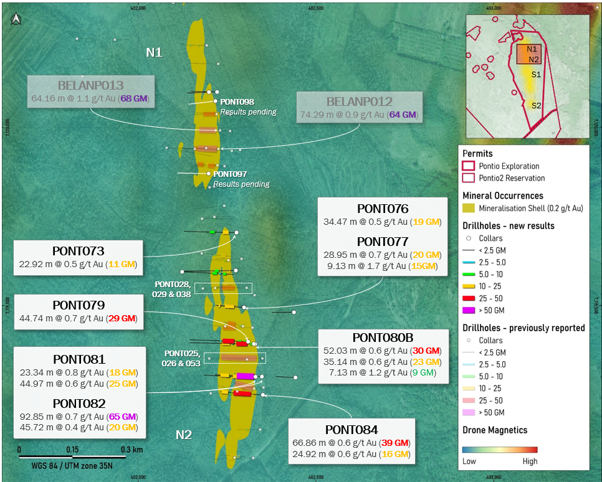
Figure 2 Plan of the N1 and N2 Sectors of the M2 Trend mineralisation at Pontio. Grade thickness (GT) is calculated as gold grade (g/t) x interval thickness (m) and is reported as gram metres (GM).
Mineralisation controls in the N1 Sector of the M2 Trend
The N1 Sector at Pontio had previously been drilled along 50m spaced profiles. The 2026 drilling in this area has focussed on trying to extend the strike of the N1 Sector both to the north and south, and to better understand the orientation and geometry of the mineralisation. Drill holes PONT071 and PONT072 were targeted at the northern extension of the N1 Sector to check the orientation of the higher grade mineralisation. Both these holes showed a number of samples with elevated gold grades within a broad halo zone of low-grade (<0.3 g/t Au) but did not intersect a significant extension of the main N1 body. The holes confirmed higher grade mineralisation is likely to occur in en-echelon NNE trending zones within the mineralised corridor. The best intersections from PONT071 were 8.83m @ 0.50 g/t Au from 28.28m; and 1.93m @ 1.13 g/t Au from 75.83m. The best intersection from PONT072 was 1.05m @ 0.64 g/t Au from 43.13m.
The N1 Sector now has 23 drillholes intercepting the body, along 50m spaced profiles. The significant intersects in N1 Sector are shown in Table 1.
Hole | From (m) | To (m) | Length (m) | Au g/t |
BELANP011 | 17.24 | 45.84 | 28.60 | 0.94 |
including | 27.80 | 45.84 | 18.04 | 1.22 |
BELANP012 | 6.76 | 81.05 | 74.29 | 0.86 |
including | 38.10 | 52.36 | 14.26 | 1.01 |
and including | 59.24 | 78.02 | 18.78 | 1.34 |
BELANP013 | 17.95 | 82.11 | 64.16 | 1.06 |
including | 37.11 | 39.08 | 1.97 | 2.67 |
and including | 53.22 | 68.04 | 14.82 | 2.29 |
BELANP014 | 25.30 | 43.15 | 17.85 | 0.71 |
including | 26.26 | 31.20 | 4.94 | 1.16 |
BELANP014 | 54.12 | 78.18 | 24.06 | 1.44 |
including | 57.25 | 77.20 | 19.95 | 1.62 |
BELANP015 | 5.50 | 50.70 | 45.20 | 1.04 |
including | 27.01 | 46.54 | 19.53 | 1.58 |
BELANP017 | 59.73 | 112.86 | 53.13 | 0.85 |
including | 78.90 | 83.00 | 4.10 | 1.51 |
BELANP017 | 91.12 | 106.63 | 15.51 | 1.47 |
BELANP018 | 49.40 | 67.81 | 18.41 | 0.64 |
including | 50.35 | 54.88 | 4.53 | 1.17 |
PONT002 | 63.60 | 104.96 | 41.36 | 0.72 |
including | 96.47 | 103.58 | 7.11 | 1.67 |
PONT034 | 59.08 | 71.30 | 12.22 | 0.50 |
PONT052 | 67.02 | 99.70 | 32.68 | 0.73 |
including | 78.21 | 91.14 | 12.93 | 1.32 |
PONT055 | 100.00 | 123.46 | 23.46 | 0.60 |
Table 1 Significant drill intersections from the N1 Sector of the M2 Trend. Intersection lengths are downhole lengths, Bulk intersections are reported at a cutoff grade of 0.3 g/t gold with 10m internal dilution. True widths are estimated as 65-85% of downhole intersect length. Drillhole locations listed in Appendix. Holes not included in Table 1 intersected no significant gold mineralisation greater than the cutoff or a grade thickness greater than 5.
Mineralisation in the N2 Sector of the M2 Trend
PONT073 was drilled on the northern extension of the N2 Sector and had two objectives, to extend the strike of the mineralisation northwards, and to test the IP chargeability anomaly lying to the west of the main M2 Trend. The drillhole intersected a number of mineralised zones of dioritic rocks where the M2 Trend was expected, with the best intersection of 22.92m @ 0.48 g/t Au. In the projected source area for the chargeability anomaly, drilling intersected dioritic and gneissic rocks containing disseminated pyrrhotite, but with only very weakly elevated gold grades.
PONT074 and PONT075 were scissor holes on the same profile.. Both holes intersected zones of mineralisation in diorites and gneissic diorites (diorites with a strong tectonic fabric), separated by gneissic inclusions. PONT074 intersected some higher grade mineralisation 2.85m of 3.87 g/t Au from 26.9m within broader mineralised intersects in the 0.5 - 0.6 g/t Au range (see Table 2). The western chargeability anomaly was again shown to be caused by barren pyrrhotite disseminations in dioritic intrusives and gneiss.
PONT076 and PONT077 to the west into a narrow portion of the N2 Sector mineralisation to test continuity. PONT076 intersected 34.47m @ 0.54 g/t Au in dioritic intrusive. The steeper and longer PONT077 intersected several zones of mineralisation including 28.95m @ 0.69 g/t Au from 54.25m and deeper zones of 7.80m @ 0.75 g/t Au from 96.57 plus 9.13m @ 1.69 g/t Au from 131.47m, extending the N2 mineralisation westwards.
PONT078 lies on the same profile as PONT076 and PONT077, but was drilled 150m to the east of the M2 Trend to test an eastern chargeability anomaly. This drillhole intersected anomalous (but low grade) gold mineralisation in intrusive diorites, with a best sample of 1.06m @ 0.63 g/t Au at 37.24m.
PONT079 and PONT080B were drilled westwards a further 100m south, into the core of the N2 Sector. PONT80B was redrilled when PONT080 had to be abandoned for technical reasons at a depth of 90m. Both PONT079 and PONT080B returned numerous intersections of mineralisation, separated by zones of gneissic inclusions, with PONT079 intersecting a cumulative 71.82m of mineralisation and PONT080B intersecting a cumulative 94.3m of mineralisation.
PONT081 and PONT082 both drilled through the porphyry unit, before intersecting the adjacent diorite intrusive to the west. Both the porphyry and the diorites contain mineralisation, although it is the thicker intersect of porphyry in PONT082 that has returned an intersection of 92.85m @ 0.70 g/t Au from 44.52 m downhole, with cumulative mineralised intersect of 138.57m. PONT081 returned a cumulative mineralised intersect of 85.54m. Cumulative intersects include several mineralised intercepts separated by intercalations of unmineralised gneiss.
PONT083 similarly to PONT078 was drilled approximately 100m to the east of the M2 Trend to test an eastern chargeability anomaly. This drillhole intersected anomalous (but low grade) gold mineralisation in intrusive diorites, with a best intersect of 2.01m @ 0.80 g/t Au at 53.05m.
PONT084 is the southernmost hole of this phase into the N2 Sector. The hole was planned to infill between the intersections in PONT006 and PONT024. The hole intersected a thick zone of porphyry (including 66.86m @ 0.59g/t Au) as well as a shorter interval of well mineralised diorite at the end of the hole (24.92m @0.63g/t Au, including 4.10m @ 1.3g/t Au) and extends mineralisation southwards as well as widening the known mineralisation
The N2 Sector now has a total 35 drillholes along approximately 50m spaced profiles, with most profiles having 2 - 4 drillholes. The significant intersections from the N2 Sector are shown in Table 2.
Hole | From (m) | To (m) | Length (m) | Au g/t |
PONT073* | 30.44 | 53.36 | 22.92 | 0.48 |
PONT073* | 85.33 | 104.13 | 18.80 | 0.35 |
PONT074* | 21.69 | 24.54 | 2.85 | 3.87 |
Including | 21.69 | 23.56 | 1.87 | 5.69 |
PONT074* | 66.76 | 83.11 | 16.35 | 0.56 |
PONT075* | 118.17 | 136.86 | 18.69 | 0.50 |
PONT075* | 160.00 | 171.97 | 11.97 | 0.48 |
PONT076* | 40.20 | 74.67 | 34.47 | 0.54 |
PONT077* | 54.25 | 83.20 | 28.95 | 0.69 |
Including | 55.00 | 66.03 |