

HM Exploration Confirms Significant Mineralization at Lewis Pilley's Project; Intersects 23 Metres of 1.2% Cu, 1.7% Zn, 10.7 g/t Ag and 0.25 g/t Au
VANCOUVER, BC / ACCESS Newswire / July 21, 2026 / HM Exploration Corp. ("HM Exploration", "HM" or the "Company") (CSE:HM)(FSE:X5H)(OTCQB:HMEXF) is pleased to announce assay results from the first seven (7) of twelve (12) drill holes from the Company's Phase One drilling program (the "Program") at its Lewis Pilley's Project (the "Project") in Newfoundland, Canada.
Highlights:
First assays confirm significant polymetallic mineralization in both the upper and lower sulphide lenses, supporting the Company's geological model (Figure 4). Both mineralized horizons remain open along strike and down dip (Figure 1).
PI-26-007*
23.0m of 1.21 % Cu, 1.67 % Zn, 10.67 g/t Ag, 0.25 g/t Au (7.00 - 30.00m)
Including 2.03 % Cu, 0.62 % Pb, 2.36 % Zn, 16.35 g/t Ag, and 0.38 g/t Au over 8.18m (16.00 - 24.18m)
2.45 % Cu, 1.70 % Zn, 92.20 g/t Ag, 5.89 g/t Au over 0.66m (155.31 - 155.97m)
0.80 % Cu, 0.52 % Zn, 3.67 g/t Ag, 0.21 g/t Au over 3.45m (175.85 - 179.30m)
PI-26-001*
4.47m of 1.49 % Cu, 1.04 % Pb, 5.05 % Zn, 19.54 g/t Ag, 0.28 g/t Au (12.09 - 16.56m)
Including 4.58 % Cu, 1.60 % Zn, 28.10 g/t Ag, and 0.56 g/t Auover 0.60m (12.70 - 13.30m)
0.50 % Cu, 1.20 % Zn, 5.77 g/t Ag, 0.15 g/t Au over 6.45m (50.30 - 56.75m)
Including 1.38 % Cu, 2.38 % Zn, 13.90 g/t Ag, and 0.35 g/t Au over 0.87m (54.07 - 54.94m)
* All reported intervals represent drilled lengths. True widths of the mineralized intersections are currently unknown.
Downhole EM, ground EM, optical and acoustic televiewer surveys will be executed imminently to help systematically plan for Phase Two drilling, testing the further extensions of the mineralized system.
Assays for holes PI-26-008 through PI-26-012 remain pending (see Press Releases dated June 29 & July 7, 2026, for information on what was observed in these drill holes).
"The intense mineralization we have visually observed in the first seven holes has now been confirmed by laboratory analysis, including high-grade intervals grading up to 2.45% Cu, 5.89 g/t Au and 92.2 g/t Ag in the lower lens and very extensive intervals in the upper lens," said Nick Rodway, CEO of HM Exploration. "These assay results confirm that the Lewis Pilley's Project hosts a polymetallic VMS system with excellent potential for expansion. With assays pending from holes eight to twelve, we are planning our EM survey in order to systematically design our Phase Two drilling program set to commence this fall."
The 2026 Phase One drilling Program was focused on evaluating the continuity of the mineralized system below known surface showings and along strike of the Clifford Jones (Bull Road) Zone (the "Zone") to improve the Company's understanding of the geological controls on mineralization. Assays have confirmed that the upper targeted copper-bearing debris flow contains significant mineralization over an interpreted strike length of approximately 60 m, from a total drill-tested length of approximately 135 m, within zones of massive to semi-massive sulphide through holes 1 and 2 as well as holes 5, 6, and 7 (Figure 1). Assay values from hole 7 also confirm that the lower mineralized sulphide lens contains significant mineralization within predominantly massive to semi-massive, and minor disseminated, sulphide mineralization (Figures 2 & 3). The assay results validate the Company's geological interpretation that multiple stacked sulphide lenses are present within the Project's Volcanogenic Massive Sulphide ("VMS") system. Both the upper and lower mineralized zones are open along strike and down-dip.
The mineralization from the upper zone is characterized by semi-massive to massive fragments of sulphide that have been fractured, transported, and chaotically mixed with varying types of volcanic rock. The fragments range from sun-rounded to angular, possibly indicating multiple transport events and reworking of these fragments through moderate to distal transport from the original deposition site. The source of the material is interpreted to be very nearby and may be supported by a stockwork vein system representing the feeder zone of the mineralization.
The mineralization from the lower zone is characterized by more massive and coherent fragments of sulphide with less rounding and fracturing than observed in the upper zone. The more ‘intact' nature of these fragments provides evidence that the new lower mineralized sulphide lens may represent debris deposited closer to the original hydrothermal vent system (Figure 4).
Significant assay results from the first seven (7) drill holes of the Phase One drilling Program can be found below in Table 1.
Table 1: Significant assays from Phase One drilling Program at the Clifford Jones (Bull Road) Zone. (NSV=No Significant Values)
Clifford Jones (Bull Road) Zone - Significant Assays* | ||||||||
Hole ID | From (m) | To (m) | Length (m) | Cu % | Pb % | Zn % | Ag g/t | Au g/t |
PI-26-001 | 12.09 | 16.56 | 4.47 | 1.49 | 1.04 | 5.05 | 19.54 | 0.28 |
Incl. | 12.70 | 13.30 | 0.60 | 4.58 | 0.19 | 1.60 | 28.10 | 0.56 |
Incl. | 14.20 | 14.92 | 0.72 | 1.96 | 3.14 | 18.40 | 44.60 | 0.30 |
And | 50.30 | 56.75 | 6.45 | 0.50 | 0.29 | 1.20 | 5.77 | 0.15 |
Incl. | 54.07 | 54.94 | 0.87 | 1.38 | 0.44 | 2.38 | 13.90 | 0.35 |
PI-26-002 | 11.10 | 16.20 | 5.10 | 0.42 | 0.08 | 0.59 | 4.61 | 0.19 |
Incl. | 14.00 | 15.00 | 1.00 | 0.89 | 0.09 | 0.91 | 6.70 | 0.26 |
PI-26-003 | NSV | |||||||
PI-26-004 | 16.48 | 16.78 | 0.30 | 0.22 | 0.04 | 0.03 | 2.20 | 0.12 |
PI-26-005 | 14.00 | 18.00 | 4.00 | 0.59 | 0.20 | 0.66 | 11.34 | 0.18 |
Incl. | 16.33 | 17.26 | 0.93 | 1.85 | 0.37 | 1.21 | 36.70 | 0.47 |
And | 28.00 | 45.97 | 17.97 | 0.34 | 0.13 | 0.69 | 4.59 | 0.12 |
Incl. | 35.30 | 43.49 | 8.19 | 0.49 | 0.20 | 1.05 | 6.84 | 0.18 |
And | 257.44 | 257.74 | 0.30 | 0.04 | 0.04 | 0.14 | 3.90 | 0.52 |
PI-26-006 | 11.43 | 13.14 | 1.71 | 0.57 | 0.37 | 1.21 | 8.56 | 0.19 |
And | 24.98 | 27.16 | 2.18 | 0.18 | 0.06 | 0.22 | 2.66 | 0.08 |
PI-26-007 | 7.00 | 30.00 | 23.00 | 1.21 | 0.38 | 1.67 | 10.67 | 0.25 |
Incl. | 16.00 | 24.18 | 8.18 | 2.03 | 0.62 | 2.36 | 16.35 | 0.38 |
And | 155.31 | 155.97 | 0.66 | 2.45 | 0.01 | 1.70 | 92.20 | 5.89 |
And | 175.85 | 179.30 | 3.45 | 0.80 | 0.05 | 0.52 | 3.67 | 0.21 |
Incl. | 178.00 | 179.00 | 1.00 | 1.08 | 0.09 | 0.97 | 4.70 | 0.29 |
* All reported intervals represent drilled lengths. True widths of the mineralized intersections are currently unknown.
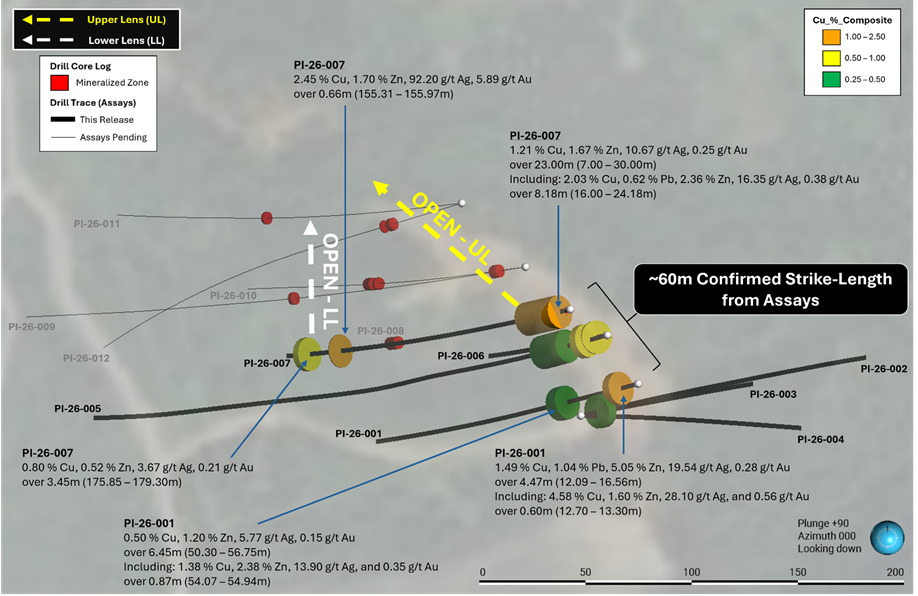
Figure 1: Plan map of 2026 diamond drilling at the Clifford Jones (Bull Road) Zone. Currently the upper lens (UL) and lower lens (LL) mineralization remains open along strike and at depth. The upper lens mineralization has been confirmed over a strike length of approximately 60 m, from a total drill-tested length of approximately 135 m, within zones of massive to semi-massive sulphide through holes 1 and 2 as well as holes 5, 6, and 7. Small red discs represent visually logged mineralized zones (assays pending). "Including" assay values not represented by colour-scale on figure.
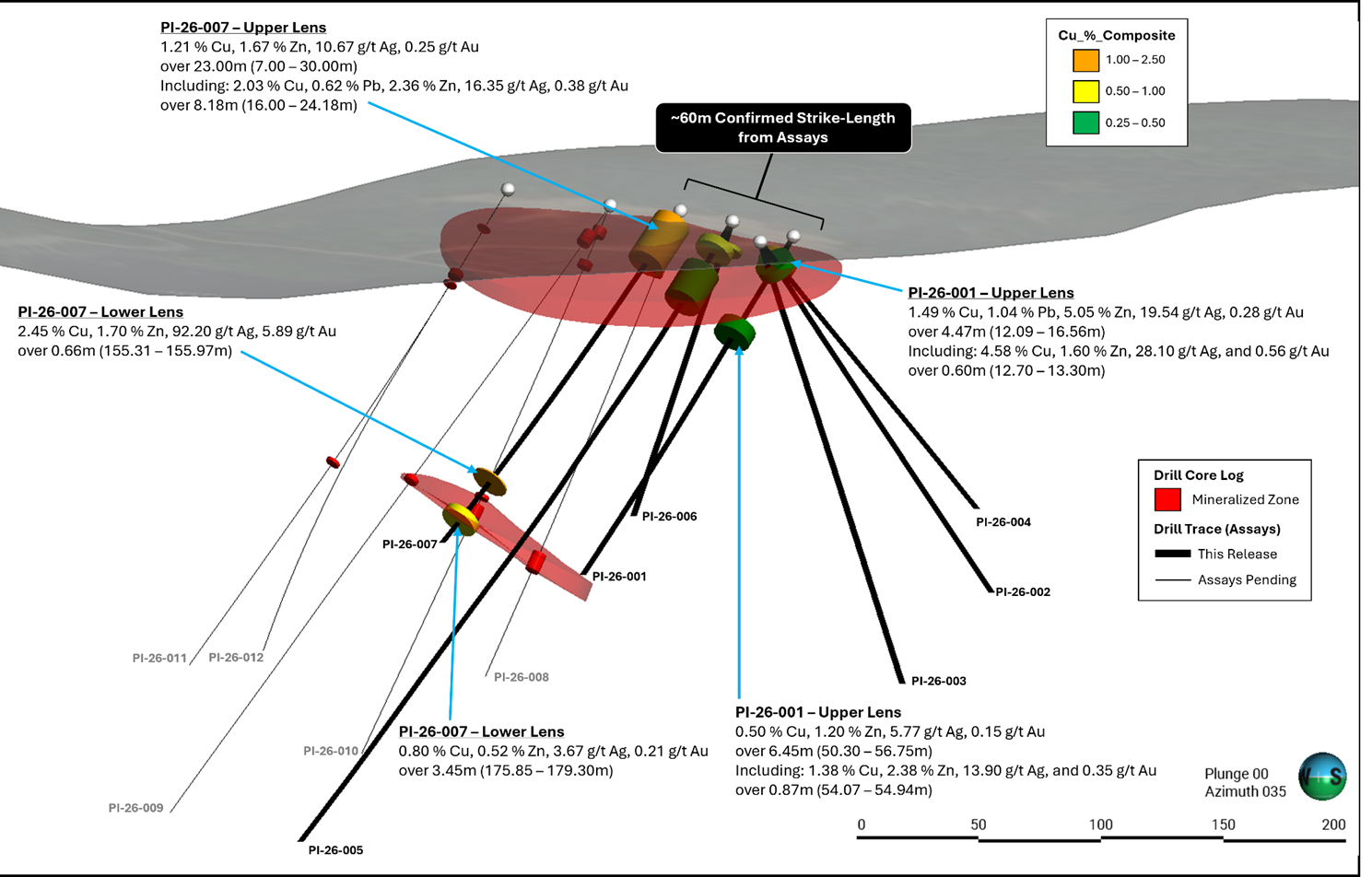
Figure 2: Oblique view of the 2026 Phase One drilling completed at the Clifford Jones (Bull Road) Zone. Small red discs represent visually logged mineralized zones (assays pending). "Including" assay values not represented by colour-scale on figure.
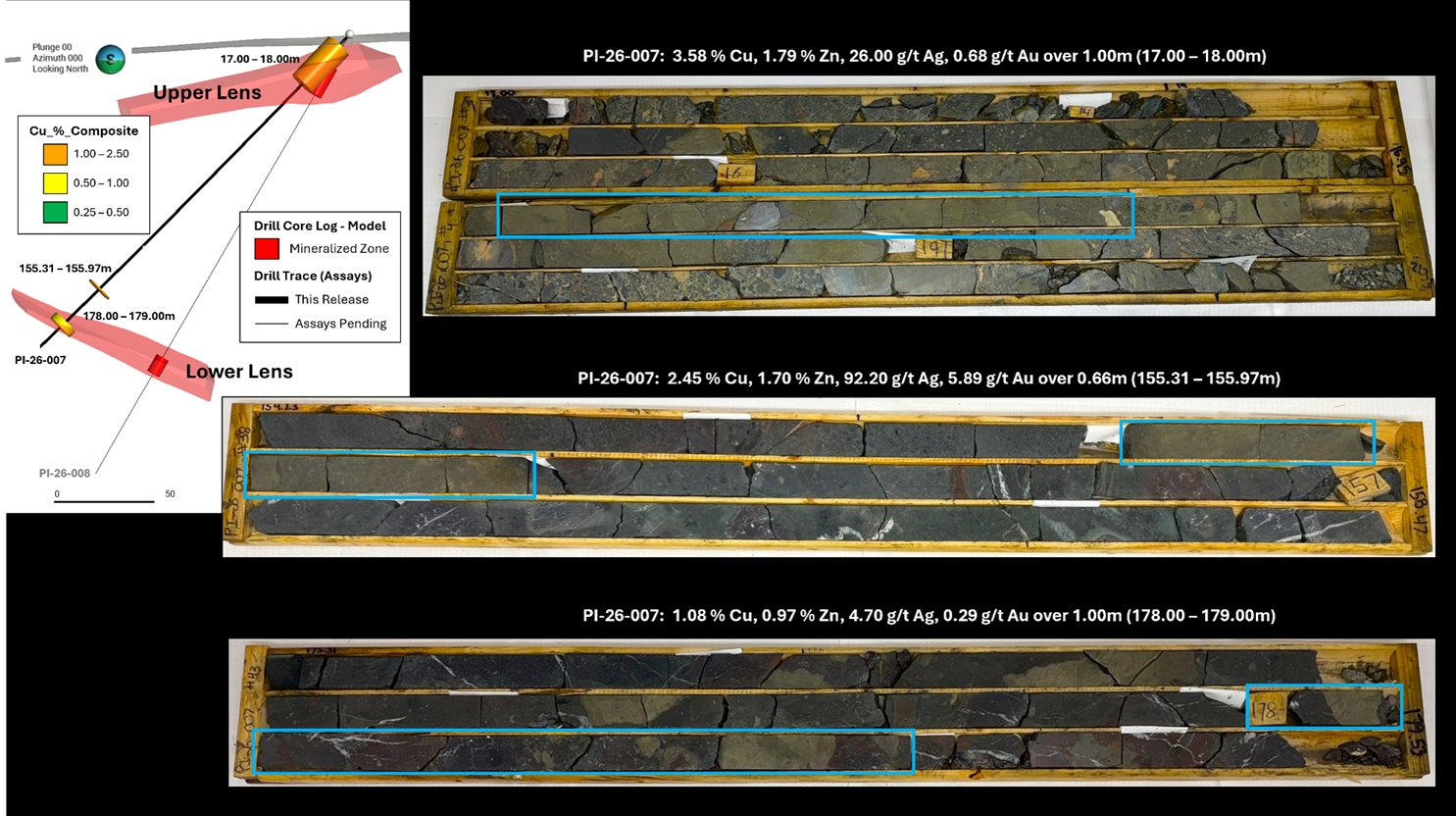
Figure 3: Cross-section of drill hole PI-26-007 (looking north) showing select significant mineralized intercepts with corresponding drill-core photos. In drill section, small red discs represent visually logged mineralized zones (assays pending).
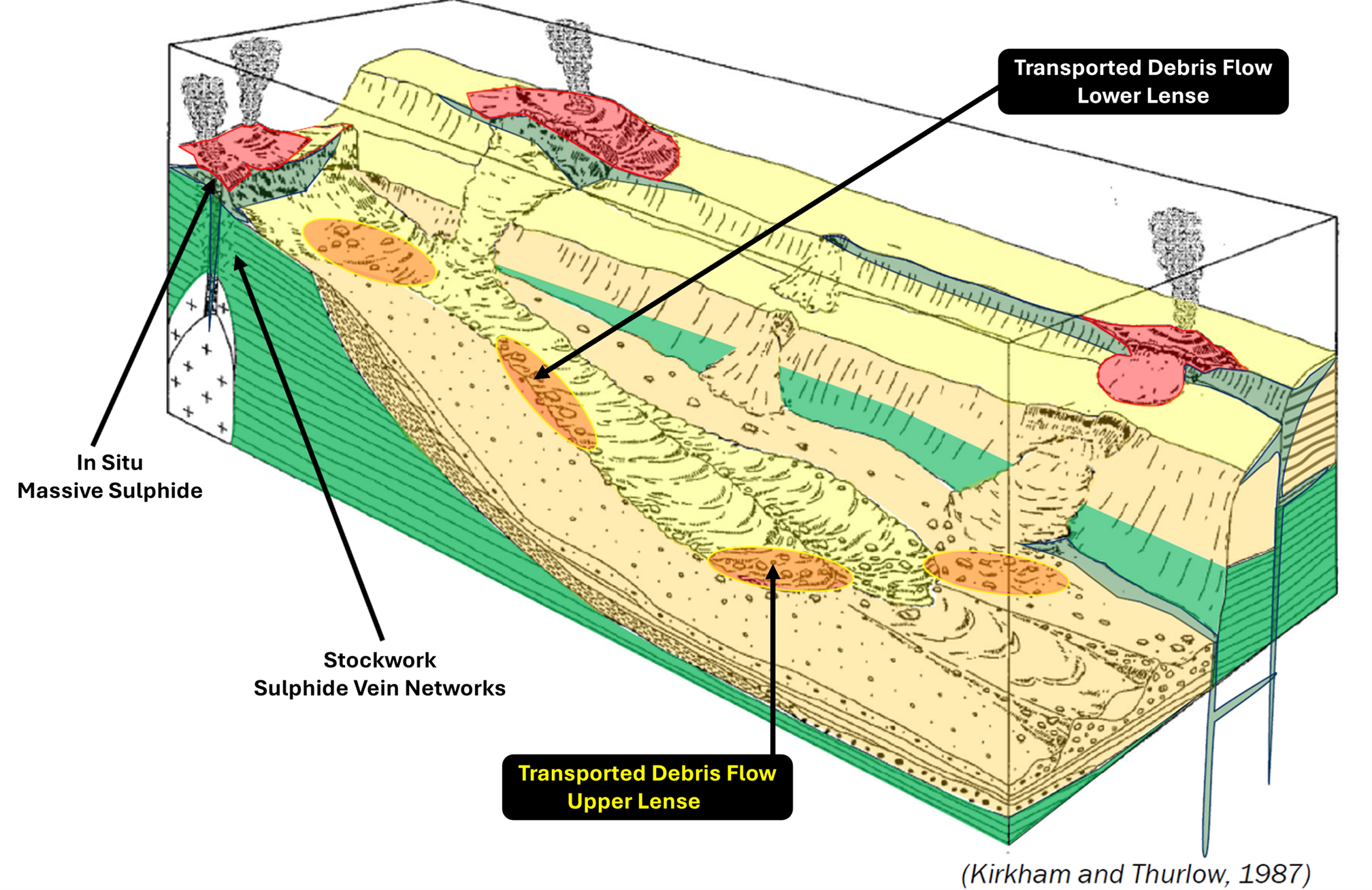
Figure 4: Conceptual model of VMS mineralization and the locations of where various types of mineralization may be located within the system. Mineralization intersected at the Clifford Jones (Bull Road) Zone appears to be transported from source; however, the angularity of the massive-sulphide clasts may indicate limited transport distance from the source vent (Modified after Kirkham and Thurlow, 1987).
Table 2: 2026 drill collar data; Coordinates reported in NAD83 - Zone 21N.
Hole ID | East | North | Azi | Dip | Depth (m) | Assay Status |
PI-26-001 | 593296 | 5485437 | 255 | -45 | 187.00 | This Release |
PI-26-002 | 593269 | 5485422 | 75 | -45 | 199.00 |