

Blencowe Resources PLC
27 August 2026
Date: 27 August 2026
Blencowe Resources Plc
("Blencowe" or the "Company"),
Further Battery Testing Success for Orom-Cross Graphite
Performance within military applications reinforces exceptional graphite quality and higher value multi-market sales potential
Blencowe Resources Plc (LSE: BRES), the natural resources company advancing the Orom-Cross graphite project in Uganda, is pleased to announce further test results using Orom-Cross graphite, demonstrating superior performance across multiple battery technologies. This follows the recent announcement of successful testing in advanced anti-radar coatings and other defence-related platforms which all open additional high value sales channels.
Two leading US graphite specialists, Apollo Energy Systems Inc. ("Apollo") and American Energy Technologies ("AETC"), together with Blencowe, are also progressing a laboratory demonstration prototype designed to meet 4HN high-performance military battery specifications required by the US Defence Logistics Agency ("DLA"). Subject to successful completion of the prototype programme the parties plan to establish a US pilot production line to demonstrate future commercial prospects, targeting 100 lead-acid cells per month.
These latest results further demonstrate the versatility of Orom-Cross graphite across military, grid energy storage, data centre and other advanced battery applications.
They also provide a higher-value market for the waste product, being spheroidisation rejects generated through Blencowe's planned uncoated spheronised purified graphite ("USPG") beneficiation process in Uganda, supporting the Company's strategy to maximise the value and utilisation of Orom-Cross graphite.
Highlights
· Apollo, AETC and Blencowe progressing a 4HN high-performance military battery prototype to US DLA specifications
· Subject to successful prototype development, the parties plan to establish a US pilot production line targeting 100 cells per month
· Opens additional potentially high-value markets across military, grid energy storage, data centres and other specialist applications
· Waste product produced within USPG beneficiation process using Orom-Cross graphite will be used as a performance enhancing additive within advanced lead-acid batteries manufactured by Apollo.
· Creates a substantially higher value sales pathway for approximately 30% of end product from the planned beneficiation facility, being the waste delivered from USPG production
· Supports Blencowe's strategy to achieve maximum utilisation of Orom-Cross concentrates processed through its planned beneficiation facility
· Independent test work by leading graphite specialists continues to demonstrate Orom-Cross's combination of high purity, superior conductivity and multi-market adaptability, which are all qualities sought by energy storage and defence-related agencies worldwide
These results follow testwork undertaken with Apollo and AETC on enhancing the performance of advanced lead-acid battery cells required for applications including grid energy storage, data centres and off-grid power. Testing has shown that Orom-Cross graphite can enhance key battery performance characteristics, with the detailed technical results set out in the Appendix to this announcement.
Military Battery Programme
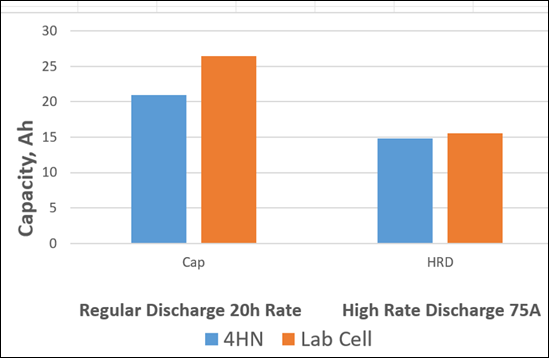
Apollo's batteries have multiple potential uses within military applications. Apollo, AETC and Blencowe are currently fabricating and testing a laboratory demonstration prototype to meet 4HN high-performance military specifications required by the DLA.
On successful completion of the prototype project, AETC, Apollo and Blencowe plan to set up a pilot line to produce 100 cells per month.
Apollo and AETC have also completed a Qualification Project for Blencowe, through which spheroidisation rejects from Orom-Cross graphite transformed into high surface area expanded delaminated ("HSAED") graphite product processed by AETC have been successfully tested as a performance enhancing additive to the negative active material in valve regulated advanced lead-acid batteries.
Apollo/AETC have established that HSAED Orom-Cross graphite enhances the high-rate partial state of charge performance of advanced valve regulated lead-acid batteries in new applications including start-stop and grid energy storage. Over the past six months the partners have been constructing a demonstration prototype battery which exceeds military specifications for the 4HN battery, with plans to begin pilot scale production in the USA.
Blencowe is extremely encouraged by the results of the program and the potential for higher value niche offtakes for the spheroidisation rejects generated at its proposed beneficiation facility in Uganda. Developing higher value markets for this material would support the Company's objective of achieving maximum utilisation of the Orom-Cross concentrates processed through the facility.
Market for Advanced Lead-Acid Batteries
AETC's production flowsheet for the manufacture of graphite for lithium-ion battery anodes generates an ultra-high purity by-product stream suitable for supply chains of lead-acid, alkaline, hearing aid, reserve (thermal) lithium primary batteries, supercapacitors and fuel cells.
Advanced lead-acid technologies continue to serve critical applications across grid storage, telecommunications, military systems and data centres, providing an additional addressable market for Orom-Cross products.
• Lead-acid batteries consume very significant amounts of graphitic carbon
• An average lead acid battery can be assumed to have approximately 1,500 Wh capacity
• The global lead acid battery market generated approximately 450 GWh of energy in 2021, equivalent to approximately 300 million batteries. An average battery contains around 0.5 kg of expander, including approximately 0.25 kg of graphite and carbon. On this basis, the global lead-acid battery market represented approximately 75,000 tonnes per annum of graphite and carbon demand in 2021.
• Since the mid-2000's, advanced forms of natural and expanded delaminated graphite have increasingly been incorporated into advanced lead-acid battery systems.
Executive Chairman Cameron Pearce commented:
"This latest test programme with AETC and Apollo Energy opens another significant potential market opportunity for Orom-Cross graphite within the large lead-acid battery sector, demonstrating enhanced performance, higher capacity, greater charge acceptance and longer battery life.
This sets Orom-Cross apart and it means our graphite can add real value in a market that already consumes tens of thousands of tonnes of graphite each year and operates outside the Chinese supply chain.
These findings build on earlier work by American Energy Technologies under the SAFELOOP programme, where Orom-Cross achieved 99.99 wt%C purity and recorded the highest performance score ever seen by AETC for a natural graphite project. Together, they reinforce Orom-Cross as a globally competitive, next-generation graphite source suited to multiple battery technologies.
As we move the project towards first production, we will keep adding further options to our broader marketing strategy, particularly in higher value western markets. These results also continue to validate the quality of our product and demonstrate how Orom-Cross can successfully differentiate from peers in what it sells and to whom."
APPENDIX TO ANNOUNCEMENT
Positive Effects of High Surface Area Graphite
· High surface area graphite serves as a capacitive buffer to absorb current at higher rates, which increases as the graphite surface area increases. This improves the dynamic charge acceptance and charge efficiency under high-rate charging conditions such as in "stop-start" duty and micro-HEVs.
· Graphite extends the area of the electrode microstructure giving additional surface for lead to be deposited on charging, thereby improving cycling performance.
· Graphite obstructs the growth of lead sulphate crystals by maintaining channels to allow irrigation throughout the electrode thereby extending cycle life, also to prevent stratification of flooded-type cells.
· Graphite forms a conductive network to reduce polarization.
· Forms a smaller and more uniform mass transfer network promoting uniform progress of the electrochemical reaction.
· When a large number of conventional lead-acid cells are connected in series - such as in full hybrid and battery EVs - the divergence in state-of-charge resulting from normal driving is virtually eliminated when graphite is incorporated, thereby eliminating the need for an equalization charge
These independent studies by leading graphite technical experts continue to demonstrate Orom-Cross's rare combination of high purity, superior conductivity, and multi-market adaptability, which are all qualities sought by energy storage and defence-related agencies worldwide.
Summary
· 3-Plate Negative Limiting Cells fabricated and tested: C/25 Capacity established as approximately 25Ah.
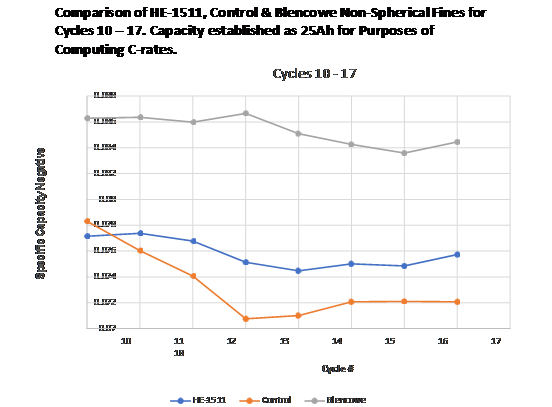
· Preliminary Cycling Results show that for the Negative Active Material (NAM), the Blencowe Non-Spherical Fines (spheroidisation rejects) additive has a higher specific capacity compared to Control and the (non-graphite added) HE-1511.
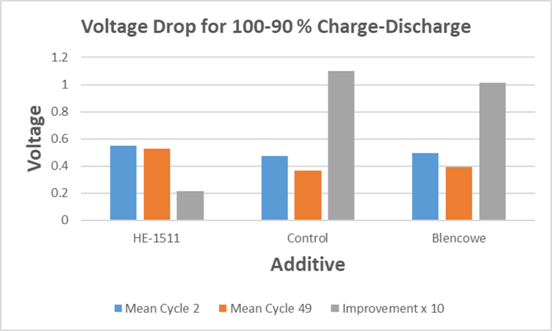
· High-Rate Full Charge (HRFC) Test 100-90% SOC @ 1C rate Blencowe similar to Control; both lower voltage drop than HE-1511
· High-Rate Partial State of Charge (HRPSoC) Test 60-50% SOC @ 1C Rate Blencowe superior to Control; both have a much lower voltage drop than Control.
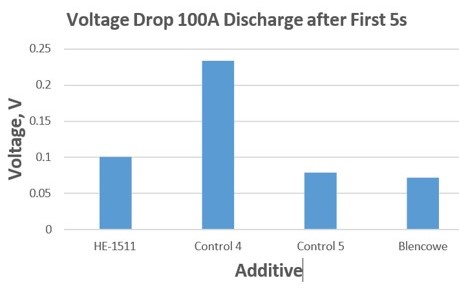
· 100A Discharge (4C) Blencowe Lowest Voltage Drop.
· Typical Capacity Sequence for large number of Shallow Cycles.
Conclusion
During the testing, the Negative Active Material (NAM) - Blencowe Non-Spherical Graphite Fines performance was comparable and superior to the Control Samples and both were superior to the cells without the Graphite addition to the NAM.
Both Graphite Samples enhanced the HRFC, HRPSoC and High-Rate Discharge characteristics (better recovery and lower voltage drop).
This work demonstrates that the Blencowe Non-Spherical Graphite Fines (Spheriodization rejects) are suitable for addition to the Negative Active Material of Apollo Valve Regulated Lead-Acid Batteries for energy storage and Start-Stop Vehicular Applications where batteries are subject to large charge and discharge pulses.
Combined, these independent studies by leading graphite technical experts continue to demonstrate Orom-Cross has a rare combination of high purity, superior conductivity, and multi-market adaptability, which are all qualities sought by energy storage and defence-related agencies worldwide.
Test Results Summary
Comparison - Blencowe vs Control vs HE-1511
The chart below illustrates the clear and consistent performance advantage of Orom-Cross graphite over the control material across the discharge cycles, confirming stronger energy retention and reduced performance degradation over time.
For further information please contact:
|
Blencowe Resources Plc |
|
|
Sam Quinn (Director) |
Tel: +44 (0)1624 681 250 |
|
Sasha Sethi (Investor Relations) |
Tel: +44 (0) 7891 677 441 |
|
Tavira Financial (Joint Broker): Jonathan Evans |
Tel: +44 (0)20 3192 1733 |
|
Oak Securities (Joint Broker): Mungo Sheehan / Jerry Keen |
Tel: +44 (0)20 3973 3678 |
|
Cavendish (Joint Broker):
Neil McDonald / Peter Lynch / Hanna Leijonmarck |
Tel: +44 (0) 20 7908 6000 |
|
|
|
|
|
Background
Orom-Cross Graphite Project
Orom-Cross is a world class graphite project both by size and end-product quality, with a high component of more valuable larger flakes within the deposit.
A 21-year Mining Licence for the project was issued by the Ugandan Government in 2019 following extensive historical work on the deposit and Blencowe is now moving towards first production.
Orom-Cross presents as a large, shallow open-pitable deposit, with a maiden JORC Indicated & Inferred Mineral Resource deposit of 64.03Mt @ 6.04% Total Graphite Content. Development of the resource is expected to benefit from a low strip ratio and free dig operations, thereby ensuring lower operating and capital costs.
Apollo Energy Systems Inc.
Apollo is a company with 60-years of experience in development of Batteries, Fuel Cells and Systems which incorporate those products. Their roots go back to 1953 when they built their first battery plant in Puerto Rico.
The company is developing "Lead Cobalt Battery" and "Alkaline Fuel Cell" to provide a Propulsion system for an electric vehicle which will enable that car to drive continuously, like a gasoline powered car, without external recharging (not necessary to "plug-in" to an outside receptacle); and will provide a Power Plant System to give electricity to a home, farm, hotel, cell towers or commercial establishment without use of the outside grid supplied by electric utility companies.
This information is provided by RNS, the news service of the London Stock Exchange. RNS is approved by the Financial Conduct Authority to act as a Primary Information Provider in the United Kingdom. Terms and conditions relating to the use and distribution of this information may apply. For further information, please contact rns@lseg.com or visit www.rns.com.
RNS may use your IP address to confirm compliance with the terms and conditions, to analyse how you engage with the information contained in this communication, and to share such analysis on an anonymised basis with others as part of our commercial services. For further information about how RNS and the London Stock Exchange use the personal data you provide us, please see our Privacy Policy.
ENDRNS may use your IP address to confirm compliance with the terms and conditions, to analyse how you engage with the information contained in this communication, and to share such analysis on an anonymised basis with others as part of our commercial services. For further information about how RNS and the London Stock Exchange use the personal data you provide us, please see our Privacy Policy.