

Electric vehicle batteries get a longer lifespan when weak cells are bypassed
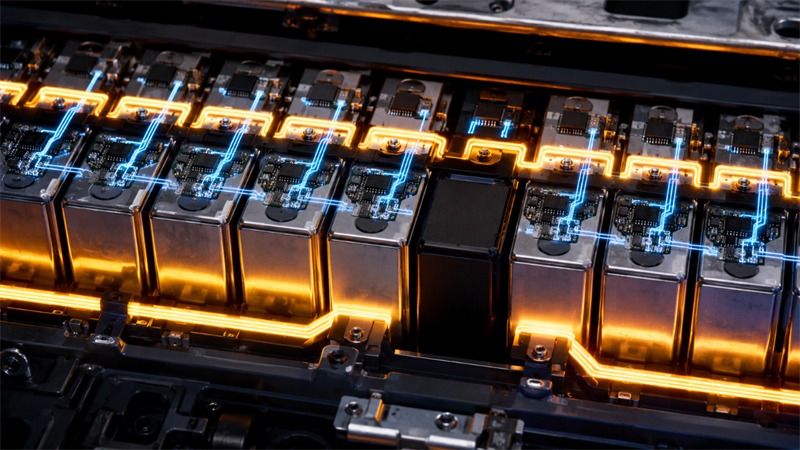
In today's electric vehicle batteries, a single weak cell can limit the life of the entire battery pack, even when the other cells are still working well. The goal is for future batteries to be able to bypass weak cells and make better use of the remaining capacity. A study, led by researchers at Chalmers University of Technology, in Sweden, now shows that a new ‘smart battery architecture’, under optimal conditions, can give electric vehicle batteries over 20 percent longer life in certain vehicles. At the same time, the total cost can be reduced over the battery's lifetime.
Battery packs in electric vehicles, or EVs, consist of many interconnected cells that do not age in the same way. In today's battery structure, the weakest cell can therefore set the limit for the entire package.
Albert Škegro, a doctoral student at the Department of Electrical Engineering at Chalmers University of Technology in Sweden, draws an analogy, describing the structure as the cells being connected by a rope, while they all try to move forward.
"Since they are bound to each other, everyone has to keep the same pace as the slowest cell and stop when that cell stops. With the solution in our study, the battery can instead bypass the cell that is causing problems and continue forward," says Albert Škegro, first author of the new study, which has been published in Nature Communications and conducted in collaboration with industry.
Previous research has shown how important differences between cells can be for the performance and lifespan of EV batteries. In a recently published study, co-authored by Chalmers researcher Changfu Zou, the researchers found that the weakest cells clearly limit the entire battery pack.
A battery that can adapt as cells age
In the new study, the researchers map the benefits of so-called reconfigurable battery packs, where switches and control systems can change the connections between the cells. These battery packs can bypass weaker cells so that more of the remaining capacity can be utilised.
In the researchers' models, the most advanced solution – where each cell can be controlled separately – can extend the lifespan by over 20 percent in some high-voltage vehicles, such as electric trucks and long-range electric cars. In practice, groups of cells are more likely to be controlled together, so the figure is a theoretical upper limit.
"Reconfiguration is not a question of 'on or off'. It is a spectrum, and where a manufacturer chooses to sit on that spectrum determines how much of the potential benefit can be realised," says Changfu Zou, Professor at the Department of Electrical Engineering at Chalmers and co-author of the study.
Longer lifespan can outweigh higher cost
To illustrate what the results can mean in practice, the researchers analysed an example with a typical 80 kilowatt-hour car battery and 12,000 kilometres of annual mileage. The example assumes that a conventional battery pack is replaced after 10 years, in line with current industry practice. In the model, the reconfigurable pack reaches the same point after about 11 years, so roughly 14 months longer. It also had a higher residual value because it had deteriorated less through aging.
"For a private electric car owner, it is a great advantage that the car's battery lasts longer. For a fleet with hundreds of battery packs, extending the battery life can mean significant savings," says Albert Škegro.
The technology is not yet available in series- or mass- produced vehicles but has been tested in research and industrial prototypes. Since it requires additional electronics, the technology has a higher initial cost, but the researchers also show that a longer service life and higher residual value can outweigh the additional cost under many realistic conditions. The potential is greatest in high-voltage vehicles with a long range and many series-connected cells.
In addition to the increased battery life, the researchers also point to more sustainability gains. Today, considerable resources are spent on testing and matching cells with similar characteristics during manufacturing. The new technology allows greater variation between cells and could therefore reduce the need for such precise matching. A larger part of the battery packs can also be given a second life, for example, as stationary energy storage.
"A battery pack that is taken out of service prematurely means both wasted material and wasted energy. Keeping battery packs in use for longer is therefore a sustainability argument even before you take the economy into account," says Albert Škegro.
More about the research:
The study System-level assessment of dynamic reconfiguration for lifetime and cost outcomes in electric vehicle battery packs | Nature Communications, published in Nature Communications.
The authors are Albert Škegro, Torsten Wik and Changfu Zou at Chalmers University of Technology; Bo Bijlenga at PHINIA Inc, Åmål; and Alexander Bessman at Scania CV AB, Södertälje. The article has also been highlighted by the editorial staff at Nature Communications, in the field of Engineering and Infrastructure.
For more information, please contact:
Changfu Zou, Professor at the Department of Electrical Engineering, Chalmers University of Technology, Sweden
+46 31772 33 92, changfu.zou@chalmers.se
Albert Škegro, PhD student at the Department of Electrical Engineering, Chalmers University of Technology, Sweden. +46 31 772 13 48, skegro@chalmers.se
Albert Škegro will be in Hamilton, Canada, until 15 November and will remain available for media enquiries during this period.
Changfu Zou speaks English and Chinese (Mandarin). Albert Škegro speaks English and Croatian. At Chalmers we have podcast studios and film equipment on site and can assist with requests for TV, radio or podcast interviews.
Captions:
The picture at the top of the page:
Smarter battery packs can give electric car batteries a longer life. The illustration shows a reconfigurable battery pack where all cells have their own switches, which are controlled by a battery management system (blue lines). A weak cell (dark) can be bypassed while the current (yellow) continues through the rest of the pack.
The illustration has been created by Albert Škegro, Chalmers University of Technology, Sweden, with the help of AI.
Attached graphic:
Conceptual diagram visualising reconfigurable battery packs (RBP) as the trunk of a tree. To reach the upper-level benefits (green) such as longer lifetime, improved safety, and faster charging, system designers must manage the lower-level challenges (red) such as control complexity, conduction losses, and cost, reflecting the architectural and control trade-offs involved in unlocking the functional advantages of RBP.
The graphic has been created by Albert Škegro, Chalmers University of Technology, Sweden.
Henrik Dahlberg
Head of Media Relations
+46-31 772 1940
henrik.dahlberg@chalmers.se
________________
Chalmers University of Technology in Gothenburg, Sweden, conducts research and education in technology and natural sciences at a high international level. The university has 3100 employees and 10,000 students, and offers education in engineering, science, maritime studies and architecture.
With scientific excellence as a basis, Chalmers promotes knowledge and technical solutions for a sustainable world. Through global commitment and entrepreneurship, we foster an innovative spirit, in close collaboration with wider society.
Chalmers was founded in 1829 and has the same motto today as it did then: Avancez – forward.
Follow us on LinkedIn. Like us on Facebook. Follow us on Instagram and tiktok.
---
Images provided in Chalmers University of Technology press releases are, unless specified otherwise, free for download and publication as long as credit is given to the University and the individual creator. Cropping and rescaling of the images is permitted when required for adaptation to the publication’s format, but modifications that would influence the message and content of the original are not. The material is primarily intended for journalistic and informative use, to assist in communication and coverage of Chalmers’ research and education. Commercial usage, for example the marketing of goods and services, is not permitted.
We kindly request credit to be given in the following format where possible:
Image/Graphic/Illustration: Chalmers University of Technology | Name Surname