
Barroso Li Project: Definitive Feasibility Study

Savannah Resources PLC
15 July 2026
15 July 2026
Savannah Resources Plc
(AIM: SAV) ('Savannah', or the 'Company')
Barroso Lithium Project: Phase 1 Definitive Feasibility Study Results
Strong economics, global competitiveness, and significant regional benefits confirmed
Savannah Resources Plc, the developer of the Barroso Lithium Project in Portugal (the 'Project'), a 'Strategic Project' under the European Critical Raw Materials Act and Europe's largest spodumene lithium deposit is pleased to announce the key findings from the Project's Phase 1 Definitive Feasibility Study (the 'DFS'). The DFS reconfirms the Project is on track to become a major European producer of low cost, sustainably sourced, spodumene concentrate for lithium batteries. Preparation for construction in 2027 will now become the key priority, backed by the €110m Portuguese State grant awarded in January 2026 (See 9 January 2026 RNS).
Table 1: Key DFS Outcomes
|
Parameters / Outcomes |
Unit |
2026 DFS |
|
Life of mine ('LOM') |
Years |
14 |
|
Average LOM Strip Ratio (waste: ore) |
5.2: 1 |
|
|
Total Ore Throughput |
Mt |
20.6 |
|
LOM Spodumene Concentrate Production (min. 5.5% Li2O) |
Mt |
2.56 |
|
Average Annual Spodumene Concentrate Production |
Ktpa |
183 |
|
Initial CAPEX (including pre-strip and contingencies) |
US$ M |
417 |
|
Initial CAPEX (excluding contingencies) |
US$ M |
377 |
|
Initial CAPEX (net of Portuguese State Grant, exc. contingencies) |
US$ M |
283 |
|
Average LOM C1 Operating Cost1 |
US$/t conc |
473 |
|
Average LOM All in Sustaining Cost2 |
US$/t conc |
646 |
|
Average concentrate (5.5% Li2O, 'SC5.5') price |
US$/t conc |
1,788 |
|
LOM Revenue (including by-product sales) |
US$ M |
4,804 |
|
LOM EBITDA |
US$ M |
3,226 |
|
LOM Post-Tax Free Cash Flow |
US$ M |
1,941 |
|
Post-Tax NPV8 (Unlevered) |
US$ M |
913 |
|
Post-Tax IRR |
% |
43.2 |
|
Post-Tax Payback Period |
Years |
1.9 |
|
Concentrate (5.5% Li2O) breakeven price (Post-tax NPV0 =0) |
US$/t |
747 |
1Operating Costs include all mining, processing, transport, G&A, and community costs, and are net of Ceramic By-Products credits
2All-in Sustaining Costs (AISC) include all mining, processing, transport, G&A and community costs, royalties, sustaining CAPEX and closure & rehabilitation costs and are net of Ceramic by-products credits and Portuguese State Grant operating milestone payments
Major Highlights
· Phase 1 operation: 14-year life, producing 2.56Mt of spodumene concentrate (183ktpa); enough lithium for 7m+ EV batteries3 based on a 20Mt first JORC Probable Reserve (see 15 July 2026 RNS).
· Based on an average concentrate price of US$1,788/t over the life of mine, the Project generates US$3.2 billion EBITDA (annual average US$230 million), US$1.9 billion free cash flow (annual average US$139 million), unlevered Post-tax NPV8 US$913 million, post-tax IRR of 43% with a Post-tax payback period of 1.9 years.
· US$473/t C1 and US$646/t All-in-sustaining costs positioned in the second quartile of the global cost curve4, make the Project Europe's most competitive hard rock project, with costs in line with some of the most competitive hard rock mines globally.
· Strong leverage to pricing is seen with a 10% increase in concentrate prices lifting unlevered post-tax NPV8 to US$1.1Bn.
· Project robustness is demonstrated by low break-even 5.5% Li2O concentrate prices ranging between US$747/t (Post-tax NPV0=0) and US$816/t (Post-tax NPV8=0).
· CAPEX includes a new US$61 million 17km national road (Boticas town bypass) that the Project will contribute to the region, and investment in processing capacity growth optionality.
· The Project generates c.500 long-term on-site jobs, hundreds of indirect jobs, and US$812 million in taxes and royalties, as well as many other significant benefits for local stakeholders. This includes the Savannah Foundation for social and cultural work and those included in the 10+ Memorandums of Understandings and other agreements signed with local community entities in the last 12 months.
· Low impact design and operation: The Project's design and operating plan meet or exceed all relevant Portuguese, European and global industry standards, creating a 'low impact' project. Key features include a 'Dry Stack' and lined Tailings Storage Facility (no 'wet' tailings dam), an autonomous water sourcing and recycling system and connection to low carbon grid power.
· US$646/t All in Sustaining Costs include US$92/t of comprehensive rehabilitation and closure costs to ensure best practice and fulfilment of 2023 environmental approval requirements.
· Project design allows for future production expansion (Phase 2), supported by further Reserve and Resource delineation and subsequent process optimisation.
3Ahead of subsequent conversion losses, based on average 60kW battery pack.
4Based on Benchmark Minerals 2030 global concentrate cost curve and Project costs pro-rated to 6% Li2O equivalents.
Emanuel Proença, CEO of Savannah said, "All at Savannah are delighted to be sharing the key findings from the DFS for the Project's first phase of production. This is another major milestone for the Project and the culmination of significant work done by our team and some of the world's most experienced sector consultants over many years. With this Project we will be unlocking significant value for all stakeholders and establishing Portugal as an important player in Europe's lithium battery value chain.
"Under the tight technical constraints of this level of study, the Project again shows its potential to deliver significant economic returns. Our expected second quartile operating costs place our Project alongside or ahead of a number of the world's largest and most reputed spodumene projects in Australia, the Americas, Africa and China. Meanwhile, the unlevered Post-tax NPV8 of over US$900 million, EBITDA of US$3.2 billion, free cashflow of US$1.9 billion and the 42% post-tax IRR highlight the intrinsic value within the Project.
"Importantly, this economic return will be delivered in parallel with significant socio-economic benefits for its region. In addition to the taxes and royalties the Project will generate are the hundreds of on-site long-term jobs created. These will bring working aged people and families back to the area and revert the dramatic population decline of recent decades. Hence the Project will create greater social cohesion. It will also provide the catalyst for local infrastructure development which will improve connectivity with the exterior and create new opportunities for the population and local businesses. As a Portuguese, I share with our local team a sense of pride in contributing to free up the Energy of the Barroso, with so many positive transformations for our region.
"Savannah is also deeply committed to sharing many other benefits generated by the Project with local stakeholders and taking its place as a responsible and useful corporate citizen in the region. We have already struck agreements with a host of key local groups and will continue expanding our local reach, as we make clear our commitment to be a force for good in our community: supporting local culture and heritage and helping local businesses to thrive and flourish.
"The DFS gives us a great platform from which to move into the next phase of development. Its findings will now be fed into the work our team is advancing on Project Finance, including compliance with obligations under the Portuguese State Grant contract, submission of the detailed design compliance report ('RECAPE'), Commercial Offtake discussions, Front-End Engineering Design and long lead item ordering as we move towards construction next year. The remainder of the year will be a very busy and decisive period for the Company."
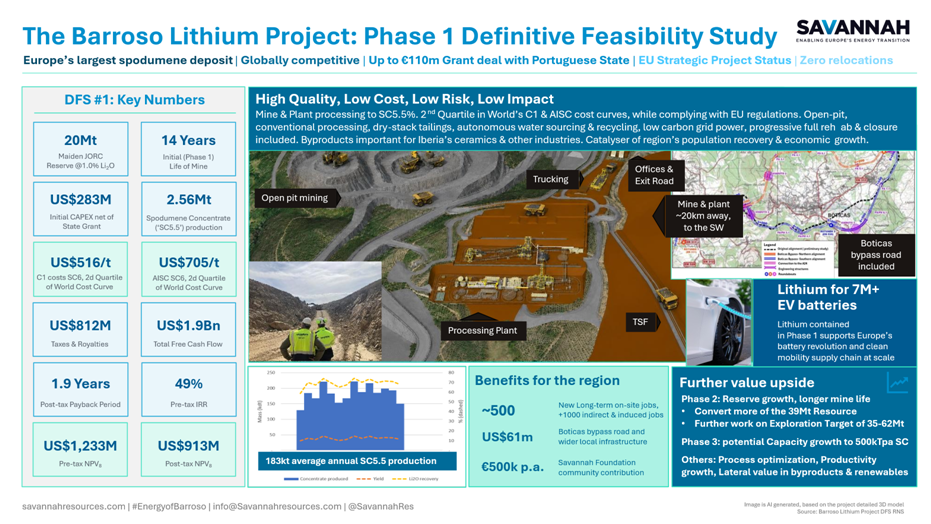
Figure 1: DFS Summary Infographic
Further information
The DFS has drawn on expertise from the following leading sector consultants with extensive experience in the global lithium industry, namely:
· Sedgman-Minsol (Australia): Metallurgy and process plant design
· Nagrom (Australia): Metallurgy
· ALS (Australia): Metallurgy
· Ashmore Advisory: Geological Resource
· Snowden Optiro (Australia): Mining and ore reserve estimation
· Knight Piesold (Australia): TSF, water management, earthworks and internal minor roads
· Model Answer (Australia): Financial modelling
Furthermore, local Portuguese consultancy and engineering firms were also engaged to incorporate the critical local knowledge and expertise on Portuguese and European regulations and standards required for the Project, including but not limited to:
· Quadrante: Power, roads, local regulatory compliance
· TPF: Boticas Bypass Road
· LNEC (Portugal's national civil engineering laboratory): Water storage reservoirs and TSF
The Executive Summary from the DFS of Phase 1 is available on the Company's website (https://savannahresources.com/project/barroso-lithium-project-portugal/) and a copy is provided below. Its operational, financial and stakeholder highlights include:
Operation highlights
The Project is of low technical risk underpinned by:
· Substantial JORC Resources: 39.2Mt at 1.05% Li₂O (1Mt of lithium carbonate equivalent) including c.27Mt in the Measured and Indicated ('M&I') categories and with all orebodies remaining open to further expansion.
· A maiden JORC Reserve: 74% of the M&I resource now converted into a 20Mt Probable Reserve at 0.99% Li₂O (c.490kt of lithium carbonate equivalent) based on a conservative concentrate price of US$1,200/t SC6 vs. current spot prices of US$2,225/t.
· Conventional mining: Open pit mining with a very low, highly competitive average waste to ore strip ratio of 5.2:1.
· Conventional processing: A 1.5Mtpa plant incorporating Dense Media Separation ('DMS') and a flotation circuit utilising environmentally friendly reagents to produce a good quality 5.5% Li2O spodumene concentrate ('SC5.5').
· Design quality and low impact features: The Project has been designed to meet or exceed all relevant Portuguese, European and global industry standards to create a leading European hardrock lithium project. 'Low impact' design features include a 'Dry Stack' and lined Tailings Storage Facility (no 'wet' tailings dam), on-site water sourcing, treatment and recycling, electrical cars in lieu of fly-in / fly-out team movements and shift changes, and low carbon grid power connection.
· Achievable CAPEX: From the Initial capital expenditure ('CAPEX') estimate of US$377 million (including pre-stripping costs, excluding contingencies), the c.US$95 million contribution from the Portuguese State Grant awarded in January 2026 will reduce the required net CAPEX financing (excluding contingency) from other sources to c.US$283 million. CAPEX includes a new US$61 million Boticas bypass road, which fulfils a long-term infrastructure goal for the Municipality and local communities.
· By-product credits: Local ceramic and industrial markets allow combined sales averaging 600ktpa across 4 different product streams, generating c.US$224 million in LOM revenue and significantly reducing waste handling and storage costs at the Project. A major source of additional value for an industrial sector that is important for Portugal.
· Commitment to impact minimisation: Comprehensive operating, rehabilitation and closure plans designed to minimise the impact of the Project over its operating life and beyond as required by the 2023 environmental approval.
· Expansion planning: Project design and CAPEX reflect higher specification of key infrastructure and spare capacity in the processing plant area footprint for potential future expansion up to 3Mtpa throughput.
Financial Highlights
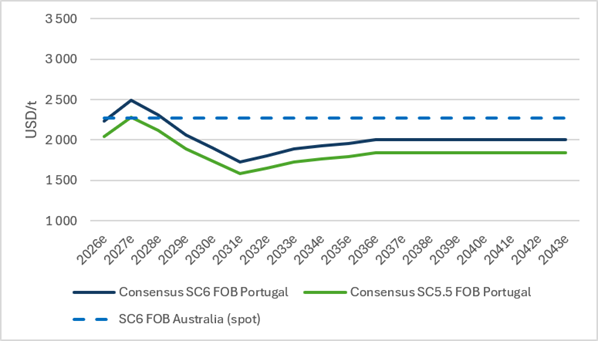
The Project's economics show the potential to create significant value based on an average 5.5% Li2O spodumene concentrate LOM price of US$1,788/t FOB Portugal vs. current 6% Li2O spot prices of c.US$2,225/t. The DFS concentrate price deck is a consensus forecast based on published forecasts from a suite of 7 banks, brokers and price reporting agencies, adjusted for FOB Portugal delivery and the Project's planned minimum 5.5% Li2O concentrate specification.
· LOM revenue from the sale of spodumene concentrate and by-products of US$4.8 billion and average annual revenue of US$343 million.
· LOM EBITDA of US$3.2 billion and average annual EBITDA of US$230 million.
· LOM post-tax free cash flow ('FCF') of US$1.9 billion, average annual FCF of US$139 million.
· Base Case unlevered post -tax NPV8 of US$913 million.
· Post-tax IRR of 43% and payback period of 1.9 years.
· Competitive C1 and All in Sustaining Costs ('AISC'): Average LOM C1 Operating Cost of US$473/t SC5.5 and AISC of US$646/t SC5.5 (including by-product credits). Both sit within the second quartile of the global cost curve (Benchmark Minerals Intelligence, 2030 global concentrate cost curve, pro-rated to 6% Li2O).
· Input leverage: Sensitivity analysis shows the Project is most leveraged to the spodumene price and lithium recovery rates among the key inputs with a ±10% variation in either parameter driving a ± c.19% change in unlevered post-tax NPV. Hence, if either the average spodumene price or processing recovery rate increased by 10%, the unlevered Post-tax NPV8 would increase to US$1.1 billion. The Project shows more modest sensitivity to changes in capital or operating costs. For example, if OPEX increased by 10%, unlevered post-tax NPV would fall by 7% only, while a similar increase in CAPEX would cause just a 4% decrease.
Figure 2: Barroso Lithium Project spodumene price forecast vs. current spot prices
Highlights for Stakeholders
· Fulfilment of a Portuguese State target to create another anchor for a new industry based on the country's lithium mineral endowment, to repopulate the country's interior and to generate prosperity in the region.
· Fulfilment of a European Commission target to create critical raw material operations within the European Union to meet the goals set in the Critical Raw Materials Act regarding domestic supply.
· Taxes and royalties totalling US$812 million, with the royalties portion to be shared between the Portuguese State and the local Municipalities.
· 300-350 jobs created during the construction phase and 480-500 on-site jobs during the operating phase (plus hundreds of indirect and induced jobs), making the Project one of the largest employers in the area and a catalyst for people of working age and families to move to the region.
· A new US$61 million Boticas bypass road fulfils a long-term infrastructure goal for the Municipality and local communities. Additional infrastructure improvements cover other local roads, telecommunications and water storage for firefighting / public use.
· The Project's social framework integrates Portuguese regulations, IFC Performance Standards, Equator Principles and UN Guiding Principles. The Project will implement nine integrated management plans covering multiple stakeholder matters, including community benefit sharing, local hiring, procurement, protecting cultural heritage, traffic management and supporting local agricultural systems.
· The Project is being developed in an area of industrial pine tree and abandoned scrubland and it does not require any community relocation. A Community Benefit Sharing Plan for neighbouring villages is structured through the Savannah Foundation, with a minimum annual budget of €500,000 once in operation, while the Good Neighbour Plan addresses compensation to local communities.
Further value creation opportunities include:
· Conversion of more existing JORC Resources into Reserves to extend the Project's life.
· Conversion of the Project's additional 30-62Mt Exploration Target2 to Resources and Reserves to extend the Project's life potentially well beyond 40 years of operation (Phase 2).
· Increase in throughput: The Project's design and CAPEX include a higher specification than required on key infrastructure, such as roads, and spare capacity in the processing plant area footprint for potential future expansion up to 3Mtpa throughput (Phase 3).
Commentary on DFS inputs vs. 2023 Scoping Study
There are a number of factors that should be considered if comparing DFS OPEX and CAPEX estimates with those from the June 2023 Scoping Study. Considering all of them shows a project with reinforced quality and more scope for growth. This includes:
· Preparation for potential Phases 2 and 3: Since the Scoping Study, a scaling of the Project has become significantly more likely, both in respect of mine life and the production capacity. To ensure scale-up optionality, CAPEX has been adjusted by, for example, installing reinforced crushing, screening, conveyor system and power transformer capacity and increasing the processing plant area footprint to allow sufficient space for a potential future expansion up to 3Mtpa.
· Improved technical solutions: Implementation of more robust solutions has also had an impact, e.g. the introduction of onstream analysers in the flotation process and a more robust technology flowsheet for water treatment. Also, equipment redundancy has been added where appropriate, to further assure high plant availability. In general, the Project's robustness and potential future value creation have been reinforced.
· Cost inflation: In the three years since the Scoping Study was published, there has been general inflation in all national markets relevant to this Study (e.g. Portugal and Europe c.8%, USA 10%, World 17%) while inflation in CAPEX on industrial projects has increased by c.18-21%. Also, salary inflation of 21% in Portugal's minimal wage and 17% in the average industrial wages has been reflected. These effects, together with others, impacted costs. For example, cost increases which negatively impacted NPV included plant equipment and construction cost (-US$57m), the bypass road construction cost (-US$27m), mining OPEX (-US$85m) and rehabilitation costs (-US$20m).
· Foreign exchange rates: Similar fluctuations to inflation have been seen in US dollar exchange rates against relevant currencies including the Euro (from 0.97$/€ to 1.14$/€) and Australian dollar, which can impact the relative costs of goods and services in the markets concerned.
· Volume adjustments: The average annual spodumene concentrate production tonnage has decreased by c.4% impacted by a more cautious view on assumed recovery rates. The assumed sales volume of similar by-products has increased by 50% based on updated market analysis and recent commercial discussions.
· Spodumene pricing: The average sales price for the Project's spodumene product has increased by 22% vs the Scoping Study average price of US$1,464/t, but the price curve used in the Scoping Study was higher in first years and dropped later in time, whereas the DFS price curve is inverted. When discounting the price curve at the 8% rate considered for the NPV calculation, the difference between both curves falls to 16%, which is very close to the 17% global inflation rate felt during the period.
· Other commodity pricing: Greater product specific pricing has been introduced for the by-product revenue stream, reflecting the more accurate definition of by-products quality which the Project is expected to produce, together with work done with potential clients for each specific byproduct stream and a more accurate assessment of by-product-related shipping costs. The average sales price for by-products has decreased by 44% vs. the Scoping Study average price of US$48/t.
· Greater cost accuracy: The DFS costs are estimated to a +/-15% level of accuracy, based on requests for quotations or recent published data, compared to the -20/+30% level in the Scoping Study three years ago.
Table 2: Summary of key DFS input and Outcomes
|
Operating Parameters |
Unit |
2026 DFS Base Case |
|
JORC Resources (including Reserve) / Average Li2O Grade |
Mt/% Li2O |
39.1/1.05 |
|
Total JORC Reserve / Average Li2O Grade |
Mt/% Li2O |
20.0/0.99 |
|
Life of mine ('LOM') |
Years |
14 |
|
Total Ore Throughput / Head grade |
Mt/% Li2O |
20.6/0.98 |
|
Average Annual Throughput / Head grade |
Mt/% Li2O |
1.47/0.98 |
|
Average LOM Strip ratio (waste to plant feed) |
w:o |
5.2:1 |
|
Plant Li₂O Recovery |
% |
69.6% |
|
LOM Spodumene Concentrate Production (min. 5.5% Li2O) |
Mt |
2.56 |
|
Average Annual Spodumene Concentrate Production |
Kt |
183 |
|
LOM By-product Sales |
Mt |
8.3 |
|
Average Annual By-product Sales |
kt |
600 |
|
Initial CAPEX (including contingencies) |
US$ M |
417 |
|
Initial CAPEX (excluding contingencies) |
US$ M |
377 |
|
Initial CAPEX (net of Portuguese State Grant, exc. Contingencies) |
US$ M |
283 |
|
LOM Operation Expenditure |
US$ M |
1,436 |
|
Average LOM C1 Operating Cost |
US$/t conc |
473 |
|
Sustaining Capital (net of Portuguese State Grant contribution) |
US$ M |
65 |
|
Closure costs |
US$ M |
237 |
|
Average LOM All in Sustaining Cost |
US$/t conc |
646 |
|
Economic Parameters |
Unit |
|
|
Average 5.5% Li2O price (FOB Portugal) |
US$/t conc |
1,788 |
|
LOM Spodumene Concentrate Revenue |
US$ M |
4,579 |
|
LOM By-product Revenue |
US$ M |
224 |
|
LOM Total Revenue |
US$ M |
4,804 |
|
Average Annual Revenue |
US$ M |
389 |
|
LOM Royalties (3% of Revenues) |
US$ M |
142 |
|
LOM EBITDA |
US$ M |
3,226 |
|
Average Annual EBITDA |
US$ M |
230 |
|
LOM Corporate and municipal taxes |
US$ M |
670 |
|
LOM Post-Tax Free Cash Flow |
US$ M |
1,941 |
|
Average Annual Post-Tax Free Cash Flow |
US$ M |
139 |
|
Pre-Tax NPV8 |
US$ M |
1,233 |
|
Pre-Tax IRR |
% |
50.0 |
|
Pre-Tax Payback Period |
Years |
1.67 |
|
Post-Tax NPV8 |
US$ M |
913 |
|
Post-Tax IRR |
% |
43.2 |
|
Post-Tax Payback Period |
Years |
1.9 |
|
Concentrate (5.5% Li2O) breakeven price (Post-tax NPV0 =0) |
US$/t |
747 |
|
Concentrate (5.5% Li2O) breakeven price (Post-tax NPV8 =0) |
US$/t |
816 |
Executive Summary
Barroso Lithium Project Phase 1 Definitive Feasibility Study
Executive Summary
July 2026
1. INTRODUCTION
PROJECT OVERVIEW
The Barroso Lithium Project (the 'Project') is located in northern Portugal and is one of Europe's largest and most advanced hard-rock lithium developments. This Definitive Feasibility Study ('DFS') for the first phase of the Project (Phase 1) assesses the technical and economic viability of developing the Project within the required environmental and social standards and regulations to develop a sustainable mining operation.
The proposed operation is expected to mine approximately 1.5Mt per annum of run-of-mine ore and produce an average of 183,000 tonnes per annum of dry spodumene concentrate grading approximately 5.5% Li2O, together with a range of bulk by-products suitable for the ceramics industry. Savannah considers this to be the initial phase of the operation, with a strategic roadmap in place to further expand the project's geological resource beyond a 40-year-equivalent mine life (Phase 2), which will potentially underpin a mining and processing throughput expansion to duplicate the base capacity of the current DFS (Phase 3) and potentially reach 500,000 tonnes per annum of production capacity. This is derived by the known geological potential of the project area and surroundings, with known underexplored pegmatite outcrops. Savannah's commitment to this strategy is evidenced by the fact that the process plant design and footprint allowed in this DFS already caters for a swift expansion, including a primary and secondary crushing and screening facility that is already dimensioned for a 3Mtpa throughput, which can be realised by just incorporating minimal engineering enhancements.
The DFS study integrates geological information, engineering design, processing methods, infrastructure requirements, regulatory obligations and financial considerations to support decision-making for the next stages of development. It reflects many years and tens of millions of dollars of work by an experienced team that covers the most critical disciplines. First class external expert support was involved in each of the key elements of the DFS, including (but not limited to) tier-one consultants with extensive experience in some of the world's most reputed lithium projects, such as Sedgman Minsol on mineralogy, metallurgy and process flow design and optimisation, with metallurgical laboratory testwork executed by two of the most reputable and experienced labs worldwide, Nagrom (Australia's most experienced in spodumene) and ALS. Additionally, Sedgman was also engaged to produce the processing plant design and Snowden Optiro to provide pit/waste dump designs and mining schedule.
Furthermore, local Portuguese consultancy and engineering firms were also engaged to incorporate the critical local knowledge and expertise on Portuguese and European regulations and standards required for this project, namely Quadrante on a set of fronts and on aggregation and quality control, and TPF on the Bypass Road project design and Environmental Impact Assessment. The work done provides the right level of robustness and preparedness for the Barroso Lithium Project at this first operational phase and it assures that the best knowledge available worldwide has been considered.
Results of this work are presented in this executive summary of the DFS for the first operational phase of the Barroso Lithium Project. They provide the path for Europe's second and largest spodumene project, with world-class cost competitiveness, to enter production. They evidence a high-quality, financially sound project that respects some of the world's most demanding compliance standards in key dimensions for any mining project, and that is ready to enter delivery phase.
LOCATION AND ACCESS
The project is situated in the municipality of Boticas, district of Vila Real, between the Serra do Barroso hills and the Tâmega River. It lies approximately 400 km north of Portugal's capital Lisbon, 140 km north-east of Portugal's second city, Porto and about 12 km south-west of municipality capital, Boticas. Regional access is supported by the Portuguese motorway and national road network, with connections to Porto, Braga and Lisbon and onward access to the Atlantic port of Leixões and Porto International Airport in approximately 2.5 hours. Local access is via the EN 103, EN 311, M519 and M1047 roads, with the Project reached from the Covas do Barroso/Alijó area.
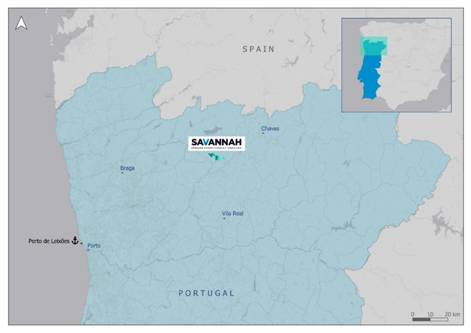
Figure 1‑1- Barroso Lithium Project Location Plan
TENURE AND PERMITTING STATUS
Mining and exploration in the region have a long history, beginning with tin activity and later lithium-related work. The Project originated from the Alvão-Barroso exploration contract signed in 2001 and evolved through environmental studies, public consultation, the granting of the C-100 Mina do Barroso Mining Concession (the 'C-100 Concession') in 2006, subsequent updates to the mine plan and Concession scope, and the formal incorporation of lithium into the Concession following a 2016 addendum. The project rights were transferred to Slipstream Resources Portugal Lda in 2017, before that company changed its name to Savannah Lithium Lda in 2018 and to Savannah Lithium Unipessoal Lda in 2020.
The Barroso Lithium Project comprises two mining concession areas: C-100 Mina do Barroso and C-190 Canedo-Covas, referred to in this DFS as Aldeia. The C-100 concession is the main and most advanced component of the Project and is supported by an initial 30-year mining concession contract with the Portuguese Government, with the option to extend by a further 20 years.
The C-100 Concession has already achieved the key environmental milestone of a favourable conditional Environmental Impact Statement (Declaração de Impacte Ambiental, or DIA), issued in May 2023. The Project is now progressing through the post-DIA phase, focused on preparation of the RECAPE and subsequent DCAPE, which are the main remaining environmental steps required to confirm the conformity of the Detailed Design Project and enable construction.
Additionally, Savannah has reached an agreement with Aldeia & Irmão, S.A. to acquire the C-190 Canedo-Covas Mining Concession. The transfer of rights request was submitted to DGEG in December 2025 and remains subject to completion of the necessary administrative formalities. Aldeia is at an earlier permitting stage and will be subject to a separate environmental permitting process before development.
PROJECT HISTORY AND JORC RESOURCE GENERATION
Savannah entered the project in 2017 through a joint venture with Slipstream Resources and other vendors and moved to 100% ownership in 2019. The project comprises the Pinheiro, Grandão, Reservatório, NOA and Aldeia deposits. Following the declaration of a small maiden JORC Resource in late 2017, between 2019 and 2023, Payne Geological Services updated the Mineral Resource Estimate, reporting a total resource of 28.0Mt at 1.05% Li2O, with 63% classified as Measured or Indicated. Subsequently in 2025 a new Mineral Resource Estimate which forms the basis for this DFS was produced after completion of a new resource definition drilling campaign, which states a total resource of 39.1 million tonnes at 1.05% Li2O, with 68% in the Measured and Indicated categories. The resource includes the portion of the Reservatório pegmatite that extends beyond the current C-100 Concession area and is partially included within a boundary extension application with DGEG.
PROJECT INFRASTRUCTURE
The project includes the development and construction of critical civil, mechanical and electrical infrastructure, including an ore processing plant (incorporating crushing, milling, Dense Media Separation and flotation units), access and internal roads, high voltage ('HV') and medium voltage ('MV') power lines, power substation, surface water reservoirs, dry stacked tailings storage facility (including a retention rockfill buttress), communications towers, industrial and administration buildings, among others. Figure 1‑2- Barroso Lithium Project Infrastructure locationsoffers an overview of the location of the different infrastructure elements within the project area.
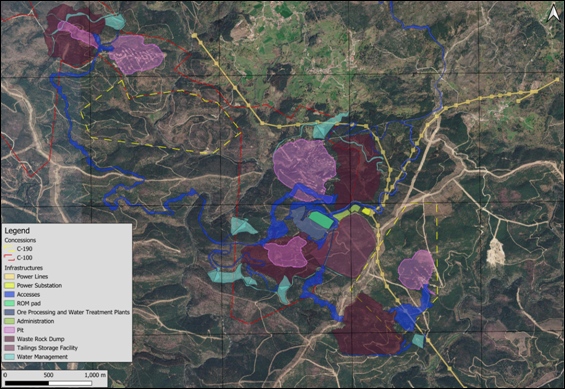
Figure 1‑2- Barroso Lithium Project Infrastructure locations
REGIONAL AND SOCIAL SETTING
The Project area is characterised by low rolling hills and deeply incised river valleys. Land use is dominated by industrial (non-native) pine forest and scrubby vegetation. There is no housing within the Project area or within a 500m zone surrounding it. Within 3km, approximately 500 people live in the rural civil parishes of Covas do Barroso, Canedo and Dornelas. The area has experienced economic decline and emigration over the last 40 years with many younger residents having migrated to larger towns and cities for education and work, which has translated into an ageing local community and limited economic activity, largely based on subsistence farming and small-scale production. Past loss of population means that ample housing is available in the region, although rehabilitation is generally needed. The regional context is therefore important to the Project's social license to operate and to its community engagement, employment and local benefit-sharing commitments.
CLIMATE AND OPERATING CONDITIONS
The Project area has a warm temperate climate, with rainy winters and dry, mild summers. Climatic conditions show strong seasonal variation, with precipitation concentrated mainly between autumn and spring and drier conditions during the summer months. These seasonal conditions are relevant to mine planning, water management, road access, construction scheduling, operational resilience and environmental controls.
The DFS design and operating strategy account for these conditions through site water management infrastructure, controlled drainage, water treatment, road and access planning, and operating procedures intended to support safe year-round construction and operations.
2. GEOLOGY AND RESOURCES
GEOLOGICAL SETTING
The Barroso Lithium Project is located within the Galicia-Trás-os-Montes Zone ('G-TMZ') of northern Portugal, a complex geological domain formed during the Variscan orogeny. The regional geology is dominated by meta-sedimentary rocks (mainly mica schists and quartzites) intruded by syn-tectonic granitic bodies. These granites are genetically linked to lithium-bearing pegmatite formation.
Figure 2-1- Portugal's Key Lithium Prospective Areas shows an overview of Portugal's key areas prospective for lithium.
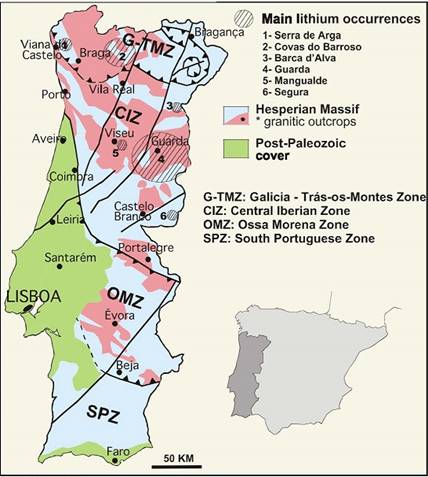
Figure 2-1- Portugal's Key Lithium Prospective Areas
Lithium mineralisation occurs in Lithium-Caesium-Tantalum ('LCT')-type pegmatites, commonly referred to as aplo-pegmatites due to the presence of alternating pegmatite and aplite bands. These bodies are structurally controlled and associated with D3 deformation, particularly along NW-SE trending ductile-brittle shear zones. Pegmatites exhibit variable geometries, from shallow-dipping tabular bodies to steep, dyke-like structures, often displaying pinch-and-swell characteristics.
Figure 2-2 shows the regional geology of the Project's location.
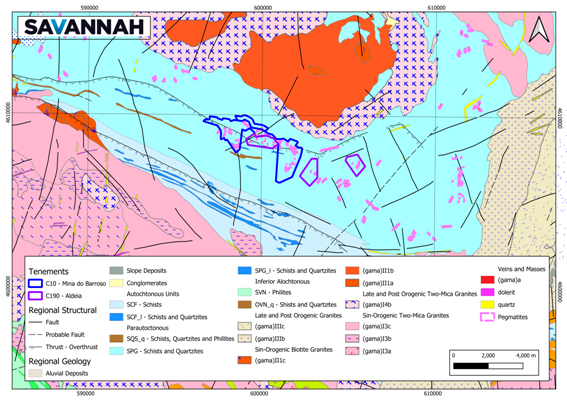
Figure 2-2- Barroso Lithium Project Regional Geology
MINERALISATION AND MINERALOGY
Lithium mineralisation is hosted almost exclusively in spodumene, the dominant lithium-bearing mineral across all the Project's deposits. The pegmatites are mineralogically simple, composed primarily of spodumene, quartz, albite and microcline (feldspars), with less than 10% muscovite presence.
Spodumene occurs in multiple generations and grain sizes, ranging from fine disseminations to coarse euhedral crystals several centimetres long. Variability in mineral texture is linked to deformation and emplacement history. In some zones, particularly those associated with tin mineralisation, traces of petalite may occur, although spodumene remains the economically dominant phase.
Weathering plays an important role in modifying near-surface mineralisation, particularly at the Reservatório deposit, where lithium depletion zones are observed due to leaching. Despite this, fresh rock mineralisation at depth remains continuous and well-developed.
STRUCTURAL CONTROLS
The distribution of pegmatites is strongly controlled by regional structural corridors. Two main structural domains are recognised:
· The NOA-Reservatório-Grandão corridor, characterised by folded and deformed lithium-bearing pegmatites within a transpressive regime.
· The Pinheiro corridor, hosting tin-bearing and less deformed pegmatites associated with brittle structures and tension gashes.
Overall, pegmatite emplacement is interpreted to be controlled by sinistral NW-SE trending shear zones, with mineralisation following structural planes developed during late-stage tectonic evolution.
DEPOSIT GEOLOGY
Five main deposits define the Barroso Lithium Project: Grandão, Reservatório, Pinheiro, NOA and Aldeia.
Grandão is the largest deposit, characterised by a broad, shallow-dipping tabular pegmatite with a secondary set of steeper dykes at depth. The deposit shows excellent continuity both along strike and down dip. The Grandão Mineral Resource area extends over a north-south strike length of 620m and includes the 320m vertical interval from 600mRL to 280mRL, open in both lateral extensions and in depth.
Reservatório comprises a single tabular pegmatite dyke striking NE-SW and dipping moderately northwest. It displays consistent thickness and grade but shows deeper weathering effects near surface. The Reservatório Mineral Resource area extends over an east-northeast strike length of 550m and includes the 190m vertical interval from 600mRL to 410mRL, open in both lateral extensions and at depth.
Pinheiro consists of multiple sub-parallel, steeply dipping pegmatite dykes, typically 10-20 metres thick, forming a structurally controlled system open at depth. The Pinheiro Mineral Resource area extends over a north-south strike length of 240m and includes the 230m vertical interval from 590mRL to 360mRL, open in both lateral extensions and in depth.
NOA is a smaller but higher-grade system, composed of steeply dipping pegmatites with coarse spodumene crystals and relatively higher lithium grades. The NOA Mineral Resource area extends over a west-northwest strike length of 420m and includes the 130m vertical interval from 700mRL to 570mRL, open in both lateral extensions and in depth.
Aldeia represents an additional resource outside the core C-100 Concession area, with a tabular pegmatite body up to 45m thick and lithium grades exceeding 1% Li2O. The Aldeia main pegmatite has a drilled extent of 250m N-S and 340m down dip and has a maximum vertical depth of 200m. The thickness of the mineralisation ranges from 10m to 45m, open in both lateral extensions and in depth.
EXPLORATION HISTORY
Exploration at Barroso began in the 1980s with academic and government-led studies identifying lithium-bearing pegmatites. Early work between 1988 and 2002 included mapping, sampling and shallow drilling.
Modern exploration commenced in 2017 following acquisition by Savannah Resources. Since then, extensive drilling campaigns have been undertaken, exceeding 50,000 metres of Reverse Circulation ('RC') and diamond drilling. These programmes focused on resource definition, extension and upgrading of confidence levels.
Additional exploration activities have included geological mapping, geochemical sampling, geophysical interpretation, metallurgical testing and structural modelling.
RESOURCE GROWTH AND ESTIMATION
The Barroso Lithium Project has demonstrated substantial resource growth over time. Initial JORC-compliant resource estimates in 2017 rapidly expanded with continued drilling through 2018 and 2019 with further drilling between 2023-2025. A major milestone was achieved with the release of the latest JORC Mineral Resource Estimate in 2025.
The combined Mineral Resource for the project (including the C-100 Concession, extension areas and the C-190 Concession) is approximately 39Mt at an average grade of 1.05% Li2O, containing over 400,000 tonnes of Li2O.
A significant proportion of the resource (over 26Mt) is classified as Measured and Indicated, reflecting a high level of geological confidence suitable for mine planning and feasibility studies. Table 2‑1 summarises the 2025 Geological Resource Statement figures.
Table 2‑1- 2025 JORC Geological Resources Statement Summary
|
Prospect |
Resource Class |
Tonnes Mt |
Li2O % |
Ta2O5 ppm |
Fe2O3 % |
Li2O Tonnes |
Date |
|
Aldeia Lithium |
Indicated |
1.6 |
1.3 |
28 |
0.5 |
21,300 |
May 2019 Mineral |
|
Inferred |
1.8 |
1.3 |
22 |
0.4 |
23,700 |
||
|
Total |
3.5 |
1.3 |
25 |
0.4 |
45,000 |
||
|
Grandão Lithium |
Measured |
8.7 |
1.06 |
21 |
0.7 |
93,100 |
August 2025 Mineral |
|
Indicated |
5.0 |
1.03 |
21 |
0.8 |
51,100 |
||
|
Inferred |
4.4 |
1.06 |
20 |
0.8 |
46,400 |
||
|
Total |
18.1 |
1.05 |
21 |
0.7 |
190,600 |
||
|
Reservatório Lithium |
Measured |
- |
- |
- |
- |
- |
July 2025 Mineral |
|
Indicated |
8.1 |
0.99 |
17 |
0.9 |
80,500 |
||
|
Inferred |
4.0 |
0.93 |
15 |
0.9 |
37,300 |
||
|
Total |
12.1 |
0.97 |
16 |
0.9 |
117,800 |
||
|
Pinheiro Lithium |
Measured |
- |
- |
- |
- |
- |
August 2025 Mineral |
|
Indicated |
2.6 |
1.11 |
21 |
0.7 |
29,300 |
||
|
Inferred |
2.2 |
1.08 |
20 |
0.7 |
23,300 |
||
|
Total |
4.8 |
1.09 |
21 |
0.7 |
52,600 |
||
|
NOA Lithium deposit |
Measured |
- |
- |
- |
- |
- |
April 2024 Mineral |
|
Indicated |
0.6 |
1.03 |
24 |
0.8 |
6,400 |
||
|
Inferred |
0.1 |
0.95 |
16 |
0.5 |
400 |
||
|
Total |
0.7 |
1.03 |
23 |
0.8 |
6,800 |
||
|
All Deposits |
Measured |
8.7 |
1.06 |
21 |
0.7 |
93,100 |
|
|
Indicated |
17.9 |
1.06 |
20 |
0.80 |
187,530 |
||
|
Inferred |
12.5 |
1.06 |
19 |
0.75 |
132,470 |
||
|
Total |
39.1 |
1.05 |
20 |
0.76 |
413,100 |
All deposits remain open at depth and along strike, indicating further exploration upside.
DRILLING AND DATA QUALITY
Drilling has been carried out using RC and diamond drilling techniques. Sampling protocols follow industry best practice, including strict QA/QC procedures with standards, blanks and duplicates.
Analytical work has been conducted by accredited laboratories using ICP-MS techniques. Results demonstrate high precision and no significant analytical bias, supporting the reliability of the dataset used for resource estimation.
To account for potential contamination (e.g. iron from RC drilling), correction factors have been applied where necessary, ensuring robust grade estimation.
FEASIBILITY STUDY AND RECENT WORK
Recent drilling programmes (2023-2025) were designed to upgrade resources to Measured and Indicated categories as part of the DFS. These programmes focused on infill drilling and testing extensions of known mineralisation.
The updated geological models and high-density drilling have improved confidence in deposit geometry, continuity and grade distribution. Metallurgical test work confirms that spodumene concentrates exceeding 5.5% Li2O can be produced using conventional processing methods such as dense media separation and flotation, with high recovery rates and production stability.
EXPLORATION POTENTIAL AND FUTURE WORK
In addition to current resources, the project hosts significant Exploration Targets estimated between 35 and 62Mt at grades ranging from 0.9% to 1.2% Li2O. These targets are based on geological modelling and demonstrate the potential for substantial future resource growth.
Further work is planned to expand known deposits, test regional pegmatite fields and refine mineralogical and metallurgical understanding.
3. MINING
MINING RESERVES
Mining ore reserves have been calculated by a Competent Person under JORC (2012) code and Fellow of the AusIMM (Australian Institute of Mining and Metallurgy), engaged by Savannah as part of the services provided by Snowden Optiro as the consultancy firm employed to produce the pit designs and LOM mining schedule for the Barroso Lithium Project. The Competent Person has sufficient experience relevant to the style of mineralisation and type of deposit under consideration and to the activity undertaken to qualify as a Competent Person as defined in the JORC Code (2012).
The Ore Reserve (July 2026) estimate for the Barroso Lithium Project has been prepared in accordance with the JORC Code (2012) and is classified as Probable Ore Reserves, derived from Measured and Indicated Mineral Resources and based on a US$1,200/t SC6.0 spodumene price for revenue calculations.
Remaining uncertainties relate primarily to metallurgical variability across deposits, project permitting and stakeholder factors. The mine schedule includes approximately 3% Inferred Mineral Resources, which does not materially impact production or financial outcomes. No Ore Reserves have been derived from Inferred Mineral Resources.
Table 3‑1 presents the ore reserves of the Barroso Lithium Project.
Table 3‑1: Barroso Lithium Project Mineral Reserves
|
Classification |
Item |
Unit |
Aldeia |
Grandão |
NOA |
Pinheiro |
Reservatório |
Total |
|
Probable |
Tonnes |
Mt |
1.6 |
11.4 |
0.5 |
2.1 |
4.4 |
20.0 |
|
Li2O grade |
% |
1.09 |
0.98 |
0.90 |
1.02 |
0.95 |
0.99 |
|
|
Fe2O3 grade |
% |
0.97 |
0.94 |
1.66 |
1.03 |
1.09 |
1.00 |
MINING METHOD
Mining will be executed as a conventional open pit excavator-truck operation. Loading equipment will be comprised of 130t nominal operating weight (or similar) backhoes and 90t nominal payload (or similar) mining dump trucks.
Mining bench height will be 5m across all deposits, with ore areas mined in 2 flitches of 2.5m each with the option of performing full 5m double-benching mining in waste only areas. Ore mining will be reached at early stages due to the shallow mineralization characteristic across the project's deposits.
Ore will be hauled on internal private haul roads to the Run of Mine ('ROM') yard and waste to the various waste dumps located near to each respective pit. As a commitment to both early rehabilitation and operational efficiency, backfilling is also included in the mining sequence, starting with Pinheiro pit once it is fully depleted, which mitigates any impact caused by an open empty pit left for an extended period of time.
Mining will be executed by an external contractor under a rates based contract, which may also include production drilling, blast hole explosive charging, tie-in and shot blasting.
Savannah will have their own technical services team and mine management team, therefore the production geology, mine planning, drill & blast engineering, blast hole sampling, surveying and contractor supervision functions will be fully controlled by the project owner, providing full direction and oversight on execution.
DRILLING AND BLASTING
Drilling, blast hole charging, tie-in and shot blasting will be executed via an external contractor, with these functions likely to be included within the mining contract scope.
Drilling will be executed in diameters ranging between 115mm to 140mm and various drill patterns depending on a blast categorisation protocol that considers a nominal rock hardness (weathered or fresh) and bulk (waste only shots on 10m deep drilling) or selective (ore/waste shots on 5m deep drilling). These parameters may be re-assessed once into operations depending on drill and blast performance and localised ground conditions. Pre-split drilling and blasting is also considered along pit walls.
Explosive and accessories supply will be contracted with a licensed and experienced company. Explosive usage will be a mixed of bulk or packaged explosives, dictated mainly by blast hole diameters and accessibility conditions. Savannah will not have explosive storage and magazines areas on-site as there are existing explosive manufacturing and storage facilities within the region, which ensures adequate operational and logistics capabilities will be available from potential explosive providers to guarantee timely deliveries up to the blasting bench whilst keeping cost competitiveness.
MINING SEQUENCE
Mining will start with pre-stripping activities during the year prior to the start of processing operations, i.e. still during construction. This will provide waste to complete construction of key infrastructure, such as water reservoirs, the Tailings Storage Facility (TSF') buttress and roads.
The first pits to be started will be Pinheiro and Grandão, followed by NOA in year 5 after depletion of Pinheiro. Reservatório starts in year 7 once NOA is depleted, with Aldeia being the last pit, starting in year 9. Reservatório, Grandão and Aldeia pits will run in parallel between years 9 to 12 when Grandão is depleted, with Reservatório and Aldeia then continuing until the end of the mine life in year 14. This is considered to be the initial phase of this project with a mine life that can potentially be extended subject to the expansion and/or conversion of the existing geological resource and after confirmation of extra mining reserves.
Figure 3‑1 outlines the life of mine ('LOM') mining sequence, including the total mass mined from each pit.
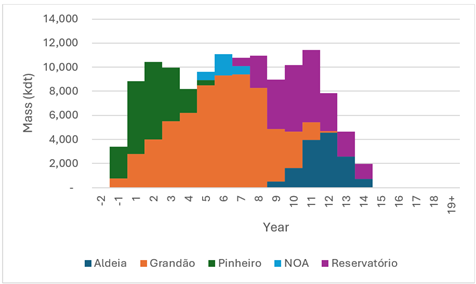
Figure 3‑1- Mining Sequence Overview
MINING MASS MOVEMENTS
Annual material movement varies throughout the mine life, peaking at 17.4 Mt in year 15, although this movement corresponds to waste backfilled from the waste dumps into the pits for rehabilitation and closure purposes. Pit mining movements peak at 11.4 Mt in year 11.
The total LOM mining inventory is 20.6 Mt at 0.98% Li2O, with total waste mined of 107.8 Mt, which represents a LOM strip ratio ('S.R.') of 5.2:1 (waste: ore) and can be considered among the best within the global hard rock open pit lithium mining industry. Figure 3‑2 depicts the total material moved throughout the Project's life.
The LOM schedule incorporates immediate and progressive backfilling of every pit as soon as enough area becomes available as mining finishes in localized stages, starting with Pinheiro, Grandão and NOA pits in year 5. Reservatório and Aldeia pits are the last ones where backfilling starts in line with the mining sequence.
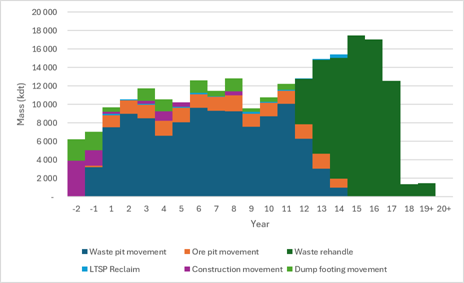
Figure 3‑2- LOM Total Material Moved
Figure 3‑3 shows the ex-pit ore and waste mass moved, as well as how the S.R. varies along the life of mine.
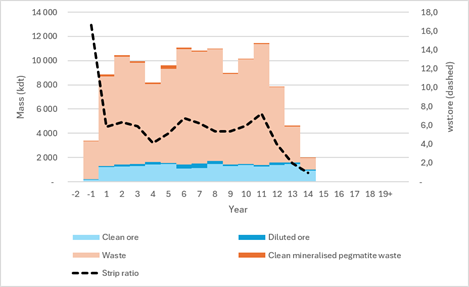
Figure 3‑3- LOM Ex-pit Ore, Waste Movement and Strip Ratio.
PROCESS PLANT ORE FEED
Ore feed is maintained at 1.5 Mt per annum, with the exception of years 1 and 14 of operations which correspond to ramp up and ramp down periods. Figure 3‑4 shows the feed grade profile throughout the life of mine.
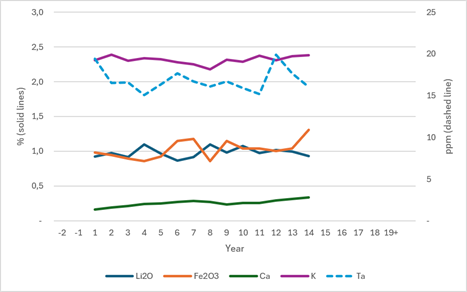
Figure 3‑4- LOM Feed Grade Profile
Gangue elements present in the ore fed through the plant are not expected to have a material impact on processing performance and can be removed throughout the different spodumene concentration stages.
ORE STOCKPILING
A ROM pad will be established where incoming ore from the pits can be stockpiled in a set of "fingers" differentiated by a defined ore quality classification. This arrangement allows for ore blending capabilities when feeding the primary crusher via front end loaders. Figure 3-5 shows a depiction of the skyway (the running platform where mining trucks will circulate on to deposit ROM ore) and ROM pad from the project's 3D model, followed by figures 3-6 and 3-7 which show the ore mass balance on stock per year and the correspondent stockpile's grade during the life of mine respectively.
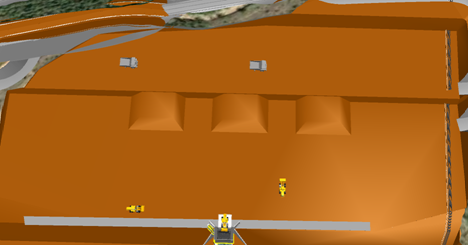
Figure 3‑5- Skyway and ROM PAD
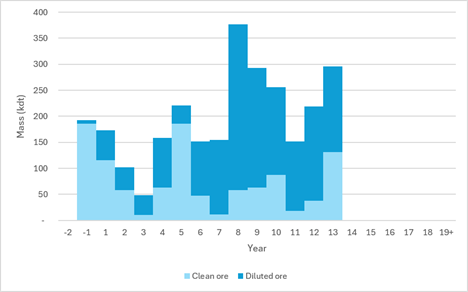
Figure 3‑6- Yearly Stockpile Tonnes Balance
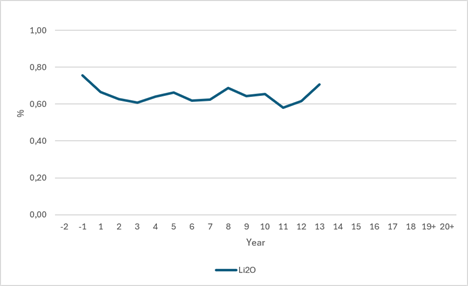
Figure 3‑7- LOM Stockpile Grade Profile
4. METALLURGY
Extensive metallurgical testwork was conducted since 2017 through reputable and very experienced laboratories in Australia such as ALS and Nagrom, two of the leading firms in metallurgical testwork, particularly in lithium spodumene. Testwork executed includes (and is not limited to) ore amenability to gravity separation, DMS pre-concentration, variability, magnetic separation, mica and spodumene flotation, comminution, locked cycle among others; ensuring the robustness of the selected flow sheet and process plant basis of design for the project.
The metallurgical testwork supports the selected DFS flowsheet, which is designed to produce a lithium spodumene concentrate product with a target grade of 5.5% Li2O. Dense Media Separation ('DMS') pre-concentration provides an effective upgrade to the flotation feed and reduces downstream mass, while flotation testing has shown that product grade can be achieved across the tested ore composites. The most important design change arising from the variability programme which has been completed, was the increase in target grind size from 106 µm to 150 µm, which improved global recovery by reducing losses to slimes and magnetic streams while maintaining acceptable flotation performance.
PROCESS FLOW SHEET AND METALLURGICAL STRATEGY
The finalised process flowsheet is designed to manage variability in lithium grade, mica content, iron-bearing minerals, slimes generation and ore texture. The flowsheet includes crushing and screening, DMS pre-concentration, grinding, desliming, magnetic separation, mica flotation, spodumene flotation and dewatering. The process produces spodumene concentrate and four tails or by-product streams: DMS floats, combined process tails from fines and magnetics, mica concentrate and spodumene flotation by-product.
The flowsheet selection was guided by a requirement to avoid strong acids and bases, use environmentally acceptable reagents (REACH certified) as per European and Portuguese regulations and in line with Savannah's commitment to a sustainable operation, and to ensure the process could be operated with flexibility across deposits and mining stages. DMS was retained because it provides pre-concentration and reduces variability to flotation. Magnetic separation was retained to manage iron contamination risk and to improve flowsheet flexibility under higher dilution scenarios. Mica flotation was selected as the most effective step to remove mica and other deleterious gangue minerals before spodumene flotation. Figure 4‑1shows the processing flow sheet diagram.
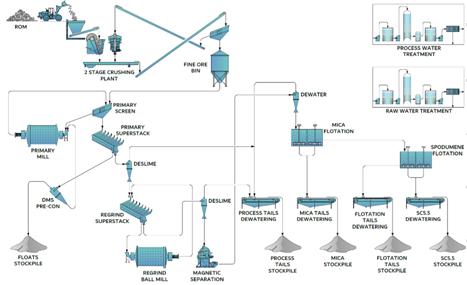
Figure 4‑1- Barroso Lithium Project Flow Sheet Diagram
SPODUMENE CONCENTRATE STREAM
Spodumene concentrate is produced after rougher and cleaner flotation stages, which is upgraded through multiple cleaning stages before obtaining the final product.
Typical expected spodumene specifications are presented in Table 4‑1- Typical Spodumene Concentrate Specifications.
Table 4‑1- Typical Spodumene Concentrate Specifications
|
Parameter |
Units |
Design |
Range |
Particle |
Cumulative |
Variation |
||
|
Min |
Max |
|||||||
|
Moisture |
wt.% |
8 |
7 |
9 |
1000 |
um |
100 |
±15% |
|
Li2O |
wt. % (dry) |
5.50 |
5.40 |
6.00 |
850 |
um |
100 |
|
|
SiO2 |
wt. % (dry) |
62.00 |
59.00 |
66.00 |
600 |
um |
100 |
|
|
Al2O3 |
wt. % (dry) |
26.00 |
22.00 |
30.00 |
425 |
um |
100 |
|
|
Fe2O3 |
wt. % (dry) |
0.75 |
0.40 |
1.10 |
300 |
um |
100 |
|
|
MgO |
wt. % (dry) |
0.10 |
0.01 |
0.40 |
212 |
um |
96 |
|
|
CaO |
wt. % (dry) |
0.60 |
0.20 |
1.00 |
150 |
um |
80 |
|
|
Na2O |
wt. % (dry) |
0.50 |
0.20 |
1.10 |
125 |
um |
69 |
|
|
K2O |
wt. % (dry) |
1.50 |
0.40 |
2.00 |
106 |
um |
59 |
|
|
TiO2 |
wt. % (dry) |
0.10 |
0.00 |
0.35 |
90 |
um |
47 |
|
|
P2O5 |
wt. % (dry) |
0.90 |
0.50 |
1.50 |
75 |
um |
37 |
|
|
MnO |
wt. % (dry) |
0.07 |
0.05 |
2.00 |
63 |
um |
29 |
|
|
S |
wt. % (dry) |
0.02 |
0.00 |
0.10 |
38 |
um |
12 |
|
|
LOI |
wt. % (dry) |
1.50 |
0.50 |
2.00 |
20 |
um |
4 |
|
KEY BY-PRODUCT AND TAILINGS STREAMS
The process produces several potentially saleable or separately manageable by-product and tailings streams. These streams are important for tailings handling, water recovery, potential by-product revenue and environmental management. DMS floats represent the coarsest by-product and the second largest by volume. The flotation by-product is the largest by-product stream by annual mass and is comparable to a feldspathic sand, with lower alkali content and relatively low impurities, making it suitable for sand-type applications. Fines and magnetics are currently considered as a combined process tails stream in the plant design, although they can be reviewed independently for market assessment. However, separating fines and magnetics in the plant would require additional thickening and filtration equipment and therefore additional capital cost.
Table 4‑2- Key By-products Production Data
|
Stream |
Typical annual production |
P80 |
Moisture content |
Key comments |
|
DMS floats |
~313 ktpa |
2,300-2,600 µm |
9-11% |
Coarsest by-product; dewatered by screen before stockpiling. |
|
Fines |
~146 ktpa |
20 µm |
15-20% |
Produced through desliming; may increase in more weathered material. |
|
Magnetics |
~30 ktpa |
150 µm |
15-20% |
Generated by Wet High-Intensity Magnetic Separator ('WHIMS'); rate varies with iron feed grade. |
|
Mica concentrate |
~174 ktpa |
140 µm |
11-15% |
Production varies with mica content; mass reporting averages approximately 10%. |
|
Flotation by-product |
~626 ktpa |
140 µm |
11-15% |
Largest by-product stream; mass reporting averages approximately 40%. |
MAJOR TESTWORK PROGRAMMES
The DFS metallurgy basis is supported by a substantial testwork database built up over a number of years. The key programmes include early gravity and flotation investigations, pilot campaigns, flowsheet development, variability testing, locked-cycle testing and ongoing low-grade and temperature-related flotation assessments. The programmes most directly supporting the DFS process design are T2922, T3032 and T3070.
Table 4‑3- Summary of Principal Metallurgical Testwork Programmes
|
Program |
Period |
Purpose |
DFS relevance |
|
T2922 |
2021-2022 |
Flowsheet development using Grandão ore. |
Established DMS, mica flotation, environmentally acceptable reagent regime, desliming and magnetic separation basis. |
|
T3032 |
2022-2024 |
Variability testing across first 10 years of planned mine feed. |
Validated flowsheet across deposits, assessed grind size and generated products/by-products. |
|
T3070 |
2022 |
Locked-cycle testing using Grandão Stage 1 composite. |
Confirmed flotation robustness under recycle conditions and supported reagent optimisation. |
|
T3496 |
2024-2025 |
Low-grade and ore-grade flotation performance variability; flotation temperature assessments. |
Work to support mine plan optimisation and processing of lower grade periods. |
FLOWSHEET DEVELOPMENT OUTCOMES
The T2922 flowsheet development programme focused on identifying a practical, robust and environmentally acceptable process route. The programme confirmed that DMS pre-concentration should be included to improve downstream feed quality and provide operating flexibility. Mica flotation was selected over coarse rejection methods because the fine grain size of mica and other deleterious minerals made pre-flotation removal more effective. Site water quality was found to be favourable, with low concentrations of elements that commonly complicate spodumene flotation, such as calcium and magnesium.
Main outcomes included:
· A suitable flotation reagent regime that uses no strong acids or bases was identified.
· DMS was selected to upgrade flotation feed grade and improve the circuit's ability to handle feed variation.
· Pre-flotation mica removal was confirmed as necessary to manage concentrate grade.
· Magnetic separation was included to manage iron-bearing contamination and improve flexibility.
· A 20 µm deslime cut was adopted to manage slimes before flotation.
The outcomes formed the basis for the subsequent variability programme.
COMMINUTION DESIGN BASIS
Comminution testing was undertaken on 10 ore composites representing the first 10 years of the mine plan, together with internal and external waste samples. Design values were selected using the 75th percentile of measured results to provide a conservative basis for plant design. The ore is harder and more abrasive than the waste material, and blending may be required to manage localised harder or more abrasive zones.
|
|
||||
|
Parameter |
Units |
Design value |
Executive interpretation |
|
|
Loose bulk density, P100 19 mm |
t/m³ |
1.55 |
Used for materials handling and storage design. |
|
|
Packed bulk density, P100 3.35 mm |
t/m³ |
1.85 |
Supports DMS feed and stockpile design assumptions. |
|
|
Solids SG |
- |
2.72 |
Core density input for process design. |
|
|
Bond Crushing Work Index |
kWh/t |
17.5 |
75th percentile value; indicates potential need for blending in hard ore zones. |
|
|
Bond Ball Mill Work Index |
kWh/t |
14.8 |
Selected design value above ore average. |
|
|
Bond Abrasion Index |
- |
0.29 |
75th percentile value; informs wear and media assumptions. |
|
Table 4‑4- Key Comminution Design Parameters
VARIABILITY PROGRAMME RESULTS
The T3032 variability programme tested the selected flowsheet across ore composites representing the expected first 10 years of mining. The programme confirmed that the process can produce saleable concentrate grade across tested composites, but also highlighted variability linked to head grade, aplitic material, mica content and particle size response.
· DMS Performance
DMS testing was conducted at a target SG cut point of 2.65. The DMS stage rejected approximately 23.2% of global mass on average, with an average global Li2O loss to floats of 4.3%. The lower-grade and more aplitic composites generally showed poorer DMS performance, reflecting finer spodumene liberation and higher lithium losses to floats.
Table 4‑5- DMS Global Performance Summary
|
Metric |
Average result |
Implication |
|
Flotation preparation feed upgrade |
124.8% |
DMS materially upgrades the feed reporting to downstream flotation. |
|
Global mass to floats |
23.2% |
Significant mass rejection before grinding and flotation. |
|
Global Li2O to floats |
4.3% |
Low average lithium loss relative to mass rejected. |
|
Global Fe2O3 to floats |
10.5% |
Partial rejection of iron-bearing gangue. |
|
Global Rb to floats |
31.0% |
Supports rejection of mica-related material before flotation. |
· Flotation Performance
Flotation testing showed that the selected flowsheet can achieve commercial product grade across all 10 composites at the 106 µm base case. However, global recovery was lower than desired due to preparation losses during grinding, desliming and magnetic separation. The flotation stage itself was generally strong, with low-grade rougher tails and stage recoveries typically in the range of approximately 87% to 93% for non-outlier composites. Losses to mica concentrate were often more significant than losses to spodumene rougher tails, emphasising the importance of controlling mica content and reagent dosing.
· Grind Size Optimisation
The grind size investigation was one of the most important outcomes of the variability programme. Increasing the grind from 106 µm to 150 µm reduced losses to slimes and magnetic separation, improved recovery to flotation feed, reduced energy requirements, and improved dewatering characteristics.
Table 4‑6- Grind Size Comparison
|
Metric |
106 µm |
150 µm |
212 µm |
Executive interpretation |
|
Average Li2O losses to slimes |
9.8% |
7.1% |
4.9% |
Coarser grind reduces overgrinding and slimes losses. |
|
Average Li2O losses to magnetics |
8.0% |
6.0% |
4.4% |
Coarser grind reduces magnetic separation losses. |
|
Average recovery to flotation feed |
77.9% |
82.6% |
86.4% |
Preparation recovery improves materially with coarser grind. |
|
Average global recovery to SC5.5 |
66.5% |
75.3% |
70.7% |
150 µm provides best overall balance for design. |
|
Adjusted average global recovery to SC5.5 |
71.6% |
75.3% |
79.5% |
Some samples may benefit from coarser operation, but 150 µm remains the practical design case. |
Although 212 µm further reduced preparation losses, flotation efficiency dropped for several samples, making 150 µm the preferred design compromise.
LOCKED-CYCLE TEST RESULTS
The locked-cycle programme was undertaken on a composite representative of Grandão Stage 1 to assess the impact of recycled solids and filtrate on flotation performance, demonstrate repeatability, optimise reagent dose rates and generate representative products and tails streams. The locked-cycle tests confirmed that the selected flotation conditions are robust and can maintain product grade and high recovery under recycle conditions with a minimum 77.7% Li2O reporting into the spodumene concentrate.
The LCT programme also demonstrated reagent optimisation potential. LCT 2 achieved a 27.5% collector dose reduction while maintaining recovery, and LCT 3 achieved a 43% collector dose reduction in the final five stages under a higher filtrate recycle scenario. The results indicate that reagent build-up in the water circuit may reduce fresh reagent demand, although this needs to be managed carefully through plant water chemistry monitoring and water treatment work.
Table 4‑7- Locked Cycle Global Results
|
Test |
DMS floats Li2O recovery |
Slimes Li2O recovery |
Mags Li2O recovery |
Mica cons Li2O recovery |
Rougher tails Li2O recovery |
SC5.5 Li2O recovery |
|
Sighter |
2.5% |
2.1% |
2.0% |
11.0% |
1.1% |
81.4% |
|
LCT 1 |
2.5% |
2.1% |
2.0% |
10.7% |
1.3% |
81.5% |
|
LCT 2 |
2.6% |
2.2% |
2.1% |
8.6% |
2.8% |
81.8% |
|
LCT 3 |
2.5% |
2.1% |
2.0% |
13.6% |
2.1% |
77.7% |
GLOBAL GRADE RECOVERY CURVE
A global grade recovery curve has been produced for a target 5.5% Li2O grade product based on all data gathered from the metallurgical testwork programme, with adjusted curves for target 5.2% and 5.8% Li2O grade also included (see Figure 4‑2)
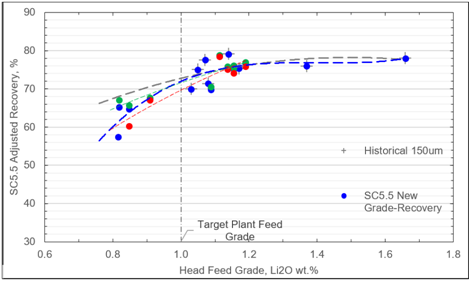
Figure 4‑2- Global Grade Recovery Curve
5. PROCESSING
BASIS OF DESIGN
The processing plant is designed for throughput rate of 1.5 Mtpa of lithium pegmatite ore, with an average feed grade of 1.0% Li2O. The design assumes a feed moisture level of 3% and includes comminution parameters derived from testwork (crushing work index 17.5 kWh/t, ball mill work index 14.8 kWh/t, abrasion index 0.29). The plant is designed to produce approximately 206 ktpa of spodumene concentrate at a minimum grade of 5.5% Li2O and achieve over 70% Li2O recovery. Crushing utilisation is assumed to be 65% and overall plant utilisation is 85%. Key by-product streams include flotation tails, DMS floats, mica concentrate and process tails, each with defined production rates and moisture contents.
OVERALL PROCESS DESCRIPTION AND LAYOUT
The process plant layout is arranged across terraces following site topography, from ROM pad to dry plant, wet plant, and filtration areas. Material flows from crushing and screening to grinding, classification, DMS, flotation, thickening, and filtration. The layout is designed for efficiency and allows for potential future expansion from 1.5 Mtpa to 3 Mtpa at a significantly lower cost. Supporting infrastructure such as reagent storage and water treatment is integrated within the plant footprint. Figure 5‑1 shows a 3D model view of the process plant and filter building infrastructure.
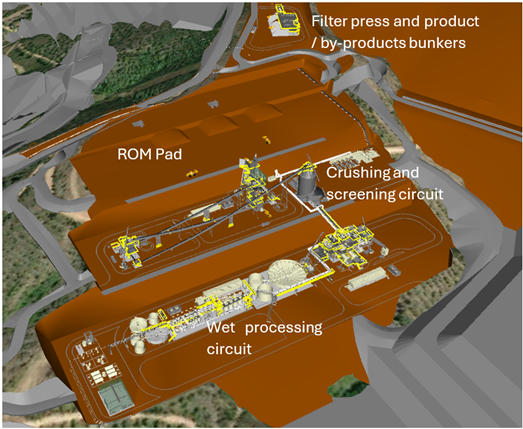
Figure 5‑1- Process Plant and Filter Press Buildings Model
CRUSHING CIRCUIT
In Stage 1, ROM ore is fed to a primary jaw crusher via a ROM bin with static grizzly. The crushed product is screened, with oversize reporting to a secondary cone crusher. The final crushed product (P80 of ~14 mm) is stored in a 3,600 t fine ore bin ahead of milling. Dust suppression, magnets, and enclosed structures are included for operational safety, equipment protection and to minimise environmental and social impact. The layout allows for a Stage 2 expansion for increased throughput (3 Mtpa) which would require a second cone crusher, modifying screen apertures and material flow and additional fine ore storage capacity.
COMMINUTION AND CLASSIFICATION
The primary milling circuit operates in closed circuit with screens (2.8-3.35 mm aperture). Screen oversize feeds the primary ball mill, while undersize is further classified using superstack screens. Coarse material feeds the DMS circuit, while fine material is deslimed using cyclones to remove particles below 20 µm. Secondary grinding is followed by further classification to achieve a target P80 of approximately 150 µm.
DENSE MEDIA SEPARATION (DMS)
The DMS circuit separates material based on density, using ferro-silica medium at a target cut density of 2.65. Heavier spodumene-rich material reports to the sinks stream, while lighter gangue material reports to floats. A medium recovery systems, including densification, magnetic separation, and water recovery stages will allow recycling of the ferro-silica. DMS floats are conveyed to stockpile or disposal, while the spodumene-rich sinks are returned to the grinding circuit.
FLOTATION PREPARATION
Following grinding and desliming, magnetic separation is applied to remove ferromagnetic material and protect downstream equipment. Wet high intensity magnetic separators ('WHIMS') further separate magnetic fractions. Non-magnetic material is directed to the mica flotation circuit, where onstream analysers are used to monitor feed composition and control reagent dosing.
MICA FLOTATION
Mica flotation removes mica and other gangue minerals prior to spodumene flotation. Conditioning involves pH control (pH ~8), depressant dosing (dextrin), and collector addition. Rougher and cleaner flotation stages are used, with tails processed to remove residual reagents before entering spodumene flotation. Continuous sampling and analysis are used to optimise performance and minimise lithium losses.
SPODUMENE FLOTATION
Conditioned slurry flows through rougher and cleaner flotation stages. Concentrate from rougher and cleaner stages is upgraded through multiple cleaning stages before final concentrate is produced. Tailings are directed to thickening. The circuit is designed for flexibility, allowing gravity flow and recirculation of intermediate streams.
CONCENTRATE AND TAILINGS HANDLING
Spodumene concentrate is dewatered using cyclones and filtration, then stockpiled for transport. Tailings streams (flotation, mica, and process tails) are thickened and dewatered using filters. Process tails are handled via a filter press due to a high slimes content. All process areas are bunded, and spill recovery systems return material to the process.
WATER TREATMENT PLANT
The Project includes an industrial water treatment system designed to manage water streams from the process plant and water recirculated from reservoirs, with the objective of maximising water reuse within the processing plant and minimising the need for controlled discharge.
The treatment philosophy is based on the collection and equalisation of affected water streams, followed by appropriate physical, chemical and polishing treatment steps to reduce suspended solids, organic load, hardness, and other relevant constituents to levels suitable for process water reuse and/or controlled discharge, where applicable.
Indicative treatment performance criteria have been developed based on the expected influent water quality and the process water requirements of the plant. These criteria indicate that the system is expected to achieve a high level of suspended solids removal, together with reductions in organic carbon, hardness, iron, manganese, silicon and other relevant parameters. The treated water quality will be further confirmed during detailed engineering, based on additional water quality data, vendor design, operational testing and applicable permitting requirements.
Treated water will preferentially be returned to the process water circuit. Any surplus water, where not reused, will be managed in accordance with the Project's water management strategy and applicable regulatory discharge requirements.
REAGENTS
Reagents are stored and handled in dedicated facilities, including bulk storage tanks and batching systems. Key reagents include soda ash, sodium silicate, oleic acid collectors, tallow amine (mica collector), flocculants, coagulants, ferro-silica magnetite and frothers. Reagent preparation and dosing systems are designed for continuous operation and flexibility, with bunding for spill containment. Reagents will comply with applicable are REACH requirements and will be managed under approval storage, handling, spill-control and environmental procedures.
UTILITIES AND INFRASTRUCTURE
Compressed air systems are provided for crushers, wet plant, and filtration, with standby capacity for critical areas. Raw water is sourced from pit dewatering and runoff, stored in the various water reservoirs and distributed for plant use. Water treatment includes dissolved air flotation, ultrafiltration, microfiltration, and reverse osmosis to enable reuse of process water.
Electrical infrastructure includes HV power distribution, substations, motor control centres, and control systems integrated via PLC (Programmable Logic Controller) and SCADA (Supervisory Control and Data Acquisition) based operator interfaces.
CONTROL AND POWER SYSTEMS
The plant is controlled using PLC-based systems with central operator interfaces, enabling monitoring and control of all process areas. Instrumentation includes level, pressure, and flow measurement, with safety systems integrated. Electrical systems include substations, transformers, switchrooms, and field devices designed for mining conditions, with total installed and demand power defined for each process area.
SPODUMENE CONCENTRATE PRODUCTION
The processing infrastructure described above allows the production of a total 2.56 Mt of spodumene concentrate over the project life, at an average of 183,000 tonnes per annum and an overall LOM lithia recovery of 70%. Figure 5-2 shows the yearly projected spodumene production, mass yield percentages and lithia recovery percentages over the life of mine.
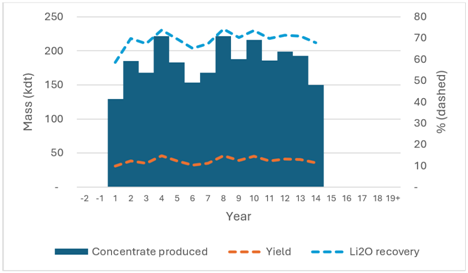
Figure 5‑2- Annual Spodumene Production, Mass Yield and Lithia Recoveries
6. TAILINGS AND WATER MANAGEMENT
6.1. TAILINGS STORAGE FACILITY
The project incorporates a dry stacked Tailings Storage Facility (TSF). The use of filtered tailings is a key design feature that reduces the volume of free water stored in the facility compared with conventional slurry deposition, making it a much more stable and safe option that significantly de-risks harm to people or the environment.
The TSF design objectives include permanent and secure containment of tailings, optimisation of mine waste haulage, reduction of visual, noise and dust impacts, control of runoff and sediment generation, reduction and control of seepage, compliance with applicable Portuguese and international standards, staged constructability, integration with mining and processing operations, and development of a long-term stable landform requiring limited post-closure maintenance.
PROJECT SETTING AND DESIGN BASIS
The local geological setting, nearby open pits and inferred subsurface conditions have strongly influenced the design of the TSF, foundations, embankment materials and water management systems.
The feasibility design has been developed in accordance with Portuguese regulatory requirements for dam safety, extractive waste management and environmental protection, supplemented by relevant Eurocodes and international tailings guidance. The design framework references Portuguese Decree Laws governing dam safety, extractive waste and water quality, Eurocode 7 for geotechnical design, ANCOLD guidance, earthquake design guidance and the Global Industry Standard on Tailings Management. Where standards differ, the design adopts the more conservative or stringent requirement to provide an appropriate level of safety, reliability and long-term performance.
TAILINGS STORAGE FACILITY CONCEPT
The TSF is designed as an integrated storage landform to contain approximately 13.4 Mt of filtered tailings and mine waste rock over the life of mine. The facility is located near the process plant to reduce pumping and haulage distances, while taking advantage of adjacent mine waste sources for embankment construction and staged development. The design incorporates a central tailings storage area bounded by perimeter embankments, stormwater diversion channels, an underdrain system, liner systems, environmental control dams, haul roads and operational access routes.
Filtered tailings will be transported from the process plant and filter building by truck. Tailings will be placed, spread and compacted by mobile equipment in staged lifts. The preferred placement approach divides the facility into four operational cells, allowing progressive filling, compaction, water management and closure shaping. This approach supports operational flexibility while maintaining separation between active tailings placement areas, stormwater collection infrastructure and embankment construction activities.
The TSF embankments are designed as zoned rockfill structures, using mine waste rock sourced principally from the Grandão pit. The design uses rockfill shoulders, lower-permeability transition zones and foundation preparation measures to provide structural stability, manage seepage and support progressive construction. Initial starter embankments are planned to be raised over time as the tailings landform develops. The final TSF configuration includes upstream and downstream slopes designed to meet long-term stability requirements, with benches and ramps to facilitate operation, inspection, maintenance and closure works.
Figure 6‑1 shows a TSF overview from the project's 3D model at its full height.
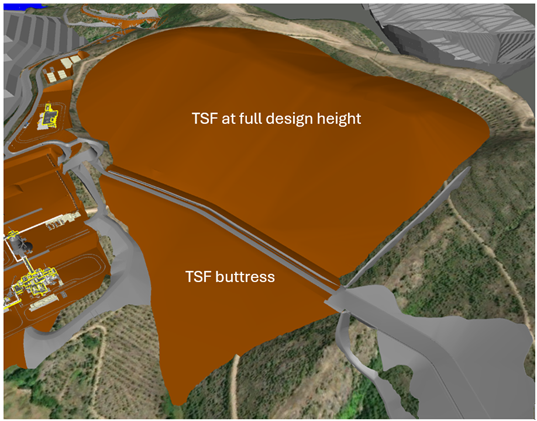
Figure 6‑1- Tailings Storage Facility and Buttress
GEOTECHNICAL, SEISMIC AND STABILITY CONSIDERATIONS
The feasibility design incorporates site investigation data, laboratory testing, geotechnical interpretation and slope stability assessment. Foundation conditions generally comprise topsoil and residual soils over weathered rock, with stronger schist and granite at depth. Foundation preparation is required beneath embankments and key infrastructure, including stripping of unsuitable materials, excavation of shallow soils where needed, foundation cleaning and local treatment of weak or saturated areas. These measures are intended to provide competent founding conditions and reduce the potential for differential settlement, instability or uncontrolled seepage pathways.
The project area is located within a region of moderate seismic hazard. The design therefore includes both operating basis and maximum design earthquake criteria, with seismic loads applied to stability analyses in accordance with relevant Portuguese, European and international guidance. Stability modelling has considered representative sections through the TSF embankments and tailings mass for static, pseudo-static and post-closure conditions. The analyses indicate that the planned embankment and tailings configurations can achieve the required factors of safety, provided that specified material properties, compaction standards, foundation preparation and water management measures are implemented during construction and operation.
The use of filtered tailings is a key design feature that reduces the volume of free water stored in the facility compared with conventional slurry deposition. The performance of filtered tailings depends on achieving appropriate moisture content, placement thickness, compaction and trafficability. Hence, operational controls will be put in place to manage key parameters including tailings density and pore pressure, to maintain surface drainage and protect the integrity of the liner and underdrainage systems. Furthermore, comprehensive construction quality assurance and ongoing surveillance will be used to confirm that the design assumptions are achieved.
Stability assessments of the TSF were developed to verify that the embankment design complies with the Eurocode 7: Geotechnical Design (EN 1997-1:2004) (Ref. 27) and the Technical Supporting Documents for Dam Safety Regulation (RSB), 1st Edition (Ref. 28), applying the Partial Factor Method as specified in RSB Annex III. Design Approaches 1 and 2 (DA1 and DA2) were adopted, with the following combinations considered:
· DA1 - Combination 1 : A1+M1+R1
· DA1 - Combination 2 : A2+M2+R2
· DA2 - A1+M1+R2
Post-seismic conditions were assessed as an Accidental Design Situation in accordance with RSB Annex III (Ref. 28), with partial factors for accidental limit states applied to both actions and material properties.
The embankment section profile adopted for this assessment represents the critical section of the TSF embankment (where it is at its greatest height), selected based on the natural ground topography and the embankment design. The TSF section at Stage Final (Crest elevation RL705 m) was adopted for the assessment. The following loading conditions were assessed:
· Long term drained stability.
· Short term undrained stability using peak undrained strengths
· Pseudo-static condition using residual strengths.
· Post-seismic condition using residual strengths.
The stability analyses were carried out using SLOPE/W software, a limit equilibrium programme. The Morgenstern-Price method was adopted to analyse the embankment stability under the drained, undrained, and post-seismic loading conditions.
Table 6‑1 summarises the TSF stability assessment results.
Table 6‑1- TSF Stability Assessment Results
|
Case |
Section |
Loading Condition |
Target FoS |
Achieved FoS |
||
|
DA1C1 |
DA1C2 |
DA2 |
||||
|
1 |
Slip surface through the |
Static (long-term) |
1.0 |
1.92 |
1.47 |
1.74 |
|
Static (short-term) |
1.0 |
1.92 |
1.45 |
1.74 |
||
|
Pseudo-static |
1.0 |
1.01 |
1.01 |
1.01 |
||
|
Post-earthquake |
1.0 |
1.45 |
1.45 |
1.45 |
||
|
2 |
Slip surface through |
Static (long-term) |
1.0 |
2.20 |
1.65 |
2.00 |
|
Static (short-term) |
1.0 |
2.20 |
1.65 |
2.00 |
||
|
Pseudo-static |
1.0 |
1.52 |
1.32 |
1.52 |
||
|
Post-earthquake |
1.0 |
2.19 |
2.19 |
2.19 |
||
|
3 |
Slip surface through |
Static (long-term) |
1.0 |
2.34 |
1.85 |
2.12 |
|
Static (short-term) |
1.0 |
1.78 |
1.43 |
1.61 |
||
|
Pseudo-static |
1.0 |
1.00 |
1.00 |
1.00 |
||
|
Post-earthquake |
1.0 |
1.68 |
1.68 |
1.68 |
||
The analyses indicate that the tailings embankment have an adequate factor of safety for the assessed loading condition.
TSF WATER MANAGEMENT AND ENVIRONMENTAL CONTROLS
The TSF includes a composite liner system, underdrainage network and perimeter drainage controls to reduce seepage, collect infiltration and manage operational contact water. The underdrain system is designed to intercept water that drains from the filtered tailings and convey it to collection points for return to the process water circuit or environmental control reservoirs. This design supports both water recovery and environmental protection by limiting uncontrolled discharge from the tailings storage area.
Environmental control reservoirs are included to manage runoff and seepage from disturbed catchments, including the TSF and process plant areas. These structures provide temporary storage, sediment control and operational flexibility during storm events.
GEOCHEMISTRY AND MATERIALS MANAGEMENT
Geochemical characterisation indicates that most tested mine waste and tailings materials are likely to have low acid generation potential, with many samples classified as non-acid forming. However, some material variability is present, and certain geological units may require controlled handling depending on their sulphide content, neutralisation capacity and leachate characteristics. The materials management strategy therefore requires ongoing geochemical classification, selective placement where necessary and integration with the TSF construction sequence.
Mine waste rock is a principal construction material for embankments, access roads and other infrastructure. Its suitability depends on gradation, strength, durability, weathering state and potential for geochemical interaction with water. The feasibility design assumes that suitable rockfill can be sourced from mine development, particularly from the Grandão pit, but recommends confirmation during detailed design and early construction through additional testing and field trials. Construction specifications should define material zones, compaction requirements, moisture controls and quality assurance procedures.
Filtered tailings behaviour will be influenced by particle size distribution, moisture content, compaction effort and operational handling. Tailings testing and deposition trials are important to confirm achievable dry density, shear strength, permeability, trafficability and settlement behaviour. These parameters are fundamental to the long-term stability and closure performance of the TSF. The operational plan will include routine monitoring of placed tailings moisture content and compaction, supported by clear acceptance criteria and corrective actions.
6.2. SURFACE WATER MANAGEMENT
The water supply and management strategy for the Barroso Lithium Project focuses on balancing the total consumption demands of the project with robust water containment, treatment, and recirculation capabilities. The strategy is centred around a network of surface water management ('SWM') structures designed to minimise environmental impacts and comply with domestic Portuguese and European standards.
The primary objectives of this integrated SWM infrastructure include:
· Flood Control & Containment: Managing stormwater inflows to prevent overtopping and uncontrolled discharge.
· Resource Pooling: Gathering water to fulfil the project's operational and processing plant demands.
· Recirculation & Treatment: Maximising the recycling of process water and implementing environmental control of contact/polluted waters.
· Controlled Diversion & Discharge: Separating non-contact clean water from disturbed contact water using a combination of surface channels, levees, pipelines, low-level bottom outlets, and emergency spillways.
To manage surface water effectively, the project site is partitioned into four distinct operational sub-areas surrounding the major open pits, namely Grandão System, Pinheiro System, Reservatório System and Aldeia System. Each system was evaluated under two developmental milestones to identify critical design loads: the Preliminary Development Stage (initial clearing, grubbing, and early pit excavation) and Stage Final (where all mine infrastructure, waste rock dumps, and tailings storage facilities are fully built out).
Figure 6‑2 shows a general overview of the C-100 block water reservoirs from the project's 3D model.
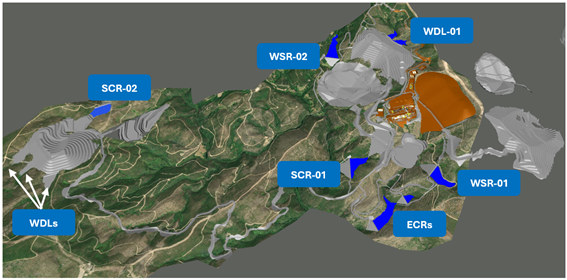


 Figure 6‑2- 3D Representation of C-100 Water Reservoirs
REGULATORY FRAMEWORK AND BASIS OF DESIGN
The design of the SWM structures is governed by strict compliance with Portuguese legislative frameworks, dam safety regulations, and internationally recognised best-practice guidelines. Where standards differ, the most conservative assumptions have been adopted to guarantee a high margin of safety. The design conforms to the following guidelines and legal decrees:
Decree-Law No. 344/2007 & Decree-Law No. 21/2018, which govern Portuguese dam safety regulations, including compulsory low-level outlet works for controlled drawdown and flow control.
· Eurocode 7 (EN 1997-1), which regulates geotechnical design standards.
· ANCOLD Guidelines (2019) & The Global Industry Standard on Tailings Management ('GISTM'): For international mining and water stewardship compliance.
· U.S. Bureau of Reclamation Design Standards No. 13: For embankment dam benchmarks
CORE SIZING AND RETURN PERIOD CRITERIA
A set of criteria were followed for sizing of reservoirs and spillways as follows:
· Spillways & Conveyance: According to Decree-Law No. 21/2018, any reservoir with a storage capacity equal or greater to 100,000 m3 must be sized for a minimum return period of 500 years. However, Technical Supporting Documents from the Portuguese Environment Agency mandate that Class I or Class II dams between 15 m and 50 m in height must convey a 1,000-year Average Recurrence Interval ('ARI') flood event, which supersedes the 500-year standard.
· Operational Capacity: Environmental Control Reservoirs ('ECRs') and Sediment Control Reservoirs ('SCRs') must completely contain a 100-year ARI, 72-hour storm event assuming an initially empty basin, preventing uncontrolled discharge during major storms.
DAM CLASSIFICATION AND HAZARD CLASSIFICATION
Dams are classified into Classes I, II, or III based on a permanent residential population impact variable (Y) and a hazard factor (X), calculated as:
X = H2 * 
where H is the dam height and V is the dam volume in hm3. Breach flow path assessments conducted by Knight Piésold identified zero permanent residences at risk (Y = 0). However, due to the absence of a detailed population survey at this stage, a conservative value of Y > 0 was adopted. As X < 1,000 for all structures, all major reservoirs are classified as Class II.
ENGINEERING AND GEOTECHNICAL SPECIFICATIONS
Embankment parameters are standardised to balance structural safety with cut/fill efficiency. The following key factors are included:
· Crest Configuration: 8-metre crest widths including integrated safety berms.
· Freeboard: Minimum of 1.0 m above the maximum water surface elevation during a 1,000-year ARI flood.
· Slopes: Upstream faces are engineered at a gradient of 2.0H:1V and downstream faces are placed at 2.5H:1V.
· Material Selection: Main bodies are constructed as homogenous rockfill derived from mine waste rock, compacted in layers by the mining fleet.
Water loss and piping are mitigated via a high-performance composite lining system applied to the upstream embankment faces as summarised below:
· Lining Profile: A coated Geosynthetic Clay Liner ('GCL') composed of sodium bentonite encapsulated between geotextiles is overlain by a 1.5 mm thick polyvinyl chloride (PVC) geomembrane.
· Basin Linings: An ECR basin is completely lined to avoid ground infiltration and seepage of polluted water from the ore processing facility. SCRs, WSRs, and Water Diversion Levees (WDLs) utilise cleared, stripped, and proof-rolled in-situ subgrades.
· Compliance: Materials and installation processes adhere to European standards EN 13361 and EN 14196.
Several measures are implemented to cater for foundation treatment and seepage detection, including:
· Dental Concrete: Used to seal fissures, voids, and cavities in exposed competent rockheads, establishing a low-permeability foundation and anchor trenches. A continuous capping layer (minimum 150 mm thick) seals weak or erodible fault zones.
· Basin Recovery System: Implemented beneath the lining of ECRs, featuring a fishbone network of graded sand mattresses and gravel transverse finger drains that passively route trapped seepage away via gravity to alleviate uplift pressures.
· Emergency Low-Level Outlets: A 600 mm HDPE drawdown pipe backfilled with reinforced concrete is situated within a basin sump, equipped with a gate valve and an integrated flow meter to allow complete emergency evacuation.
OPERATIONAL CATCHMENT SYSTEMS
GRANDÃO SYSTEM
Designed strictly around the Stage Final footprint, this system diverts a 3.3 km2 undisturbed upstream catchment area away from the Grandão Pit and Waste Rock Dump ('WRD'). Surface water management infrastructure in this system is comprised of:
· WDL-01: A water diversion levee that attenuates a 0.95 km2 catchment. It features an 18.5 m crest height, a 260 m crest length, and a 500-year ARI spillway. It drains completely between events via gravity through a buried 1,200 mm HDPE pipeline running 0.72 km northwest, discharging into WSR-02.
· WSR-02: A water storage reservoir acting as the terminal collection unit, accumulating runoff from WDL-01 and an additional 2.25 km2 catchment. It stands 30.4 m high with a storage volume of 427,600 m3. Its 1,000-year ARI spillway channel stretches 815 m to return clean water safely into the Covas River downstream of the Grandão pit.
PINHEIRO SYSTEM
This system undergoes major transformations between developmental stages, capturing sediment-heavy runoff from the TSF, Pinheiro Pit, WRD, and operational pads.
· Initial Stage Pit Utilization: Topographic constraints limit the initial storage capacity of ECR-02. To satisfy containment regulations, the Pinheiro Pit will be excavated early during the dry season to serve as temporary containment for heavy stormwater events until the WRD is fully established.
· Diversion Channels (DC-P-01 to 03): DC-P-01 runs along the TSF buttress crest and is completely lined with 1.5 mm PVC to stop water ingress into the tailings mass. DC-P-03 routes these flows around the Pinheiro WRD into a pipeline discharging near ECR-02.
· WSR-01: A 24.7 m high dam storing 146,700 m3 to keep external runoff out of the Pinheiro Pit and WRD. It acts as a processing, dust suppression, and potable water source.
· ECR-01 & ECR-02: Lined reservoirs with the primary function of storing untreated and treated water from the ore processing plant. ECR-01 holds untreated process water, while ECR-02 stores 442,500 m3 of treated process water for priority recirculation back to the plant via a 152 m3/h pumping system.
· SCR-01: Collects pad runoff and pit dewatering to serve as the plant's primary water source, holding a minimum 10,000 m3 safety pool for dry scenarios.
RESERVATÓRIO SYSTEM
Manages sediment-laden runoff from the NOA Pit, NOA WRD, and Reservatório Pit.
· Upstream Levee Network: Topography restricts the footprint size of SCR-02. Consequently, three upstream Water Diversion Levees (WDL-02, WDL-03, and WDL-04) are integrated directly into the toe of the NOA WRD to temporarily attenuate flows and discharge them down to SCR-02 via independent pipelines.
· SCR-02 & Bund: Comprises a 16.3 m high primary embankment and a 2.7 m high secondary bund to boost basin capacity to 228,000 m3. It treats sediment from the NOA WRD and acts as a water source for local dust suppression.
· Reservatório Pit Containment: No physical room exists downstream for an independent SCR. The Reservatório pit must be developed to maintain internal storage capacity, from which settled water is pumped directly up to SCR-02
ALDEIA SYSTEM
The Aldeia System is situated southeast from the main site and is required to treat sediment laden runoff from:
· Aldeia Pit;
· Aldeia Waste rock Dump; and
· General mining activities within the catchment area.
All sediment laden water for both Initial Stage and Stage Final will be treated through sediment dropout in SCR-03 before being discharged to the Covas River.
GEOTECHNICAL ASSESSMENT
A geotechnical desktop assessment has been conducted based on a wealth of information already available from the project area, including from pit geotechnical drilling and analyses, surface geotechnical mapping and geological records from resource drilling campaigns. Furthermore, a detailed geotechnical investigation in the exact location of the various infrastructure is already under execution and all the designs and stability analyses will be validated upon determining of all relevant geotechnical properties of the ground and construction materials.
From the desktop assessment, it has been established a general site stratigraphy of topsoil (1-2 m), alluvium material near river streams (1-4 m), highly weathered schist/phyllite soil (5-14 m), and a rockhead of moderately weathered rock starting between 6-10 m deep. The following considerations have been taken when designing the structures and conducting stability analyses:
· Foundation Replacement: Saturated or low-strength alluvial layers underneath embankments are stripped and backfilled with engineered rockfill (Zone C).
· Friction Angles: Rockfill body design utilises a drained friction angle of 31° and a post-seismic residual friction angle of 28°.
· Seismic Thresholds: Structures are engineered against a Safety Evaluation Earthquake ('SEE') with a 1:10,000 annual exceedance probability, corresponding to a peak ground acceleration of 0.31g.
HYDROLOGIC CURVE NUMBERS
Stormwater runoff modelling via HydroCAD applied the SCS Curve Number method based on a temperate Mediterranean climate and intermediate antecedent moisture conditions (AMC 2). Table 6 2 summarises such numbers.
Table 6‑2- SCS Curve Numbers
|
Land Use Type |
SCS Curve Number Adopted DOCX |
|
Operation Pads (Terrace) |
90 |
|
Tailings Storage Facility (TSF) Surface |
82 |
|
Natural Catchments / Topsoil Stockpiles |
79 |
|
Waste Rock Dumps (WRD) |
72 |
KEY SWM INFRASTRUCTURE DIMENSIONS AND SIZING PARAMETERS
Table 6‑3 shows a summary of all the reservoirs and levees key dimensions and parameters.
Table 6‑3- SWM Infrastructure Key parameters
|
Structure ID |
Function Type |
Crest Level (mRL) |
Dam Height (m) |
Storage Vol. (m3) |
Critical Design Stage |
Spillway Design Flood (ARI) |
|
ECR-01 |
Process Water |
515.8 |
14.8 |
26,000 |
Stage Final |
1,000-Year |
|
ECR-02 |
Process Water / |
492.0 |
27.3 |
442,500 |
Initial Stage |
1,000-Year |
|
SCR-01 |
Sediment Control |
508.9 |
27.4 |
185,300 |
Stage Final |
1,000-Year |
|
SCR-02 |
Sediment Control |
659.0 |
16.3 |
228,000 |
Stage Final |
1,000-Year |
|
SCR-03 |
Sediment Control |
504.1 |
32.3 |
377,700 |
Stage Final |
1,000-Year |
|
WSR-01 |
Clean Runoff |
592.0 |
24.7 |
146,700 |
Stage Final |
1,000-Year |
|
WSR-02 |
Clean Runoff |
584.2 |
30.4 |
427,600 |
Stage Final |
1,000-Year |
|
WDL-01 |
Flow Attenuation |
629.5 |
18.5 |
0 |
Stage Final |
500-Year |
|
WDL-02 |
Flow Attenuation |
696.7 |
3.6 |
0 |
Stage Final |
100-Year |
|
WDL-03 |
Flow Attenuation |
701.5 |
2.3 |
0 |
Stage Final |
100-Year |
|
WDL-04 |
Flow Attenuation |
711.6 |
5.9 |
0 |
Stage Final |
100-Year |
Note that WDL storage volumes are rated as zero because they feature unobstructed bottom pipe outlets designed to empty the basins completely via gravity after rainfall events.
STRUCTURAL STABILITY, MONITORING AND CLOSURE
LIMIT EQUILIBRIUM STABILITY EVALUATION
Definitive slope stability modelling was performed using SLOPE/W software via the Morgenstern-Price method. Structural verification was completed at the Ultimate Limit State (ULS) adhering to Eurocode 7 and the Portuguese Dam Safety Regulation (RSB) Partial Factor Method.
Across all evaluation criteria, including Design Approach 1 (Combinations 1 & 2), Design Approach 2, rapid upstream drawdown, short-term undrained states, and post-seismic residual testing, all configurations surpassed the statutory minimum target factor of safety ('FoS') i.e. FoS >= 1.0. For instance, long-term steady-state seepage testing achieved minimum safety factors ranging from 1.24 to 1.33 under the highly restrictive DA1C2 parameters and reached up to 1.81 to 2.26 under DA1C1 parameters across the ECR, SCR, WSR, and WDL systems.
SAFETY, MONITORING, AND AUTOMATION INFRASTRUCTURE
To meet Decree-Law No. 21/2018 expectations, a comprehensive site monitoring array is wired directly into the central Supervisory Control and Data Acquisition (SCADA) automated notification system. Monitoring parameters include:
· Pore Pressure Tracking: performed by Vibrating Wire Piezometers (VWPs) embedded within sand layers and sealed with bentonite-cement grout track phreatic surfaces in unlined walls.
· Displacement & Settlement: Dual-axis accelerometers and surface-mounted tiltmeters measure real-time angular orientation (±0.0125% accuracy) to capture early signs of rotational failure. Embankment crest paths are paired with physical survey pins.
· Hydraulics: Manual staff gauges cross-verify automated electronic depth monitors, while inline flow meters audit discharge pipelines.
· Inspection Regimen: Routine visual inspections of slopes for wet spots, tension cracks, or seepage are conducted daily. Formal geotechnical safety audits occur annually, alongside comprehensive dam behaviour reports compiled every 5 years.
CLOSURE, DECOMMISSIONING, AND COMMUNITY INTEGRATION
The ultimate goal of the closure design is to return the project area to a safe, geotechnically stable, non-polluting landform covered in self-sustaining native vegetation.
· Decommissioning Protocol: All ECR, SCR, and WSR reservoirs will be dewatered, built-up internal silt collected and removed, and concrete components broken down for safe disposal inside a designated mine waste dump. Natural drainage paths and catchments will be re-established wherever practical.
· Community Integration: To support local communities during environmental emergencies or periods of drought, the clean water reservoir WSR-02 will remain accessible for firefighting and wildfire relief. Additionally, Savannah plans to construct an open public leisure area adjacent to the reservoir for community use.
6.3. WATER BALANCE
A detailed water balance model was developed for the project as part of the Definitive Feasibility Study, which confirms that total water demand will be satisfied throughout the project life. The model covers the process plant, potable water requirements, Tailings Storage Facility, Environmental Control Reservoirs, Sediment Control Reservoirs, and Water Storage Reservoirs. In addition to confirming the project will have sufficient water to ensure continuous operation, a key objective of the water balance was also to confirm that no uncontrolled or emergency spillway discharges to the Covas River will occur, except where specific controlled discharge provisions are intended.
MODEL OBJECTIVES AND SCOPE
The water balance was developed to establish reservoir filling rates, verify process plant and potable water supply reliability, determine required treatment rates for process water, and define controlled discharge rates needed to avoid uncontrolled spillway releases. The model uses a monthly time step and accounts for rainfall runoff, evaporation, pit dewatering, process plant water demands, tailings seepage, dust suppression, and reservoir operating constraints. Water Diversion Levees were generally excluded from the water balance because their design is governed by hydrologic modelling, although WDL-01 was included as an inflow source to WSR-02.
Three climate scenarios were assessed: average conditions, a 100-year ARI one-year dry sequence, and a 100-year ARI one-year wet sequence. The annual rainfall totals used in the model were 1,649 mm for average conditions, 646 mm for the dry sequence, and 3,394 mm for the wet sequence, with average annual lake evaporation of 1,339 mm. The design storm event referenced for infrastructure resilience is a 100-year ARI, 72-hour storm with rainfall depth of 220 mm.
KEY ASSUMPTIONS AND WATER MANAGEMENT STRATEGY
The model assumes that ECRs and SCRs are not allowed to discharge through emergency spillways, and that water in ECR-02, WSRs, and SCRs is of acceptable quality for controlled discharge to the environment, which is guaranteed by inherent design capabilities or features to each of those reservoirs as follows:
· ECR-02: will receive only excess treated water from the water plant and run-off rain water from its catchment area. There is more than enough retention time by the size of the reservoirs to provide decantation treatment of solids prior to any controlled discharge
· SCR-01: will receive only run-off rain water from its catchment area and water pumped from pit sumps. Like ECR-02, the size of this reservoir also provides more than enough retention time to allow decantation treatment of solids prior to any controlled discharge
· WSR-02: this reservoir only catches clean run-off rain water upstream of Grandão pit, therefore allowing for free overflow discharge as this water doesn't pose a pollution threat to the environment
ECR-01 and ECR-02 are assumed to be emptied to minimum pond level before Year 1 operations begin.
Water supply priority is based on using water already present in the ore, followed by ECR-02 as the minimum raw water source, SCR-01 for additional process plant, dust suppression, and washdown demand, then pit dewatering bores if required, and finally WSR-01 storage as a backup. Seasonal dust suppression demand was reduced during wetter months, including an 80% reduction in December and January, a 50% reduction in October, November, February, and March, and the full 7.23 t/h demand during the remaining months.
PROCESS PLANT WATER SUPPLY FINDINGS
The model concludes that the process plant has adequate water supply throughout the life of mine under all assessed conditions, including the 100-year ARI dry scenario. The plant demand of 142.8 t/h can be supplied by ECR-02, SCR-01, and pit dewatering bores without shortfall. In all scenarios, ECR-02 is the primary supply source, SCR-01 acts as the secondary source, and pit dewatering bores provide additional supply when needed. WSR-01 was identified as a backup supply option but was not required to meet demand, even under the dry scenario.
CRITICAL TREATMENT AND DISCHARGE REQUIREMENTS
Table 6‑4 summarises the functions and critical requirements of reservoirs for the C-100 concession.
Table 6‑4- Functions and Critical Requirements of Reservoirs
|
Facility |
Function |
Maximum requirement under wet scenario (100yr ARI) |
|
ECR-01 |
Stores contaminated process water before treatment |
Process water treatment rate of 162 t/h |
|
ECR-02 |
Stores treated process water for recycle or controlled discharge |
Controlled discharge to Covas River of 486 t/h |
|
SCR-01 |
Receives surface water runoff from Grandão and Pinheiro pits and supports plant water demand |
Controlled discharge to Covas River of 1,380 t/h |
|
SCR-02 |
Receives surface water runoff from NOA and Reservatório pits |
Controlled discharge to Covas River of 169 t/h |
|
WSR-01 |
Diverts and stores stormwater runoff away from Pinheiro waste dump and pit |
Piped outlet discharge capacity of 176 t/h |
These rates are required to maintain a minimum 1.0 m freeboard to spillway invert and avoid uncontrolled spillway discharge under wet conditions. SCR-01 is the most hydraulically demanding facility in the model, with a required wet-scenario discharge capacity of 1,380 t/h. SCR-03 is treated separately as it is part of the separate Aldeia C-190 hydrological system, with no interaction with C-100.
RESERVOIRS ROLES AND OPERATING IMPLICATIONS
ECR-01 is the containment point for contaminated process plant water and tailings underdrainage before treatment. The preliminary process water treatment rate of 110.64 t/h is insufficient once external catchment inflows are considered; under wet conditions the required treatment capacity rises to 162 t/h. Treated water is then routed to ECR-02, which serves as the main treated-water storage and recycling reservoir.
SCR-01 (Pinheiro-Grandão area), SCR-02 (NOA-Reservatório area) and SCR-03 (Aldeia area) are critical for managing pit runoff. SCR-01 receives surface water from the Grandão and Pinheiro pits and is also used to supplement plant and potable water requirements during dry periods. SCR-02 receives runoff from the NOA and Reservatório pits, while SCR-03 receives it from Aldeia pit. All SCRs require controlled discharge capability to manage storage volumes and prevent spillway discharge. WSR-01 is primarily a stormwater diversion and backup supply reservoir, while WSR-02 may be used for local purposes such as drought relief and firefighting.
CONCLUSION
The water balance modelling supports the conclusion that the Barroso Lithium Project can meet its process plant and potable water requirements through the life of mine using ECR-02, SCR-01, and pit dewatering bores, without relying on WSR-01 even in the 100-year ARI dry scenario. The principal design focus is therefore not water scarcity, but wet-weather storage management, process water treatment capacity, and controlled discharge infrastructure.
The most important wet-scenario requirements are a 162 t/h treatment capacity for ECR-01, a 486 t/h discharge capacity for ECR-02, a 1,380 t/h discharge capacity for SCR-01, a 169 t/h discharge capacity for SCR-02, and a 176 t/h piped outlet capacity for WSR-01.
7. PROJECT INFRASTRUCTURE
The Barroso Lithium Project includes supporting infrastructure required for full operation, grouped into bulk earthworks, roads, buildings, and utilities. These infrastructures support processing, logistics, and site operations, and were designed to DFS level standards for cost estimation and engineering definition.
A general overview of the location of the various infrastructure is shown in the following figure.
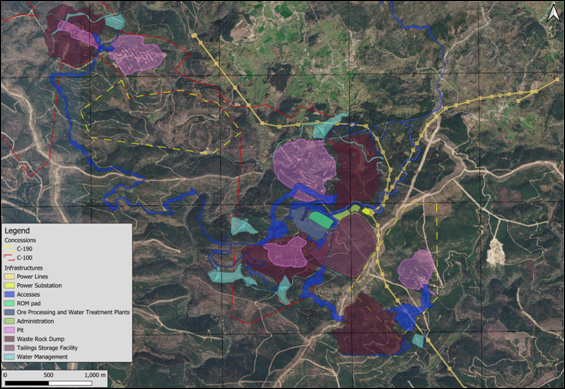
Figure 7‑1- Barroso Lithium Project General Infrastructure Locations
BULK EARTHWORKS
Eight main earthwork pads are planned, including for the processing plant terraces, filter building, administration building, high-voltage power switchyard and mobile maintenance workshop. The designs aim to minimise cut volumes while maximising usable space. Slopes are assumed at 1V:3H for fills and up to 1V:0.5H for cuts. Excess cut material will be reused for roads and water infrastructure. Drainage is handled through toe drains and future detailed design. Total cut volumes significantly exceed fills, indicating reuse potential.
NORTH ACCESS ROAD AND INTERNAL ROADS
The road network includes the North access road, internal haul roads, and minor access roads. The North access road connects to the existing R311 regional road and is approximately 10.9 km long, with a design speed of 30 km/h. Internal haul roads support mining operations with trucks up to 100 t.
The Eastern Block where the processing infrastructure is located, will be linked to the Western Block by a sealed road, namely Haul Road 0, suitable for use by smaller trucks (up to 60t gross weight) due to topographic and distance constraints that prevent the possibility to use mining haul trucks to transport the ore from NOA and Reservatório pits to the ROM pad.
Other internal haul roads to link the Grandão, Pinheiro and Aldeia pits to the ROM pad and respective waste dumps will be built with sufficient width to accommodate up to 100t nominal payload mining trucks.
Road geometries include defined slope limits, drainage systems, and safety features. Minor internal roads (12 total) provide access to infrastructure such as pads and water facilities, and are designed to follow natural topography, minimise earthworks and to accommodate small size trucks and light vehicle traffic only.
Typical cross section diagrams of the North Access Road, Haul Road 0 and internal mining haul roads are shown in Figure 7‑2, Figure 7‑3 and Figure 7‑4 respectively.
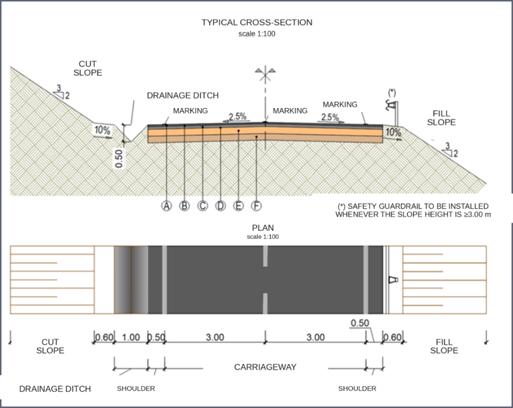
Figure 7‑2- North Access Road Typical Cross Section and Plan View
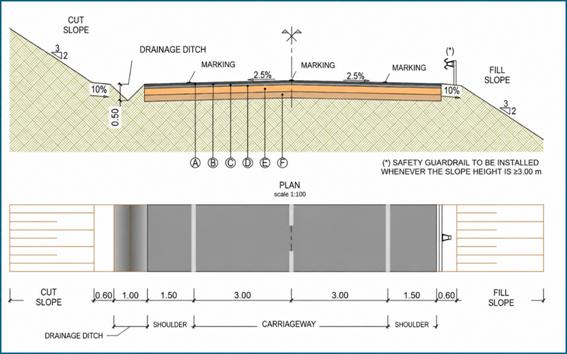 Figure 7‑3- Haul Road 0 Typical Cross Section and Plan View
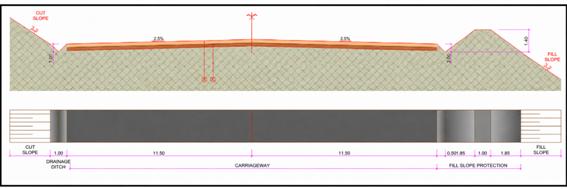
Figure 7‑4- Internal Mining Haul Roads Typical Section
COVAS RIVER BRIDGE
A 100 m long reinforced concrete bridge is included on Haul Road 0 to cross the Covas river. The structure uses a three-span configuration and avoids impacts to environmentally sensitive areas. It is designed for a 100-year life and complies with Eurocodes. The bridge satisfies traffic loads, environmental constraints, and safety considerations, and is constructed using conventional methods.
The bridge will be built in year 4 of operations as part of construction works of the road linking NOA and Reservatório pits with the ROM pad (Haul Road 0).
Figure 7‑5 shows a typical plan view and longitudinal section of the bridge.
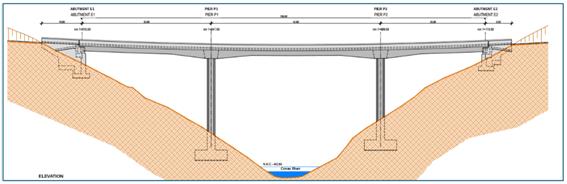 Figure 7‑5- Covas River Bridge Plan and Longitudinal View
BYPASS ROAD
A new bypass road will be built to connect the project to the A24 highway and divert traffic from local towns. It is approximately 16.5 km in length, combining new construction and upgrades. The road is designed to improve safety, reduce travel times, and accommodate heavy vehicle traffic. Two alternatives were assessed, with the northern alignment selected due to overall project advantages. The road includes roundabouts, viaducts, drainage systems, and flexible pavement structures, with a design speed of 60 km/h.
This road will be open for public use and constitutes an enormous benefit to the local town of Boticas and neighbouring communities.
Figure 7‑6 shows an overview of the two Bypass Road alignment options assessed, with the northern one (red) selected as the preferred option.
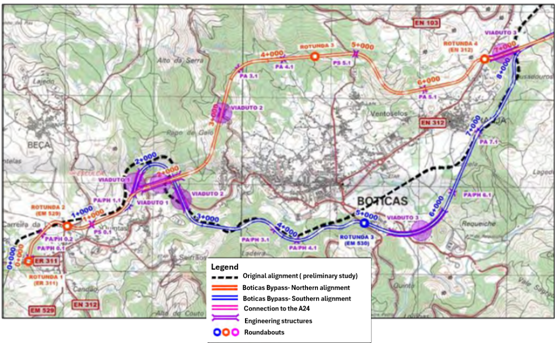 Figure 7‑6- Bypass Road North and South Alignments
DRAINAGE AND HYDROLOGY
Road drainage includes both longitudinal and transverse systems, with culverts, ditches, and hydraulic structures designed to manage runoff. Hydrological design uses regional rainfall data and standard methods to determine flow rates. Water is directed to natural watercourses or control structures, with design return periods of up to 100 years for key elements.
BUILDINGS
The project includes administration, laboratory, workshop, warehouse, amenities, and medical facilities. The administration building supports operational and management activities while the on-site laboratory will conduct blast hole sampling and ore processing sample analysis.
The workshop will be located within the ore processing area to provide maintenance for plant and equipment, with lifting and servicing capabilities. The warehouse will store spare parts and consumables. Amenities include changing rooms, sanitation, and rest areas, while a medical facility provides onsite health services.
MINING SERVICE AREA
A dedicated mining service area supports maintenance of mining equipment, including fuel storage, workshops, washing facilities, and offices. It is located adjacent to the plant area and designed to support operational efficiency.
UTILITIES
The infrastructure includes power, water supply, wastewater handling, and communications. These support plant operations and site activities and are integrated with the broader project design.
8. ENVIRONMENTAL PERMITTING STATUS
The Barroso Lithium Project comprises two mining concession areas: C-100 Mina do Barroso and C-190 Canedo-Covas, referred to in this DFS as Aldeia. Although both concessions are considered on an integrated basis for the DFS, they are at different stages of environmental assessment and permitting.
The C-100 Mina do Barroso Concession is the main and most advanced component of the Project from an environmental permitting perspective. The Environmental Impact Assessment process for Mina do Barroso has already been completed and culminated in the issuance of a favourable conditional Environmental Impact Statement (Declaração de Impacte Ambiental, or DIA) in May 2023. This represents the critical environmental milestone already achieved by the Project, as the DIA confirms the environmental viability of the Project location and establishes the conditions, mitigation measures, compensation measures, monitoring requirements and additional studies to be implemented during the subsequent phases of project development.
The Project is now in the post-DIA phase, focused on the preparation of the RECAPE (Relatório de Conformidade Ambiental do Projeto de Execução) and the detailed demonstration of compliance with the DIA conditions. The RECAPE will demonstrate that the Detailed Design Project complies with the DIA and incorporates the required mitigation, compensation, monitoring and environmental management measures. Following approval of the RECAPE, the competent authority may issue the DCAPE (Declaração de Conformidade Ambiental do Projeto de Execução), confirming the environmental conformity of the Detailed Design Project and enabling the Project to proceed towards construction.
In parallel with construction, and prior to the commencement of operations, the remaining operational permits and authorisations will be obtained. These include, where applicable, permits related to the Industrial Emissions Regime, the IPPC framework, water resources, mining waste management and other environmental titles to be incorporated into the Single Environmental Title (Título Único Ambiental, or TUA). These permits are primarily related to the operational phase and are not considered prerequisites for the start of construction.
The C-190 Canedo-Covas concession, referred to as Aldeia, is at an earlier permitting stage. It has not yet been subject to an autonomous Environmental Impact Assessment process. Any future development of Aldeia will require the applicable environmental and technical studies and compliance with the relevant Portuguese environmental permitting procedures. The future permitting process for Aldeia is expected to be more straightforward than the Mina do Barroso process, as Aldeia is not expected to include a processing plant and is therefore anticipated to have a simpler project configuration and a more limited development footprint.
Based on the current development concept, the Environmental Impact Assessment procedure for Aldeia is expected to be developed at the Detailed Design stage. This would allow environmental conformity to be assessed directly on the basis of the Detailed Design, with the expected sequence comprising submission of the Environmental Impact Assessment Study, issuance of the corresponding DIA at Detailed Design stage, and subsequent update of the TUA, including the applicable Environmental Licence. A separate RECAPE/DCAPE phase is therefore not expected to be required for Aldeia under the currently envisaged permitting pathway.
Overall, the key environmental permitting risk for Mina do Barroso has been significantly reduced through the issuance of the favourable conditional DIA. The main remaining environmental milestone required to enable construction is the successful completion of the RECAPE/DCAPE process. For Aldeia, the environmental permitting process remains to be initiated and will need to be confirmed through dedicated studies, field surveys and project-specific assessment.
ENVIRONMENTAL BASELINE
Extensive environmental baseline studies were undertaken for Mina do Barroso to support the Environmental Impact Assessment process. These included desktop studies, field surveys and monitoring campaigns covering surface and groundwater resources, geology, geomorphology, soils, land use, biodiversity and ecosystems, landscape, cultural heritage, air quality, noise, vibration, climate and socioeconomic conditions. These studies provide the baseline against which potential construction, operation and closure impacts have been assessed.
The Project is located in a rural and mountainous area of northern Portugal, within the Barroso region. The landscape is characterised by steep slopes, small plateaus, forest areas, shrubland, pastures, agricultural plots, rural settlements and a dense drainage network. Land use reflects the interaction between topography, geology, soil conditions and traditional rural practices, with production forest, shrubland, pastures and agricultural areas present across the wider study area.
Surface water resources are a key environmental factor for the Project. The C-100 concession is located within the Douro Hydrographic Region and the Tâmega sub-basin, with local watercourses including the Covas River, Beça River, Ribeiro do Couto and Ribeiro de Gondiães. Groundwater occurs mainly in fractured granitic and metasedimentary rocks, with generally low productivity but local importance for domestic and agricultural uses.
The ecological baseline identified habitats, flora and fauna of conservation interest within the Project's area of influence. Although the Project is not located within a classified protected area, it is situated in a region with ecological sensitivities and is near areas of conservation relevance. Biodiversity, water resources, landscape and the social component were among the most important factors considered during the EIA process and subsequent Project reformulation.
The wider Barroso region, covering the municipalities of Boticas and Montalegre, is recognised by the Food and Agriculture Organization of the United Nations as a Globally Important Agricultural Heritage System. This designation reflects the importance of the traditional agro-silvo-pastoral system, rural land-use patterns and cultural landscape of the region, and reinforces the need for careful landscape management, stakeholder engagement and transparent environmental monitoring throughout the Project life cycle.
For Aldeia, the current environmental description remains preliminary and is based on available regional information, studies undertaken for the neighbouring C-100 Concession and currently available technical information. The known setting is broadly comparable to the wider Barroso region, with a rural and mountainous environment, forest and shrubland areas, agricultural land uses, surface water features and ecological sensitivities. However, the environmental baseline for Aldeia will need to be confirmed through dedicated studies, field surveys and project-specific assessments as part of its future permitting process.
KEY ENVIRONMENTAL CONSIDERATIONS AND IMPACTS
The Environmental Impact Assessment for Mina do Barroso considered the construction, operation and closure phases of the Project. Potential impacts were identified in relation to, among other factors, land-use change, vegetation clearance, habitat disturbance, landscape alteration, surface and groundwater interactions, noise and vibration, air quality, traffic and socioeconomic conditions.
The reformulation of the Mina do Barroso Project reduced several environmental impacts compared with the design initially assessed in the EIA. This was achieved through layout optimisation, reduction of the permanent disturbance area, removal of more impactful solutions affecting watercourses and sensitive habitats, relocation of infrastructure and strengthening of mitigation, compensation and monitoring measures.
Notwithstanding these improvements, some environmental descriptors continue to present relevant impacts and risks. These include water resources, ecological systems, landscape, soils and land use, noise, air quality and the social component. These impacts have been assessed under the EIA process and are subject to full implementation of the conditions established in the DIA.
Water management is a central environmental consideration. The Project design incorporates surface water management infrastructure, separation of clean and contact water, containment of affected waters, water treatment, reuse of process water and controlled discharge where applicable. These measures are intended to manage hydrological risks, protect receiving water bodies and support compliance with applicable environmental requirements.
Ecological impacts are principally associated with habitat disturbance, vegetation clearance, potential effects on species of conservation interest and cumulative pressures on the surrounding ecological network. These impacts are to be managed through avoidance, minimisation, compensation, monitoring and adaptive management measures, in accordance with the DIA and the commitments to be detailed in the RECAPE.
Landscape, soils and land-use impacts are associated with the physical footprint of the pits, waste rock facilities, tailings storage facility, water management structures, access roads and other infrastructure. These impacts are addressed through layout optimisation, progressive rehabilitation, landscape integration, erosion control and closure planning.
Noise, vibration and air quality impacts are associated mainly with construction works, mining activities, blasting, traffic, material handling and processing operations. The reformulated Project reduced noise propagation at sensitive receptors through changes to the location of the processing plant, internal access roads, platform levels and operating hours for some activities. Nevertheless, noise and vibration remain potential nuisance risks and will require continued management through compliance with legal limits, good operating practices, equipment maintenance, traffic control and regular monitoring at sensitive receptors.
Positive socioeconomic impacts are also expected, including direct and indirect employment, procurement opportunities, local and regional economic development, and contribution to the European critical raw materials value chain and energy transition objectives. These benefits must be delivered alongside continued stakeholder engagement, grievance management and implementation of the Project's social and environmental commitments.
MITIGATION, MONITORING & ENVIRONMENTAL MANAGEMENT
A comprehensive set of mitigation, compensation, monitoring and environmental management measures has been defined through the EIA process and the DIA. These measures are being incorporated into the Project design and implementation strategy and will be documented in the RECAPE, together with the evidence demonstrating how the Project complies with each DIA condition.
The mitigation hierarchy applied to the Project is based on avoiding impacts where practicable, reducing or minimising impacts where avoidance is not possible, compensating residual impacts where required, and monitoring performance throughout construction, operation and closure. This approach applies across the main environmental descriptors, including water resources, biodiversity, landscape, soils, air quality, noise, vibration, cultural heritage and the social component.
Environmental monitoring programmes will be implemented throughout the Project life cycle to confirm compliance with regulatory requirements, verify the effectiveness of mitigation and compensation measures, and allow corrective actions to be implemented where necessary. Monitoring will cover the environmental descriptors required under the DIA and subsequent environmental titles, including water resources, biodiversity, air quality, noise, vibration and other relevant factors.
Cultural heritage impacts are considered manageable, provided that the required safeguards are implemented. These include archaeological monitoring, marking and protection of known occurrences, preventive measures and chance-find procedures during construction, earthworks and access road development.
Cumulative impacts were also considered in the environmental assessment, particularly in relation to climate change, noise, landscape, air quality, water resources, ecological systems, socioeconomics and soils. Integrated monitoring and coordination with competent authorities will be required to ensure that cumulative effects remain controlled and that mitigation measures are adjusted where necessary.
Overall, the environmental assessment confirms that Mina do Barroso can proceed subject to successful completion of the RECAPE/DCAPE process and full implementation of the mitigation, compensation, monitoring and environmental management measures required under the DIA. For Aldeia, environmental conclusions remain preliminary and will need to be confirmed through the future autonomous permitting process.
9. SOCIAL FRAMEWORK
The Project's social framework integrates Portuguese legal requirements and international standards, particularly IFC Performance Standards, Equator Principles and UN Guiding Principles. The Project is currently in the RECAPE phase of the environmental licencing process (which also covers social aspects) following the favourable conditional DIA issued in May 2023.
The social framework is based on two key documents: the Social Impact Assessment ('SIA'), prepared by Community Insights Group and completed in 2026, and the Stakeholder Engagement Plan ('SEP'), issued in 2026. The SIA is based on the Social Framework methodology and includes household survey data (333 households within 5 km), stakeholder workshops and impact analysis. The SEP operationalises engagement, consultation, grievance management and monitoring.
The regulatory framework includes the Portuguese Constitution, Administrative Procedure Code, EIA regime, mining legislation, Baldios Law, access to information laws and GDPR. International alignment includes IFC Performance Standards, OECD guidance and UN frameworks. The Project commits to standards exceeding regulatory requirements, particularly in consultation, livelihood restoration and grievance mechanisms.
The SIA identifies the Project's area of influence at local and regional scales. Locally, four parishes with a total population of 1,200 are included in the area of influence, with a few nearby residences located within 550-950 meters from the pits when at their full extent. No houses exist inside the project's defined area, nor within 500m of the operation areas in any direction. Regionally, impacts extend across municipalities in Alto Tâmega. The population is approximately 5,000 in Boticas, with a rural settlement pattern.
The Barroso region is recognised as a Globally Important Agricultural Heritage System ('GIAHS'), characterised by agro-sylvo-pastoral practices. The Project footprint represents approximately 0.01% of the designated area, and it is mostly covered by an industrial pine tree forest. Measures are defined to protect cultural heritage and support local agricultural systems.
A significant portion of land in the area is managed under the baldios communal system. The Project requires leasing communal land and Savannah engages directly with the Assemblies of Compartes on this point. Compensation is structured collectively for community benefit.
Demographically, the area is characterised by an ageing population (37% over 65), population decline and reliance on agriculture, livestock and pensions. Over 70% of households depend partially on land-based livelihoods. The Project is expected to create 300-350 construction jobs and 480-500 operational jobs, contributing to economic revitalisation and potentially reversing demographic trends. Salaries will far exceed the current local standard, with Savannah's lowest salary today matching the regional average.
Community perceptions indicate strong attachment to place but concerns regarding water, dust, traffic and compatibility with the GIAHS identity. These concerns have influenced project redesign, including elimination of river water abstraction, new access road routing, relocation of facilities and daytime operations.
Stakeholders are identified and categorised based on influence and interest, with specific measures for vulnerable groups. Engagement activities have evolved from early disclosure to formal consultation and ongoing operational engagement between 2017 and 2026, including surveys, public meetings and institutional engagement. This work has been strongly accelerated since 2024, with positive results.
A series of 15 Memoranda of Understanding signed in 2025-2026 formalise partnerships across healthcare, municipal cooperation, land use, forestry management and community organisations, supporting project integration and benefit sharing. A Local Advisory and Monitoring Committee ('CLCM') is being established to provide participatory oversight and manage community investment.
The SIA identifies 33 impacts across social dimensions. Positive impacts include increased employment, higher household income, local business development, improved infrastructure and services, and strengthened community cohesion. These are reinforced through local hiring, procurement and investment strategies.
Concerns over negative impacts include land access restrictions, concerns over water resources, health risks, traffic safety, environmental disturbance (noise, dust), cultural heritage concerns and housing effects. Mitigation measures include livelihood restoration at replacement cost, monitoring systems, traffic management, health and safety planning, cultural heritage protection and structured community engagement.
The Project will implement nine integrated management plans covering stakeholder engagement, community health and safety, livelihood restoration, local hiring, procurement, community investment, influx management, traffic management and cultural heritage. These plans will be aligned with IFC standards and operate as an integrated system.
A Grievance Redress Mechanism (GRM) was already established, providing accessible, transparent and non-judicial complaint handling. It includes multiple submission channels, defined governance structure, response timelines and protection against retaliation.
Community benefit sharing is structured through the Savannah Foundation, with a minimum annual budget of €500,000, the Good Neighbour Plan addressing local impacts, and statutory royalty distribution to the municipality (up to 50%) and compensation to baldios communities (agreements with Canedo and Dornelas baldios have already been signed). These mechanisms will ensure long-term value distribution.
Monitoring is based on defined indicators, verification methods, reporting frequencies and responsibilities. Participatory monitoring mechanisms, including community involvement in environmental monitoring, aim to ensure transparency and trust.
Overall, the Project presents a developed social management system based on detailed baseline data, structured stakeholder engagement and demonstrated responsiveness to community concerns. The integration of social management measures, benefit sharing mechanisms and regulatory compliance frameworks provides a basis for managing impacts and supporting long-term regional development.
10. TRANSPORT AND LOGISTICS
A dedicated Transport and Logistics Study was prepared by an independent specialist consultant to support the DFS for the Barroso Lithium Project. In parallel, Savannah has also undertaken market engagement with potential future logistics providers, port operators and transport companies, in order to better understand the practical and commercial dynamics that may apply during the future implementation and contracting phases.
From an operational perspective, the study assessed different logistics alternatives for both inbound and outbound flows, covering the flows for equipment, materials, consumables and reagents to the Project site, as well as the transport of spodumene concentrate and by-products from the Project site to export facilities or other potential destinations.
With regard specifically to product export logistics, several port options in Portugal and Spain were considered at a preliminary level, reflecting the range of potential export routes available to the Project. For the purposes of the independent study, the analysis was developed in greater detail for three Portuguese ports: Aveiro, Leixões and Viana do Castelo. These ports were selected due to their relative proximity to the Project, existing bulk-handling capabilities and potential ability to support the export of spodumene concentrate and by-products. Overall, the assessment concluded that the three ports considered in the DFS could, in principle, support the Project's export logistics requirements. Each port presents different characteristics in terms of distance from the Project, vessel size limitations, port infrastructure, storage availability, internal handling requirements and overall cost. In all cases, the study identified either existing port storage capacity or logistics areas within, or in the vicinity of, the port facilities that could potentially be allocated to the Project, subject to further technical and commercial discussions with the relevant operators.
Leixões port was identified in the independent study as the most cost-effective option and has therefore been adopted as the logistics costing basis for the DFS financial model. This reflects its shorter inland transport distance, existing infrastructure, capacity to accommodate larger bulk vessels and competitive end-to-end logistics costs. Aveiro also presents favourable operating characteristics, including the ability to receive larger vessels, although the greater distance from the Project and the need for additional internal transport between warehouse and quay result in higher overall costs. Viana do Castelo remains a potential logistics alternative, although the current analysis indicates some limitations in terms of vessel size and depth, which may affect its competitiveness for larger shipment scenarios. Notwithstanding the use of Leixões as the DFS base case, the study does not exclude the use of other ports. The final logistics solution may involve Leixões, Aveiro, Viana do Castelo or other port options, depending on the outcome of future commercial negotiations, availability of storage and handling capacity, vessel scheduling, final offtake arrangements and the specific requirements of future logistics contracts. As such, the DFS approach is considered conservative and practical, while preserving flexibility for future optimisation.
In addition to port logistics, the study assessed the main road access alternatives from the Project's industrial facilities to the national motorway network and onwards to the potential export ports. Several route options were reviewed, taking into account distance, travel time, road geometry, traffic conditions and suitability for heavy goods vehicles. The assessment concluded that there are several viable access possibilities and that no structural or critical constraints were identified that would prevent the circulation of heavy vehicles.
The route survey undertaken as part of the study identified specific constraints on certain sections of the existing road network, including narrow sections, localised vertical clearance limitations and lower-standard access roads closer to the Project site. These constraints are considered manageable and will be addressed through the planned access road works and required upgrades to municipal or unclassified road sections. The study also notes that the existing national and motorway network has sufficient capacity to accommodate the traffic generated by the Project, both during construction and operations.
During the construction phase, the Project will rely on the existing road network for the delivery of equipment, materials and other construction-related supplies. Traffic generated during this phase is expected to be temporary and limited in scale when compared with the available road capacity. During operations, traffic will mainly relate to the transport of spodumene concentrate, by-products, consumables, reagents, suppliers and workforce movements. The study estimates that the total operational traffic generated by the Project would remain within the capacity of the surrounding road network.
A key element of the future logistics strategy is the planned Boticas Bypass and direct connection to the A24 motorway. This infrastructure is expected to significantly improve the long-term logistics solution by diverting heavy traffic away from local communities and urban crossings, reducing potential social and environmental impacts, and improving safety and operational efficiency. While existing roads may be used during construction and in the early stages of operations, the Boticas Bypass is expected to provide the preferred long-term route for operational traffic once available.
The study also considered the potential use of rail transport. However, based on the available infrastructure, capacity limitations and operational constraints, railway transport was not deemed a feasible solution for the Project at this stage. Road transport therefore remains the primary logistics mode for the movement of spodumene concentrate and other materials.
In summary, the logistics assessment confirms that the Barroso Lithium Project has access to a range of credible logistics solutions. The DFS adopts Leixões as the base case for logistics costing due to its cost competitiveness and operational suitability, while maintaining flexibility to consider other ports should more favourable technical or commercial conditions emerge. The road network assessment confirms that the Project can be supported by existing and planned infrastructure, with the Boticas Bypass expected to further reduce impacts on local communities and strengthen the robustness of the long-term logistics solution.
11. LEGAL FRAMEWORK
This section summarises the legal framework governing mining activities in Portugal, with specific reference to the Barroso Lithium Project, the C-100 Mina do Barroso Mining Concession and the C-190 Canedo-Covas Mining Concession.
Under Portuguese law, mineral deposits are part of the public domain of the State. Private entities may only disclose, explore or exploit mineral deposits through legally granted private-use rights, typically established by administrative contract between the private entity and the State. Mining activity must serve the public interest, which is based on a balance between environmental sustainability, transparency and public participation, and the fair distribution of economic benefits between the State, municipalities and local populations.
The principal legal framework is established by Law No. 54/2015, of 22 June, which sets out the general regime for geological resources, and Decree-Law No. 30/2021, of 7 May, which regulates the exploration and exploitation of natural mineral deposits. Mining activities must also comply with complementary national and European legislation covering environmental impact assessment, single environmental licensing, industrial emissions, mining waste management, environmental liability, occupational health and safety, explosives, labour matters, closure and rehabilitation.
The Directorate-General for Energy and Geology is the central authority responsible for managing geological resources, instructing mining rights procedures and supervising mining activity. Environmental matters are addressed through the relevant environmental authorities, including APA, the Portuguese Environment Agency for Environmental Impact Assessment and environmental licensing procedures, as applicable. Municipalities and other public authorities, including ICNF (Instituto da Conservação da Natureza e das Florestas) are also consulted where their statutory responsibilities are engaged, including in relation to land use, environmental protection, spatial planning, cultural heritage, public participation and local benefit-sharing. In projects subject to an Environmental Impact Assessment, such as the licencing of the C-100 Concession, APA coordinates a multidisciplinary commission, that integrates multiple public authorities, each one of them, responsible for evaluating different parameters of the Project.
Mining activity is structured into sequential legal phases. These include preliminary assessment, prospecting and exploration, experimental exploitation and exploitation. The exploitation phase is carried out under an exploitation concession, which authorises the commercial exploitation of the mineral deposit. Rights may be granted following a private initiative or, where applicable, through a public tender procedure promoted by the State. Exploitation concessions are subject to technical, financial, environmental and administrative conditions.
The concessionaire is required to operate in accordance with the approved Mining Plan and the applicable technical standards, with the purpose to obtain the best economic use of the mineral resources. The concessionaire is also subject to obligations including annual work programmes, qualified technical management, environmental protection, waste management, financial guarantees, closure planning, rehabilitation and compliance reporting. DGEG may supervise the activity, require corrective actions and, where justified, order suspension of works in the event of serious danger to public health, the environment or safety.
The C-100 Mina do Barroso Mining Concession is held by Savannah Lithium Unipessoal Lda. and covers the exploitation of feldspar, quartz and lithium ore in the municipality of Boticas. The concession contract was originally entered into on 12 May 2006 and was subsequently amended, including to incorporate lithium. The concession was granted for an initial period of 30 years, from 12 May 2006 to 12 May 2036, and is extendable for a further 20 years, to 12 May 2056.
Because the C-100 Concession was granted under the previous mining regulations, it does not automatically fall under the full regime of Decree-Law No. 30/2021. It remains governed by the prior legal regime, notably Decree-Law No. 90/90, unless and until the concessionaire and the Government agree to transition it to the current regime or an amendment to the concession agreement triggers that transition.
The C-190 Canedo-Covas Mining Concession was awarded to Aldeia, S.A. in December 2024. The concession contains three blocks, one of which (Block B) is adjacent to the C-100 Concession and it is located in the same Municipality of Boticas. The other two blocks (Blocks A and C), are located nearby, but in the neighbour Municipality of Ribeira de Pena. The C-190 exploitation contract has an initial duration of 25 years and may be extended twice, first by 15 years and then by a further 10 years. Savannah has reached an agreement to acquire the C-190 Concession, and the administrative process to transfer the concession to Savannah was submitted to DGEG in December 2025. Completion of the transfer remains subject to the applicable administrative formalities. Together, the C-100 and C-190 concessions form the Barroso Lithium Project.
The commercialisation of products derived from authorised mining activities is subject to DGEG oversight. Export, sale or other transfer of products not originating from authorised exploitations or legally imported sources is prohibited. Exports must comply with applicable European Union legislation and treaties, and the State may have pre-emption rights over exploitation products where justified by the public interest.
The Project is subject to financial obligations typical of mining projects in Portugal, including exploitation charges, taxes and applicable administrative fees. Under Decree-Law No. 30/2021, mining charges are generally calculated by reference to a minimum standard of 3% of the value of the ore at the mine gate, potentially reduced to 2% where industrial processing of the ore is undertaken in Portugal. The distribution of exploitation charges includes allocation to the municipality or municipalities where the operation is located. For the C-100 Concession, the royalty calculation formula is subject to renegotiation with the Government in 2026 and, following such renegotiation, every five years.
In the specific case of C-100, the environmental regulator also issued a recommendation in connection with the DIA regarding the distribution of royalties, including allocation to Boticas Municipality, local project development through the Geological Resources Fund, and the development of the bypass road linking the Project to the highway.
The legal framework also requires the concessionaire to plan for closure and post-closure obligations. Closure planning is integrated into the Mining Plan and must address environmental, social and economic impacts, including rehabilitation, worker transition measures and support for new economic activities where applicable. Environmental and landscape restoration obligations continue beyond the end of the concession term, and financial guarantees are only fully released once the competent authority has verified compliance with the applicable obligations.
There are no specific restrictions on foreign investment in mining companies or mining projects in Portugal. Foreign investors are subject to the same administrative procedures, rights and obligations as Portuguese investors. The Project will also be subject to the Portuguese corporate tax framework and other applicable taxes, duties and fees. Based on the expected timing of taxable profits, the Project is expected to be subject to Portuguese Corporate Income Tax at a base rate of 17% from 2028, together with any applicable municipal surtax and state surtax. The state surtax applies progressively to taxable profits above €1.5 million, starting at 3% and increasing up to 9% for taxable profits above €35 million. As a result, the Project's effective corporate tax burden may be materially higher than the base corporate tax rate.
Overall, Portugal provides a defined legal framework for the development, operation, supervision and closure of mining projects. For the Barroso Lithium Project, the key legal matters are the continued compliance of the C-100 Concession with its applicable concession and permitting framework, completion of the C-190 Concession transfer process, compliance with the approved Mining Plan and environmental authorisations, and fulfilment of the Project's financial, social, environmental, closure and reporting obligations.
12. DECARBONISATION
Having a low carbon footprint activity is seen as a future strength by Savannah. Even though commercial value from such low carbon is not yet easily materialised in today's market, this will likely change in the future, with the growing importance of batteries bringing further scrutiny and rules on feedstock sources. Also, properly decarbonising activities should allow the Company to stay competitive, meet evolving market demands, protect against carbon pricing, unlock new sources of capital, grow its reputation, brand value and social responsibility, and build long-term operational resilience.
The decarbonisation approach for the Barroso Lithium Project is framed within European and Portuguese climate policies, which aim for carbon neutrality by 2050 and significant emissions reductions by 2030 compared to 1990 levels. Industry benchmarking shows that some mining companies are committing to net zero Scope 1 and Scope 2 emissions by 2050, with interim reduction targets typically ranging from 30% to 70%.
The Barroso Lithium Project's baseline is privileged versus competitors, as it benefits from a set of positive elements that are inherent to its operation and its setting: the geographic position, relatively close to the coast, reduces transportation needs; being in Northern Portugal gives it access to significant water and clean power, with zero incorporation of coal or any form of carbon intense electricity generation; and having access to regional housing for staff avoids very carbon-intensive fly-in fly-out logistics solutions.
A baseline emissions inventory identifies the main sources of greenhouse gas emissions across Scope 1, Scope 2, and Scope 3 categories. Scope 1 emissions, associated with direct fuel combustion, primarily arise from diesel-powered mining equipment, haulage trucks, and generators, and are estimated at approximately 25,269 tonnes of CO2 equivalent per year. Scope 2 emissions, related to purchased electricity, are relatively limited due to the high contribution of renewable energy into Portugal's grid power. With an annual energy consumption of about 71 GWh and a grid emissions factor of 97g CO2 per kWh, Scope 2 emissions are estimated at 6,712 tonnes of CO2 equivalent per year. Scope 3 emissions, which include transport, shipping, and downstream processing, represent the largest share of total emissions, estimated roughly at 287,000 tonnes of CO2 equivalent per year, largely driven by chemical refining and maritime transport of spodumene concentrate, with inbound logistics being negligible. Numbers will vary and depend heavily on exact final destinations of products when in operation.
The decarbonisation strategy also responds to national legislation, including Decree-Law 30/2021, which requires mining projects to incorporate energy efficiency, renewable energy integration, and circular economy principles. The strategy also considers broader national and European climate objectives, including the Carbon Neutrality Roadmap 2050 and the National Energy and Climate Plan, which set ambitious targets for emissions reductions in industry and transport sectors.
The project has defined several decarbonisation options, including reducing or eliminating Scope 1 emissions through alternative fuels and electrification, sourcing at least 80% of electricity from renewable sources from the start of operations with the ambition to reach 100%, and working towards having reduced logistics chains and engaging supply chain partners to address Scope 3 emissions.
For Scope 1 emissions, operational measures such as payload optimisation and improved fleet efficiency are considered to reduce fuel consumption. Also, non-core equipment such as staff-allocated lightweight vehicles and pickups will be exclusively electric. On top, the project is prepared to implement in the future two possible solutions that would result in drastic Scope 1 reductions: green fuels and electric mining equipment.
Green fuels would be the short-term option: these would be advanced biofuels such as hydrotreated vegetable oil and biodiesel derived from waste materials, in partial or direct substitution of diesel. Savannah has confirmed that these fuels can be used in existing equipment without significant modifications, and that lifecycle emissions would be reduced by up to 80-100%. An offer by a specialized supplier is on the table, making this path possible and financially bearable.
The medium-term option is further electrification of mining equipment, which has been studied in depth together with a world leading OEM company. Simulation studies indicate that battery electric mining trucks currently face challenges related to higher costs, lower productivity due to charging requirements, and limited availability of suitable equipment in the market. As a result, a phased approach is considered, with initial reliance on conventional equipment, and potential transition to electric fleets as technology matures. Potential gains in future costs have not been included.
Scope 2 emissions are mitigated primarily through the use of Portugal's renewable electricity grid and the potential procurement of renewable energy through guarantees of origin and power purchase agreements. Process optimisation within the plant is also expected to contribute to energy efficiency improvements and reductions in electricity consumption. While on-site renewable energy generation through solar or wind power is technically feasible, it is not considered initially as it requires significant capital investment and faces constraints related to land availability for a minor improvement versus an already very green grid power.
For Scope 3 emissions, the strategy focuses on collaboration with logistics providers and downstream partners, as well as exploring electrification options for transport fleets. Joint work in the progressive adoption of green fuels is also planned. On top, significant work has already been done and will continue with various potential partners in order to help accelerate the near-shoring of a downstream battery value chain, including to locations within or very close to Europe, and potentially even in Portugal, which would drastically reduce or even fully eliminate the maritime freight portion of the trip.
As soon as more refining facilities are available in Europe, it is Savannah's expectation that further commercial agreements with those will eventually be reached, hence significantly reducing the logistical burden and thus its emissions. However, the largest component of Scope 3 emissions arises from downstream chemical processing, which is outside the direct control of the project and therefore more difficult to mitigate. Savannah has mostly engaged with companies that adopt responsible production practices themselves and use high-technology state-of-the-art processes, which are naturally more emission-efficient and adopt further environmental impact mitigation practices.
Additional measures for emission mitigation include the gradual electrification of light vehicles, installation of charging infrastructure (including at staff homes and off-site company premises), and initiatives to support lower-emission transport among contractors and suppliers. These measures aim to reduce emissions beyond the direct operational boundary of the project.
Carbon offsetting is considered only as a last resort to address residual emissions that cannot be eliminated through operational or technological measures. Potential offset options include forestation, which contributes to carbon sequestration while providing environmental and social benefits, and biodiverse pastures, which enhance soil carbon storage and agricultural productivity. The purchase of carbon credits is also considered, although it may involve significant and potentially increasing costs over time.
Finally, the project will implement monitoring and reporting systems to track emissions performance, including digital tools and annual reporting aligned with European standards. Independent verification will be used to ensure transparency and compliance, supporting the overall objective of progressively reducing emissions and aligning the project with broader decarbonisation goals.
13. CAPITAL COST ESTIMATE
The project's CAPEX estimate covers the full scope of the first phase of the Barroso Lithium Project. The estimate is expressed in US dollars as of June 2026 and is within the guidelines for DFS-level accuracy of ±15% (Association for Advancement of Cost Engineering ('AACE') Class 3).
The total initial capital cost for the project is estimated at US$417.5 million, including contingency. This total includes major cost categories such as pre-production mining, bulk earthworks, internal and access roads, water reservoirs, TSF, the bypass road, mechanical equipment, electrical and instrumentation systems, concrete, structural steel, piping, EPCM costs, freight, commissioning, spares, owner's cost and contingency. The ore processing facility constitutes the single largest CAPEX item at US$145.3 million, while contingency alone represents circa US$40 million. Table 13‑1 summarises the total project CAPEX broken down by main categories.
Table 13‑1- Barroso Lithium Project Upfront CAPEX
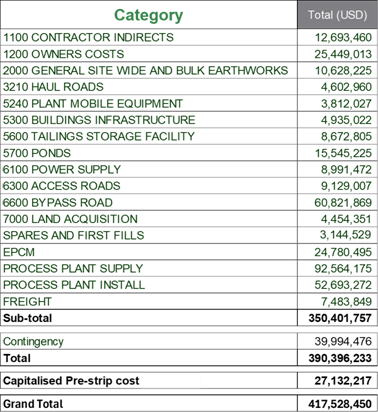
The contracting strategy will vary depending on the magnitude and complexity of the element: the process plant is to be delivered under an Engineering, Procurement, and Construction Management ('EPCM') execution model, and additional project required infrastructure is to be delivered under various models, such as schedule of rates or Engineering, Procurement, and Construction ('EPC') contracts.
The overall project CAPEX cost estimate is based on a detailed engineering approach using project-specific data and standard industry methodologies. Quantities for major components such as earthworks, concrete, structural steel, piping, and mechanical equipment were derived from 3D models, process flow diagrams, equipment lists, and preliminary engineering designs. Electrical and instrumentation quantities were compiled from single-line diagrams, load lists, and system layouts.
Pricing development relied on a combination of supplier quotations, internal databases, and market benchmarks. Major equipment costs, bulk earthworks, water reservoirs and TSF unit rates were obtained through a competitive request-for-quotation process involving multiple vendors where possible. Bulk materials such as steel, concrete, and piping were priced using rates obtained from regional contractors, particularly in Portugal and Spain. Freight costs were estimated based on supplier inputs and validated logistics models considering transport distances, volumes, and transport modes.
Installation costs were estimated using contractor-provided rates and project-specific labour productivity assumptions. Labour cost structures include direct and indirect labour, supervision, travel, accommodation, equipment, and contractor overheads. Installation rates reflect European and Portuguese market conditions, and productivity factors were applied to align with contractor estimates.
Additional allowances were included for commissioning spares, strategic spares, and first fills, calculated as percentages of direct costs.
The high-voltage grid connection cost estimate was developed using a hybrid methodology combining supplier quotations, unit-rate estimates, and benchmarking.
EPCM and commissioning costs were calculated from first principles based on equipment scope and engineering requirements, preliminary EPCM quotations from reputable and experienced companies and with a combination of European and international labour rates applied.
Owner's costs are treated separately from the main CAPEX and include amongst other items project management, permitting, legal services, recruitment, training, site establishment, IT systems, communications infrastructure, and operational readiness activities. These costs are designed to support project execution and transition into operations and were estimated using benchmarks and vendor data.
Contingency was developed through a structured risk analysis process with Monte Carlo simulations applied for the process plant as this is the most critical CAPEX and operational component of the project. This approach assessed uncertainties in quantities, rates, schedule, escalation, and external risks. The resulting contingency distribution indicates a range of potential outcomes, with overall project contingency sitting at 11% of direct and preliminary costs at the median level. Key risks include schedule delays, weather impacts, cost escalation, contractor performance, and potential increases in equipment and material costs.
Key sustaining capital assumptions include annual allocations for road maintenance, water management infrastructure, environmental monitoring, and plant maintenance, typically calculated as percentages of initial capital or fixed annual allowances. Equipment replacement cycles and refurbishment requirements for mobile assets and support equipment are also included. Mining fleet costs are excluded as it will be provided by contractors. The cost of construction of major infrastructure in subsequent years after the start of operations was estimated based on bill of quantities derived from their respective designs and unit rates obtained from direct request for pricing processes with contractors, or existing public pricing databases. A pool of high-quality suppliers was considered for each item, and it is expectable that some cost items are reduced when higher competitive pressure is applied in actual formal bidding processes.
The project's sustaining CAPEX totals US$92.0 million and includes all the necessary work to maintain the asset, as well as the construction of key infrastructure to access and enable operations in future mining areas such as NOA, Reservatório and Aldeia pits. The top 10 sustaining CAPEX items are outlined below:
Table 13‑2- Barroso Lithium Project Top 10 Sustaining CAPEX Items
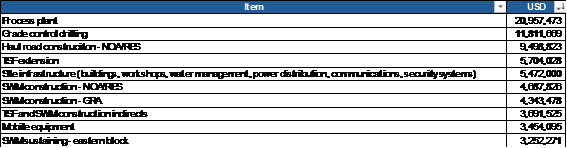
Closure CAPEX is significant, as it is currently estimated at US$237 million, including backfilling of all pits with waste from waste rock dumps to restore the existing topography as close as practicable, dismantling of all water reservoirs, internal roads and general restitution of the original topography and water lines, including revegetation of all areas cleared for construction and operation of the project.
The schedule analysis suggests project build completion date by the end of 2028 depending on risk scenarios and weather impacts. Weather-related delays were identified as a significant contributor to schedule uncertainty, particularly given local climatic conditions. As is always the case with complex construction projects, other execution-related uncertainties may result in a longer pathway to completion.
Overall, this capital cost estimate provides a comprehensive and structured assessment of the investment required to develop the Barroso Lithium Project, incorporating detailed engineering inputs, market-based pricing, and risk-adjusted contingency analysis consistent with DFS standards.
14. OPERATING COST ESTIMATE
The operating cost estimate (OPEX) reflects the expected costs associated with the entire operational value chain of the project, including when applicable logistics costs from pit to port on a FOB basis, as well as all operational and general and administrative ('G&A') costs related to the Project. The estimate has an accuracy range of ±15%, consistent with a DFS level (Association for Advancement of Cost Engineering ('AACE') Class 3) and is expressed in US dollars based on June 2026 conditions.
The processing cost estimate is based on a plant design capacity of 1.5 Mt per annum of ROM feed with capacity to produce over 200kt of spodumene concentrate per annum. The operation is assumed to run for 7,446 hours per year, which corresponds to an 85% utilisation rate. Escalation has not been included, either prior to the start of operations or over the life of mine.
Mining is the highest C1 cost component, with estimate based on a schedule of rates arrangement with work executed by a mining contractor and quantities defined in the LOM mining schedule. These costs include explosive supply, drill and blast, ex-pit waste and ore loading and hauling, ROM ore feed to the crusher, tailings rehandle and placement in the TSF, ancillary and dayworks cost, and finally contractor's and owner's mining overheads.
Processing represents the second highest C1 cost, with consumables being the largest operating cost within this activity. Consumables cost estimate is based on detailed consumption rates derived from process design criteria and metallurgical requirements. These include grinding media, liners, reagents, and chemicals used in flotation, thickening, and filtration processes. Consumption rates are expressed per tonne of ROM processed, and prices are based on vendor quotations, including delivery to site.
Labour costs are based on a detailed organisational structure and staffing plan for continuous operations. The wet processing circuit is assumed to operate on a 24/7 basis using four rotating crews with 12-hour shifts. A total of 194 personnel during established operations are included as part of Savannah's own direct staff, covering all disciplines related to the production and logistics chain, plus G&A labour. Labour costs are derived by Portuguese benchmark rates and include wages and statutory on-costs. Labour costs for a set of highly skilled positions not likely to be found in the local labour market are estimated based on international benchmarking.
Maintenance costs are estimated using a factor-based approach derived from the installed equipment and industry experience. Different equipment types are assigned specific annual maintenance factors, reflecting their expected wear and maintenance requirements. These factors incorporate both planned and unplanned maintenance, including parts and consumables necessary to sustain plant performance.
Power costs are calculated from the plant's electrical load profile, using an estimated demand power of approximately 9.7 MW. Total annual electricity consumption is around 71.0 GWh. A unit electricity cost of approximately EUR 0.075 per kWh is applied, resulting in a total annual power cost of approximately US$6.0 million. Further potential cost optimization coming from a PPA was not included at this stage.
Mobile equipment costs include both ownership and operating expenses for the fleet required to support process plant operations. These costs cover depreciation, fuel consumption, maintenance, tyres, and lubricants, as well as occasional hire of specialised equipment such as cranes. Fuel costs are based on diesel at approximately EUR 1.16 per litre, with Savannah managing the fuel supply contract directly with the selected provider.
General and administration costs include relevant labour and a range of indirect expenses such as training, safety and HSE consumables, recruitment, contractor support, and office operations. Additional costs, including utilities, communications, cleaning, and site services, have all been included resorting to regional or national requests for quotation.
Laboratory services costs are based on a third-party contract covering personnel, equipment, and consumables. Likewise, the treatment and disposal of residual water and sludge from the water treatment plant is costed based on a third-party service arrangement. Further support services such as security, cleaning and canteen are also assumed to be outsourced and included separately.
Transport and logistics costs for spodumene concentrate are considered separately and based on export via the Port of Leixões to international markets on a FOB basis. By-product transport costs are excluded, as these are assumed to be sold on an ex-works basis.
The C1 operating cost estimate excludes several items, such as sustaining capital, closure costs, government charges, royalties, taxes, and contingency. It also excludes workforce mobilisation, accommodation to some extent, and project start-up costs, reflecting an assumption of locally sourced labour.
The Project's life of mine C1 cost sits at US$472.9/t of SC 5.5 spodumene product and All-In Sustaining Cost ('AISC') at US$646.3/t of SC 5.5 spodumene product. These equate to US$515.9/t and US$705/t respectively on a SC 6.0 basis.
Overall, the OPEX estimate provides a structured and detailed assessment of operating costs for the Barroso Lithium Project, based on engineering design, process requirements, and benchmarked cost data. It is aligned with DFS standards and supports economic evaluation of the project.
Table 14‑1- Barroso Lithium Project Operating Cost Summary presents a summary of the Barroso Lithium Project operating cost.
Table 14‑1- Barroso Lithium Project Operating Cost Summary
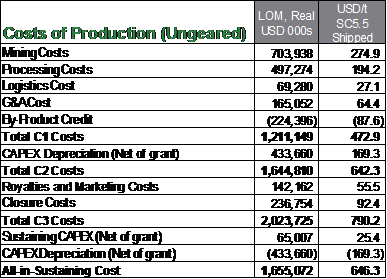
15. PROJECT IMPLEMENTATION
The project will be executed under an Engineering, Procurement and Construction Management model for the ore processing plant scope, supported by a Front-End Engineering Design ('FEED') phase that starts immediately at DFS stage, prior to final investment decision. This approach enables early progress on critical engineering and procurement activities and reduces overall project delivery risk. Other fronts will be delivered as follows:
· Earthworks, water reservoirs, TSF and internal roads on a schedule of rates arrangement, with such fronts likely being executed by the mining contractor with regards to bulk earthworks and by a separate civil contractor with relation to other scope such as piping, instrumentation installation, lining, etc.
· Power substation and overhead lines diversion on an EPC arrangement.
· North access road and bypass road under schedule of rates with civil contractors.
Under the EPCM model, the contractor will be responsible for detailed engineering design, procurement of equipment and materials, construction management, and commissioning of the processing plant and associated infrastructure. Project fronts outside the core EPCM scope will be managed by Savannah's own Project Management Team, supported by structured management systems, procedures, and a Project Management Plan. Document control, reporting, and communication systems will ensure traceability, consistency, and coordination between stakeholders. Engineering will be conducted through a multidisciplinary structure, progressing from FEED to detailed design, with key design reviews carried out at multiple stages (30%, 60%, and 90% completion) to validate operability, safety, and constructability.
Procurement will be organised into discrete contract packages covering equipment supply, fabrication, and construction works. A combination of lump-sum and schedule-of-rates contracts will be used, with a focus on engaging local and regional contractors where possible and advisable. Quality assurance and supplier control processes will be implemented, including inspections, audits, and compliance with approved quality plans.
Construction will be executed through multiple work packages covering civil works, structural, mechanical and piping (SMP), electrical and instrumentation, and buildings. Activities will be organised into defined work areas to enable efficient progression and handover into commissioning. The EPCM contractor will manage construction contractors, while Savannah retains oversight of performance, quality, and compliance.
Construction support systems will include temporary facilities, water and power supply, communications infrastructure, and emergency response arrangements. Environmental and community considerations are integrated into the construction plan, including measures for noise abatement, waste and water management, biodiversity protection, and cultural heritage preservation. Community engagement and communication plans will also be implemented to manage impacts on local stakeholders.
Commissioning is structured into defined phases, ranging from construction verification through to full operational performance testing. These phases include pre-commissioning, no-load testing, commissioning with material, and final handover. Responsibilities transition progressively from construction to commissioning teams and ultimately to operations, ensuring continuity and knowledge transfer. Performance testing confirms that the plant meets design capacity before final handover.
Project controls play a central role in managing cost, schedule, and risk. This includes monitoring progress, managing changes through formal procedures, and maintaining alignment with baseline plans. Interface management is also critical, ensuring coordination between multiple contractors and project components through structured processes and regular communication.
Additional implementation elements include the development of supporting infrastructure such as the high-voltage power connection, bypass road, and contract mining operations. The HV power system will be delivered through EPC contracts and integrated into the national grid. The bypass road will be constructed as a separate project under Portuguese regulations, while mining operations will be undertaken by a contractor under a performance-based agreement.
PROJECT SCHEDULE
The project schedule indicates a total duration of approximately 22 months from the start of construction of the North Access Road to first concentrate, with FEED starting in Q3 2026 and incorporating some detailed engineering of critical processing items to achieve a high degree of confidence on process plant design prior to FID. Key milestones include EPCM contract award, commencement of earthworks, site establishment, and commissioning.
The project's critical path is defined by the construction of power lines and substation, process plant energisation and finally commissioning to arrive at first concentrate in November 2028, noting that construction of the Bypass Road is not in the critical path and its completion post nameplate production doesn't impact the project's operations or logistics to transport concentrate to port as existing local roads can be used to access the A24 freeway.
Figure 15‑1 shows an overview of the Barroso Lithium Project construction schedule from start of North Access Road and FID through to nameplate production and completion of the Bypass Road.
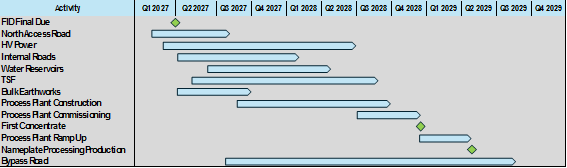
Figure 15‑1- Barroso Lithium Project Construction Schedule Overview
16. OPERATIONAL READINESS
Operational Readiness ("OR") for the Barroso Lithium Project is being treated as a project risk-control activity, not as a late-stage recruitment exercise. Its purpose is to ensure that Savannah has the owner capability, operating personnel, systems, procedures, maintenance data, contractor interfaces, operational controls and governance arrangements required to transition from project delivery and construction into safe, stable and sustainable operations.
For Barroso Lithium Project, OR is intended to ensure that Savannah can receive the Project from the delivery organisation, participate effectively in commissioning, take ownership of the installed assets, manage contractor interfaces, maintain compliance with applicable regulatory and licence requirements, and stabilise production during ramp-up.
OR is particularly important for Barroso Lithium Project because the Project will not be delivered through a single package or single contracting route. The processing plant package is expected to follow a FEED-to-EPCM pathway, while other scopes, including infrastructure, water management, power, roads, tailings, mining and specialist services, will follow different delivery routes, including EPCM, EPC, specialist contractor packages or Owner's Team-managed scopes. The OR programme therefore focuses on ensuring that these packages are not only physically constructed, but are integrated, documented, tested and handed over into one coherent operating organisation.
The OR scope covers the principal areas required to prepare Savannah for first ore, ramp-up and stable operations. These include the mobilisation of critical owner roles, completion of operating and maintenance procedures, configuration of operating systems, development of the asset register and maintenance master data, definition of contractor interfaces, readiness of warehouse and spares, confirmation of compliance routines, and preparation of commissioning, handover and ramp-up controls. The OR scope is intentionally cross-functional and requires coordination between project delivery, future operations leadership, technical services, processing, mining, HSE, environment, HR, supply chain, finance, commercial, IT/OT, document control, contractors and external advisers.
A staged construction-to-operations transition model will be adopted to avoid a "cold handover" at the end of construction. The transition will not be treated as a single handover event at the end of construction. Instead, key Savannah personnel will be mobilised progressively during project execution and commissioning so that operational requirements influence systems configuration, maintainability, spares, procedures, training, commissioning planning and handover preparation before operational accountability is transferred.
During commissioning, Savannah's future operating team will participate alongside EPCM contractors, EPC contractors, vendors and specialist contractors. This phase will be used to build asset familiarity, validate procedures, test control and reporting systems, confirm maintenance workflows, identify deficiencies, capture vendor knowledge and prepare the organisation for first ore. Formal handover to operations will be based on defined readiness gates and acceptance criteria, supported by evidence such as controlled documents, training records, system tests, asset data, spares lists, inspection records, permits, punch-list status, commissioning records and signed acceptance documentation.
Table 16‑1- Readiness evidence by area
|
Readiness area |
Typical evidence of readiness |
|
Organisation and governance |
Approved organisation charts, role descriptions, reporting lines, decision rights, mobilisation plan and commissioning-stage accountabilities. |
|
People and training |
Recruitment status, onboarding records, training matrix, competency records, vendor training records and role-specific authorisations. |
|
Procedures and operating discipline |
Approved SOPs, maintenance procedures, emergency procedures, permit-to-work procedures, contractor procedures and reporting routines. |
|
Systems and data |
Configured ERP, CMMS, HSE, laboratory, document control and reporting systems, with assigned system owners and trained users. |
|
Maintenance and assets |
Asset register, maintenance master data, preventive maintenance plans, critical spares list, warehouse setup, vendor manuals and warranty records. |
|
Contractor readiness |
Approved contractor scopes, mobilisation plans, KPIs, reporting routines, safety processes, operational processes, environmental control processes, escalation processes, induction records and interface procedures. |
|
Compliance and ESG |
Permit condition register, monitoring plans, reporting calendar, HSE procedures, environmental controls, labour compliance review and community interface processes. |
|
Commissioning and handover |
Commissioning participation plan, handover dossiers, punch-list register, system acceptance records, training completion records and first ore readiness review. |
|
Ramp-up readiness |
Ramp-up plan, daily and weekly review routines, performance tracking, issue register, improvement actions and residual handover closure plan. |
Maintenance and systems readiness will be key start-up deliverables. The focus will be on ensuring that asset data, maintenance strategies, spares, warehouse controls, vendor documentation, CMMS configuration and operational systems are not only prepared, but usable by trained Savannah personnel before first ore.
Contractor and interface readiness will also be a core OR focus. This is particularly important because Barroso Lithium Project will rely on clear interfaces between Savannah, delivery contractors, operational contractors, vendors and specialist service providers. The OR programme will define the practical handover and operating interfaces required before start-up, including scope boundaries, KPIs, reporting requirements, escalation routes, mobilisation requirements, safety and environmental obligations, commercial controls and handover expectations. Particular attention will be given to the interfaces between mining, ROM management, grade control, processing, maintenance, water management, tailings, logistics and site services.
Compliance readiness will ensure that operational legal, environmental, safety, water, labour, community and reporting obligations are translated into assigned responsibilities, procedures, monitoring routines, inspection requirements, reporting calendars and trained personnel before operations commence. This will support Savannah's ability to operate in accordance with Portuguese regulatory requirements, DIA and permitting commitments, environmental obligations and broader sustainability commitments.
The OR roadmap will be aligned with the overall project schedule and developed through defined phases from DFS completion to FID, early construction, construction, commissioning, first ore and ramp-up. Each phase will include defined deliverables and evidence of readiness, so that gaps are identified early enough to be corrected before they affect commissioning or start-up. The first 90 days of operations will be treated as a structured stabilisation period, during which operating routines will be embedded, residual handover items closed, procedures refined, maintenance discipline strengthened, contractor interfaces stabilised and improvement opportunities captured.
OR governance will be managed as an integrated project-to-operations programme. Readiness activities will be assigned to workstream owners, tracked through readiness reviews and readiness dashboards, reviewed at defined project milestones and escalated where gaps could affect commissioning, handover, first ore, compliance or ramp-up. The intent is to make OR a visible project control, with clear evidence of readiness before key decisions, rather than a parallel workstream that is only assessed at the end of construction.
Overall, the OR programme is intended to reduce ramp-up risk, avoid late mobilisation of critical functions, protect design intent, support compliance, clarify contractor accountabilities and ensure that the Barroso Lithium Project is not only physically complete, but ready to operate. For Barroso Lithium Project, successful Operational Readiness means that Savannah can receive the assets, control the contractor interfaces, operate and maintain the processing plant, maintain regulatory and environmental compliance, and move into stable production with clear accountabilities and usable systems from the start.
17. OPERATIONS MANAGEMENT
The Operations Management model for the Barroso Lithium Project is based on a hybrid operating structure in which Savannah retains direct control of the functions that determine operational value, compliance and product quality, while using contractors and specialist service providers where execution efficiency, flexibility or specific expertise are required.
This model is designed to ensure that Savannah remains accountable for the full mine-to-product value chain, from ore definition and mine planning through to ore delivery, processing, tailings deposition, concentrate and by-products handling, product logistics, environmental compliance and operational reporting. Contractor execution does not transfer operational accountability away from Savannah.
The steady-state organisation will operate under a COO-led model, supported by Savannah-managed mining oversight, processing, technical services, maintenance, HSE, environment, supply chain, warehouse, logistics, commercial, HR, finance and community-related functions. The approved operations organisation distinguishes between Savannah roles and contracted services, reflecting the intended balance between owner control and specialist external support.
Table 17‑1- Savannah- managed areas and contracted operational services
|
Area |
Savannah-managed |
Contracted services |
|
HSE and Water |
- OH and contractor compliance. - Safety. - Environmental activities. - WTP operation. |
- Security. - Recycling management. |
|
Processing |
- Plant operations. - Plant maintenance. - Product and by-product logistics. - Metallurgy. - Laboratory coordination. |
- Laboratory operations. - Tailings deposition. - ROM feed to crushing. |
|
Mining |
- Mining contractor coordination. - Technical services. - Mine planning. - D&B design. - Surveying. - Geotechnical control. - Geology and grade control. |
- Mining operations. |
|
Maintenance and Facilities |
- Energy coordination. - OT. - Facilities coordination. - Facilities cleaning. |
- HV / Electrical maintenance. - Industrial cleaning. - Facilities maintenance. |
|
Other Operational Areas |
- Exploration. - Warehouse operation. |
- Diamond drilling. - IT services. - Medical services. - Road transport. - Port logistics. |
Processing will be owner-operated. Savannah will directly manage plant operations, metallurgical control, product quality, production reporting and plant performance improvement. Plant maintenance will be Savannah-led, supported by specialist contractors where required. This approach is intended to protect plant stability, recovery, concentrate quality, maintenance discipline and operational learning during ramp-up and steady-state production.
Mining will be contractor-operated, but under Savannah's technical direction, planning control and operational oversight. Savannah will retain control of mine planning, geology, grade control, survey, drill and blast engineering, geotechnical input, reconciliation and contractor supervision. The mining contractor will execute the physical mining activities, mobile equipment operations and mobile equipment maintenance, while Savannah will verify performance against the mine plan, ore quality requirements, safety standards, environmental obligations and contractual KPIs.
The mine-to-plant interface will be one of the most important operating controls. Mine planning, grade control, ROM management, dispatch, processing and reconciliation will be managed as connected activities. The objective is to ensure that mining execution supports plant stability, rather than optimising mining activity in isolation. Ore delivery, ROM stockpile management, feed grade, ore type, dilution, ore loss, recovery, plant constraints and product quality will therefore be reviewed through integrated planning and reporting routines.
Tailings deposition will be contractor-executed under Savannah control and technical oversight. This interface will require coordination between processing, filtered tailings handling, dispatch, geotechnical monitoring, water management, environmental controls and TSF operating requirements. The operating requirement is that tailings placement remains safe, traceable, compliant and aligned with the overall site water and closure strategy.
Water treatment and water management will remain under Savannah operational control, reflecting their importance to environmental compliance, process stability and site resilience. Water systems, contact water, non-contact water, treatment requirements, reuse, discharge controls and monitoring obligations will be integrated into the overall operating model and reviewed as production-critical infrastructure.
Dispatch will be contractor-operated, but it will function within Savannah's operating control framework. Its role will be operational rather than commercial, supporting mining execution, ROM movements, tailings deposition and field coordination. Savannah will define the planning priorities, reporting requirements, escalation points and reconciliation requirements that the dispatch function must support.
Product and by-product logistics will be managed by Savannah through defined interfaces with contracted transport and port logistics providers. The logistics function will coordinate concentrate and by-product handling, sampling, weighing, storage, inventory control, documentation, shipment planning and commercial handover. Logistics must support plant continuity and commercial reliability and must not become a constraint on processing operations.
Laboratory services, security, medical services, industrial cleaning, certain facilities maintenance, HV/electrical support, IT services, recycling management and selected specialist services will be outsourced where appropriate. These services will operate under Savannah-defined scopes, safety standards, environmental requirements, reporting routines, KPIs and escalation processes. Rescue capability will be retained through Savannah coordination and operator co-responsibility, supported by appropriate emergency response procedures and training.
The operation will be managed through an integrated control and reporting approach covering mining, processing, tailings, water, power, maintenance, HSE, environment, logistics, commercial and cost performance. This should not be understood only as a software system. It will include control systems, operational technology, reporting tools, data flows, procedures, review routines, KPIs and disciplined decision-making. Where full digital integration is not available at start-up, controlled manual workflows will be used to ensure that critical information remains visible, traceable and used.
The DIA for the Barroso Lithium Project, issued in May 2023, establishes schedule restrictions for certain operational activities. These restrictions vary by activity and location and have been incorporated into the operating model, contractor coverage assumptions and shift systems. The main operating restrictions are summarised in the following tables:
Table 17‑2-DIA schedule restrictions for the main mining operational activities
|
Location |
Drilling |
Blasting |
|
All locations |
07:00 - 20:00 Only on workdays |
12:00 - 17:00 Only on workdays |
Table 17‑3- DIA schedule restrictions for the main hauling operational activities
|
Location |
Ore hauling |
Waste hauling |
Tailings hauling |
|
Pinheiro Pit |
07:00 - 23:00 365 days/year |
07:00 - 23:00 365 days/year |
07:00 - 23:00 365 days/year |
|
Grandão Pit |
07:00 - 20:00 365 days/year |
07:00 - 20:00 365 days/year |
07:00 - 20:00 365 days/year |
|
Noa Pit |
07:00 - 20:00 365 days/year |
07:00 - 23:00 365 days/year |
07:00 - 20:00 365 days/year |
|
Reservatório Pit |
07:00 - 20:00 365 days/year |
07:00 - 23:00 365 days/year |
07:00 - 20:00h 365 days/year |
Table 17‑4- DIA schedule restrictions for the main general operational activities
|
Location |
Processing |
Transport to Outside |
|
All locations |
24 h/day 365 days/year |
07:00 - 20:00 365 days/year |
Shift systems will be applied according to the operational requirements of each function and the DIA schedule restrictions. Continuous processing activities will be covered by rotating crews, while mining, technical services, maintenance, HSE, environment, logistics, warehouse and support functions will follow rosters appropriate to their operating requirements, legal constraints, fatigue management and required coverage. The approved organisation chart identifies the applicable shift systems for each group and distinguishes between continuous, extended-coverage and day-based roles.
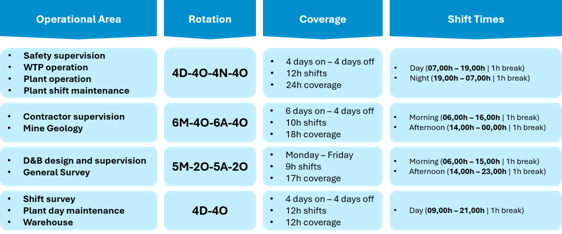
(D = day shift; N = night shift; M = morning shift; A = afternoon shift; O = off days)
Figure 17‑1- Shift rosters and applicable areas
Operational performance will be managed through daily, weekly and monthly routines. These routines will cover safety, environmental compliance, mining performance, plant throughput, recovery, product quality, maintenance performance, contractor performance, ROM and product stocks, logistics, cost control and improvement actions. Reconciliation will be used to compare the mine plan, grade control model, mined quantities, ROM stocks, plant feed, laboratory results, concentrate production, by-products, tailings and shipment records.
The Operations Management model also supports progressive workforce development. Savannah will build a competent operating workforce, prioritising Portuguese and local/regional capability where practical, while using targeted specialist expertise where required to reduce start-up and ramp-up risk. Contractor personnel will be required to work within Savannah's site standards, HSE requirements, operational routines and compliance framework.
Overall, the Operations Management model is intended to provide clear accountability, strong owner control, disciplined contractor management, stable processing performance, reliable technical governance and integrated operational decision-making. It provides the steady-state operating framework that the Operational Readiness programme is designed to mobilise, test and hand over into operations.
18. LITHIUM PRODUCT & BY-PRODUCTS PRICING
18.1. PRODUCT PRICING
Lithium has moved from a niche industrial metal to a globally recognised critical raw material, driven primarily by lithium-ion battery demand from electric vehicles and stationary energy storage. Demand has grown more than tenfold over the last 15 years to over 1.5Mt of Lithium carbonate equivalent ('LCE') and is forecast by Benchmark Mineral Intelligence ('BMI') to increase to approximately 5Mt LCE by 2040.
Supply has broadly kept pace to date through new hard-rock and brine developments, particularly in Australia, South America, China and Africa. However, the market is expected to remain close to balance through the remainder of the 2020s before tightening materially in the 2030s as demand growth outpaces risk-adjusted supply additions and the market is expected to tip into deficit. This supports a constructive long-term price outlook for lithium products, including spodumene concentrate.
LITHIUM SUPPLY
(Market data taken from Benchmark Minerals Intelligence Q1 2026 Lithium Forecast Report unless otherwise stated)
Currently lithium raw material supply (1.6Mt LCE in 2025) is dominated by production of spodumene concentrate from the mining of pegmatite ore (c.56% of supply), and lithium chemical production from brines (c.31%). The balance is produced as concentrates from mining other lithium bearing minerals either from pegmatite or other host rocks (c.10%), and recycling (c.3%).
For chemical production specifically (1.3Mt LCE), China's large refining industry dominates the market accounting for 67% of production, followed by Chile (22%), Argentina (7%) and Australia, Indonesia and South Korea with just over 1% of production each.
Looking ahead, lithium raw material supply is expected to grow at a compound annual growth rate of approximately 7% through to 2040, resulting in a 2.8 times increase in supply to 4.5Mt LCE. Recycling is expected to be by far the fastest growing contributor and is expected to surpass both brine (24% share by 2040) and other hard rock supply (9%) during the 2030s to become the second largest source of supply (31%) by 2040. Spodumene is expected to maintain its number one position but is also expected to see the slowest growth rate and hence lose market share to the other supply sources over the forecast period (36% in 2040).
Figure 18‑1 illustrates the weighted lithium supply by region in LCE tonnes.
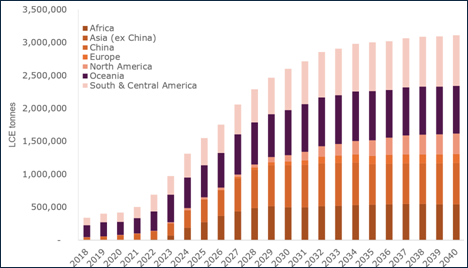
Figure 18‑1- Lithium Supply by Region, excluding recycling (~1.4Mt by 2040)
(Source: Benchmark Mineral Intelligence Q1 2026 Lithium Forecast Report)
LITHIUM DEMAND
(Market data taken from Benchmark Minerals Intelligence Q1 2026 Lithium Forecast Report unless otherwise stated)
Lithium batteries, used in electric vehicles, mobile electronics and stationary battery storage systems have been the dominant driver of lithium demand growth over the past 15 years. At present, lithium consumption for batteries accounts for approximately 90% of the 1.6Mt LCE total global demand, compared to 10% for industrial demand, which includes lithium's use in ceramics, glassware and lubricants as well as other applications.
Within the battery applications, electric vehicles represent the biggest demand sector, accounting for 72% of overall lithium demand from batteries.
While electric vehicle sales have seen strong growth over the past 15 years, demand from BESS applications has seen extremely rapid growth over the past 5 years. With the increased contribution of renewable energy into grid power, greater use of back-up power facilities at industrial sites and increased use in residential settings, lithium demand from stationary battery storage applications has grown an estimated 19 times since 2020 and now accounts for c.23% of total lithium demand from batteries. Mobile electronics and other applications account for the remaining c.5% of demand.
Looking ahead, total lithium demand is expected to grow by c.3 times out to 2040 (4.9Mt LCE), equating to a near 8% compound annual growth rate. Battery demand is set to remain the dominant demand driver, growing a c.8% per annum and increasing its market share to 93%. Underlying this growth is further uplift in electric vehicle sales, with total sales expected to approach 80 million units by the end of the forecast period with penetration rates reaching over 60%, creating lithium demand of c.3.7Mt LCE (80% of total battery demand and 75% of total lithium demand). BESS demand is also expected to continue to grow, though not at recent rates. Total BESS demand is expected to reach 0.7Mt LCE by the end of the forecast period with its share of total battery demand falling to around 15%. Mobile electronic and other battery applications maintain their 5% stake, accounting for over 0.2Mt LCE of demand. Industrial demand is expected to more than double to c.0.4Mt LCE but see its share of overall lithium demand fall to around 7%. Figure 18-2 shows the projected global demand by application.
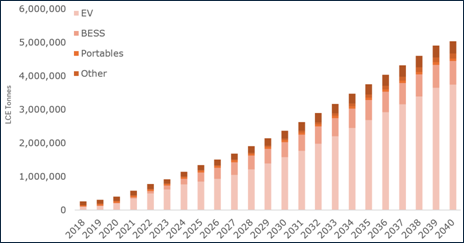
Figure 18‑2- Lithium Global Demand Forecast
(Source: Benchmark Mineral Intelligence Q1 2026 Lithium Forecast Report)
MARKET BALANCE
(Market data taken from Benchmark Minerals Intelligence Q1 2026 Lithium Forecast Report unless otherwise stated)
BMI forecasts continuing market tightness during the remainder of the 2020s and into the early 2030s. Small surpluses are forecast during this period (max c.140kt LCE), but these are 5% or less of total demand indicating a market broadly balanced as opposed to significantly oversupplied. Furthermore, BMI highlight that if BESS growth were to continue at recent rates and the Chinese electric vehicle market was to see a further pickup, the market could tighten further in the medium term. Market balance forecast is illustrated in Figure 18-3.
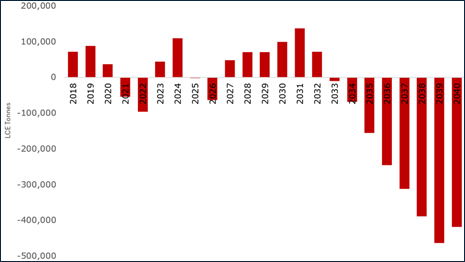
Figure 18‑3- Lithium Market Balance Forecast
(Source: Benchmark Mineral Intelligence Q1 2026 Lithium Forecast Report)
As with many metal markets, closely synchronising supply with demand has been challenging in lithium with fluctuations in demand and supply development timelines often impacted by permitting challenges. This has led to periods of both under and oversupply in recent years and corresponding high and low prices. However, in broad terms, global supply, which exceeded demand in 2015, grew by 5 times to keep pace with demand through to 2025 as new projects were brought online in Australia, South America and Africa. At present, market conditions are relatively tight due to robust demand and some curtailments to supply, principally in China and Australia.
In the longer term, the outlook is for the supply side to be seriously challenged to meet future growth in demand on the timescale required. Even after factoring in the risked development of currently known projects in the development pipeline, significant further supply capacity will be required to bring the market into balance. For example, to balance BMI's maximum forecast deficit (463kt LCE, 2039) alone would require the equivalent annual output of c.18 phase 1 Barroso Lithium Projects to be available at that time. Against this level of market tightness, competition for existing supply is going to become increasingly fierce, which implies upside risk to pricing. Furthermore, to achieve the level of sustained development within the global lithium industry required to balance the market, sufficiently high pricing will be needed to incentivise the billions of dollars of investment required.
LITHIUM SPODUMENE CONCENTRATE PRICE ASSUMPTIONS
Spot prices for 6% Li2O spodumene concentrate rose sharply from less than US$600/t in June 2025 to approximately US$3,000/t in May 2026, before settling around US$2,300/t today. Savannah's study uses a consensus forecast based on a set of seven well-known international banks, brokers and metals market pricing consultants, adjusted for FOB Portugal delivery and the Project's planned minimum 5.5% Li2O concentrate specification.
Table 18‑1 shows Savannah's pricing assumption on a SC6.0 and SC5.5 FOB basis respectively.
Table 18‑1- Spodumene Concentrate Pricing Assumption Adjusted to SC5.5 FOB Portugal (US$/t)
|
Year |
2026e |
2027e |
2028e |
2029e |
2030e |
2031e |
2032e |
2033e |
2034e |
|
SC6 Consensus price adjusted to FOB Portugal |
2,229* |
2,492* |
2,311* |
2,062 |
1,897 |
1,729 |
1,801 |
1 ,890 |
1,928 |
|
Consensus price adjusted to SC5.5 FOB Portugal |
2,043* |
2,284* |
2 ,118* |
1,890 |
1,739 |
1,585 |
1,651 |
1,733 |
1,767 |
*2026-2028 prices are not used in forecast as no sales are made in these years
|
Year |
2035e |
2036e |
2037e |
2038e |
2039e |
2040e |
2041e |
2042e |
L-T |
|
SC6 Consensus price adjusted to FOB Portugal |
1,960 |
2,008 |
2,008 |
2,008 |
2,008 |
2,008 |
2,008 |
2,008 |
2,008 |
|
Consensus price adjusted to SC5.5 FOB Portugal |
1,796 |
1,841 |
1,841 |
1,841 |
1,841 |
1,841 |
1,841 |
1,841 |
1,841 |
Figure 18-4 shows how Savannah's SC5.5 pricing assumption compares in the long term to current SC6.0 CIF China and SC6 FOB Australia prices.
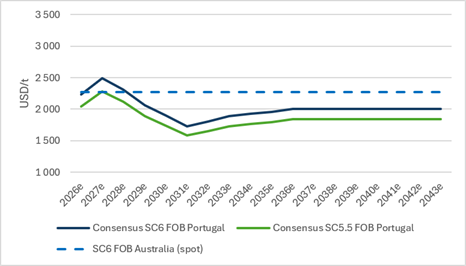
Figure 18‑4- Barroso Lithium Project Spodumene Price Forecast
OFFTAKE CONTRACTS
In June 2024 Savannah announced that it had entered a Strategic Partnership agreement with AMG Critical Materials N.V. ('AMG'). Part of that agreement related to future spodumene offtake from the Barroso Lithium Project. The base case scenario would see AMG take or pay for 45ktpa of concentrate during the first 5 years of operation with a possibility of doubling the tonnage and duration to 90ktpa and 10 years respectively, if AMG provides Savannah an acceptable 'full financing solution' for the Project. The agreement states in any case that the offtake will be based on prevailing market pricing.
Regarding the currently unallocated balance of future spodumene concentrate product, Savannah initiated a second partnership process in the end of 2025 which has received significant interest from a range of counterparties looking to secure future offtake. Discussions are advancing with a group of counterparties and Savannah expects to conclude this process later in 2026 with an offtake agreement which covers the majority of its unallocated production.
Savannah notes recent multi-year spodumene offtake agreements announced to the market, e.g. PLS/Canmax Technologies (February 2026) and Lithium Ionic/Yahua Group/Grand Chen (March 2025) which feature a minimum US$1,000/t SC6 price, significant pre-payment finance and no cap price.
As with AMG, Savannah's additional commercial partner(s) will be selected on the competitiveness of their proposal and associated terms, but also on their strategic fit with the Project and the Company. A portion of production may remain unallocated for sales into the spot market.
CONCLUSION
Spodumene concentrate is the single largest source of supply to the global lithium market and this situation is expected to continue through the remainder of the 2020s and throughout the 2030s. Savannah's Barroso Lithium Project can supplement the spodumene supply sector and make a meaningful contribution to a new supply base in Europe. However, with strong demand growth expected in lithium-ion batteries, global lithium supply is expected to be severely challenged to keep pace. As a result, a period of near balance in the market in the short to medium term is expected to give way to far tighter conditions in the long term despite significant development across all lithium supply subsectors. These competitive market conditions coupled with the need to encourage greater supply are expected to be supportive of lithium product prices, including spodumene concentrate.
Based on recent price forecasts from a range of international banks, brokers and pricing consultants, Savannah has produced a real price forecast for the Project's economic model based on the expected 5.5% Li2O product specification and making sales on an FOB basis. The Project price forecast for SC5.5 FOB Portugal from 2029 onwards ranges between a maximum of US$1,890/t (2029) and a minimum of US$1,585/t (2031), resulting in an average price per tonne of US$1,788 SC5.5 (US$1,951/t SC6.0)/t.
18.2. BY-PRODUCTS PRICING
In addition to its primary product, spodumene concentrate (5.5% Li2O), the operation will generate several mineral by-product streams, including DMS Floats, Process Tails, Mica Concentrate and Flotation Tails. These by-products are typical of a clean spodumene-rich mineralogy and consist mainly of feldspar, quartz and mica. While not particularly high-value materials individually, their proximity to established industrial markets in Iberia provides a strong competitive advantage in terms of logistics and potential commercialisation.
The project benefits from its location near the Iberian ceramics and industrial minerals industries, especially in Portugal and Spain. This proximity supports potential sales into sectors such as ceramics, feldspar-based products, mica products and potentially quartz-related industries. In addition to generating incremental revenue, by-product utilisation contributes to improved sustainability by reducing tailings volumes, improving material efficiency and supporting circular economy principles.
Each by-product stream has distinct characteristics. DMS Floats have chemical properties similar to low-to-medium grade feldspar, with alkali content around 8.6%, making them suitable for ceramic applications such as tiles. Flotation Tails Stockpile is a fine-grained material comparable to feldspathic sand, with lower alkali content and relatively low impurities, making it suitable for sand-type applications. Process Tails contain higher impurity levels but have elevated lithium content, which could be beneficial in certain ceramic blends. Mica concentrate material may be suitable for niche industrial uses, depending on beneficiation performance and product consistency.
Estimated annual production volumes are significant, totalling hundreds of thousands of tonnes per year for each stream. However, not all produced material is expected to be sold, and commercialisation assumptions are based on realistic market absorption capacity rather than total production.
The commercial assessment of by-products was conducted through technical evaluation, independent market studies and direct engagement with potential customers. External studies focused on the Iberian ceramics and industrial minerals markets, which represent the most relevant demand centres. These studies confirm that feldspar consumption in Iberia exceeds approximately 3.5 Mt per year, with additional demand for quartz and feldspathic sands. Spain represents the largest market, while Portugal is a smaller but strategically important regional consumer.
Benchmarking against comparable products shows that DMS Floats align most closely with existing feldspar products used in the ceramics industry, while Flotation Tails are more comparable to feldspathic sands. This supports their positioning in established markets with known demand and pricing structures. Public market data further confirms that the Iberian feldspar market is large, mature and partially dependent on imports, particularly in Spain, reinforcing the opportunity for locally sourced alternatives.
Direct engagement with market participants, including industrial users, traders and producers, has confirmed interest in the by-product streams. This process involved sharing technical data and, in some cases, product samples. As a result, Savannah has secured non-binding Letters of Intent (LOIs) with selected counterparties, demonstrating potential demand and commercial viability.
The LOIs indicate potential sales volumes and pricing ranges, which were used as a basis for DFS assumptions. The total indicative volume discussed across counterparties reaches up to approximately 865 ktpa. For conservative modelling, the project assumes a combined sales of around 600ktpa comprised of different streams, representing a portion of the expected production.
Pricing assumptions were adjusted to an ex-works basis by accounting for transportation and logistics costs. Sales are expected to be distributed across Portugal, Spain, Italy and potentially other markets, depending on logistics and customer requirements. Most product is expected to be transported by truck, with some shipments involving combined road and maritime logistics. Differentiated pricing will be applied to each stream dictated by different commercial conditions, nevertheless for the purposes of revenue calculations into the DFS, a weighted average ex-works sales price for the combined projected by-products sales of approximately US$27/t was applied, derived from product placement as per market study and one on one engagement with potential clients.
Overall, the by-product strategy supports both economic and environmental objectives. It provides an additional revenue stream, reduces waste and tailings management requirements, improves site efficiency and strengthens the project's role in supplying raw materials to regional industries. The combination of strong local demand, favourable logistics, confirmed market interest and potential demand growth for Savannah's by-products supports the conclusion that these streams represent a value component of the Barroso Lithium Project that cannot be underestimated.
19. PROJECT FINANCIAL MODEL
The Barroso Lithium Project shows outstanding financial performance, with key metrics to be highlighted including a pre-tax NPV of US$1.2 Billion (US$913 Million post-tax), post-tax IRR of 43.2% and a payback period of only 1.9 years, reflecting the high quality of the asset, which still holds plenty of potential with future expansion plans already in the agenda, that if materialised will significantly enhance the value of the Project and significantly escalate investor's return.
Key financial and operational metrics are outlined in the following tables:
Table 19‑1- Barroso Lithium Project Key Metrics
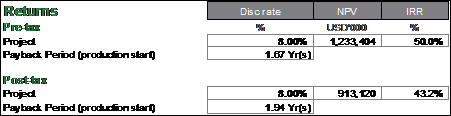
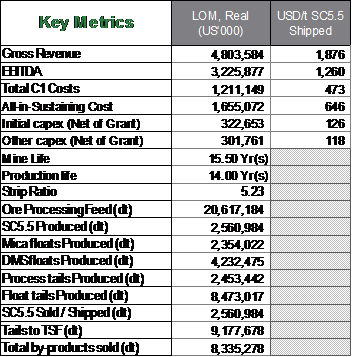
PROJECT SENSITIVITY
The sensitivity analysis confirms the Project's strong economic resilience across a broad range of key operating and financial assumptions. While, as expected for a mining operation, project value is most sensitive to changes in spodumene prices, the analysis demonstrates that the Project continues to generate robust post-tax returns under conservative pricing scenarios.
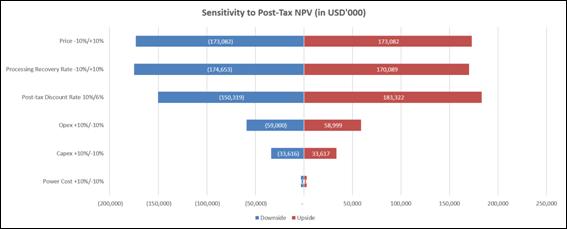
Figure 19‑1- Barroso Lithium Project Sensitivity Analysis
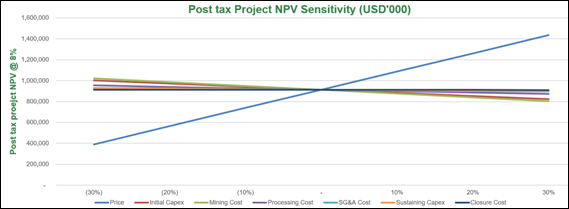
Figure 19‑2- Barroso Lithium Project Sensitivity Analysis
Sensitivity to operating costs, capital expenditure, processing recoveries and the discount rate is comparatively moderate, reflecting the quality of the orebody, the competitiveness of the cost structure. Overall, the analysis reinforces confidence that the Project is well positioned to deliver attractive long-term value through commodity price cycles.
20. PROJECT RISK ASSESSMENT
A structured project risk assessment was undertaken for the Barroso Lithium Project using Savannah Resources' corporate risk management framework through multidisciplinary workshops involving Savannah personnel, engineering consultants and subject matter experts. The assessment considered legal and permitting, technical, operational, environmental, social, commercial, financial and project delivery risks across the project lifecycle. Risks were assessed using the corporate 5×5 likelihood-consequence matrix and assigned accountable owners together with defined mitigation actions.
The register contains 120 project risks, 2 of which scored as extreme.
Table 20‑1- Barroso Lithium Project Risk Count Summary
|
Risk Severity |
Count |
|
1 Insignificant |
0 |
|
2 Low |
4 |
|
3 Moderate |
62 |
|
4 High |
52 |
|
5 Extreme |
2 |
|
Total |
120 |
The risk profile presented in this Executive Summary represents the inherent risk position. Residual risk will continue to be refined as mitigation measures are implemented through detailed engineering, procurement, construction, operational readiness and commissioning.
Table 20‑2- Barroso Lithium Project Risk Assessment Summary
|
Category |
Risk or sensitivity |
Potential impact |
Mitigation / control |
|
Commercial & Market |
Spodumene concentrate realised price and commercial terms below DFS assumptions. |
Extreme |
Marketing strategy, customer diversification, conservative pricing assumptions and continuous market monitoring. |
|
Project Delivery & Construction |
Commissioning, performance demonstration and operational handover not achieved as planned. |
Extreme |
Integrated commissioning plan, operational readiness programme, early owner involvement and staged performance testing. |
|
Legal, Regulatory & Permitting |
RECAPE approval delayed or DCAPE not obtained. |
High |
Early authority engagement, experienced permitting consultants and proactive management of approval actions. |
|
Legal, Regulatory & Permitting |
DIA pre-construction conditions not completed or evidenced. |
High |
Controlled compliance matrix, named action owners, independent reviews and progressive submission of deliverables. |
|
Legal, Regulatory & Permitting |
Land access and possession not secured when required. |
High |
Accelerated land acquisition process, stakeholder engagement and prioritisation of critical work fronts. |
|
Processing & Product Quality |
Process plant or critical equipment underperforms design basis. |
High |
Conservative design basis, vendor engagement, testwork validation and performance monitoring. |
|
Project Delivery & Construction |
Integrated project schedule not achieved. |
High |
Integrated planning, interface management, schedule reviews and critical-path monitoring. |
|
Tailings & Water Management |
Tailings storage capacity unavailable when required. |
High |
Progressive TSF development, capacity reconciliation and staged construction planning. |
|
Financial & Economic |
Total Project operating costs exceed DFS assumptions. |
High |
Cost control, competitive procurement, operational optimisation and continuous performance monitoring. |
|
Project Delivery & Construction |
Initial water-management infrastructure unavailable before site disturbance. |
High |
Integrated water infrastructure planning, staged construction and early completion of critical water-management facilities. |
The most material project risks relate to commodity pricing, permitting, land access, commissioning, process plant performance, project delivery, water and tailings management, and achievement of the Project's operating cost assumptions. Each of these risks have been assigned to a responsible owner and is supported by defined mitigation measures. Risk management will remain an integral component of detailed engineering, construction, commissioning and operations, with the register reviewed periodically to reflect project progress, emerging risks and the effectiveness of implemented controls.
21. PROJECT OPPORTUNITIES & FUTURE WORK
The work performed to complete the DFS has identified a structured set of opportunities and further work to be progressed beyond the current study phase. The opportunities represent potential sources of additional value, resilience, production growth or strategic flexibility that are not included in the DFS base-case valuation unless otherwise stated. The further work comprises the engineering, investigation, permitting, procurement and operational-readiness activities required to progressively mature the Project through FEED, detailed design, construction, commissioning and operations. Together, these registers provide a controlled framework for protecting the DFS basis while systematically pursuing value enhancement and reducing residual execution and operating uncertainty.
OPPORTUNITIES
An opportunity assessment has been completed for the Barroso Lithium Project following review of the DFS workstreams and contributions from Savannah personnel and specialist advisers. The current register identifies 25 opportunities across the resource base, project expansion, mining and processing, infrastructure, sustainability and commercial value capture.
The opportunities range from near-term design and operating optimisations to longer-term strategic options. They provide potential routes to extend mine life, increase production and payable recovery, reduce capital and operating costs, improve resilience and environmental performance, and strengthen the Project's position in the European battery and industrial-minerals value chains.
Table 21-1- Project opportunities
|
Opportunity Theme |
Principal opportunities |
Potential contributions |
|
Resource growth and mine-life extension |
Additional Aldeia mapping and drilling; Reservatório and targeted concession extensions; wider resource conversion and regional exploration; selective aggregation of nearby resource or ore-feed options. |
Additional mineable inventory, earlier access to higher-grade feed, longer mine life and greater scheduling flexibility. |
|
Production growth and strategic expansion |
Protection of a future increase in processing throughput to approximately 3 Mtpa; long-term ambition to produce approximately 500 ktpa of SC5.5; and a structured future Phase and beyond development roadmap. |
Higher production and project value, extended use of infrastructure, stronger offtake leverage and a larger contribution to European supply chains. |
|
Mining and material movement |
Alternative ROM transport by conveyor or similar system; periodic reassessment of contractor, hybrid and owner-operated mining models; and progressive transition to electric, automated or autonomous mining equipment. |
Lower haulage and mining costs, reduced traffic and emissions, improved operational control and potential productivity gains. |
|
Processing and product optimisation |
Sensor-based ore sorting; increased plant availability or utilisation; ore-specific grind and recycled-water reagent optimisation; grade-recovery-payability optimisation and a possible third cleaner stage; a low-temperature-tolerant reagent; and diversified by-product beneficiation and markets. |
Higher payable production and recovery, lower power and reagent consumption, improved plant stability, reduced heat-tracing requirements and additional product revenue. |
|
Water, tailings, infrastructure and closure |
Optimised water storage, recycling and reuse; greater use of suitable site-won material and adaptive TSF staging; alternative long-term pit uses and closure configurations; and potential small-scale pumped-storage generation. |
Lower freshwater demand, imported material, haulage, early capital and closure liability, together with potential environmental, community and energy benefits. |
|
Operations, logistics, financing and market value |
Integrated mine-to-product reconciliation and continuous improvement; larger vessel parcels and a qualified secondary route; financing and refinancing optimisation; controlled physical marketing and trading; and support for regional refining and CAM development. |
Earlier loss detection, stronger contractor control, lower freight and financing costs, improved resilience, greater margin capture and enhanced strategic value. |
The opportunity register is intended to preserve and govern potential value beyond the defined DFS base case. No incremental production, revenue, cost saving or financing benefit was included in the financial model. Value should be recognised only when the relevant technical, commercial, permitting, contractual or financing basis has been demonstrated and approved.
· Detailed design and pre-FID: progress opportunities that can be validated through testwork, geotechnical information, vendor confirmation, competitive procurement or controlled design optimisation.
· Commissioning and operations: capture plant availability, recovery, reagent, grind, reconciliation and continuous-improvement opportunities through controlled operating trials and formal change management.
· Expansion and strategic options: protect space, interfaces and decision gates for resource growth, higher throughput, regional feed aggregation, downstream partnerships and future fleet technologies without committing unsupported capital or value.
· Governance: maintain each opportunity in the controlled register with an accountable owner, enabling conditions, evaluation timing and evidence required for inclusion in an approved business case.
This approach allows the Project to retain credible upside while preserving the integrity and robustness of the DFS base case.
FURTHER WORK
A structured Further Work Register has been established for the Barroso Lithium Project following review of the DFS workstreams. The agreed register contains 25 activities that are legitimately required after completion of the DFS, spanning post-DFS resource definition, FEED and detailed design, permitting, procurement, construction planning, operational readiness and pre-commissioning assurance.
The register is not intended to defer work required to validate the DFS base case. Technical, commercial, cost, schedule and financial matters necessary to support the DFS conclusions were closed before completion of DFS. The remaining activities will progressively convert the DFS basis into vendor-confirmed designs, executable work packages, permits, operating systems and controlled handover evidence.
Table 21-2- Further work activities
|
Further work themes |
Principal activities |
Purpose and delivery outcomes |
|
Resources and mine-plan development |
Post-DFS drilling to improve confidence in orebody geometry, weathering, internal waste and deeper zones, followed by updates to the Mineral Resource, Ore Reserve and mine plan when the results become available. |
Improved geological confidence, refined mine planning and a controlled basis for subsequent schedule and reserve updates. |
|
Process plant and treatment systems |
Update crushing simulations using final hardness data and vendor input; complete detailed process-water and wastewater-treatment design; and undertake reliability, availability, maintainability, operability and single-point-failure reviews, including required redundancy and strategic spares. |
Vendor-confirmed equipment duties, improved plant reliability and a design suitable for procurement, commissioning and stable operations. |
|
Geotechnical, civil and site infrastructure |
Complete geotechnical investigations for the plant, roads, Covas Bridge, TSF and reservoirs; reconcile earthworks and the material balance; complete road and vehicle reviews; finalise the Covas Bridge execution and contingency plan; and develop detailed electrical reliability, energisation and communications systems. |
Reduced construction uncertainty, confirmed quantities and interfaces, safe site access, and reliable power and communications for construction and operations. |
|
Environmental, social and decarbonisation |
Complete seasonal C-190/Aldeia baseline surveys; finalise social-management plans and the obligations register; implement the decarbonisation roadmap and maintain the greenhouse-gas inventory; and confirm the technical and commercial basis for HVO/B100 before implementation. |
Support for future approvals, controlled delivery of commitments and evidence-based reduction of Project emissions. |
|
Logistics, commercial and delivery planning |
Prepare the equipment-specific abnormal-load plan; tender and contract outbound product logistics; complete dangerous-goods, route-security and emergency-response plans; develop the asset-level lifecycle and sustaining-capital plan; and approve the Owner's construction organisation and mobilisation profile. |
Executable construction and logistics arrangements, improved commercial certainty, defined lifecycle funding and clear Owner accountability. |
|
Operational readiness, water, tailings and HSE |
Complete operational-readiness systems and gate evidence; finalise outsourced laboratory arrangements; complete detailed water-treatment and discharge design; maintain the TSF deposition and raise plan; approve the OMS Manual, TARP, EPRP, Engineer-of-Record and independent-review governance; and develop the Operational HSE Hazard Register through formal hazard studies. |
Controlled transition from project delivery to operations, compliant water and tailings management, and verified readiness of people, systems and critical controls. |
The Further Work Register should be maintained as a controlled delivery register rather than as a narrative list of recommendations. Each item should have an accountable owner, timing, predecessor activities, defined deliverable, acceptance criteria, status and a clear link to the Project schedule and assurance process.
· Pre-FID and FEED: complete work required to confirm the execution strategy, update quantities and vendor basis, progress critical approvals and demonstrate that residual risk is acceptable before commitment.
· Detailed design and procurement: convert the DFS basis into approved design criteria, equipment guarantees, tender packages, interface documents and execution plans.
· Construction and commissioning: close readiness, safety, logistics, energisation, emergency-response and handover requirements through formal gates and evidence packs.
· Operations and lifecycle: maintain and update the drilling, sustaining-capital, decarbonisation, TSF, HSE and performance-management work as operating data become available.
· Governance: close an item only when the defined deliverable and acceptance evidence have been approved; transfer any resulting actions into the controlled Project schedule, risk register, opportunity register or operational management system.
This approach ensures that the work remaining after the DFS is transparent, sequenced and governed, while preserving the principle that the DFS itself must stand on a complete and defensible technical and financial basis.
Competent Persons
The information in this announcement that relates to exploration results is based upon information compiled by Mr John Morris Pereira, Exploration Manager of Savannah Resources Limited. Mr Pereira is a Member of the European Federation of Geologists (EFG) and has sufficient experience which is relevant to the style of mineralisation and type of deposit under consideration and to the activity which he is undertaking to qualify as a Competent Person as defined in the December 2012 edition of the "Australasian Code for Reporting of Exploration Results, Mineral Resources and Ore Reserves" (JORC Code). Mr Pereira consents to the inclusion in the report of the matters based upon the information in the form and context in which it appears.
The information in this release that relates to Mineral Resources and Exploration Targets for the Grandão, Reservatório, Pinheiro, NOA, and Aldeia deposits, including lithium (in the form of Spodumene mineralization) and Co-Products - Industrial Minerals (Quartz and Feldspar), as well as the Barroso Lithium Project Exploration Targets is based on information compiled by Mr Shaun Searle who is a Member of the Australasian Institute of Geoscientists. Mr Searle is an employee of Ashmore Advisory Pty Ltd and independent consultant to Savannah Resources Plc. Mr Searle has sufficient experience, which is relevant to the style of mineralisation and type of deposit under consideration and to the activity which he has undertaken to qualify as a Competent Person as defined in the 2012 Edition of the 'Australasian Code for the Reporting of Exploration Results, Mineral Resources and Ore Reserves'. Mr Searle consents to the inclusion in this report of the matters based on this information in the form and context in which it appears.
The information in this release that relates to Mineral Reserves, including lithium (in the form of Spodumene mineralization) at the Barroso Lithium Project is based on information compiled by Mr Allan Earl who is a Fellow of the Australasian Institute of Mining and Metallurgy. Mr Earl is an employee of Datamine Australia Pty Ltd (Snowden Optiro) and an independent consultant to Savannah Resources Plc. Mr Earl has sufficient experience, which is relevant to the style of mineralisation and type of deposit under consideration and to the activity which he has undertaken to qualify as a Competent Person as defined in the 2012 Edition of the 'Australasian Code for the Reporting of Exploration Results, Mineral Resources and Ore Reserves'. Mr Earl consents to the inclusion in this report of the matters based on this information in the form and context in which it appears.
The information in this release that relates to metallurgy and metallurgical test work has been reviewed by Mr Robert Simmons, MAusIMM, B. Eng. (Chemical Engineering). Mr Simmons is not an employee of the Company but is engaged as a contract consultant. Mr Simmons is a Member of the Australasian Institute of Mining and Metallurgy, he has sufficient experience with the style of processing response and type of deposit under consideration, and to the activities undertaken, to qualify as a competent person as defined in the 2012 edition of the "Australian Code for the Reporting of Exploration Results, Mineral Resources and Ore Reserves". Mr Simmons consents to the inclusion in this report of the contained technical information in the form and context as it appears.
Forward Looking Statement
This announcement contains forward-looking statements regarding the Company, the Barroso Lithium Project, and the results of the DFS. Words such as 'anticipates,' 'expects,' 'intends,' 'plans,' 'believes,' 'seeks,' 'estimates,' and similar expressions are often, but not always, intended to identify forward-looking statements. These statements are not guarantees of future performance and are based on current expectations, estimates and assumptions, and are subject to risks, uncertainties and other factors, some of which are beyond the Company's control, and/or are difficult to predict, that could cause actual results to differ materially from those expressed or implied by such statements. Factors that may cause such differences include changes in commodity prices, financing availability, permitting outcomes, operating costs, regulatory requirements and general economic conditions. The Company cautions security holders and prospective security holders not to place undue reliance on these forward-looking statements, which reflect the view of the Company only as of the date of this announcement. Except as required by the Financial Conduct Authority, applicable law or the AIM Rules for Companies, the Company will not undertake any obligation to release publicly any revisions or updates to these forward-looking statements to reflect events, circumstances, or unanticipated events occurring after the date of this announcement.
DFS Cautionary Statement
The DFS has been completed to assess the technical and economic viability of the Barroso Lithium Project and to support decisions relating to project development, financing and implementation. The DFS is based on a number of assumptions, estimates and forecasts which, whilst considered reasonable by the Company and its advisers at the time of preparation, may prove to be inaccurate or incomplete. Key assumptions include, amongst others, assumptions relating to lithium concentrate pricing, operating costs, capital expenditure, exchange rates, taxation, mining dilution and recovery, metallurgical performance, product quality and recoveries, infrastructure availability, labour availability, contractor performance, financing arrangements and the timing and receipt of all necessary regulatory approvals.
The financial metrics presented in the DFS, including NPV, IRR, payback period and cash flow forecasts, are estimates only and should not be regarded as guarantees of future financial or operating performance. There can be no assurance that the Project will achieve the economic outcomes described in the DFS or that the assumptions underpinning the DFS will be realised. The development of the Project remains subject to, amongst other matters, the successful securing of project financing, the receipt and maintenance of all required licences, permits and regulatory approvals, the continued availability of acceptable infrastructure and services, and the Company's ability to execute the Project in accordance with the assumptions and schedules contained within the DFS. Investors should not place undue reliance on the production forecasts, economic projections or forward-looking statements presented in this announcement. Actual outcomes may differ materially from those described in the DFS.
The DFS reflects market, technical and regulatory conditions prevailing at the effective date of the study. Future lithium market conditions, including pricing, demand, battery chemistry developments, global supply growth and European critical raw materials policy, may differ from those assumed in the DFS and could materially impact Project economics and development outcomes.
Disclaimer
Benchmark Mineral Intelligence ("Benchmark") has not prepared, commissioned, reviewed, approved or participated in the preparation of this Definitive Feasibility Study or any related technical, economic or project assessment. Any Benchmark data, forecasts or commentary reproduced or summarised in this report are included solely for general market context and remain independent Benchmark research. Their inclusion should not be interpreted as Benchmark's verification or endorsement of the Barroso Lithium Project, its assumptions, conclusions or investment merits. Benchmark accepts no responsibility or liability for the use of its information in this report or for any reliance placed on the report. Benchmark research reflects the information and assumptions available at the relevant publication date and may change without notice.
Regulatory Information
This Announcement contains inside information for the purposes of the UK version of the market abuse regulation (EU No. 596/2014) as it forms part of United Kingdom domestic law by virtue of the European Union (Withdrawal) Act 2018 ("UK MAR").
Savannah - Enabling Europe's energy transition.
**ENDS**
 Follow Savannah Resources on LinkedIn
For further information please visit www.savannahresources.com or contact:
|
Savannah Resources PLC Emanuel Proença, CEO Asa Bridle, Investor Relations |
Tel: +351 963 850 959 Tel: +44 207 117 2489 |
|
António Neves Costa, Media Relations |
Tel: +351 962 678 912 |
|
SP Angel Corporate Finance LLP (Nominated Advisor & Joint Broker) David Hignell / Charlie Bouverat (Corporate Finance) Grant Barker / Abigail Wayne (Sales & Broking)
|
Tel: +44 20 3470 0470 |
|
Canaccord Genuity Limited (Joint Broker) James Asensio / Rory Blundell / Charlie Hammond (Corporate Broking) Ben Knott (Sales) |
Tel: +44 20 7523 8000 |
About Savannah
Savannah Resources is a mineral resource development company and the sole owner of the Barroso Lithium Project (the 'Project') in northern Portugal. The Project is the largest battery grade spodumene lithium resource outlined to date in Europe and was classified as a 'Strategic Project' by the European Commission under the Critical Raw Materials Act in March 2025 and was approved for a Portuguese State development Grant of up to €110m in January 2026.
Through the Project, Savannah will help Portugal to play an important role in providing a long-term, locally sourced, lithium raw material supply for Europe's lithium battery value chain. Once in operation the Project will produce enough lithium (contained in c.183,000tpa of spodumene concentrate) for approximately half a million vehicle battery packs per year and hence make a significant contribution towards the European Commission's Critical Raw Material Act goal of a minimum 10% of European endogenous lithium production from 2030.
Savannah is focused on the responsible development and operation of the Barroso Lithium Project so that its impact on the environment is minimised and the socio-economic benefits that it can bring to all its stakeholders are maximised.
The Company is listed and regulated on the AIM Market of the London Stock Exchange and trades under the ticker "SAV".
This information is provided by RNS, the news service of the London Stock Exchange. RNS is approved by the Financial Conduct Authority to act as a Primary Information Provider in the United Kingdom. Terms and conditions relating to the use and distribution of this information may apply. For further information, please contact rns@lseg.com or visit www.rns.com.
RNS may use your IP address to confirm compliance with the terms and conditions, to analyse how you engage with the information contained in this communication, and to share such analysis on an anonymised basis with others as part of our commercial services. For further information about how RNS and the London Stock Exchange use the personal data you provide us, please see our Privacy Policy.
ENDRNS may use your IP address to confirm compliance with the terms and conditions, to analyse how you engage with the information contained in this communication, and to share such analysis on an anonymised basis with others as part of our commercial services. For further information about how RNS and the London Stock Exchange use the personal data you provide us, please see our Privacy Policy.