
Antimony Targeted for Nevada Exploration

London BTC Company Limited
14 August 2026
LONDON BTC COMPANY LIMITED
US Critical Mineral Antimony Targeted for Nevada Exploration
London, New York, 14 August 2026 - London BTC Company Limited ("Company") (BTC: LSE, VINZF: OTCQB), the London Stock Exchange main market-listed company is pleased to announce that high-grade Antimony ("Sb") has been recorded only 120 metres south of the Company's Black Star Gold-Silver Project (the "Project" or "Black Star") in Nevada, USA and the Company is excited and optimistic that Antimony may also have the potential to be present on its Black Star mineral claims.
On 15 July 2026, the Company announced a gold discovery in Nevada with surface sampling reporting grades up to 16.23 g/t (0.52 oz/t Au) and 50.5 g/t silver (1.62 oz/t Ag).
It has now been determined that the gold and silver mineralisation at Black Star sits within the same trending mineralised corridor as reported Antimony mineralisation immediately to the south of the Company's mineral claims.
Detailed research by the Company's geological team has identified key and important historical data highlighting the area's potential for hosting high-grade of Antimony discoveries.
Antimony is designated as a critical mineral in the United States, reflecting its importance to U.S. economic and national security and the vulnerability of its supply chain. Antimony also has important defense applications, including its use in ammunition and other military systems.
David Lenigas, Chairman of the Company, stated, "Since its initial due diligence and ground staking, Black Star has consistently provided high-quality results. We staked this ground for its potential of high-grade gold, and the work our technical consultant has done since has now identified a critical mineral as a potential by-product of the mineralisation. A trend holding over 1% Antimony and up to 16.23 grams per tonne gold is exactly the type of asset we want in our portfolio. The United States is import-dependent for Antimony and is actively funding domestic supply, so a gold-silver project like Black Star, which may also carry an Antimony credit, is a materially more attractive proposition than either metal on its own."
Key Points
• A review of USGS and NBMG archive data has identified historical data proximal to the intrusion-related Black Star system grading greater than 1% Antimony (>10,000 ppm Sb). The result exceeded the upper limit of the analytical method used, and the true Antimony grade is unknown (USGS, MRDS, 1985).
• Antimony is designated a critical and strategic mineral by the United States Government. The USGS reports that the United States remain substantially import-reliant for Antimony, and that Antimony is one of the minerals subject to Chinese export restrictions on shipments to the United States (USGS, 2025).
• The US government has committed to a $12 billion stockpile to establish an inventory from critical and strategic mineral projects, including $10 billion in funding from the US Export-Import Bank (EXIM) and a further $2 billion in private funding (Reuters, 2026).
• Gold projects carrying an Antimony credit are attracting significant strategic capital in the United States. In May 2026 EXIM approved a US$2.9 billion senior secured loan for Perpetua Resources' Stibnite Gold Project in Idaho, a gold-Antimony development (Perpetua Resources, 2026).
• Recent engagement with Dahrouge Geological Consulting allows for immediate access to experienced field personnel for further sampling, geological mapping and technical assessment.
• The Black Star project consists of 36 mineral claims over 744 acres (3 km2) in Pershing County, Nevada. Approximately 60 miles (96 km) from the Company's Huntington-Whitman Project and 73 miles (117 km) from its Amonett-Frank Project.
• The Antimony-bearing sample lies approximately 120 m south of the Black Star claims and within the same structural corridor that returned 16.23 g/t Au and 50.5 g/t Ag from the Company's 2026 due diligence rock chip programme conducted by Schiehallion Consulting.
• Economic Sb is a recognised part of hydrothermal Au-Ag systems in the USA. The value and potential of these projects are demonstrated by the Meadow Creek region of Idaho, which represents a domestic development for the economic extraction of Gold and Antimony.
• The historical sample also returned 2% copper, 700 ppm silver, 1,000 ppm arsenic, 1,000 ppm bismuth and 700 ppm lead. This is an association characteristic of Cu-Sb-Ag sulphosalt mineralisation of the tetrahedrite group.
• This historical sample sits within mineralisation which is interpreted to occupy within the same structural trend and host rock as the sampled Black Star mineralisation. While no modern Antimony assays exist for Black Star, new Au-Sb assays will be a priority for the asset.
• Antimony was not included in the analytical suite used for the Company's 2026 rock chip programme, which was assayed for gold and silver only. Antimony will be included as standard in all future analytical suites at Black Star.
• Field Teams will be mobilised in late August, and new Gold-Antimony sampling around Black Star is a priority for these teams.
CEO Commentary
Hewie Rattray, CEO of the Company, stated:
"Black Star is rapidly developing into one of the most exciting assets in our Nevada portfolio. We originally secured the project for its high-grade gold potential, with initial sampling returning up to 16.23 g/t gold, but the identification of historical antimony mineralisation grading in excess of 1% just 120 metres from our claims adds a potentially significant new dimension to the project. At a time when the United States is placing strategic importance on securing domestic supplies of critical minerals, we believe Black Star is well positioned. Our upcoming field programme will now target this gold-silver-antimony system aggressively, and we are very excited about what the next phase of exploration could reveal."
Antimony at Black Star
The Project comprises of 36 unpatented mineral claims over 744 acres (3 km²) (Figure 1). The staked ground focuses on the historically targeted geological contact between metavolcanics and granodiorite. The contact is targeted by shafts, adits and prospect pits. A review of government databases, technical literature and historical company reports identified limited follow-up exploration since the 1980s (USGS, MRDS Records).
Historical sampling at Black Star was undertaken by the Nevada Bureau of Mines and Geology in June 1985 as part of a regional mineral inventory of the Sonoma-Gerlach Resource Area (USGS, MRDS, 1985) and is captured in the USGS Mineral Resource Data System.
Three rock samples were collected across the historical workings, sample IDs: 2928, 2929, and 2930. These samples were analysed by semi-quantitative emission spectrography, with gold determined by atomic absorption.
Recorded results from the historical samples are set out below:
|
Element |
Sample 2928 |
Sample 2929 |
Sample 2930 |
Unit |
|
Gold (Au) |
9.0 |
7.0 |
1.5 |
ppm |
|
Silver (Ag) |
2 |
7 |
700 |
ppm |
|
Antimony (Sb) |
No Data |
No Data |
>10,000 |
ppm |
|
Copper (Cu) |
150 |
700 |
20,000 |
ppm |
|
Arsenic (As) |
300 |
500 |
1,000 |
ppm |
|
Bismuth (Bi) |
500 |
700 |
1,000 |
ppm |
|
Lead (Pb) |
30 |
50 |
700 |
ppm |
|
Zinc (Zn) |
n.r. |
n.r. |
300 |
ppm |
|
Cadmium (Cd) |
n.r. |
n.r. |
50 |
ppm |
Table 1: Selected historical analytical results (USGS, MRDS, 1985).
"No Data" indicates that Antimony was not reported; this does not indicate that the element is absent. The Antimony result for sample 2930 was reported as exceeding the method's upper determination limit.
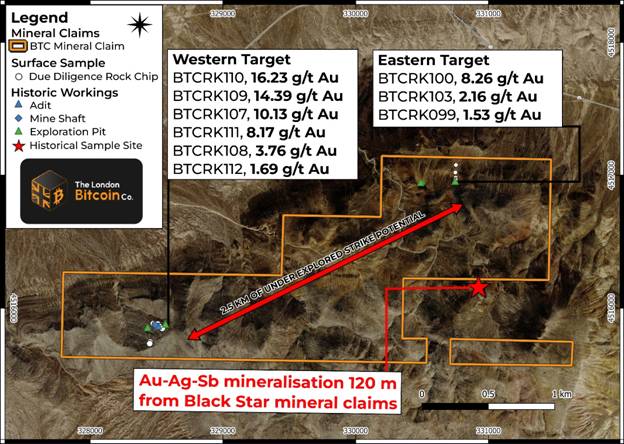
Figure 1: Black Star Project Plan, showing 2026 rock chip sample locations and historical sample site containing Au-Ag-Sb mineralisation, Pershing County, Nevada
Conducted as part of the Company's wider portfolio expansion strategy, the Company's geological consultant, Schiehallion Consulting, completed due diligence over the Black Star Project in June 2026. A total of 19 rock chip samples were collected by a qualified geologist and submitted for PhotonAssay™ analysis at MSALABS.
Sample highlights are provided below:
Western Black Star
• BTCRK110, 16.23 g/t Au, 49 g/t Ag
• BTCRK109, 14.39 g/t Au, 35.4 g/t Ag
• BTCRK107, 10.13 g/t Au, 33 g/t Ag
• BTCRK111, 8.17 g/t Au, 7.9 g/t Ag
• BTCRK108, 3.76 g/t Au, 14.5 g/t Ag
• BTCRK112, 1.69 g/t Au, 6.3 g/t Ag
Eastern Black Star
• BTCRK100, 8.26 g/t Au, 50.5 g/t Ag
• BTCRK103, 2.16 g/t Au, 22.8 g/t Ag
• BTCRK099, 1.53 g/t Au
MSALABS dried, crushed and pulverised the samples, which were then separated into 500g jars. Utilising Chrysos Corporation's PhotonAssay™ method, results were obtained within days of submission. PhotonAssay™ holds a lower detection limit of 0.015 ppm. Samples were routinely submitted for Fire Assay as part of follow-up QA/QC to confirm the validity of high-grade results. Fire Assay results were comparable to PhotonAssay™ results.
Further information relating to this sampling programme can be found in the Company's RNS dated 15th July 2026 titled 'Gold Discovery in Nevada, USA'.
Further information relating to QAQC verification of samples can be found in the Company's RNS dated 5th August 2026 titled 'Gold Assays Return up to 143.1 g/t in Nevada USA'.
Antimony and United States Critical Minerals Policy
Antimony is a designated critical and strategic mineral by the United States Government based on its importance to national defence and industry. Antimony is used in a range of defence applications, including ammunition, night vision equipment and infrared optics (CSIS, 2024). Global mine supply of Antimony is dominated by China, which has enacted export restrictions on the commodity. Additionally, there have been intermittent restrictions on the use of Chinese Antimony for end use in US military and defence weapon systems, exposing a gap in the US defence sector (CSIS, 2024). Following these developments, the US has publicly announced its support for domestic critical mineral supply chains and has backed this with significant investment through federal and national programmes.
In 2025, the United States Geological Survey (USGS) reported that the United States remained reliant on imports from China for 14 of 33 critical minerals for which it was import-dependent, with Antimony amongst the commodities subject to Chinese export restrictions to the US. To combat dependence on foreign nations, the US government has committed to a $12 billion stockpile of critical and strategic minerals through the use of the US EXIM Bank and private funding (Reuters, 2026).
Antimony prices responded accordingly, with international assessments rising to a peak of US$59,750 per tonne in July 2025 (Fastmarkets, 2026). China, Tajikistan, Russia, Bolivia and Myanmar dominate primary Antimony production; as a result, geopolitics is a key driver of the Antimony market, though this is primarily fuelled by US-China trade tensions (Fastmarkets, 2026).
The response in domestic exploration and recycling has been significant, though the building of alternative supply chains takes time. The US EXIM Bank has been a key catalyst in the development of domestic Antimony infrastructure, approving a US$2.9 billion senior secured long-term loan to Perpetua Resources Corp. (NASDAQ: PPTA) for the Stibnite Gold Project in Idaho, a gold project with a significant Antimony component, under the Make More in America Initiative (Perpetua Resources, 2026). The loan becomes available pending completion of definitive conditions expected in the second half of 2026.
Antimony is a critical and strategic mineral in the US, with global geopolitical tensions fuelling a favourable market outlook (Fastmarkets, 2026). For the Company to be exploring an Au-Ag-Sb system in Nevada, consistently ranked among the world's most attractive mining jurisdictions (Fraser Institute, 2025), positions the Company and the Black Star project within a supply chain that both federal policy and private capital are actively building. However, gold and silver will remain the primary focus of future exploration developments.
Strategic Significance for the Company
The Black Star area was staked based on its Au-Ag potential. The Project fulfilled multiple geological criteria in the targeting stage and presented a prospective target for due diligence sampling and subsequent staking. The Black Star project provided significant upside with demonstrated high-grade Au-Ag mineralisation, a large untested footprint with immediate targets, and system-scale potential. The presence of Antimony mineralisation was previously unweighted in the assessment of project value; newfound research opens potential for Antimony credits.
Black Star remains a gold-silver exploration project. The significance of the Antimony data is that it introduces the possibility of a critical mineral alongside precious metals, in a jurisdiction where domestic critical mineral supply receives direct and substantial government support. Should Antimony mineralisation be confirmed within the Black Star project, it would open the Project to potential development and funding pathways available, including United States critical minerals programmes.
The recovery of Antimony would be de-risked if recovered as a by-product of a gold operation. Antimony would represent a credit rather than the sole basis for development, with reliance on gold to cover operational costs.
The Antimony result of greater than 10,000 ppm Sb from sample 2930 is significant and materially affects exploration strategy at the Black Star project. Further sampling of mineralisation at Black Star, with the inclusion of Antimony in the assay suite, is now a high priority to determine overall Antimony grade and consistency within Au-Ag mineralisation.
Geological Interpretation
The mineralisation at the Black Star project is developed across a major contact between metavolcanic rocks to the east and granodiorite to the west, with the majority of historical workings following north-northwest trending quartz veins hosted within the granodiorite (USGS, MRDS). The Company has previously reported the presence of black tourmaline adjacent to contact zones, together with an intrusion-related geochemical signature, as supporting a proximal fertile intrusion at depth.
Antimony is found within intrusion-related systems, though it is rarely formed in economic concentrations. The most probable interpretation for the presence of Antimony would be the hydrothermal enrichment and concentration of the element alongside Au-Ag mineralisation. However, the source, consistency and extent of Antimony are currently unknown, so this interpretation should be treated as conceptual.
Further geological interpretation at this stage requires confirmation of local Antimony grade and an understanding of geological and geochemical setting. Sampling of Au-Ag-Sb mineralisation will be a priority for the Company. This field programme will be immediately followed by updated assay information, further information on the geological setting and insight into the economic relevance of mineralisation.
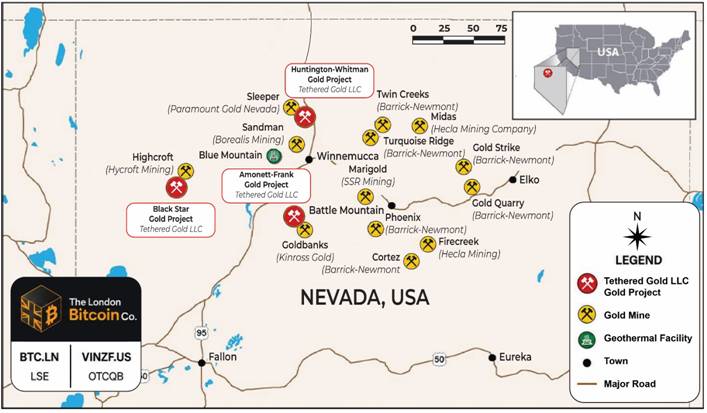
Figure 2: Black Star Project regional setting, Pershing County, Northern Nevada
Forward Work Programme
• If recoverable, multi-element re-assay of sample material from the Company's 2026 rock chip programme to include Antimony.
• Comprehensive rock chip sampling of the 2.5 km corridor between target zones, clustering around quartz networks and zones of alteration. All samples to be assayed for Au-Ag-Sb.
• Rock chip sampling programme extended to the South-East to target mineralisation trending from the historical Au-Ag-Sb recorded sample site onto the Company's mineral claims.
• Geological mapping to define the structural setting and economic significance of the separate components of the mineral system, focus on intrusion-hydrothermal relationships.
• Compilation of geoscientific data to assist in the understanding of the local geology, alteration and structural setting and to provide drill-ready targets.
• Progression of further gold and silver project staking in Nevada and Arizona, in line with the Company's previously announced phased strategy.
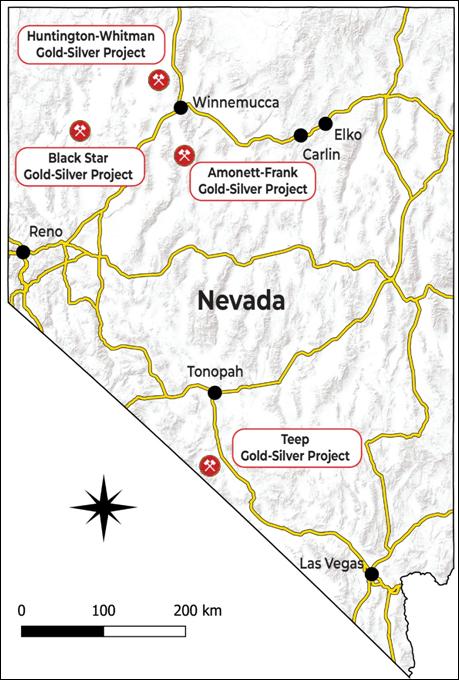
Figure 3: London BTC Company gold-silver project portfolio, State of Nevada
For further information please contact:
|
London BTC Company Limited |
Hewie Rattray, CEO hewie@ldnbtc.com David Lenigas, david@ldnbtc.com Rob Scott, Finance Director, rob@ldnbtc.com Jeremy Edelman, jeremy@ldnbtc.com |
|
First Sentinel (Corporate Adviser) |
Brian Stockbridge / Gabrielle Cordeiro / Ahmed Iqbal brian@first-sentinel.com gabrielle@first-sentinel.com ahmed.iqbal@first-sentinel.com T: +44 (0) 20 3855 5551 |
|
Clear Capital Markets (Broker) |
Bob Roberts bobroberts@clear-cm.co.uk T: +44 (0) 20 3869 6080 |
|
Marex Financial (Joint Broker and Advisor) |
Angelo Sofocleous / Matt Bailey (Broking) Email: corporate@marex.com T: +44 (0) 207 655 6000 |
About London BTC Company Limited
The Company's primary listing is on the London Stock Exchange (United Kingdom) under the ticker "BTC.L" and it trades in the USA on the OTCQB under the ticker "VINZF". The Company is building up a strategic Bitcoin holding through acquiring Bitcoin as a treasury and currency management tool and through adding Bitcoin generated from its mining operations in North America. The Company currently operates Bitcoin miners hosted across multiple third-party facilities in Indiana, Iowa, Nebraska and Texas (USA) and Labrador (Canada). As part of its hedging strategy, the Company has begun building a portfolio of US gold assets in the Tier 1 gold jurisdiction of Nevada, to complement its core Bitcoin treasury and mining operations, thereby providing shareholders with exposure to two scarce and globally recognised stores of value.
Cautionary Statement
This announcement contains references to technical information sourced from third-party reports, public databases, technical literature and government reports, including historical analytical results collected by the Nevada Bureau of Mines and Geology in 1985 and published by the United States Geological Survey. These historical results have not been verified by the Company, have not been verified by a Competent Person, are not reported in compliance with any current Mineral Resource or Ore Reserve code, and should not be relied upon as indicative of the prospectivity of the Project or of any future resource, reserve or production from the Project.
The Company emphasises that no economic study has been undertaken at Black Star, that no Mineral Resource has been estimated, and there is no certainty that the historical Antimony results described in this announcement will be reproduced by modern sampling or that a deposit of economic significance is present. This cannot be confirmed with the current information available at the project.
All the samples discussed in this release are selective in nature with a high potential for bias and should not be considered as being representative of the overall mineralised structure or zone.
While the alteration, mineralisation styles and metal associations observed to date show similarities to systems in the region and elsewhere, all such comparisons are conceptual only. There is no assurance that mineralisation encountered at Black Star will be comparable in scale, grade, mineralogy or economic characteristics to any other deposit or project referred to in this announcement. References to third-party projects, financings and government programmes are provided for market context only and do not imply that Black Star is of comparable merit or that the Company has applied for, or expects to receive, any form of government support.
Competent Person's Statement
The information in this report that relates to exploration results and technical information is based on information compiled by Fionnlagh (Finn) Hunter, Principal Geological Consultant at Schiehallion Consulting, who is a Member of the Australasian Institute of Mining and Metallurgy (AusIMM) and has sufficient experience of relevance to the styles of mineralisation and the types of deposits under consideration, and to the activities undertaken, to qualify as a Competent Person as defined in the 2012 Edition of the Joint Ore Reserves Committee (JORC) Australasian Code for Reporting of Exploration Results, Mineral Resources and Ore Reserves. Mr Hunter consents to the inclusion in this report of the matters based on the information in the form and context in which it appears.
The directors of London BTC Company Limited accept responsibility for this announcement.
References
1. Bonham, Harold F., Jr., Larry J. Garside, Robert B. Jones, Keith G. Papke, Jack Quade, and Joseph V. Tingley. A Mineral Inventory of the Paradise-Denio and Sonoma-Gerlach Resource Areas, Winnemucca District, Nevada. Nevada Bureau of Mines and Geology Open File Report 85-3. Reno: Nevada Bureau of Mines and Geology, 1985.
2. Calkins, F. C. "Gold Deposits of Slumbering Hills." University of Nevada Bulletin 32 (1938).
3. Center for Strategic and International Studies. "China Imposes Its Most Stringent Critical Minerals Export Restrictions Yet Amidst Rising Geopolitical Tensions." Dec 4, 2024
4. Du, Xiaoying, and Nico Zhang. "Antimony 2026: Ample Supply, Strategic Demand to Guide Geopolitical Oversight." Fastmarkets, January 7, 2026.
5. Fraser Institute. Annual Survey of Mining Companies, 2025. Vancouver: Fraser Institute, 2026.
6. Fulton, J. A. "The Austins' Gold Mine in the Slumbering Hills." Western Mining News, 1935-1937. Article on file, Nevada Bureau of Mines and Geology.
7. Hudson, D. M. "Summary of the Geology of the Comstock District, Nevada." In Bulk Mineable Precious Metal Deposits of the Western United States: Guidebook for Field Trips, edited by J. L. Johnson, 413-18. Reno: Geological Society of Nevada, 1987.
8. Johnson, Maureen G. Geology and Mineral Deposits of Pershing County, Nevada. Nevada Bureau of Mines and Geology Bulletin 89. Reno: Nevada Bureau of Mines and Geology, 1977.
9. Kinross Gold Corporation. 2021 Annual Mineral Reserve and Resource Statement. Toronto: Kinross Gold Corporation, 2021.
10. Perpetua Resources Corp. "Export-Import Bank of the United States Approves $2.9 Billion Loan for Development of Perpetua Resources' Stibnite Gold Project." News release, May 21, 2026.
11. Reuters. "Trump Launches $12 Billion Minerals Stockpile to Counter China - Bloomberg News." February 2, 2026.
12. Sheaffer, Kristin N. "Gold." In Mineral Commodity Summaries 2026. Reston, VA: U.S. Geological Survey, 2026.
13. Stone, B. "The Goldbanks Deposit-A Recent Discovery of Disseminated Gold in Tertiary Volcaniclastics, Pershing County, Nevada." Pershing County, NV: Kinross Gold USA Inc., 2010.
14. U.S. Geological Survey. "Black Star Claim Group." Mineral Resources Data System (MRDS), no. 10047484.
15. U.S. Geological Survey. "Black Star Claim Group." Mineral Resources Data System (MRDS), no. 10197920.
16. U.S. Geological Survey. "Dottie Group." Mineral Resources Data System (MRDS), no. 10222757.
17. U.S. Geological Survey. "Heather Arising." Mineral Resources Data System (MRDS), no. 10198567.
18. U.S. Geological Survey. "J.D." Mineral Resources Data System (MRDS), no. 10150096.
19. U.S. Geological Survey. Mineral Commodity Summaries 2025. Reston, VA: U.S. Department of the Interior, 2025.
20. U.S. Geological Survey. "NBMG Sample Site 2927." Mineral Resources Data System (MRDS), no. 10047486.
21. U.S. Geological Survey. "Unnamed Mine." Mineral Resources Data System (MRDS), no. 10125228.
This information is provided by RNS, the news service of the London Stock Exchange. RNS is approved by the Financial Conduct Authority to act as a Primary Information Provider in the United Kingdom. Terms and conditions relating to the use and distribution of this information may apply. For further information, please contact rns@lseg.com or visit www.rns.com.
RNS may use your IP address to confirm compliance with the terms and conditions, to analyse how you engage with the information contained in this communication, and to share such analysis on an anonymised basis with others as part of our commercial services. For further information about how RNS and the London Stock Exchange use the personal data you provide us, please see our Privacy Policy.
ENDRNS may use your IP address to confirm compliance with the terms and conditions, to analyse how you engage with the information contained in this communication, and to share such analysis on an anonymised basis with others as part of our commercial services. For further information about how RNS and the London Stock Exchange use the personal data you provide us, please see our Privacy Policy.