

The information contained within this announcement is deemed by the Company to constitute inside information stipulated under the Market Abuse Regulation (EU) No. 596/2014, as retained as part of the law of England and Wales. Upon the publication of this announcement via the Regulatory Information Service, this inside information is now considered to be in the public domain.
FOR IMMEDIATE RELEASE
28 July 2026
London, UK
Defence Holdings PLC
("Defence" or "the Company")
Annual Results
Defence Holdings PLC (ALRT) announces its audited Annual Results for the 12-month period ended 31 March 2026.
The full Annual Report of the Company is available on the Company’s website:https://www.defencetechnologies.com/investors .
About Defence Holdings PLC (ALRT)
Defence Holdings PLC (LSE: ALRT) is the UK's first listed software-led defence company. Its five-year strategic plan focuses on delivering sovereign digital capabilities across national security, resilience, and defence readiness.
Website:www.defencetechnologies.com
Media Enquiries
Andrew Roughan, Director
Defence Holdings PLC
Tel: +44 (0)20 3855 5551 · Email: press@defencetechnologies.com
Caution regarding forward looking statements
Certain statements in this announcement, are, or may be deemed to be, forward looking statements. Forward looking statements are identified by their use of terms and phrases such as ''believe'', ''could'', "should" ''envisage'', ''estimate'', ''intend'', ''may'', ''plan'', ''potentially'', "expect", ''will'' or the negative of those, variations or comparable expressions, including references to assumptions. These forward-looking statements are not based on historical facts but rather on the Directors' current expectations and assumptions regarding the Company's future growth, results of operations, performance, future capital and other expenditures (including the amount, nature and sources of funding thereof), competitive advantages, business prospects and opportunities. Such forward looking statements reflect the Directors' current beliefs and assumptions and are based on information currently available to the Directors.
Such statements are based on current expectations and assumptions and are subject to a number of risks and uncertainties that could cause actual events or results to differ materially from any expected future events or results expressed or implied in these forward-looking statements. Persons receiving and reading this announcement should not place undue reliance on forward-looking statements. Unless otherwise required by applicable law, regulation or accounting standard, the Company does not undertake to update or revise any forward-looking statements, whether as a result of new information, future developments or otherwise.
DEFENCE HOLDINGS PLC – Company Number 12187837
CHAIRMAN’SREPORT
FOR THE YEAR ENDED 31 MARCH 2026
The year ended 31 March 2026 was a decisive execution year for Defence Holdings PLC. Having completed the disposal of its former esports operations and repositioned itself around defence technology, the Company moved from strategic reset into the early delivery phase of a software-led defence platform. The period was marked by a strengthened leadership team, a binding strategic partnership with Whitespace, the development of the Defence Technologies delivery platform, the launch of 3 proprietary products, and the creation of a structured Accelerator for sovereign software capabilities.
The Board believes these developments materially strengthen the Company's ability to address a clear market need: rapid, sovereign, AI-enabled software capabilities that can be developed, assured and deployed at a pace more consistent with the tempo of modern conflict and national security requirements.
Strategic Transformation and Operational Progress
The Company's 2025-2030 Strategic Plan remains centred on four core technology pillars:
- Drone Warfare and Aggregation
- AI Agents for Defence Operations
- Information and Influence Warfare
- Critical Infrastructure Defence
During the year, the Company began translating those pillars into operational workstreams. In August 2025, Defence Holdings signed a Letter of Intent with Whitespace and then completed a binding Strategic Partnership with Whitespace Global Limited. The partnership provides a framework for the co-development of defence-focused software applications and AI agents on Whitespace's Collective OS platform, with initial builds for UK Ministry of Defence and allied use cases already underway during the period.
This partnership is strategically important because it gives Defence Holdings access to proven, sovereign AI infrastructure, engineering capability and established defence relationships. It also provides a practical route to product development, customer validation and secure deployment across classified, regulated and disconnected environments.
The appointment of Andy McCartney as Chief Technology Officer embedded direct technical leadership in the Company. His experience in AI infrastructure, Whitespace and mission-critical software development is central to the design, build and deployment of Defence Holdings' AI product stack. The appointment of Richard "Bertie" Bassett as Vice President, Defence Programmes added senior operational credibility and a direct link between product development, frontline requirements and defence procurement priorities.
Through the partnership with Whitespace, the company has created the ability to build products and intellectual property where it sees customer problems that are not served. This has successfully created 3 products to ‘proof of concept’ stage which have been presented to potential initial customers with a goal to partner with them to access use cases, data and skilled insights. This new and disruptive model has been positively received by customers. One of these products, post the end of the financial year, successfully triggered a revenue-bearing customer contract with the UK’s Ministry of Defence, with the expectation of more to follow in the future.
In February 2026, the Company launched the Defence Holdings Accelerator. The Accelerator is designed to identify, harden and deploy early-stage sovereign software, AI and data capabilities into UK and allied defence environments. It formalises a repeatable route through which Defence Holdings can engage high-potential SMEs and founder-led ventures, align them to validated operational requirements, support secure architecture from the outset and deploy capital selectively where operational demand and delivery feasibility are demonstrated.
Board and Leadership
The Board and senior leadership team have been significantly strengthened to support the Company’s mission. The current Board members are as follows:
|
Name |
Current role |
Strategic contribution |
|
Lord Houghton of Richmond |
Non-Executive Chairman |
Former UK Chief of the Defence Staff; senior defence and national security leadership. |
|
Andrew Roughan |
Chief Executive Officer |
Government-aligned technology, defence, national security and critical infrastructure execution. |
|
Andy McCartney |
Chief Technology Officer |
AI infrastructure, sovereign software, Whitespace and mission-critical product delivery. |
|
Brian Stockbridge |
Executive Director |
Capital markets, governance continuity and execution of the strategic pivot. |
|
James Norwood |
Non-Executive Vice Chairman |
Aerospace, cyber, defence systems and NATO-industrial engagement. |
|
Ian Yarwood-Lovett |
Independent Non-Executive Director |
Simulation, strategic wargaming and operator-focused software design. |
|
Anthony Stazicker CGC |
Non-Executive Director |
Former Royal Marine and UK Special Forces operational expertise. |
|
Derek Lew |
Non-Executive Director |
Strategic repositioning, restructuring and shareholder continuity. |
Lord Houghton's appointment as Non-Executive Chairman, effective 1 October 2025, brought significant strategic credibility and policy insight. James Norwood transitioned to a Vice Chairman role and was invited to join the Coalition of the Willing supporting the NATO Industry Advisory Group, strengthening the Company's proximity to NATO-industrial priorities. Andrew Roughan's appointment as Chief Executive Officer, effective 30 March 2026, provides executive leadership for the next phase of programme delivery and organisational scale.
Capital Platform and Financial Performance
The year was, as expected, primarily a year of investment, leadership build-out and capability development rather than revenue generation. The Company continued to deploy capital into business infrastructure, product development, technical partnerships, governance and commercial readiness. The May 2025 fundraise provided an important foundation for this work, and the subsequent establishment of a US OTC cross-listing and At-The-Market equity issuance facility increased the Company's capital-markets flexibility and visibility with North American investors.
The ATM facility is intended to be used selectively and with internal volume controls, aligning capital raising with programme milestones and shareholder value considerations. During the period, the Company also issued warrants in connection with key appointments and announced warrant exercises. The final share capital, PDMR and warrant tables should be reconciled to the registrar records and financial statements before publication.
Outlook
Defence Holdings enters the next financial year with a more credible leadership platform, a defined strategic partnership, an active sovereign AI product pipeline, a hyperscale infrastructure relationship for our product building efforts, a structured Accelerator and improved market access. The Board's priority is disciplined execution: converting strategic relationships and product builds into validated, deployable capabilities while maintaining rigorous governance, security, export-control discipline and capital allocation.
The international defence and national security environment continues to favour organisations that can translate software, AI and data capability into operational effect quickly and securely. The Company is positioned to pursue that opportunity as a UK-listed, sovereign software-led defence technology platform.
Lord Houghton of Richmond
Non-Executive Chairman
27/07/2026
DEFENCE HOLDINGS PLC – Company Number 12187837
STRATEGIC REPORT
FOR THE YEAR ENDED 31 MARCH 2026
Principal Activity
Defence Holdings PLC is a UK-listed software-led defence technology company. Its principal activity is the development, partnering, acceleration and commercialisation of sovereign digital capabilities for defence, national security and resilience customers, with a focus on AI-enabled software, autonomous systems, information integrity, critical infrastructure protection and secure deployment architectures. Defence Holdings will both take equity positions in high potential companies and build products where they identify gaps in the market.
The Company operates as a strategic platform rather than a single point-solution provider. Its model combines capital discipline, public-market governance, senior defence relationships, technical partnerships and rapid software innovation to develop products aligned to UK and allied defence priorities.
Strategy and Operational Review
The Company's core strategy is to build and scale sovereign, modular, software-first capabilities in areas where national security requirements are converging with advances in AI, data, autonomy and cyber-physical resilience. During the year, the Company made progress in five connected areas:
- Strategic partnership: completing the binding Whitespace partnership and establishing Defence Technologies as the primary delivery platform for sovereign defence AI applications.
- Product development: progressing the build of 3 sovereign AI technology products focused on cognitive warfare, workflow efficiency and integrity, and agentic AI for decision superiority.
- Technical infrastructure: selecting Google Cloud for our initial product build cloud platform to support data residency, security controls and disconnected operations. Note: we have subsequently diversified our technology partnerships to include Oracle.
- Leadership depth: appointing a CEO, CTO, Vice President for Defence Programmes, Non-Executive Chairman and additional national-security expertise to support product execution, customer engagement and governance.
- Pipeline expansion: launching the Defence Holdings Accelerator to identify, harden and deploy early-stage sovereign software, AI and data capabilities into defence environments.
These developments move the Company beyond a strategy-only phase. They provide a practical delivery architecture: validated operational problems, sovereign software design, trusted partners, hyperscale infrastructure where appropriate, disciplined capital deployment and routes to adoption through Defence Technologies and the Accelerator.
Product Build
The company has built 3 products in this financial year with a goal of amassing at least a total of 6 products (3 additional) in the period to come. The stimulus for a product build is assessing customer demand and problem set, and seeing areas that are under-served. We seek to bring the customer on this journey by validating our thesis and then regularly engaging throughout the build cycle. The model intends to onboard a paying customer at the end of the proof of concept, which will act as a design partner for future iterations of the product thereby increasing the customers’ propensity to buy and scale.
During the go to market effort of our 3 products, we have engaged the Ministry of Defence, UK Intelligence Community, law enforcement agencies, private sector partners and international alliances. Thus far, and post this accounting period, this has triggered our first customer contract with the expectation of more in the near future. This will be the principal activity that drives revenue into the organisation.
Defence Holdings Accelerator
The Defence Holdings Accelerator has been launched to provide a structured route for early-stage software and AI capabilities to move from prototype to defence-ready deployment. It focuses on mission-aligned sovereign software, AI and data capabilities, giving SMEs access to senior defence stakeholders, validated problem statements, secure integration pathways and selective capital support.
The Accelerator is intended to support the Company's broader platform model by expanding the pipeline feeding Defence Technologies. Capabilities matured through the Accelerator may be integrated into the Company's sovereign software stack, developed into standalone products, or commercialised through structured partnerships where operational demand is demonstrated. This will be the principal channel that creates investment pipeline for the organisation.
Business Model
The Company expects to generate value through a combination of proprietary product development, strategic co-development, platform licensing, managed service agreements, cost recovery and revenue-share arrangements, bespoke programme development and selective capital participation in mission-aligned capabilities. The model is designed to avoid dependence on a single product and instead create a portfolio of sovereign software capabilities aligned to validated defence and national security demand.
The Company's software-first approach is intended to offer agility, updateability and lower marginal deployment costs compared with traditional hardware-centric procurement. However, the Board recognises that defence adoption cycles remain complex and that security accreditation, procurement timing, classified programme constraints and regulatory compliance must be managed carefully.
Financial Performance
The year ended 31 March 2026 was a pre-revenue investment year for the new defence technology strategy.
|
Metric |
Year ended 31 March 2026 |
18 months ended 31 March 2025 |
|
Revenue |
£nil |
£4.33m |
|
Operating loss |
£(4.56m) |
£(2.97m) |
|
Loss before taxation |
£(4.56m) |
£(1.04m) |
|
Cash and cash equivalents |
£0.88m |
£0.07m |
|
Total equity |
£2.73m |
£(0.65m) |
Administrative expenses principally reflect the cost base required to build the new platform, including professional fees, governance and public-market costs, leadership and adviser incentives, technical development, and the establishment of partnerships and programme infrastructure.
Principal Risks and Uncertainties
Early-stage execution risk
The Company remains in the early stages of its defence technology strategy and is not yet generating material revenues from the new business model. There is no assurance that product builds will convert into contracted deployments at the expected pace or scale.
Technology development and assurance risk
The Company's software, AI and data capabilities require rigorous testing, security assurance, accreditation and operational validation. Technical delays, integration issues, model performance limitations or certification requirements could affect delivery timelines.
Partner and dependency risk
The Company relies on strategic partners including Whitespace and hyperscale infrastructure providers. Changes in partner priorities, contractual terms, technical roadmaps or availability of specialist engineering resources could affect product development.
Government procurement and customer concentration risk
Defence and national security sales involve long procurement cycles, budgetary approvals, security vetting and stakeholder complexity. Initial opportunities may be concentrated with a small number of government or allied customers.
Funding and dilution risk
Further capital is likely to be required to fund product development, assurance, recruitment and market engagement. Use of the ATM facility, warrant exercises or future equity raises may dilute existing shareholders.
Regulatory, export-control and national security risk
The Company operates in a highly regulated sector involving export controls, data protection, security classifications, procurement rules, sanctions and national security considerations. Non-compliance could have material consequences.
Classified programme visibility risk
Some product builds and customer engagements may be classified or commercially sensitive, limiting the information that can be disclosed to shareholders and potentially making progress harder to assess externally.
Cybersecurity and operational resilience risk
The Company's activities involve sensitive information and secure software development. A cyber incident, supply-chain compromise or failure of operational resilience controls could damage reputation, customer confidence and regulatory standing.
Key person risk
The strategy is dependent on the expertise, relationships and credibility of key directors, executives, advisers and partners. Loss of key individuals could adversely affect delivery and stakeholder confidence.
Reputational and ethical AI risk
The use of AI in defence and national security is subject to heightened public, legal and ethical scrutiny. The Company must maintain strong governance around responsible use, auditability, human oversight and transparency where disclosure is possible.
Section 172 Statement
The Directors consider that they have acted in the way most likely to promote the success of the Company for the benefit of members as a whole, while having regard to the matters set out in section 172 of the Companies Act 2006.
During the year, the Board considered the likely long-term consequences of the strategic pivot and sought to balance the interests of shareholders, employees, advisers, suppliers, partners, prospective customers and wider stakeholders in the defence and national security ecosystem. Principal Board decisions during the year included completing the Whitespace strategic partnership, appointing senior technical and executive leadership, strengthening the Board with defence and national security expertise, selecting hyperscale infrastructure for our initial product build cloud platform, establishing an ATM facility and US OTC cross-listing, and launching the Defence Holdings Accelerator. These decisions were taken with the objective of building long-term sovereign capability, improving commercial readiness, preserving capital discipline and enhancing the Company's credibility with UK and allied stakeholders.
The Board recognises that operating in defence technology carries particular societal responsibilities. The Company's strategy is therefore focused on lawful, responsible, secure and sovereign capabilities, with an emphasis on resilience, information integrity, human oversight, compliance and the protection of national security interests.
Andrew Roughan
Chief Executive Officer
27/07/2026
DEFENCE HOLDINGS PLC – Company Number 12187837
DIRECTORS' REPORT
FOR THE YEAR ENDED 31 MARCH 2026
General Information
The Directors present the Annual Report and audited financial statements for the year ended 31 March 2026. Defence Holdings PLC is registered in England and Wales under company number 12187837. The Company's Ordinary Shares are admitted to the Official List and traded on the London Stock Exchange under the ticker ALRT. The Company's current published investor materials describe it as a software-led defence technology platform focused on sovereign capability, AI, autonomy, secure communications, and cyber defence.
Dividends
Thedirectorsdonotproposeadividendinrespectoftheyearended31March2026(2025:nil).
Directors
TheBoardisresponsiblefortheCompany'sobjectivesandbusinessstrategyanditsoverallsupervision.Acquisition, divestment and other strategic decisions will all be considered and determined by the Board.
AttendanceatBoardmeetingsduringtheyearendedyearended31March2026wereasfollows:
|
Member |
Meetings attended |
|
A McCartney |
9 |
|
A Roughan |
1 |
|
A Stazicker |
8 |
|
B Stockbridge |
9 |
|
D Lew |
9 |
|
I Yarwood-Lovett |
8 |
|
J Norwood |
9 |
|
Lord Houghton |
6 |
TheBoardwillprovideleadershipwithinaframeworkofappropriateandeffectivecontrols.TheBoardwillsetup,operate and monitor the corporate governance values of the Company, and will have overall responsibility for setting the Company's strategic aims, defining the business objective, managing the financial and operational resources of the CompanyandreviewingtheperformanceoftheofficersandmanagementoftheCompany'sbusiness.
TheCompanysupportstheconceptof aneffectiveBoardleading andcontrollingtheCompany.TheBoardisresponsible for approving Company policy and strategy. It meets when required, and has a schedule of matters specifically reserved to it for decision. Management supply the Board with appropriate and timely information and the Directors are free to seekanyfurtherinformationtheyconsidernecessary.AllDirectorshaveaccesstoadvicefromindependentprofessionals at the Company's expense. Training is available for new Directors and other Directors as necessary. All Directors are subject to re-election annually and, on appointment, at the first AGM after appointment.
Communications with shareholders
Communications with shareholders are given a high priority. In addition to the publication of an annual report and an interimreport,thereisregulardialoguewithshareholdersandanalysts.TheAnnualGeneralMeetingisviewedasaforum for communicating with shareholders, particularly private investors. Shareholders may question the Chairman and other membersoftheBoardattheAnnualGeneralMeeting.Allpublishedinformationforshareholdersisalsoavailableonthe Company website, including annual and interim reports, circulars, announcements and significant shareholdings.
Accountability and Audit
TheBoardpresentsabalancedandunderstandableassessmentoftheCompany'spositionandprospectsinallinterimand price sensitive reports to regulators as well as in the information required to be presented by statutory requirements.
The Company's audit committee is comprised of James Norwood and Derek Lew (as chair). The audit committee met twiceduringthereportingperiodtoconsidertheintegrityofthefinancialstatementsoftheCompany,includingitsannual andinterimaccounts;theeffectivenessoftheCompany'sinternalcontrolsandriskmanagementsystems;auditorreports; and terms of appointment and remuneration for the auditor.
Internalcontrol
The Directors acknowledge they are responsible for the Company's systems of internal control and for reviewing the effectivenessofthesesystems.Theriskmanagementprocessandsystemsofinternalcontrolaredesignedtomanagerather thaneliminatetheriskoftheCompanyfailingtoachieveitsstrategicobjectives.Itshouldberecognisedthatsuchsystems can only provide reasonable and not absolute assurance against material misstatement or loss.
Politicaldonations
TheCompanydidnotmakeanypoliticaldonationsorexpenditure(2025:£nil).
Directorsanddirectors'interests
Thedirectorswhoheldofficeduringtheyearanduptothedateofsignatureofthefinancialstatementswere,asfollows:
|
Director |
Year of appointment |
|
D Lew |
03-Dec-19 |
|
B Stockbridge |
31-Mar-22 |
|
A McCartney |
28-Jul-25 |
|
A Stazicker |
28-Jul-25 |
|
I Yarwood-Lovett |
28-Jul-25 |
|
J Norwood |
28-Jul-25 |
|
J Houghton |
01-Oct-25 |
|
A Roughan |
30-Mar-26 |
Directors' shareholdings
|
|
|
31 March 2026 |
|
31 March 2025 |
|
|
Ordinary Shares |
Percentage of issued share |
Ordinary Shares |
Percentage of issued share |
|
Brian Stockbridge |
40,128,205 |
1.62 |
1,666,667 |
0.21 |
|
Derek Lew |
81,864,102 |
3.31 |
12,633,333 |
1.57 |
|
Total |
121,992,307 |
4.93 |
14,300,000 |
1.78 |
Directors' warrant holdings
|
|
Warrants over ordinary shares |
Warrants over ordinary shares |
|
Lord Houghton of Richmond |
48,663,062 |
- |
|
Andrew Roughan |
142,907,576 |
- |
|
Andy McCartney |
77,860,899 |
- |
|
Brian Stockbridge |
161,346,154 |
7,500,000 |
|
James Norwood |
19,465,225 |
- |
|
Ian Yarwood-Lovett |
9,732,613 |
- |
|
Anthony Stazicker |
19,465,225 |
- |
|
Derek Lew |
7,500,000 |
7,500,000 |
|
Total |
486,940,754 |
15,000,000 |
|
|
|
|
Going concern
The Directors, having made due and careful enquiry, have reviewed detailed cash-flow forecasts through to 31 July 2027 under both a base case and a sensitised downside scenario. These forecasts incorporate delays to contracted revenue and increased overhead costs and indicate that the Company has sufficient liquidity to meet its obligations as they fall due throughout the assessment period.
The Company completed a £3.45 million fundraise during 2025 and, subsequent to the year end, raised a further £4 million through a placing and subscription. The Directors consider that the resulting strengthened cash position has resolved the material uncertainty reported in the prior year. Accordingly, no material uncertainty related to going concern exists at the date of approval, and the financial statements have been prepared on a going concern basis.
FinancialRiskManagement
The Companyhas a simple capital structure and itsprincipal financial asset is cash. The Company has a limited number oftransactionswithEurope,theUnitedStatesandCanadaandisthereforesubjecttomarketriskbywayofbeingexposed tovariationsinforeignexchangerates.TheCompanyhaslittleexposuretocreditriskduetoholdingitscashreserveswith credible institutions. TheCompany may alsobe exposed toliquidity and capital risk,dueto the natureof operations and therequirementsfordefence-technology.TheCompany managestheserisksthroughmaintenanceofsufficient working capital.
SubstantialShareholdings
At31 March2026,theCompanyhadbeeninformedofthefollowingsubstantialinterestsover3%oftheissuedsharecapital of the Company:
|
Number of |
Percentage |
|
|
Barclays Direct Investing Nominees Limited |
92,708,331 |
3.75% |
|
Hargreaves Lansdown (Nominees) Limited |
346,301,037 |
14.00% |
|
Hargreaves Lansdown (Nominees) Limited |
218,375,864 |
8.83% |
|
Hargreaves Lansdown (Nominees) Limited |
241,356,631 |
9.76% |
|
HSDL Nominees Limited |
75,997,544 |
3.07% |
|
HSDL Nominees Limited |
78,329,394 |
3.17% |
|
Interactive Brokers LLC |
320,156,839 |
12.94% |
|
Lynchwood Nominees Limited |
181,806,281 |
7.35% |
|
Vidacos Nominees Limited |
158,118,397 |
6.39% |
Greenhouse gas emissions
As at the year end, the Directors, operate both from their respective homes, with little to no travel. The Company limits internationaltravel,preferringtousevideoconferencingtechnologywherepossible.Given itssize,thereislimitedscope for the Company to have a major impact on environmental matters, however the Directors are mindful of their responsibilities in this regard and strive to seek opportunities where improvements may be made.
Climate-relatedFinancialDisclosures
TheFinancialStabilityBoard'sTaskForceonClimate-relatedFinancialDisclosures(TCFD)recommendationsserveasa global foundation for effective reportingon the operational and financial implications of the interrelationship between climate change and business, and set out recommended disclosures structured under four core elements:
- Governance-Theorganisation'sgovernancearoundclimate-relatedrisksandopportunities;
- Strategy - The actual and potential impacts of climate-related risks and opportunities for an organisation's businesses, strategy, and financial planning;
- RiskManagement-Theprocessesusedbytheorganisationtoidentify,assess,andmanageclimate-relatedrisks;and
- MetricsandTargets -Themetricsandtargetsused toassessandmanagerelevantclimate-relatedrisksandopportunities.
Thesearesupportedbyrecommendeddisclosuresthatbuildontheframeworkwithinformationintendedtohelpinvestors and others understand how reporting companies assess climate-related risks and opportunities.
ThetablebelowshowsourcurrentprogressagainsttheTCFDrecommendations.
|
TCFD Pillar |
Recommended Disclosure |
Defence Holdings Summary |
|
Governance |
|
At its current stage of development, the Company’s operations are at a small scale and its environmental impact is also small scale. However, the Board recognises its responsibility to protect the environment, particularly as the Company grows. TheBoardhasoversightofclimate-relatedmatters,includingrisksand opportunities.The Board is supported by the Audit Committee, which isresponsibleforkeepingunderreviewtheadequacyandeffectiveness oftheCompany’sinternalcontrolandriskmanagementsystems,including thoserelated toclimate. |
|
Strategy |
|
TheCompanyiscommittedtoahealthiernetzeroplanet andconsiders this in development of its long-term strategy. The Board is committed to strive for environmental sustainability, ensuringthattheCompany’sfacilitiesoptimiseenergyusage,minimise waste and protect nature and people. TheCompanywillcontinuetoidentifyandconsiderESGrisksand opportunitiesindevelopmentofitsstrategy. |
|
Risk Management |
|
Asasmallcompany,DefenceHoldingsisabletoembedclimate-related risk management into its overall internal control environment from an early stage, thus hugely reducing transition risk. AstheCompanygrows,theidentification,assessmentandmanagement of climate-related risks and opportunities will be actively discussed during Board and management meetings. |
|
Metrics and Targets |
|
As the Company grows, it will continue to monitor its energy use. The Company will seek to collect, structure, and effectively disclose related performance date for the material climate-related risks and opportunities identified where relevant. The Board will also look to adopt SASB recommended disclosures in the next 2-3 years. The Company already minimises business travel, and therefore energy use and emissions, through the use of internet based communications tools. It has a policy of switching off devices when not in use. |
Thecompanydoesnothaveanygasusageanddoesnotownorrentanypropertyorvehicles.
Equal Opportunity
TheCompanypromotesapolicyforthecreationofequalandethnicallydiverseemploymentopportunitiesincludingwith respect to gender. The Company promotes and encourages employee involvement wherever practical as it recognises employees as a valuable asset and is one of the key contributions to the Company's success.
Provisionofinformationtoauditor
SofaraseachoftheDirectorsisawareatthetimethisreportisapproved:
- thereisnorelevantauditinformationofwhichtheCompany'sauditorisunaware; and
- theDirectorshavetakenallstepsthattheyoughttohavetakentomakethemselvesawareofany relevantauditinformation and to establish that the Company's auditor is aware of that information.
Auditors
Theauditors,Parker Russell,haveindicatedtheirwillingnesstocontinueinoffice,andaresolutionthattheybere-appointed will be proposed at the annual general meeting.
Directors'ResponsibilityStatement
ThedirectorsareresponsibleforpreparingtheAnnualReportandthefinancialstatementsinaccordancewithapplicable law and regulations.
Companylawrequiresthedirectorstopreparefinancialstatementsforeachfinancialperiod.Underthatlaw thedirectors have prepared the Company financial statements in accordance with UK-adopted international accounting standards. Undercompanylawthedirectorsmustnotapprovethe financialstatementsunlessthey aresatisfiedthat theygiveatrue and fair view of the state of affairs of the Company and of the profit and loss of the Company for that period.
Inpreparingthesefinancialstatements,thedirectorsarerequiredto:
- Selectsuitableaccountingpoliciesandthenapplythem consistently;
- Make judgementsandaccountingestimatesthatarereasonableandprudent;
- State whetherapplicableaccountingstandardshave been followed,subjecttoanymaterialdeparturesdisclosed andexplainedin thefinancial statements; and
- Preparethefinancialstatementsonthegoingconcernbasisunlessitis ininappropriatetopresumethattheCompany will continue in business.
The directors are responsible for keeping adequate accounting records that are sufficient to show and explain the Company's transactions and disclose with reasonable accuracy at any time the financial position of the Company and enable them to ensure that the financial statements comply with the Companies Act 2006. They are also responsible for safeguarding the assets of the Company and hence for taking reasonable steps for the prevention and detection of fraud and other irregularities.
WebsitePublication
Thedirectorsareresponsibleforensuringtheannualreportandthefinancialstatementsaremadeavailableonawebsite. Financial statements are published on the Company's website in accordance with legislation in the United Kingdom governing the preparation and dissemination of financial statements, which may vary from legislation in other jurisdictions.ThemaintenanceandintegrityoftheCompany'swebsiteistheresponsibilityofthedirectors.Thedirectors' responsibility also extends to the ongoing integrity of the financial statements contained therein.
Directors’responsibilitiespursuanttoDTR4(DisclosureandTransparencyRules)
Eachofthedirectorsconfirmtothebestoftheirknowledge:
- TheCompanyfinancialstatementshavebeenpreparedinaccordancewithUK-adoptedinternationalaccounting standardsandgiveatrueandfairviewoftheassets,liabilities,financialpositionandprofitandlossoftheCompany;and
- The Annualreportincludesafair reviewofthedevelopmentandperformanceof thebusinessand financial position of the Company together with a description of the principal risks and uncertainties that it faces.
Thisreportwasapprovedbytheboardon27 July 2026andsignedonitsbehalfby:
Brian Stockbridge
Executive Director
DEFENCE HOLDINGS PLC – Company Number 12187837
REMUNERATION REPORT
FOR THE YEAR ENDED 31 MARCH 2026
This remuneration report sets out the Company's policy on the remuneration of executive and non- executive directors together with details of Directors' remuneration packages and service contracts for the Year ended 31 March 2026.
The Company's remuneration committee is comprised of Derek Lew (as committee chair), Ian Yarwood-Lovett and James Norwood. The remuneration committee is to meet at least twice a year and has as its remit the determination and review of, among others, the remuneration of executives on the Board and any share incentive plans of the Company.
Total remuneration for Directors and employees for the year ending 2026 was £1.3m (2025: £2.3m). Please refer to Note 6 below.
RemunerationPolicy
Insettingthepolicy,theBoardhastakenthefollowingintoaccount:
- Theneedto attract,retain andmotivate individuals ofacalibrewhowill ensuresuccessful leadership andmanagement of theCompany;
- TheCompany'sgeneralaimofseekingtorewardall employeesfairlyaccordingtothenature oftheir roleand their performance
- Remunerationpackagesofferedbysimilarcompanieswithinthesamesector;
- The need toalign theinterestsof shareholdersasa wholewiththelong-termgrowthofthe Company; and
- Theneedtobeflexibleandadjustwithoperationalchangesthroughoutthetermofthispolicy.
Future PolicyTable
ExecutiveDirectors
|
Element |
Purpose |
Policy |
Operation |
Opportunity & Performance Conditions |
|
Basesalary |
To award forservices provided |
Based on recommendations of the remunerationcommittee,withcomparisonwith other companies of a similar size & sector |
Paidmonthly &reviewable annually |
N/A |
|
Pension |
N/A |
Statutory,whereappropriate |
N/A |
N/A |
|
Benefits |
N/A |
Healthanddentalplans |
N/A |
N/A |
|
AnnualBonus |
N/A |
Based on the recommendations of the remunerationcommitteeinrelationtothe contributions of the Company |
N/A |
N/A |
|
Share options |
To award forservices provided |
Based on the recommendations of the remuneration committee as part of a managementincentive,whereappropriate |
N/A |
N/A |
Non-ExecutiveDirectors
|
Element |
Purpose |
Policy |
Operation |
Opportunity & Performance Conditions |
|
Basesalary |
Toawardfor services provided |
Based on recommendations of the remuneration committee,withcomparisonwithothercompaniesofa similar size & sector |
Paidmonthly &reviewable annually |
N/A |
|
Pension |
N/A |
Statutory,whereappropriate |
N/A |
N/A |
|
Benefits |
N/A |
Healthanddentalplans |
N/A |
N/A |
|
Annual Bonus |
N/A |
Basedontherecommendationsoftheremuneration committee in relation to the contributions of the Company |
N/A |
N/A |
|
Share options |
To award forservices provided |
Based on the recommendationsof the remuneration committeeaspartofamanagementincentive,where appropriate |
N/A |
N/A |
Notestothefuturepolicytable
The Directors shall also be paid by the Company all travelling, hotel and other expenses as they may incur in attending meetings of the Directors or general meetings or otherwise in connection with the discharge of their duties.
Directors’Remuneration(audited)
Details of Directors' remuneration during the year ended 31 March 2026 is as follows:
|
Name |
Base Salary |
Pension |
National Insurance |
Share-based payment (Warrants) |
Share-based payment (Equity) |
Total |
|
|
(£‘000) |
(£‘000) |
(£’000) |
(£’000) |
(£’000) |
(£‘000) |
|
A McCartney |
112 |
0.9 |
15 |
58 |
186 |
|
|
A Roughan |
- |
- |
- |
1 |
1 |
|
|
A Stazicker |
30 |
0.3 |
4 |
13 |
47 |
|
|
BStockbridge |
120 |
- |
- |
623 |
25 |
768 |
|
DLew |
41 |
- |
- |
- |
46 |
87 |
|
I Yarwood-Lovett |
20 |
- |
2 |
7 |
29 |
|
|
J Norwood |
42 |
0.2 |
2 |
13 |
57 |
|
|
Lord Houghton |
24 |
- |
3 |
62 |
89 |
|
|
Total |
389 |
1 |
26 |
777 |
71 |
1,264 |
Of the total £1,264k in directors' remuneration, £416k was paid in cash (base salary, pension, and national insurance), while the remaining £848k comprised non-cash share-based payments in the form of warrants and equity.
On 28 July 2025, Brian Stockbridge was granted 153,846,154 warrants over ordinary shares with a nil exercise price. The award was made in recognition of services provided in connection with the successful completion of the Company’s May 2025 equity fundraising. The award was fully vested on grant following completion of the fundraising and remained outstanding at 31 March 2026.
Termsofappointment
TheservicesoftheDirectors,providedunderthetermsofagreementwiththeCompanyaredatedasfollows:
|
Director |
Year of appointment |
Number of completed years |
Date of current engagement letter |
|
D Lew |
03-Dec-19 |
6 |
03 December 2019 |
|
B Stockbridge |
31-Mar-22 |
4 |
31 March 2022 |
|
A McCartney |
28-Jul-25 |
0 |
28 July 2025 |
|
A Stazicker |
28-Jul-25 |
0 |
28 July 2025 |
|
I Yarwood-Lovett |
28-Jul-25 |
0 |
28 July 2025 |
|
J Norwood |
28-Jul-25 |
0 |
28 July 2025 |
|
J Houghton |
01-Oct-25 |
0 |
01 October 2025 |
|
A Roughan |
30-Mar-26 |
0 |
30 March 2026 |
Consideration of shareholder views
The Board will consider shareholder feedback received and guidance from shareholder bodies. This feedback, plus any additional feedback received from time to time, is considered as part of the Company's annual policy on remuneration.
Policyfornewappointments
Base salary levels will take into account market data for the relevant role, internal relativities, the individual's experience and their current base salary. Where an individual is recruited at below market norms, they may be re-aligned over time (e.g. two to three years), subject to performance in the role. Benefits will generally be in accordance with the approved policy.
For external and internal appointments, the Board may agree that the Company will meet certain relocation and/or incidental expenses as appropriate.
HistoricalSharePricePerformance Comparison
The table below compares the share price performance (based on a notional investment of £100) of Defence Holdings Plc against the FTSE Small Cap index for the period 2 October 2020 to 31 March 2026. The FTSE Small Cap index has been chosen to provide a wider market comparator containing companies of an appropriate size.
|
FTSESmallCap |
Company |
|
|
31 March 2026 |
£131.04 |
£25.00 |
|
30 September 2025 |
£132.70 |
£78.85 |
|
31March2025 |
£106.76 |
£9.13 |
|
30September2023 |
£120.52 |
£7.19 |
|
30September2022 |
£116.16 |
£26.88 |
|
30September2021 |
£145.96 |
£63.75 |
|
2October2020 |
£100.00 |
£100.00 |
The Companywaslistedon2October2020sothereis nohistoricalshare price datapriortothisdate.
CorporateGovernanceStatement
The Company intends to comply with the provisions of the Corporate Governance Code published by the Quoted Companies Alliance (QCA Corporate Governance Code) insofar as is appropriate having regard to the size and nature of the Company and the size and composition of the Board.
The Company’s ordinary shares are admitted to the equity shares (transition) category of the FCA’s Official List. Accordingly, the Company is subject to the UK Listing Rules applicable to issuers in that category.The QCA has identified 10 principles that focus on the pursuit of medium to long-term growth in value for shareholders without stifling the entrepreneurial spirit in which a company was created.
Companies need to deliver growth in long-term shareholder value. This requires an efficient, effective and dynamic management framework and should be accompanied by good communication which helps to promote confidence and trust.
Deliver growth
Principle 1: Establish a strategy and business model which promote long-term value for shareholders.
The Company's strategy and business model were initially established and set out in the Company's IPO Admission Document. The strategy is reviewed, assessed and revised at Board meetings as required. The Company's strategy, business model and progress are communicated through the Strategic Report of each Annual Report.
Principle 2: Seek to understand and meet shareholder needs and expectations.
The Company's Chair meets with existing shareholders from time to time as do the Executive Directors.
The Company has an active social media presence which seeks to keep all stakeholder groups informed of progress.
The Company welcomes all attendees to its Annual General Meetings ("AGMs") and seeks to engage with them both formally and informally on the day.
Principle 3: Take into account wider stakeholder and social responsibilities and their implications for long-term success.
As a people-centric business, much of their 'day job' involves communication/meetings with both external third parties and the Company's staff. Minimising the environmental impact of these activities is actively encouraged through the Group's:
Employment policies e.g. travel, use of public transport, working from home
Use of Google Meet and Slack, web-based communications facilities.
Principle 4: Embed effective risk management, considering both opportunities and threats, throughout the organisation.
The Company's approach to risk management together with the principal risks and uncertainties applicable, their possible consequences and mitigation are set out in the Principal Risks and Uncertainties section of the Company's Annual Report. The Board reviews, evaluates and prioritises risks to ensure that appropriate measures are in place to effectively manage and mitigate those identified.
Maintain a dynamic management framework
Principle 5: Maintain the Board as a well-functioning, balanced team led by the Chair.
The Corporate Governance section of the Company's Annual Report details the composition of its Board and Committees. These are also included within the Investor Relations section of its website.
All of the Directors (both Executive and Non-executive) are committing the time necessary to fulfil their roles. Non-executive Directors sit on the Audit and Risk and Remuneration Committees. The Board meets formally at least six times a year. During the year to 30 September 2023, the Board met 7 times.
Principle 6: Ensure that between them the Directors have the necessary up-to-date experience, skills and capabilities.
A biography of each Board member is included within the Investor Relations section of its website. These list current and past roles of each Board member and also describe the relevant business experience that each Director brings to the Board, plus their academic and professional qualifications. The biographies show the balanced blend of skills and experience required to enable the Company to execute its strategic objectives within a corporate governance framework which has been tailored to its business activities.
Principle 7: Evaluate Board performance based on clear and relevant objectives, seeking continuous improvement.
The Corporate Governance section of the Annual Report describes the function of the Board and its Committees. Whilst the Company does not have a Nominations Committee, the Directors regularly review the structure, size, composition (including the skills, knowledge, experiences and diversity) of the Board and make recommendations to the Board with regard to any changes.
Principle 8: Promote a corporate culture that is based on ethical values and behaviors.
Within the Annual Report, the Chairman's statement provides further evidence of the iteration and implementation of the framework that continues to develop the Company's culture and support both existing and new employees. This sets out the Company's purpose, values and culture.
Principle 9: Maintain governance structures and processes that are fit for purpose and support good decision-making by the Board.
The Investor Relations area of the Company's website includes a Corporate Governance section which, in addition to the high-level explanation of the application of the QCA Code, describes the composition of the Board and its Committees, together with a brief biography of each Board member.
The roles of Committees are described, along with their terms of reference and matters reserved by the Board for its consideration.
The Corporate Governance section of the Annual Report also details the composition of the Board and its Committees, and the role of each Committee.
Principle 10: Communicate how the company is governed and is performing by maintaining a dialogue with shareholders and other relevant stakeholders.
The Corporate Governance section of the Annual Report includes disclosure of Board Committees, their composition and where relevant, any work undertaken during the year. It includes a detailed Remuneration Report. The s172 Statement section of the Annual Report provides details of stakeholder communication practices.
The website includes all historic Annual Reports, results announcements and presentations, and other governance-related material. These can be found in the Investor Relations section, under Regulatory News. This section of the website also includes the results of all AGMs.
This report was approved by the board on 27 July 2026 and signed on its behalf by:
Derek Lew
Chair of the Remuneration Committee
Defence Holdings PLC
Parker Russell UK LLP's Independent Auditor's
Report to the members of Defence Holdings PLC
Opinion
We have audited the financial statements of Defence Holdings PLC (the "Company") for the year ended 31 March 2026, which comprise the statement of comprehensive income, statement of financial position, statement of changes in equity, statement of cash flows and the related notes to the financial statements, including material accounting policy information. The financial reporting framework that has been applied in their preparation is applicable law and UK-adopted international accounting standards.
In our opinion, the financial statements:
•give a true and fair view of the state of the Company's affairs as at 31 March 2026 and of its loss for the year then ended;
•have been properly prepared in accordance with UK-adopted international accounting standards; and
•have been prepared in accordance with the requirements of the Companies Act 2006.
Basis for opinion
We conducted our audit in accordance with International Standards on Auditing (UK) (ISAs (UK)) and applicable law. Our responsibilities under those standards are further described in the Auditor's responsibilities for the audit of the financial statements section of our report. We are independent of the Company in accordance with the ethical requirements that are relevant to our audit of the financial statements in the UK, including the FRC's Ethical Standard as applied to public interest entities, and we have fulfilled our other ethical responsibilities in accordance with these requirements. We believe that the audit evidence we have obtained is sufficient and appropriate to provide a basis for our opinion.
Conclusions relating to going concern
In auditing the financial statements, we have concluded that the directors' use of the going concern basis of accounting in the preparation of the financial statements is appropriate. Based on the work we have performed, we have not identified any material uncertainties relating to events or conditions that, individually or collectively, may cast significant doubt on the Company's ability to continue as a going concern for a period of at least twelve months from the date on which the financial statements are authorised for issue.
Our evaluation of the directors' assessment of the Company's ability to continue as a going concern included:
•evaluating the directors' cash-flow forecasts for a period extending at least twelve months from the expected date of approval of the financial statements, including checking their mathematical accuracy and consistency with Board-approved plans and the Company's current operating structure;
•assessing available post-year-end cash information and comparing forecast expenditure and cash flows with actual performance;
•evaluating the post-year-end £4 million gross equity placing, including the terms of the placing and evidence supporting the availability of the related net proceeds;
•challenging the principal assumptions relating to operating expenditure, development commitments, recruitment, discretionary spending and the timing of anticipated commercial cash inflows;
•evaluating downside sensitivities and reverse stress testing, including the directors' ability to defer or reduce discretionary expenditure; and
•considering the Company's first revenue-generating Ministry of Defence contract as corroborative evidence of post-year-end commercial progress and assessing the adequacy of the related going concern and subsequent-event disclosures.
Our responsibilities and the responsibilities of the directors with respect to going concern are described in the relevant sections of this report.
Key audit matters
Key audit matters are the matters that, in our professional judgement, were of most significance in our audit of the financial statements of the current period. They include the most significant assessed risks of material misstatement, whether or not due to fraud, including those that had the greatest effect on our overall audit strategy, the allocation of resources in the audit and the direction of the engagement team's efforts. These matters were addressed in the context of our audit of the financial statements as a whole and in forming our opinion thereon, and we do not provide a separate opinion on these matters.
|
Key audit matter |
How our audit addressed this matter |
|
Existence and recoverability of other debtors |
|
|
Trade and other receivables include approximately £230,000 relating to amounts paid by the Company in connection with liabilities originating from the former Guild Esports business. The successor entity has entered insolvency proceedings and recovery is dependent on the Company's legal rights and the outcome of the insolvency process. The balance is material to the financial statements and the assessment of recoverability under IFRS 9 involves significant judgement. Because the balance is material and recovery depends on an insolvency process, we identified this as one of the most significant assessed risks of material misstatement. Refer to Note 10, Trade and other receivables. |
•agreed the balance to the underlying accounting records and inspected evidence supporting the payments made by the Company; •inspected the business-disposal documentation and other contractual evidence to assess the Company's rights to recovery; •inspected correspondence with the successor entity, the appointed insolvency practitioners and legal advisers; •considered post-year-end receipts and other evidence of recovery available up to the date of our report; •challenged the directors' expected-credit-loss assessment, including the probability and amount of recovery under the insolvency process; and •assessed the adequacy of the related accounting policy, estimation and financial-statement disclosures. |
|
Recoverability and accounting for the Whitespace research and development prepayment |
|
|
At 31 March 2026, the Company recognised a £608k prepayment to Whitespace Global Limited under a strategic partnership for the development of sovereign AI-enabled defence software and infrastructure solutions. During the year, the Company paid £1.0 million under the arrangement, of which £392k relating to services and development activity received by the reporting date was recognised as research and development expenditure. The accounting involves judgement regarding the services and deliverables received by year end, the Company’s contractual and intellectual-property rights, recoverability of the remaining prepayment, the commercial and technical prospects of the projects and whether any expenditure meets the recognition criteria for an intangible asset under IAS 38. Whitespace Global Limited is also a related party of the Company. Given the materiality of the remaining balance, its related-party nature and the significant judgement involved in recoverability and accounting classification, we identified this as one of the most significant assessed risks of material misstatement.Refer to Note 10, Trade and other receivables, and the Related party transactions note. |
•inspected the executed strategic partnership agreement, statements of work, invoices, payment records and relevant Board approvals; •evaluated the contractual milestones, acceptance criteria and the Company's rights to project outputs and intellectual property; •inspected evidence of development activity and deliverables completed before and after the reporting date and considered the appropriate cut-off and classification of expenditure; •challenged the directors' assessment of technical feasibility, intention and ability to complete the projects, availability of resources and the prospects for commercial deployment; •considered whether any part of the balance should be expensed, capitalised or impaired and assessed relevant post-year-end commercial evidence; and •assessed the adequacy of the accounting policy, significant-judgement and related-party disclosures. |
|
Valuation and accounting for share-based payments |
|
|
The Company issued a significant number of warrants and other equity-settled awards to directors, employees and advisers during the year and recognised a material share-based payment charge and reserve. The arrangements require judgement in determining the grant date, classification, vesting and service conditions, recognition period and valuation. The Black-Scholes model is sensitive to assumptions including the quoted share price, expected volatility, expected life, risk-free interest rate and expected dividends. Given the materiality and complexity of the arrangements and the estimation uncertainty in the valuation inputs, we identified this as one of the most significant assessed risks of material misstatement. Refer to Note 13, Share-based payments, and the audited section of the Directors' Remuneration Report. |
•inspected warrant agreements, service agreements, Board approvals, regulatory announcements and supporting share-capital records and assessed the completeness of the award population; •evaluated the classification, grant dates, vesting and service conditions and the periods over which the awards should be recognised under IFRS 2; •recalculated the fair values using the applicable valuation methodology and tested the mathematical accuracy of the models; •challenged significant inputs by reference to the Company's quoted share price, historical market data, contractual terms and observable risk-free rates; •reconciled awards granted, exercised, lapsed and outstanding to the accounting charge, equity reserve and share-capital records; and •assessed the adequacy of the related accounting policy, estimation uncertainty, directors' remuneration and share-based payment disclosures. |
Our application of materiality
The scope of our audit was influenced by our application of materiality. We set certain quantitative thresholds for materiality. These, together with qualitative considerations, helped us to determine the nature, timing and extent of our audit procedures and to evaluate the effect of misstatements, both individually and in aggregate, on the financial statements as a whole.
|
Measure |
Amount |
Basis |
|
Overall materiality |
£49,000 (2025: £87,000) |
Initially set at approximately 2% of planning gross assets and retained at £49,000 after reassessment against final gross assets (approximately 1.5%) and qualitative factors, including the first-year audit and listed-company regulatory considerations. |
|
Performance materiality |
£24,500 (2025: 44,000) |
50% of overall materiality, reduced to reflect the first-year audit, the developing control environment and the number and nature of significant and fraud risks. |
|
Threshold for reporting misstatements |
£2,450 (2025: 4,400) |
Misstatements above this amount, and any lower amounts that warranted reporting for qualitative reasons, were reported to those charged with governance. |
Benchmark percentage: Overall materiality was initially determined at £49,000, representing approximately 2% of gross assets based on the planning financial information. We reassessed materiality using the final financial information and retained it at £49,000, equivalent to approximately 1.4% of final gross assets, after considering the first-year audit, the developing control environment and qualitative regulatory factors. Transactions with directors and related parties, and certain regulatory and remuneration disclosures, were treated as material by nature and were subject to lower or nil thresholds as appropriate.
An overview of the scope of our audit
We designed our audit by determining materiality and assessing the risks of material misstatement in the financial statements. In particular, we considered areas involving significant accounting judgement, estimation uncertainty or management bias, and the risk of management override of controls.
The Company is a single legal entity and does not prepare consolidated financial statements. Our audit scope covered the complete financial information of Defence Holdings PLC.
|
Entity |
Principal audit focus |
|
Defence Holdings PLC |
Financial statements, cash and post-year-end funding, receivables, the Whitespace development prepayment, operating expenditure, share capital and warrants, share-based payments, directors and related parties, taxation, subsequent events and going concern. |
As the Company is a single legal entity, we performed a full-scope audit of its complete financial information. Our scope was designed to address each of the key audit matters described above and was influenced by our application of overall materiality of £49,000 and performance materiality of £24,500. Revenue for the year was £nil.
Other information
The other information comprises the information included in the annual report, other than the financial statements and our auditor's report thereon. The directors are responsible for the other information contained within the annual report. Our opinion on the financial statements does not cover the other information and, except to the extent otherwise explicitly stated in our report, we do not express any form of assurance conclusion thereon.
Our responsibility is to read the other information and, in doing so, consider whether the other information is materially inconsistent with the financial statements or our knowledge obtained in the course of the audit, or otherwise appears to be materially misstated. If we identify such material inconsistencies or apparent material misstatements, we are required to determine whether this gives rise to a material misstatement in the financial statements themselves. If, based on the work we have performed, we conclude that there is a material misstatement of this other information, we are required to report that fact.
We have nothing to report in this regard.
Opinions on other matters prescribed by the Companies Act 2006
In our opinion, based on the work undertaken in the course of the audit:
•the information given in the strategic report and the directors' report for the financial year for which the financial statements are prepared is consistent with the financial statements;
•the strategic report and the directors' report have been prepared in accordance with applicable legal requirements; and
•the part of the directors' remuneration report to be audited has been properly prepared in accordance with the Companies Act 2006.
Matters on which we are required to report by exception
In the light of the knowledge and understanding of the Company and its environment obtained in the course of the audit, we have not identified material misstatements in the strategic report or the directors' report.
We have nothing to report in respect of the following matters in relation to which the Companies Act 2006 requires us to report to you if, in our opinion:
•adequate accounting records have not been kept, or returns adequate for our audit have not been received from branches not visited by us;
•the financial statements and the part of the directors' remuneration report to be audited are not in agreement with the accounting records and returns;
•certain disclosures of directors' remuneration specified by law are not made; or
•we have not received all the information and explanations we require for our audit.
Responsibilities of directors
As explained more fully in the statement of directors' responsibilities, the directors are responsible for the preparation of the financial statements and for being satisfied that they give a true and fair view, and for such internal control as the directors determine is necessary to enable the preparation of financial statements that are free from material misstatement, whether due to fraud or error.
In preparing the financial statements, the directors are responsible for assessing the Company's ability to continue as a going concern, disclosing, as applicable, matters related to going concern and using the going concern basis of accounting unless the directors either intend to liquidate the Company or to cease operations, or have no realistic alternative but to do so.
Those charged with governance are responsible for overseeing the Company’s financial reporting process.
Auditor's responsibilities for the audit of the financial statements
Our objectives are to obtain reasonable assurance about whether the financial statements as a whole are free from material misstatement, whether due to fraud or error, and to issue an auditor's report that includes our opinion. Reasonable assurance is a high level of assurance, but is not a guarantee that an audit conducted in accordance with ISAs (UK) will always detect a material misstatement when it exists. Misstatements can arise from fraud or error and are considered material if, individually or in the aggregate, they could reasonably be expected to influence the economic decisions of users taken on the basis of these financial statements.
As part of an audit in accordance with ISAs (UK), we exercise professional judgement and maintain professional scepticism throughout the audit. We also:
•identify and assess the risks of material misstatement of the financial statements, whether due to fraud or error, design and perform audit procedures responsive to those risks, and obtain audit evidence that is sufficient and appropriate to provide a basis for our opinion. The risk of not detecting a material misstatement resulting from fraud is higher than for one resulting from error, as fraud may involve collusion, forgery, intentional omissions, misrepresentations or the override of internal control;
•obtain an understanding of internal control relevant to the audit in order to design audit procedures that are appropriate in the circumstances, but not for the purpose of expressing an opinion on the effectiveness of the Company's internal control;
•evaluate the appropriateness of accounting policies used and the reasonableness of accounting estimates and related disclosures made by the directors;
•conclude on the appropriateness of the directors' use of the going concern basis of accounting and, based on the audit evidence obtained, whether a material uncertainty exists related to events or conditions that may cast significant doubt on the Company's ability to continue as a going concern. If we conclude that a material uncertainty exists, we are required to draw attention in our report to the related disclosures or, if such disclosures are inadequate, to modify our opinion;
•evaluate the overall presentation, structure and content of the financial statements, including the disclosures, and whether the financial statements represent the underlying transactions and events in a manner that achieves fair presentation; and
•communicate with those charged with governance regarding, among other matters, the planned scope and timing of the audit, significant audit findings and any significant deficiencies in internal control that we identify during our audit.
We also provide those charged with governance with a statement that we have complied with relevant ethical requirements regarding independence and communicate with them all relationships and other matters that may reasonably be thought to bear on our independence and, where applicable, related safeguards.
From the matters communicated with those charged with governance, we determine those matters that were of most significance in the audit of the financial statements of the current period and are therefore the key audit matters. We describe these matters in our auditor's report unless law or regulation precludes public disclosure about the matter or, in extremely rare circumstances, we determine that a matter should not be communicated because the adverse consequences of doing so would reasonably be expected to outweigh the public interest benefits of such communication.
Extent to which the audit was considered capable of detecting irregularities, including fraud
Irregularities, including fraud, are instances of non-compliance with laws and regulations. We design procedures in line with our responsibilities, outlined above, to detect material misstatements in respect of irregularities, including fraud. The extent to which our procedures are capable of detecting irregularities, including fraud, is detailed below.
Based on our understanding of the Company and the sector in which it operates, we identified the laws and regulations with a direct effect on material amounts and disclosures in the financial statements as including the Companies Act 2006, UK-adopted international accounting standards and tax legislation. We also considered other laws and regulations fundamental to the Company's operations, including the UK Listing Rules, the Disclosure Guidance and Transparency Rules, the UK Market Abuse Regulation, employment and data-protection requirements, and laws and regulations relevant to defence procurement, sanctions, export controls and national security.
Our procedures included:
•enquiries of management, the directors and those charged with governance concerning actual and potential litigation, claims, fraud and non-compliance with laws and regulations;
•inspection of Board and committee minutes, material contracts, legal correspondence, regulatory announcements and available communications with regulators and professional advisers;
•consideration of the Company's controls and procedures for compliance with laws and regulations, the release of inside information and the identification of related-party relationships and transactions;
•testing of journal entries and other adjustments, with a focus on unusual entries, entries posted by senior management, year-end adjustments and transactions outside the normal course of business;
•review of material equity issues, At-the-Market equity issuance transactions, warrants, share-based payments, directors' remuneration, related-party transactions and other unusual or complex transactions for evidence of management bias or override;
•procedures over material development arrangements and receivables, including inspection of underlying contractual, settlement and post-year-end evidence; and
•assessment of whether the financial statements and other information appropriately disclosed matters relating to the Company's regulatory status, capital raising, defence-sector activities, related parties, subsequent events and going concern.
There are inherent limitations in the audit procedures described above. The more removed that laws and regulations are from financial transactions, the less likely it is that we would become aware of non-compliance. Auditing standards also limit the audit procedures required to identify non-compliance with laws and regulations to enquiry of the directors and other management and inspection of regulatory and legal correspondence, if any. Material misstatements that arise due to fraud can be harder to detect than those that arise from error because fraud may involve deliberate concealment or collusion.
A further description of our responsibilities for the audit of the financial statements is located on the Financial Reporting Council’s website at https://www.frc.org.uk/auditorsresponsibilities. This description forms part of our auditor’s report.
Other matter
The financial statements of the Company for the 18-month period ended 31 March 2025 were audited by another auditor who expressed an unmodified opinion on those financial statements on 20 July 2025.
Other matters that we are required to address
We were appointed by the Board of Directors on 23 January 2026 to audit the financial statements for the year ended 31 March 2026. The period of total uninterrupted engagement, including previous renewals and reappointments of the firm, is one year.
We confirm that we are independent of the Company and have not provided any prohibited non-audit services, as defined by the Ethical Standard issued by the Financial Reporting Council. Our audit report is consistent with our additional report to the Audit Committee / Board of Directors explaining the results of our audit.
Use of our report
This report is made solely to the Company's members, as a body, in accordance with Chapter 3 of Part 16 of the Companies Act 2006. Our audit work has been undertaken so that we might state to the Company's members those matters we are required to state to them in an auditor's report and for no other purpose. To the fullest extent permitted by law, we do not accept or assume responsibility to anyone other than the Company and the Company's members as a body, for our audit work, for this report, or for the opinion we have formed.
Jason Parker MA, FCA
(Senior Statutory Auditor)
for and on behalf of Parker Russell UK LLP
Statutory Auditor
Date: 27/07/2026
London

DEFENCE HOLDINGS PLC – Company Number 12187837
STATEMENT OF COMPREHENSIVE INCOME
FOR THE YEAR ENDED 31 MARCH 2026
|
Year ended |
18 Months |
||
|
|
Note |
£’000 |
£’000 |
|
Continuing Operations |
|
||
|
Revenue |
3 |
- |
4,334 |
|
Cost of sales |
4 |
- |
(1,202) |
|
Gross profit |
|
- |
3,132 |
|
Administration expenses |
4 |
(4,556) |
(5,191) |
|
Depreciation & Amortisation |
9 |
(6) |
(871) |
|
Operating profit/(loss) |
|
(4,562) |
(2,967) |
|
Finance costs |
- |
(242) |
|
|
Gain on disposal of Trade |
- |
2,106 |
|
|
Realised Currency Gains |
- |
4 |
|
|
Loss before taxation |
|
(4,562) |
(1,042) |
|
Taxation |
7 |
235 |
(235) |
|
Loss after taxation |
|
(4,327) |
(1,277) |
|
Other comprehensive income |
- |
- |
|
|
Total comprehensive income for the year |
|
(4,327) |
(1,277) |
|
|
|||
|
Basic and diluted earnings per share (pence) |
9 |
(0.243) |
(0.17) |
The accompanying accounting policies and notes on pages 28 to 43 form part of the financial statement.
DEFENCE HOLDINGS PLC – Company Number 12187837
STATEMENT OF FINANCIAL POSITION AS AT 31 MARCH 2026
|
31 March |
31 March |
||
|
|
Note |
£’000 |
£’000 |
|
Non-Current assets |
|
||
|
Office Equipment |
9 |
11 |
|
|
Total Non-current assets |
|
11 |
0 |
|
|
|||
|
Current assets |
|
||
|
Total Cash at bank and in hand |
886 |
69 |
|
|
Trade and other receivables |
10 |
2,368 |
8 |
|
Total Current assets |
|
3,254 |
77 |
|
|
|||
|
Current liabilities |
|
||
|
Trade and other payables |
11 |
535 |
494 |
|
Tax Payable |
7 |
235 |
|
|
Total Current liabilities |
|
535 |
729 |
|
|
|||
|
Non-current Liability |
|
- |
- |
|
Total Non-Current liabilities |
|
- |
- |
|
|
|||
|
Net assets |
|
2,730 |
(652) |
|
|
|||
|
Equity |
|
||
|
Retained Earnings |
(30,308) |
(25,981) |
|
|
Share Capital |
12 |
2,474 |
805 |
|
Share Premium |
12 |
28,778 |
23,673 |
|
Share based payments reserve |
13 |
1,786 |
851 |
|
2,730 |
(652) |
The accompanying accounting policies and notes on pages 28 to 43 form part of the financial statements.
The financial statements were approved by the board on 27 July 2026 by:
Brian Stockbridge
Executive Director
DEFENCE HOLDINGS PLC – Company Number 12187837
STATEMENT OF CHANGES IN EQUITY
FOR THE YEAR ENDED 31 MARCH 2026
|
Share Capital |
Share Premium |
Share Reserve |
Retained Earnings |
Total Equity |
|
|
|
£’000 |
£’000 |
£’000 |
£’000 |
£’000 |
|
As at 30 September 2023 |
622 |
23,061 |
838 |
(24,752) |
(231) |
|
|
|||||
|
(Loss) for the period |
- |
- |
- |
(1,277) |
(1,277) |
|
Total Comprehensive loss for the period |
- |
- |
- |
(1,277) |
(1,277) |
|
Shares issued during the period |
183 |
647 |
- |
- |
830 |
|
Share-based payments |
- |
- |
237 |
- |
237 |
|
Exercised and lapsed warrants |
- |
- |
(224) |
48 |
(176) |
|
Share issue cost during the period |
- |
(35) |
- |
- |
(35) |
|
Total transactions with owners |
183 |
612 |
13 |
48 |
856 |
|
As at 31 March 2025 |
805 |
23,673 |
851 |
(25,981) |
(652) |
|
|
|||||
|
(Loss) for the period |
- |
- |
- |
(4,327) |
(4,327) |
|
Total Comprehensive loss for the period |
- |
- |
- |
(4,327) |
(4,327) |
|
Shares issued during the period |
1,669 |
6,113 |
7,782 |
||
|
Share-based payments and related equity issue costs |
- |
(623) |
2,566 |
1,943 |
|
|
Exercised and lapsed warrants |
(1,631) |
(1,631) |
|||
|
Share issue cost during the period |
(385) |
(385) |
|||
|
Total transactions with owners |
1,669 |
5,105 |
935 |
(4,327) |
3,382 |
|
As at 31 March 2026 |
2,474 |
28,778 |
1,786 |
(30,308) |
2,730 |
The accompanying accounting policies and notes on pages 28 to 43 form part of the financial statements.
|
DEFENCE HOLDINGS PLC – Company Number 12187837 STATEMENT OF CASHFLOW FOR THE YEAR ENDED 31 MARCH 2026 |
|
|
Year ended 31-Mar-2026 |
18 Months ended 31-Mar-2025 |
||
|
Note |
£'000 |
£'000 |
|
|
Cash flow from operating activities |
|
|
|
|
Loss for the financial period/year |
(4,327) |
(1,042) |
|
|
Adjustments for: |
|
|
|
|
Lease liability finance charge |
- |
211 |
|
|
Amortisation & impairment of intangibles |
- |
72 |
|
|
Depreciation (property, plant, equipment) |
9 |
6 |
326 |
|
Depreciation (right-of-use assets) |
- |
453 |
|
|
(Gain)/Loss on disposal of assets |
- |
(2,106) |
|
|
Share-based payments (warrants) |
13 |
1,939 |
61 |
|
- |
|||
|
Reversal of corporation tax provision |
7 |
(235) |
- |
|
Shares issued in settlement of directors’ fee |
350 |
- |
|
|
ATM Receivables |
1,349 |
- |
|
|
Changes in working capital: |
|
|
|
|
Decrease/(increase) in trade receivables |
10 |
(2,359) |
455 |
|
(Decrease)/increase in trade payables |
11 |
40 |
1,059 |
|
Net Cash Used in Operating Activities |
|
(3,237) |
(511) |
|
Cash Flow from Investing Activities |
|
|
|
|
Purchase of property, plant, equipment |
(17) |
(47) |
|
|
Net Cash Used in Investing Activities |
|
(17) |
(47) |
|
Cash Flow from Financing Activities |
|
|
|
|
Proceeds from share issuance |
12 |
6,774 |
795 |
|
Non-cash adjustment for share issuance |
(1,354) |
- |
|
|
ATM Receivables |
(1,349) |
||
|
Payment of provisions |
- |
(346) |
|
|
Payment of lease liabilities |
- |
(281) |
|
|
Net cash generated from/(used in) financing activities |
|
4,071 |
168 |
|
|
|
|
|
|
Net increase (decrease) in cash and cash equivalents |
|
817 |
(390) |
|
Cash and cash equivalents at beginning of the period |
69 |
459 |
|
|
Cash and cash equivalents at end of the period |
|
886 |
69 |
DEFENCE HOLDINGS PLC – Company Number 12187837
NOTES TO THE FINANCIAL STATEMENTS
FOR THE YEAR ENDED 31 MARCH 2026
1GENERAL INFORMATION
Defence Holdings PLC is a public limited company incorporated in England and Wales and domiciled in the United Kingdom.The registered officeis21 Arlington Street, London, England, SW1A 1RN (2025:72CharlotteStreet,London,England,W1T4QQ; 2023: 2ChanceStreet,London, E1 6JT). TheCompany wasincorporated on 3September2019 originallyunderthename“TheLordsEsportsPlc”before changing its name to " Guild Esports Plc" on 17 April 2020, then "Cassel Capital Plc" on 28 January 2025 and then "Defence Holdings Plc" on 19 May 2025.
TheCompany'sprincipalactivitiesandnature ofitsoperationsare disclosedinthe Directors'Report.
2ACCOUNTING POLICIES
IAS 8 requires that management shall use its judgement in developing and applying accounting policies that result in information which is relevant to the economic decision-making needs of users, that are reliable, free from bias, prudent, complete and represent faithfully the financial position, financial performance and cash flows of the entity.
2.1Basis of preparation
The financial statements have been prepared in accordance with UK-adopted international accounting standards andwiththose parts of the Companies Act 2006 applicable to companies reporting under IFRS, except as otherwise stated.
The financial statements are prepared in sterling, which is the functional currency of the Company. Monetary amounts in these financial statements are rounded to the nearest £’000. The financial statements have been prepared under the historical cost convention. The principal accounting policies adopted are set out below.
The Company has adopted the applicable amendments to standards effective for accounting periods commencing on 1 April 2025. The nature and effect of these changes as a result of the adoption of these amended standards did not have an impact on the financial statements of the Company and, hence, have not been disclosed. The Company has not early adopted any standards, interpretations or amendments that have been issued but are not yet effective.
The Company changed its accounting reference date from 30 September to 31 March during the prior period. As a result, the current financial statements cover a 12-month period ended 31 March 2026, compared to the prior financial period of 18 months from 1 October 2023 to 31 March 2025. As a result, the amounts presented in the primary financial statements are not entirely comparable to the prior period figures due to the difference in length of reporting periods, as well as the disposal of the Company's esports business that took place in the prior period.
2.2Going concern
The Directors, having made due and careful enquiry, are of the opinion that the Company has adequate working capital to meet its obligations over the next 12 months. In making this assessment, the Directors have reviewed detailed cash flow forecasts and projections through to 31 July 2027, prepared by management, under both a base case and a sensitised downside scenario. The downside scenario reflects delays to contracted revenue and increased overhead costs. Under both scenarios, the Company is projected to maintain sufficient liquidity to meet its obligations as they fall due throughout the assessment period.
The Company successfully completed a £3.45 million fundraise in 2025, following approval of the prospectus by the FCA and admission of the new shares to trading on the London Stock Exchange. This funding has provided the Company with a strengthened financial platform to support its strategic objectives in the defence technology sector.
Subsequent to the year-end, the Company raised £4 million through a placing and subscription, providing sufficient capital to fund the Company's planned operations and strategic objectives for the foreseeable future.
In the prior year, the financial statements were prepared with reference to a material uncertainty related to going concern, arising from conditionality of the committed £3.45 million fundraise. The Directors are satisfied that the completion of the post year-end fundraise, together with the resulting strengthened cash position, has resolved that uncertainty. Accordingly, no such material uncertainty exists as at the date of approval of these financial statements. The Directors have therefore adopted the going concern basis of accounting in the preparation of the annual financial statements.
2.3Segmental reporting
The Directors have determined that the Company operates as a single operating segment, being the development and commercialisation of defence technology products. This determination reflects the internal reporting structure and the basis on which the Board reviews financial performance and allocates resources. Accordingly, no segmental analysis is presented; the financial information for the single segment is as disclosed throughout these financial statements.
Entity-wide disclosures: The Company generated no revenue during the year (prior year: £4,334k). The entity-wide disclosures relating to products and services, geographic information (revenue) and major customers required by IFRS 8 are therefore not applicable.
2.4Cash and cash equivalents
Cash and cash equivalents comprise cash on hand and demand deposits with banks. During the period, the Company banked with Revolut Bank UK Ltd and Wise Payments Limited.
2.5Research and Development
Research and development expenditure is classified into either the research phase or the development phase.
Expenditure incurred during the research phase, which is undertaken to obtain new scientific or technical knowledge without identifying a specific future asset, is recognised as an expense as incurred. At this stage, it is not possible to demonstrate that an identifiable intangible asset exists or that it will generate probable future economic benefits.
Development expenditure is capitalised as an internally generated intangible asset only when the Company can demonstrate that the recognition criteria set out in IAS 38Intangible Assetshave been met. In particular, the Company must demonstrate that:
- the project is technically feasible to complete and the Company intends, and has the ability, to complete and use or sell the asset;
- the asset is expected to generate probable future economic benefits, supported by evidence of a market for the asset or, where it is to be used internally, its expected usefulness to the Company;
- adequate technical, financial and other resources are available to complete the development and to use or sell the asset; and
- expenditure attributable to the asset during its development can be measured reliably.
Development expenditure is capitalised only from the date on which all of the above recognition criteria have been satisfied. Expenditure incurred before this point is recognised as an expense and is not subsequently reinstated as part of the cost of the asset.
The Company's assessment of when these recognition criteria are met, and the process applied in making that assessment, is set out below.
Prepayments pending assessment
Where the Company makes payments in advance under a development arrangement, including under a strategic partnership with an external developer, these are initially held as prepayments rather than capitalised. At the point payment is made, the Company has not yet carried out the assessment needed to establish whether the IAS 38 criteria above have been satisfied, so no part of the payment is treated as an intangible asset on payment.
Moving from prepayment to intangible asset
Management reviews each development arrangement at the reporting date to assess how far the underlying work has progressed against the recognition criteria. Where the arrangement is a strategic partnership, this review draws on input from a joint oversight committee made up of representatives from the Company and the partner, which tracks delivery against agreed milestones and reports back to management. The committee's findings feed into management's judgement but don't replace it. Management is responsible for determining whether the recognition criteria have been satisfied..
Once management is satisfied that the criteria have been met for a given piece of work, the corresponding amount is moved out of prepayments and recognised as an internally generated intangible asset (programme asset). Any part of the prepayment relating to work not yet assessed as meeting the criteria stays as a prepayment and is looked at again the following period.
If a project, or part of one, is later expected not to proceed or not to deliver future economic benefit, the relevant amount, whether it's sitting in prepayments or has already been capitalised, is written off to the income statement straight away.
Releasing prepayments to expense
Where work has been performed under a development arrangement but management concludes, on review at the reporting date, that the IAS 38 recognition criteria have not been satisfied, the corresponding portion of the prepayment is released to the income statement and recognised as a research and development expense.
Impairment and amortisation
Larger, individually significant programmes are tested for impairment on their own as separate cash-generating units. Smaller programmes are grouped and tested on a pooled basis, using an average lead time and useful life across the pool.
Capitalised development costs are amortised straight-line over their estimated useful life, the period the Company expects to see the related economic benefit, starting once the asset is ready for use. Useful life and method are reassessed at least annually.
2.6Equity and reserves
Sharecapitalisdeterminedusingthenominalvalueofsharesthathavebeenissued.
Shares to be issued relates to monies received in advance ahead of the issue of shares that was completed post period end following the admission to the London Stock Exchange. Upon the issue of these shares this reserve will be split between share capital and share premium reserves.
The Share premium account includes any premiums received on the initial issuing of the share capital. The share premium account includes premiums received on the issue of share capital. Transaction costs directly attributable to the issue of shares are deducted from equity, net of any related income tax benefit.
Share-based payments
Equity-settled share-based payment transactions are measured at the fair value of the equity instruments granted at the grant date. The fair value of the services received is recognised as the services are received, with a corresponding increase in the share-based payment reserve.
The debit arising from an equity-settled share-based payment is normally recognised as an expense unless the services received qualify for recognition as an asset under another applicable accounting standard or represent qualifying transaction costs of an equity transaction.
Where share-based payments are issued in exchange for services that are incremental and directly attributable to a successfully completed issue of new equity instruments, and which would otherwise have been avoided, the corresponding cost is deducted directly from share premium in accordance with IAS 32. Where services relate partly to an equity issue and partly to other activities, the cost is allocated between equity and profit or loss on a rational and consistent basis.
Equity-settled awards are not subsequently remeasured after the grant date. On exercise, expiry or lapse, amounts may be transferred between components of equity without affecting total equity.
2.7Earnings per share
TheCompanypresentsbasicanddilutedearningspersharedataforitsOrdinaryShares.
BasicearningsperOrdinaryShareiscalculatedbydividingtheprofitorlossattributable toShareholdersbytheweighted average number of Ordinary Shares outstanding during the period.
DilutedearningsperOrdinaryShareiscalculatedbyadjustingtheearningsandnumberofOrdinarySharesforthe effectsofdilutive potential Ordinary Shares.
2.8Taxation
Tax currently receivable or payable is based on taxable profit or loss for the period. Taxable profit or loss differs from profit or loss as reported in the income statement because it excludes items of income and expense that are taxable or deductible in other years and it further excludes items that are never taxable or deductible. The liability for current tax is calculated using tax rates that have been enacted or substantively enacted by the balance sheet date.
Deferred tax is proved in full on temporary differences arising between the tax bases of assets and liabilities and their carrying amounts in the financial statement. Deferred tax isdetermined using tax rates (and laws) that have been enacted or substantively enacted by the balance sheetdateand areexpected to applywhen the related deferred income taxassetis realised of the deferred tax asset or liability is settled.
2.9 Property, plant and equipment
Property, plant and equipment are stated at cost less accumulated depreciation and any accumulated impairment losses.
When the Company acquires any plant and equipment it is stated in the accounts at its cost of acquisition less a provision.
Depreciation is charged to write off the costs less estimated residual value of plant and equipment on a straight basis
over their estimated useful lives being:
- Office equipment 33% straight-line per annum
- Office equipment (furniture) 33% straight-line per annum
- Computer equipment 33% straight-line per annum
The gain or loss arising on the disposal of an asset is determined as the difference between the sale proceeds and the
carrying value of the asset, and is recognised in the income statement.
2.10Financial instruments
Financial assets are recognised in the Company's statement of financial position when the Company becomes party to the contractual provisions of the instrument.
Financial assets held at amortised cost
Financial instruments are classified as financial assets measured at amortised cost where the objective is to hold these assets in order to collect contractual cash flows, and the contractual cash flows are solely payments of principal and interest. They arise principally from amounts receivable, prepayments and cash and cash equivalents held by the Company. They are initially recognised at fair value plus transaction costs directly attributable to their acquisition or issue, and are subsequently carried at amortised cost using the effective interest rate method, less provision for impairment where necessary.
Impairment of financial assets
Financial assets, other than those measured at fair value through profit or loss, are assessed for indicators of impairment at each reporting end date.
Financial assets are impaired where there is objective evidence that, as a result of one or more events that occurred after the initial recognition of the financial asset, the estimated future cash flows of the investment have been affected.
Derecognition of financial assets
Financial assets are derecognised only when the contractual rights to the cash flows from the asset expire, or when it transfers the financial asset and substantially all the risks and rewards of ownership to another party.
Financial liabilities
Financial liabilities, including trade and other payables and accrued liabilities, are initially measured at fair value and are subsequently measured at amortised cost using the effective interest rate method.
2.11Critical accounting judgements and key sources of estimation uncertainty
Thepreparationofthefinancialstatementsrequiresmanagementtomakeestimatesandjudgementsandformassumptions that affect thereported amounts of the assets, liabilities, revenue and costs during the periods presented therein, and the disclosure of contingent liabilities at the date of the financial information. Estimates and judgements are continually evaluatedandbasedonmanagement'shistoricalexperienceandotherfactors,includingfutureexpectationsandeventsthat are believed to be reasonable.
Duringtheyear,theCompanyissuedwarrants.ThedirectorshaveappliedtheBlack-Scholespricingmodeltoassess the costs associatedwiththeshare-basedpayments.TheBlack-Scholesmodelisdependentuponseveralinputswherethe directors must exercise their judgement, specifically: risk-free investment rate; expected share price volatility at the time of the grant; and expected level of redemption. The assumptions applied by the directors, and the associated costs recognised in the financial statements are outlined in these financial statements.
2.12Foreign currency
During the year, the Company had no foreign currency transactions or balances denominated in currencies other than pounds sterling.
2.13New standards, amendments and interpretations New standards and amended standards
The following new standards or amendments to existing standards were adopted as endorsed by the UK Endorsement Board (UKEB)witheffectivedate1January2024forthefirsttimebuthad nomaterialimpactonthe financialstatements.
- Leaseliabilityinasaleandleasebacktransaction(AmendmentstoIFRS16)
- Classification of Liabilities as Current or Non-current and Non-current Liabilities with Covenants (Amendments to IAS
- Disclosures:SupplierFinanceArrangements–(AmendmentstoIAS7andIFRS7)
Future accounting developments
ThefollowingaccountingstandardshavebeenissuedbytheIASBandendorsedbytheUKEBbutarenotyeteffective.
- Lack of exchangeability(AmendmentstoIAS1)
- Classification and Measurement of Financial Instruments (Amendments to IFRS9 and IFRS7 AnnualImprovementstoIFRSAccountingStandards-Volume11
- PowerPurchaseAgreements (Amendments toIFRS9andIFRS7)
- IFRS 18 - Presentation and Disclosure in Financial Statements and IFRS 19 - Subsidiaries without Public Accountability: Disclosures are not yet endorsed by UKEB.
The Company is currently assessing the impact of these amendments, however the impact to the Company financial reporting is not expected to be material.
3REVENUE
During the year ended 31 March 2026, the Company remained in the development and commercialisation phase of its strategic sovereign-AI and defence technology initiatives. While the Company continued to advance a number of strategic projects and partnership initiatives, no material customer contracts had progressed to a stage at which revenue recognition criteria under IFRS 15 were satisfied during the year.
|
Year ended 31 Mar 2026 |
18 Months ended 31 Mar 2025 |
|
|
Revenue analysed by class of business |
||
|
Sponsorshiprevenue-overtime* |
N/A |
2,217 |
|
Events |
N/A |
199 |
|
GuildStudios-pointintime |
N/A |
1,454 |
|
Prizemoney-pointintime |
N/A |
277 |
|
Otherrevenue-pointintime |
N/A |
187 |
|
- |
4,334 |
|
Revenue analysed by geographical market |
Year ended 31 Mar 2026 |
18 Months ended 31 Mar 2025 |
|
UK |
N/A |
3,787 |
|
EMEA |
N/A |
511 |
|
USA |
N/A |
36 |
|
- |
4,334 |
|
4 |
OPERATING COSTS AND ADMINISTRATIVE EXPENDITURE |
|||
|
Year ended |
18 Months ended |
|||
|
31 Mar 2026 |
31 Mar 2025 |
|||
|
£’000 |
£’000 |
|||
|
Cost of Sales |
||||
|
Playerprizemoney |
- |
(271) |
||
|
Sponsorshipdirectcosts |
- |
(171) |
||
|
Studiodirectcost |
- |
(693) |
||
|
Otherdirectcosts |
- |
(67) |
||
|
Total Cost of Sales |
- |
(1,202) |
||
|
Administrative Costs |
||||
|
Directorsfees (cash payments) |
(416) |
(527) |
||
|
Esports/contentcreatorcosts |
- |
(798) |
||
|
Ambassadorfees |
- |
(161) |
||
|
Academycosts |
- |
(474) |
||
|
Legal/professionalfees |
(350) |
(192) |
||
|
Marketing/promotion |
(452) |
(685) |
||
|
Staff/operations |
(33) |
(2,293) |
||
|
Share-basedpayments |
(1,943) |
(61) |
||
|
R&D Costs |
(392) |
|||
|
Other administrative expense |
(970) |
- |
||
|
Total Administrative Costs |
(4,556) |
(5,191) |
||
5AUDITORS REMUNERATION
|
|
Year ended 31 Mar 2026 |
18 Months ended 31Mar 2025
|
|
|
£’000 |
£’000 |
|
Fees payable to the Company's auditor for the audit of the Companyfinancial statements |
38 |
24 |
|
|
38 |
24 |
6STAFF COSTS AND DIRECTORS' EMOLUMENTS
Directors'remunerationandemployeecostsfortheCompanyissetoutbelowandasperDirectorsRemunerationreport.
|
Theaggregateremunerationofemployeescomprised: |
|||
|
Year ended 31 Mar 2026 |
18 Months ended 31 Mar 2025 |
||
|
£’000 |
£’000 |
||
|
Wagesandsalaries |
29 |
1,523 |
|
|
Socialsecurity |
4 |
178 |
|
|
Pensioncosts |
- |
25 |
|
|
Share-basedpayments (warrants) |
17 |
61 |
|
|
50 |
1,787 |
||
|
Theaggregateremunerationof directors comprised: |
|||
|
Year ended 31 Mar 2026 |
18 Months ended 31 Mar 2025 |
||
|
£’000 |
£’000 |
||
|
Directors'remunerationandfees |
389 |
525 |
|
|
Share-based payments (warrants) |
777 |
- |
|
|
Share-based payments (shares) |
71 |
- |
|
|
Social security |
26 |
32 |
|
|
Companypensioncontributionstodefinedcontributionschemes |
1 |
2 |
|
|
1,264 |
559 |
||
Included within share-based payments—warrants is £623k relating to 153,846,154 nil-exercise-price warrants granted to Brian Stockbridge for services directly attributable to the successful May 2025 equity fundraising. The amount is included in Directors’ emoluments but was recognised directly as a deduction from share premium rather than as an expense in profit or loss.
The highest-paid Director was Brian Stockbridge, who received total remuneration of £768k. This comprised cash remuneration of £120k and non-cash share-based remuneration of £648k, consisting of £623k relating to warrants and £25k relating to ordinary shares. No pension contributions were made in respect of this Director during the year
On average, including non-executive directors, the Company employed 9 staff members (2025:37) of which 9 were in management positions (2025: 6).
|
Gender Analysis as at 31st Mar 26 |
Male |
Female |
|
Directors |
8 |
0 |
|
8 |
0 |
7TAXATION
Noliabilitytocorporationtaxesarisesintheperiod. Thecharge/(credit)fortheyearcanbereconciledtothelossperthestatementofcomprehensiveincome,asfollows:
|
31 Mar 2026 £’000 |
31 Mar 2025 £’000 |
||||
|
Thechargeforyearismadeupasfollows: |
|||||
|
Corporationtaxfortheyear |
(235) |
235 |
|||
|
Reconciliation ofthetaxchargeappearingintheincomestatement tothelossthat wouldresultfromapplyingthe standardrate of tax to the results for the year is: |
|||||
|
Lossbeforetax |
4,562 |
1,042 |
|||
|
TaxcreditattheweightedaverageofthestandardrateofcorporationtaxinUKof25% |
(1,141) |
(261) |
|||
|
Impactofcostsdisallowedfortaxpurposes |
474 |
114 |
|||
|
Unutilisedtaxlossescarriedforward |
680 |
147 |
|||
|
Capital Allowance |
(13) |
- |
|||
|
Adjustment for the past year |
(235) |
- |
|||
|
Capitalgains tax |
- |
235 |
|||
|
Corporation tax charge for the year |
(235) |
235 |
|||
TheCompanyhastotalcarriedforwardlossesof£28,525,133 (FY2025:£25,806,248)availabletobecarriedforwardagainst tradingprofitsarisinginfutureperiods.Nodeferredtaxassetsinrespectoftaxlosseshavebeenrecognisedintheaccounts on the basis that future taxable profits are not considered sufficiently certain.
8EARNINGS PER SHARE
The calculation of the basic and diluted earnings per share is calculated by dividing the profit or loss for the period/year by the weightedaverage number of ordinary shares in issue during the period.
|
31 Mar 2026 |
31 Mar 2025 |
|
|
Lossfortheyearfromcontinuingoperations(£'000) |
(4,327) |
(1,277) |
|
Weightedaveragenumberofordinaryshares |
1,783,355,287 |
764,005,927 |
|
Basic EPS from continuing operations (pence) |
(0.24) |
(0.17) |
There is no difference between the diluted loss per share and the basic loss per share presented due to the loss position of the Company. Share options and warrants could potentially dilute basic earnings per share in the future, but were not included in the calculation of diluted earnings per share as they are anti-dilutive for the year presented. See note 13 for further details.
9PROPERTY, PLANT AND EQUIPMENT
|
2026 |
Office Equipment |
|
£’000 |
|
|
Cost |
|
|
At 1 April 2025 |
- |
|
Additions |
17 |
|
Disposals |
- |
|
At 31 March 2026 |
17 |
|
Depreciation |
|
|
At 1 April 2025 |
- |
|
Charge for the period |
(6) |
|
Disposals |
- |
|
At 31 March 2026 |
(6) |
|
Net book value at 1 April 2025 |
- |
|
Net book value at 31 March 2026 |
11 |
|
2025 |
Office Equipment |
Leasehold improvements |
Total |
|
£'000 |
£'000 |
£'000 |
|
|
Cost |
|||
|
At 30 September 2023 |
602 |
1,235 |
1,837 |
|
Additions |
- |
47 |
47 |
|
Disposals |
(602) |
(1,282) |
(1,884) |
|
At 31 March 2025 |
- |
- |
- |
|
Depreciation |
|||
|
At 30 September 2023 |
(246) |
(139) |
(385) |
|
Charge for the period |
(199) |
(127) |
(326) |
|
Disposals |
445 |
266 |
711 |
|
At 31 March 2025 |
- |
- |
- |
|
Net book value at 30 September 2023 |
356 |
1,096 |
1,452 |
|
Net book value At 31 March 2025 |
- |
- |
- |
10TRADE AND OTHER RECEIVABLES
|
31 Mar 2026 £’000 |
31 Mar 2025 £’000 |
|
|
Prepayments |
67 |
8 |
|
Prepayments - Whitespace strategic partnership |
608 |
- |
|
Receivable for ATM |
1,349 |
- |
|
VATreceivable |
344 |
- |
|
Other debtors |
230 |
- |
|
Less Provision for Doubtful Debts |
(230) |
- |
|
Total |
2,368 |
8 |
Included within other receivables is an amount of £230k due in relation to liabilities originating from the former Guild Esports business. Following the disposal of substantially all of the Group's esports-related operations, assets and liabilities, these amounts were settled by Defence Holdings plc on behalf of the successor Guild entity. The successor entity has subsequently entered insolvency proceedings and, given the uncertainty over recoverability, the full amount has been provided for and charged to the income statement as a bad debt expense in the current year. The Company continues to engage with the appointed liquidators in seeking recovery of these balances, and any subsequent recoveries will be recognised in the income statement in the period received.
Other debtors also include £1,349k relating to proceeds receivable under the Company’s At-The-Market (“ATM”) equity issuance facility operated through Fortified Securities. At the reporting date, the related shares had been issued but settlement proceeds had not yet been received by the Company.
Whitespace strategic partnership
The Company paid £1,000,000 during the year in connection with its strategic partnership with Whitespace Global Limited for the development of sovereign AI-enabled defence software and infrastructure solutions. As the underlying deliverables had not been completed when the payment was made, the full amount was initially recognised as a prepayment.
At 31 March 2026, a joint oversight committee comprising representatives of the Company and Whitespace reviewed progress across the three engagements funded under the partnership. Drawing on this review, management assessed the costs incurred under each engagement against the IAS 38 recognition criteria. As those criteria had not been met at the reporting date, all costs incurred to 31 March 2026 have been recognised as an expense in the income statement:
|
£'000 |
||||
|
Prepayment on initial payment |
1,000 |
|||
|
Recognised as expense — costs incurred to 31 March 2026 |
(392) |
|||
|
Prepayment carried forward at 31 March 2026 |
608 |
|||
Ixian – WebOps Analyst Portal — £220k expensed
Ixian was delivered in full during the year. All contracted deliverables, including the MVP portal, environment build, CI/CD tooling, security testing, an independent penetration test and end-user evaluation workshops, were completed. The engagement was a proof-of-concept delivery. At 31 March 2026, management determined that the IAS 38 recognition criteria for capitalisation had not been met, as the probability of the asset generating future economic benefits for the Company could not be established with sufficient certainty. Accordingly, the full contracted cost of £220k has been recognised as an expense in the income statement.
ROTI/ROVI – Gloucestershire Constabulary — £71k expensed; £54k held as prepayment
This engagement remains at the Proof-of-Value stage. As set out in the Company's public announcement, the second phase, which will assess evidential-grade accuracy and the potential for wider rollout, is subject to the successful outcome of the initial phase and further approvals. As these conditions had not been satisfied at the year end, management does not consider the future economic benefits to be sufficiently probable. Accordingly, the £71k of costs incurred to date has been recognised as an expense in the income statement. The remaining £54k, relating to work not yet performed at the year end, continues to be recognised as a prepayment.
Project S – Sovereign Agentic Decision-Superiority POC — £100k expensed; £29k held as prepayment
The costs of £100k incurred to 31 March 2026 on this engagement, covering the core proof-of-concept build, secure development environment, mobile and offline demonstration capability, and stakeholder demonstrations, have been recognised as an expense. At 31 March 2026, the engagement remained at proof-of-concept stage and management determined that the IAS 38 recognition criteria for capitalisation had not been met.
The remaining £29k relates to work that had not been performed by the year end, principally the independent penetration test and cyber assurance sign-off. As these costs had not yet been incurred, they continue to be recognised as a prepayment.
Subsequent event
After the year end, the Company signed its first revenue-generating contract with the UK Ministry of Defence. The contract covers an intelligence and decision-support capability based on the technology developed under Project S.
As the procurement process concluded after 31 March 2026, the contract is treated as a non-adjusting event under IAS 10. It does not affect the amounts recognised in these financial statements.
Unallocated balance
The remaining £526k represents the portion of the £1m Whitespace funding pool that had not been allocated to a specific engagement at the year-end. As no qualifying development expenditure had been incurred against this balance, it continues to be recognised as a prepayment.
11TRADE AND OTHER PAYABLES
|
|
31 Mar 2026 £’000 |
31 Mar 2025 £’000 |
|
Tradepayables |
449 |
68 |
|
Accruals |
38 |
302 |
|
Socialsecurityandothertaxation |
18 |
- |
|
VATpayable |
- |
94 |
|
Directors'loan |
30 |
30 |
|
Total |
535 |
494 |
12SHARE CAPITAL
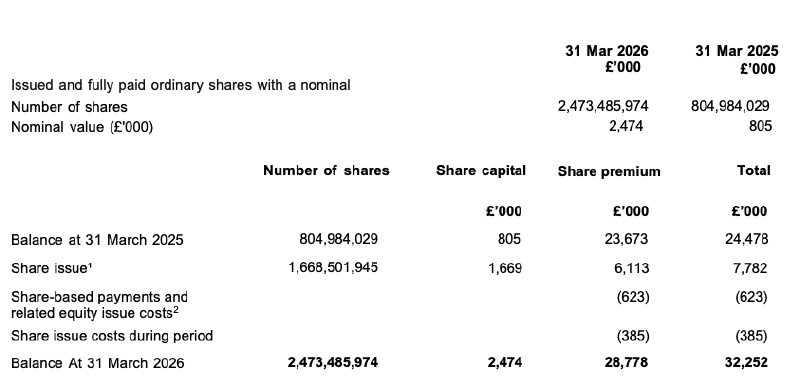
¹In May 2025 the Company completed a £3,450,000 fundraise, before direct costs, by way of a placing, conditional placing and subscription for 1,061,538,460 new ordinary shares at a price of £0.00325 per share. The fundraising received strong support from institutional and existing investors and included participation from the Company’s directors, who subscribed for an aggregate total of £350,000.
2In connection with the successful completion of the May 2025 fundraising, the Company granted Brian Stockbridge 153,846,154 nil-exercise-price warrants on 28 July 2025. The warrants were issued in consideration for services that the Directors concluded were incremental and directly attributable to the completed issue of new ordinary shares.
The grant-date fair value of the warrants was £623,000. In accordance with IFRS 2 and IAS 32, this amount was recognised as a deduction from share premium with a corresponding credit to the share-based payment reserve. The transaction was non-cash and therefore did not reduce the cash proceeds received from the fundraising.
In October 2025 the Company implemented an At-The-Market (“ATM”) equity issuance facility through Fortified Securities to provide additional working capital and funding flexibility. During the financial year ended 31 March 2026, the ATM facility raised aggregate gross proceeds of approximately £713,117 through a series of market placements and settlements.
In September 2025, the Company received notices for the exercise of warrants over 62,343,642 ordinary shares, resulting in the issue of 62,343,642 new ordinary shares.
In October 2025, the Company received notices for the exercise of warrants over 227,999,279 ordinary shares, resulting in the issue of 227,999,279 new ordinary shares.
In December 2025, the Company received notice for the exercise of warrants over 45,000,000 ordinary shares, resulting in the issue of 45,000,000 new ordinary shares.
In February 2026, the Company received notice for the exercise of warrants over 46,693,028 ordinary shares, resulting in the issue of 46,693,028 new ordinary shares.
13SHARE BASED PAYMENTS
|
Grant-date fair value assuming all vesting conditions are satisfied |
Fair value recognised in equity |
|
|
£’000 |
£’000 |
|
|
Balance as at 31 March 2025 Warrants issued in the period |
851 |
851 |
|
Warrants issued in the period |
4,373 |
2,566 |
|
Warrants lapsed/expired during the period |
- |
- |
|
Warrants exercised during the period |
(1,631) |
(1,631) |
|
Balance as at 31 March 2026 |
3,593 |
1,786 |
Of the £2,566k recognised in the share-based payment reserve during the year, £1,943k was recognised as an expense in profit or loss. The remaining £623k, relating to warrants issued for services incremental and directly attributable to the May 2025 equity fundraising, was recognised as a deduction from share premium.
On 20 September 2023, the Company granted 4,151,334 warrants to subscribe for ordinary shares with an exercise price of 0.6p.
On 7 February 2025, the Company granted 11,679,135 warrants to subscribe for ordinary shares with an exercise price of 0.325p.
On 28 July 2025, the Company granted 568,597,200 warrants to subscribe for ordinary shares, of which 461,538,462 were granted to directors with an exercise price of 0p, and 107,058,738 were granted to directors with an exercise price of 0.325p.
On 27 August 2025,the Company granted 38,930,448 warrants to senior management. The warrants have an expiry date of 5 years from the date of agreement and an exercise price of 0.325p.
Out of 461,538,462warrants, 153,846,154 were granted directly to Brian Stockbridge in consideration for services provided in connection with the successful completion of the Company’s May 2025 equity fundraising. The grant-date fair value of the warrants granted to Brian Stockbridge was £623,000. This amount was recognised directly as a deduction from share premium because the underlying services were assessed as incremental and directly attributable to the completed issue of new ordinary shares. The corresponding credit was recognised in the share-based payment reserve. The remaining 307,692,308 nil-exercise-price warrants granted on that date were accounted for according to the nature of the services and applicable vesting conditions associated with those separate awards.
On 27 August 2025, the Company granted 63,692,308 warrants over ordinary shares to its broker. The warrants have an expiry date of 5 years from the date of agreement and an exercise price of 0.325p.
On 4 September 2025 the Company granted 48,663,062 warrants over ordinary shares to Non-Executive Chairman. The warrants have an expiry date of 5 years from the date of agreement and an exercise price of 1.45p per share.
On 22 January 2026 the Company granted 12,500,000 warrants over ordinary shares to advisor. The warrants have an expiry date of 5 years from the date of agreement and an exercise price of 2p per share.
Certain of the warrants referred to above, including those issued to the Company's broker, vested in full on grant, and no further vesting conditions attach to them. Where warrants were not fully vested on grant, and save where different terms are stated above, they are subject to the following vesting conditions: subject to satisfying the Engagement Conditions on the relevant vesting dates, the Warrant will vest as to 12/36ths of the total number of Warrants on the first anniversary of this grant and the remaining 24/36ths will vest in equal monthly instalments over the following 24 months, such that by the third anniversary of this grant, subject to meeting the Engagement Conditions on each of the relevant dates, the warrants would have vested in full. The grant-date fair value of warrants subject to vesting conditions is recognised over the relevant vesting period.
On 30 March 2026 the Company granted three tranches of warrants at 71,453,788; 35,726,894 and 35,726,894 over ordinary shares as director remuneration. The warrants have an expiry date of 5 years from the date of agreement and an exercise price of 1.38p, 3.45p, and 6.90p, respectively. The warrants shall vest over a period of three years with a two year cliff, in accordance with the rules of the Company’s applicable warrant or incentive scheme.
|
Grant date |
Number of warrants |
Share price |
Exercise Price |
Expected volatility (%) |
Expected life |
Risk free rate (%) |
Expense Recognise (%) |
Expected dividends (%) |
|
20-Sep-23 |
4,151,334 |
£0.00675 |
£0.00600 |
78.76 |
5 |
5.19 |
100 |
0 |
|
07-Feb-25 |
11,679,135 |
£0.00070 |
£0.00325 |
93.04 |
5 |
3.97 |
100 |
0 |
|
28-Jul-25 |
461,538,462 |
£0.00405 |
Nil |
94.79 |
5 |
4.22 |
100 |
0 |
|
28-Jul-25 |
107,058,738 |
£0.00405 |
£0.00325 |
94.79 |
5 |
4.22 |
100 |
0 |
|
27-Aug-25 |
38,930,448 |
£0.00580 |
£0.00325 |
94.78 |
5 |
3.97 |
22 |
0 |
|
27-Aug-25 |
63,692,308 |
£0.00670 |
£0.00325 |
94.98 |
5 |
3.97 |
100 |
0 |
|
04-Sep-25 |
48,663,062 |
£0.01150 |
£0.01450 |
94.96 |
5 |
3.97 |
17 |
0 |
|
22-Jan-26 |
12,500,000 |
£0.01850 |
£0.02000 |
103.95 |
5 |
3.73 |
100 |
0 |
|
30-Mar-26 |
71,453,788 |
£0.01210 |
£0.01380 |
104.59 |
5 |
3.75 |
0 |
0 |
|
30-Mar-26 |
35,726,894 |
£0.01210 |
£0.03450 |
104.59 |
5 |
3.75 |
0 |
0 |
|
30-Mar-26 |
35,726,894 |
£0.01210 |
£0.06900 |
104.59 |
5 |
3.75 |
0 |
0 |
ThefollowingwarrantsoverordinaryshareshavebeengrantedbytheCompanyandareoutstanding:
|
Grant date |
Expiry period |
Exercise price |
Outstanding at 31 March 2026 |
Exercisable at 31 March 2026 |
|
27-Sep-22 |
N/A |
£0.02700 |
25,930,868 |
25,930,868 |
|
02-Oct-20 |
N/A |
£0.10400 |
20,584,694 |
20,584,694 |
|
01-Nov-22 |
5 years from agreement |
£0.01400 |
2,000,000 |
2,000,000 |
|
20-Jun-23 |
5 years from agreement |
£0.00670 |
15,000,000 |
15,000,000 |
|
22-Dec-23 |
5 years from agreement |
£0.00500 |
20,000,000 |
20,000,000 |
|
24-Jan-24 |
5 years from agreement |
£0.00800 |
1,000,000 |
1,000,000 |
|
07-Feb-25 |
5 years from agreement |
£0.00325 |
11,679,135 |
11,679,135 |
|
28-Jul-25 |
5 years from agreement |
£nil |
153,846,155 |
153,846,155 |
|
28-Jul-25 |
5 years from agreement |
£0.00325 |
107,058,738 |
107,058,738 |
|
27-Aug-25 |
5 years from agreement |
£0.00325 |
38,930,448 |
38,930,448 |
|
04-Sep-25 |
5 years from agreement |
£0.01450 |
48,663,062 |
48,663,062 |
|
22-Jan-26 |
5 years from agreement |
£0.02000 |
12,500,000 |
12,500,000 |
|
30-Mar-26 |
5 years from agreement |
£0.01380 |
71,453,788 |
71,453,788 |
|
30-Mar-26 |
5 years from agreement |
£0.03450 |
35,726,894 |
35,726,894 |
|
30-Mar-26 |
5 years from agreement |
£0.06900 |
35,726,894 |
35,726,894 |
|
600,100,676 |
600,100,676 |
As at 31 March 2026
|
Weighted average exercise price |
Number of warrants |
|
|
Outstandingatthebeginningoftheyear |
0.8p |
91,015,562 |
|
Exercisedduringtheyear |
0.1p |
382,035,949 |
|
Issuedduringtheyear |
0.2p |
891,121,063 |
|
Outstandingattheendoftheyear |
1.1p |
600,100,676 |
|
Exercisableattheendoftheyear |
1.1p |
600,100,676 |
14FINANCIAL ASSETS AND FINANCIAL LIABILITIES
|
Financial |
Financial |
Total |
|
|
31-Mar-26 |
£'000 |
£'000 |
£'000 |
|
Financial assets / liabilities |
|
||
|
Trade and other receivables |
2,368 |
- |
2,368 |
|
Cash and cash equivalents |
886 |
- |
886 |
|
Trade and other payables |
- |
(353) |
(353) |
|
Lease liabilities (current) |
- |
- |
- |
|
|
3,254 |
(353) |
2,901 |
|
Financial |
Financial |
Total |
|
|
31-Mar-25 |
£'000 |
£'000 |
£'000 |
|
Financial assets / liabilities |
|
||
|
Trade and other receivables |
- |
- |
- |
|
Cash and cash equivalents |
69 |
- |
69 |
|
Trade and other payables |
- |
(494) |
(494) |
|
Lease liabilities (current) |
- |
- |
- |
|
69 |
(494) |
(425) |
15FINANCIAL RISK MANAGEMENT
Equity instruments issued by the Company are recorded at the proceeds received, net of transaction costs. Incremental costs directly attributable to the issue of new shares or options are shown in equity as a deduction, net of tax, from the proceeds.
Financial risk factors
The Company's activities expose it to a variety of financial risks: market risk (including currency risk and interest rate risk), credit risk and liquidity risk. The Company's overall risk management programme focuses on the unpredictability of financial markets and seeks to minimise potential adverse effects on the Company's financial performance. The Company has no borrowings but is exposed to market risk in terms of foreign exchange risk. Risk management is undertaken by the board of directors.
Credit risk
The Company is exposed to credit risk arises from outstanding receivables, which stood at £2,368k (2025: £nil) at period close (see Note 10). The ATM receivable is dependent on the progress of share settlement under the ATM facility and the Company's share price movements; as such, the potential receivable amount may differ from the actual amount ultimately received. Management does not expect any losses from non-performance of these receivables. The amount of exposure to any individual counter party is subject to a limit, which is assessed by the board. The Company considers the credit ratings of banks in which it holds funds in order to limit risk of loss of assets.
Liquidity risk
Liquidity risk arises from the Company’s management of working capital. It is the risk that the Company will encounter difficulty in meeting its financial obligations as they fall due. Controls over expenditure are carefully managed, in order to maintain its cash reserves.
Capital risk management
The Company’s objectives when managing capital are to safeguard the Company’s ability to continue as a going concern, in order to provide returns for shareholders and benefits for other stakeholders, and to maintain an optimal capital structure. The Company has no borrowings. In order to maintain or adjust the capital structure, the Company may issue new shares as appropriate.
16CAPITAL COMMITMENTS & CONTINGENT LIABILITIES
There were no capital commitments and contingent liabilities at 31 March 2026.
17RELATED PARTY TRANSACTIONS
Year ended 31 March 2026
During the year, the Company entered into the following related party transactions:
The Company paid £8,000 to Korvath Ltd, a company of which Andrew McCartney is a director, in respect of Mr McCartney's services as Non-Executive Director for the period from June 2025 to July 2025, prior to his appointment as Chief Technology Officer of the Company on 18 August 2025.
The Company paid £1,090,000 to Whitespace Global Limited, a company of which Andrew McCartney is a director, comprising £90,000 for services provided by an embedded engineer working within the UK Ministry of Defence and £1,000,000 paid under a strategic partnership for the development of bespoke defence-oriented software applications and AI agents (see Note 10).
The Company paid £120,000 to Sentry One (Cyprus) Limited, a company in which Brian Stockbridge, a Director, is the ultimate beneficial owner, in respect of his services as Chief Financial Officer and Interim Chief Executive Officer for the period from June 2025 to March 2026.
On 28 July 2025, the Company granted Brian Stockbridge 153,846,154 warrants over ordinary shares with a nil exercise price. The award was made in recognition of services provided by Mr Stockbridge in connection with the successful completion of the Company’s May 2025 equity fundraising. The grant-date fair value of the award was £623,000. The Directors concluded that the services were incremental and directly attributable to the completed issue of new ordinary shares and would not otherwise have been incurred. Accordingly, the amount was deducted directly from share premium, with a corresponding credit to the share-based payment reserve. The amount is included within the Directors’ remuneration disclosures in Note 6 and the share-based payment disclosures in Note 13. At 31 March 2026, all 153,846,154 warrants had vested, remained outstanding and were fully exercisable.
The Company paid £172,271 in aggregate to First Sentinel Corporate Finance Limited, a company of which Brian Stockbridge is the Chief Executive Officer, comprising £75,000 in respect of corporate advisory services and £97,271 in respect of office occupancy and related operational costs.
The Company paid £97,074 in aggregate to Lantern Corporate Services Limited, a company of which Brian Stockbridge is a director, comprising £52,000 in respect of accounting services, £16,087 in respect of company secretarial services and related expenses, and £28,988 in respect of staff costs for an individual providing operating management services to the Company.
The Company paid £31,405 to Norstar Advisory Services Limited, a company of which James Norwood is a director, comprising £30,000 in respect of Mr Norwood's Director's fees for the period from May 2025 to December 2025 and £1,405 in respect of business expenses reimbursed.
The Company paid £40,500 to California Two Pizza Ventures Inc., a company of which Derek Lew is a director, in respect of Mr Lew’s Director’s fees for the period from July 2025 to March 2026.
Year ended 31 March 2025
During the prior period, the Company received and repaid a loan from a director amounting to £543,490 and £513,515 respectively.
18EVENTS SUBSEQUENT TO PERIOD END
The following non-adjusting events occurring between the reporting date of 31 March 2026 and the date on which these financial statements were authorised for issue are disclosed in accordance with IAS 10 Events after the Reporting Period. None of these events provides evidence of conditions that existed at the reporting date and, accordingly, no adjustments have been made to the amounts recognised in these financial statements.
ATM Facility
Subsequent to the reporting date, Fortified Securities raised additional gross proceeds of £123,400 under the Company's at-the-market facility for the period ending 18 May 2026, bringing total gross proceeds raised under the facility to £877,967.
A further £114,590 was subsequently raised, bringing the total cumulative gross proceeds raised under the facility since inception to £992,557.
On 25 June 2026, in connection with the launch of the Placing described below, the Company placed the ATM facility into indefinite suspension. At the date of suspension, Fortified Securities held 90,500,000 ordinary shares in the Company, representing 3.66% of the issued share capital at that time.
Placing
On 25 June 2026, the Company completed an accelerated bookbuild placing of 400,000,000 new ordinary shares of £0.001 nominal value at an issue price of £0.01 per share, raising gross proceeds of £4 million. Settlement and admission of the placing shares to trading on the London Stock Exchange's Main Market took place on 1 July 2026.
First Revenue-Generating Contract with the UK Ministry of Defence
On 3 July 2026, the Company announced that it had secured and commenced its first revenue-generating contract with the UK Ministry of Defence. The contract has a value of approximately £226,000 over a three-month period and relates to the testing and deployment of an integrated intelligence, decision-support and operational effects capability. This contract represents the Company’s transition into a revenue-generating business.
Whitespace Programme
As disclosed in Note 10, the Company held a prepayment of £608,000 at 31 March 2026 in respect of development work performed by Whitespace Global Limited under a strategic partnership. The Directors have concluded that any evidence regarding the progress or feasibility of the Whitespace programme emerging between the reporting date and the date of authorisation of these financial statements relates to developments arising after the reporting date and does not provide evidence of conditions that existed at 31 March 2026.
Accordingly, this is treated as a non-adjusting event and the classification and carrying amount of the Whitespace prepayment at 31 March 2026 have not been adjusted.
19CONTROL
Intheopinionofthe Directorsas atthe yearend andthe dateof thesefinancialstatementsthereisno singleultimate controlling party.