

Gabelli Merchant Partners PLC
14 August 2026
Gabelli Merchant Partners Plc
Annual Report and Accounts
For the year ended 30 June 2026
Gabelli Merchant Partners Plc (GMP-LN) is pleased to announce its audited results for the Period Ended 30 June 2026. The full audited financial statements will be uploaded to the Company website: https://www.gabelli.co.uk/investment-products/gabelli-merchant-partners/.
The Company announces it will hold its Annual General Meeting ("AGM") at 14:00 BST on 15 September 2026 at 3 St. James's Place London SW1A 1NP. Further details on the arrangement for this year's AGM are set out in the Notice of AGM. The Notice of AGM, together with a Form of Proxy, will be posted to shareholders in due course and will also be available on the Company's website.
Celebrating 50 Years of Gabelli
Five Decades of Value Investing
2026 marks the 50th anniversary of Gabelli & Company and the 10th anniversary of Associated Capital Group, Inc. Since its founding in 1976 as an institutional research firm by Mario J. Gabelli, the organisation has evolved into a diversified global investment management business offering a broad range of investment capabilities. Throughout this evolution, the driving force behind the organisation has remained its research-driven culture. The principles that underpinned its success in 1976 continue to guide the organisation today: fundamental bottom-up research, a disciplined investment process and a focus on creating long-term value.
Today, Gabelli Merchant Partners forms part of this broader investment heritage, benefiting from the same research-driven culture and disciplined investment philosophy that have guided the Gabelli organisation for the past five decades.
As we celebrate these milestones, we remain committed to preserving these principles while continuing to evolve alongside the changing needs of our shareholders and the opportunities presented by global markets.
A History of Growth
|
1976 |
Gabelli & Company is founded by Mario J. Gabelli, establishing the Private Market Value with a Catalyst™ investment philosophy |
|
1985 |
Launch of dedicated merger arbitrage strategy through the Gabelli Associates Fund LP |
|
1986 |
Launch of the Gabelli Equity Trust (NYSE: GAB), the firm's first closed-end fund and the foundation of a listed-funds platform that continues to expand today |
|
2015 |
Associated Capital Group, Inc. is established following its spin-off from GAMCO Investors, creating an independent platform focused on alternative investments, institutional asset management and merchant banking |
|
2017 |
Gabelli Merger Plus+ Trust Plc is admitted to trading on the London Stock Exchange. The Company was subsequently renamed Gabelli Merchant Partners Plc to reflect its broader investment strategy and operating activities |
|
2024 |
Acquisition of Gabelli Securities International UK Limited (GSIL UK), adding an FCA-regulated investment management platform and expanding the Company's strategic and operating capabilities |
|
2026 |
Gabelli & Company celebrates its 50th anniversary and Associated Capital Group marks its 10th anniversary, reflecting a shared commitment to disciplined investing, independent thinking and long-term stewardship. |
Strategic Report
The Directors present the Strategic Report of the Group and Company for the year ended 30 June 2026.
Portfolio Summary
Largest Portfolio Security holdings (excluding cash and cash equivalents)
|
|
As at 30 June 2026 |
||||||||||||||||
|
Security¹ |
% of total |
Market value3 |
Offsetting market |
% of total |
|||||||||||||
|
U.S. Treasury Bill 10 Sep 2026 |
8.0 |
5,461 |
8.0 |
||||||||||||||
|
U.S. Treasury Bill 14 Jul 2026 |
6.6 |
4,494 |
6.6 |
||||||||||||||
|
U.S. Treasury Bill 13 Aug 2026 |
4.4 |
2,987 |
4.4 |
||||||||||||||
|
U.S. Treasury Bill 12 Nov 2026 |
4.3 |
2,958 |
4.3 |
||||||||||||||
|
U.S. Treasury Bill 17 Dec 2026 |
4.3 |
2,947 |
4.3 |
||||||||||||||
|
U.S. Treasury Bill 09 Jul 2026 |
3.7 |
2,498 |
3.7 |
||||||||||||||
|
U.S. Treasury Bill 28 Jul 2026 |
3.6 |
2,493 |
3.6 |
||||||||||||||
|
U.S. Treasury Bill 27 Aug 2026 |
3.6 |
2,485 |
3.6 |
||||||||||||||
|
U.S. Treasury Bill 24 Sep 2026 |
3.6 |
2,478 |
3.6 |
||||||||||||||
|
U.S. Treasury Bill 27 Nov 2026 |
3.6 |
2,461 |
3.6 |
||||||||||||||
|
Electronic Arts Inc |
3.0 |
2,050 |
3.0 |
||||||||||||||
|
Chart Industries Inc |
2.8 |
1,943 |
2.8 |
||||||||||||||
|
Warner Bros Discovery Inc |
2.8 |
1,928 |
2.8 |
||||||||||||||
|
U.S. Treasury Bill 16 Jul 2026 |
2.2 |
1,498 |
2.2 |
||||||||||||||
|
TXNM Energy Inc |
2.2 |
1,485 |
2.2 |
||||||||||||||
|
Janus Henderson Group plc |
2.0 |
1,338 |
2.0 |
||||||||||||||
|
Penumbra Inc |
1.6 |
1,122 |
1.6 |
||||||||||||||
|
Norfolk Southern Corp |
1.6 |
1,106 |
1.6 |
||||||||||||||
|
Kenvue Inc |
1.6 |
1,103 |
1.6 |
||||||||||||||
|
AES Corp |
1.6 |
1,097 |
1.6 |
||||||||||||||
|
Sub-total Top 20 Holdings |
|
67.1 |
|
|
|
45,932 |
|
- |
|
67.1 |
|||||||
|
Other holdings6 |
32.9 |
22,457 |
|
(210) |
32.9 |
||||||||||||
|
Total holdings |
|
100.0 |
|
|
|
68,389 |
|
|
|
(210) |
|
|
|
100.0 |
|||
1 Long position.
2 Represents the total position value (market value plus the offsetting market value) as a percentage of the total portfolio value.
3 Market value of the long position.
4 Market value of the offsetting position.
5 Represents the market value as a percentage of the total portfolio value.
6 Includes derivatives, individual positions are each less than $750 thousand in market value.
|
Portfolio allocation as at 30 June 2026 |
% |
|||
|
Equities |
50.4 |
|||
|
Fixed income |
49.5 |
|||
|
Derivatives (contracts for difference) |
0.1 |
|||
|
Total |
|
100.0 |
||
Financial Highlights
|
As at Year Ended |
As at Year Ended |
|||||||
|
Performance |
30 June 2026 |
30 June 2025 |
||||||
|
Net asset value per share1 |
$ |
10.66 |
$ |
10.50 |
||||
|
Dividends per share paid during the year² |
$ |
0.25 |
$ |
0.18 |
||||
|
Share price |
$ |
8.60 |
$ |
9.05 |
||||
|
Discount to Net Asset Value3,4 |
19.32 |
% |
13.81 |
% |
||||
|
Year ended |
Year ended |
|||||||
|
Total returns |
30 June 2026 |
30 June 2025 |
||||||
|
Net asset value per share4,5 |
3.98 |
% |
6.51 |
% |
||||
|
U.S. 3-month Treasury Bill Index |
3.95 |
% |
4.34 |
% |
||||
|
Share price4,6 |
-2.21 |
% |
3.11 |
% |
||||
|
Year ended |
Year ended |
|||||||
|
Per Share Returns |
30 June 2026 |
30 June 2025 |
||||||
|
Total return per share |
$ |
0.41 |
$ |
0.63 |
||||
|
Year ended |
Year ended |
|||||||
|
Ongoing charges4,7 |
30 June 2026 |
30 June 2025 |
||||||
|
Annualised ongoing charges |
1.91 |
% |
2.00 |
% |
||||
Source: Portfolio Manager (Gabelli Funds, LLC), verified by the Administrator (State Street Bank and Trust Company).
1 Net Asset Value (NAV) includes deferred tax asset balance sheet adjustments resulting from the Group being a close company.
2 The dividends paid during the fiscal year ended 30 June 2026 consist of $0.10 per share for the year ended 30 June 2025 and $0.15 per share for the interim dividend for the year ended 30 June 2026. The dividends paid during the fiscal year ended 30 June 2025 consist of $0.16 per share for the full year dividend for the year ended 30 June 2024 and $0.02 per share for the interim dividend for the year ended 30 June 2025. The Board has continued to review and assess the Group's distribution policy.
3 The amount by which the market price per share is lower than the NAV per share, expressed as a percentage of the NAV per share.
4 These key performance indicators are alternative performance measures. Further information regarding the use of alternative performance measures can be found in the Strategic Report in the Annual Report and Financial Statements for the year ended 30 June 2026.
5 Net Asset Value per ordinary share, total return represents the theoretical return on NAV per ordinary share, assuming that dividends paid to shareholders were reinvested at the NAV per ordinary share at the close of business on the day shares were quoted ex-dividend.
6 Share Price Total Return represents the theoretical return to a shareholder, on a closing market price basis, assuming that all dividends received were reinvested, without transaction costs, into the ordinary shares of the Group at the close of business on the day the shares were quoted ex-dividend.
7 Ongoing Charges are operating expenses incurred in the running of the Group, but excluding financing costs. These are expressed as a percentage of the average net asset value during the period and this is calculated in accordance with guidance issued by the Association of Investment Companies.
During the year, NAV per share increased from $10.50 to $10.66 and the Group generated a NAV total return of 3.98%, compared with 6.51% in the prior year. The share price decreased from $9.05 to $8.60, resulting in a share price total return of -2.21% and a discount to NAV of 19.32% from 13.81% in 2025. Total return per share was $0.41 compared to $0.63. The Board continues to monitor both investment performance and the level of the share price discount to NAV.
Statement from the Chair
Introduction
Gabelli Merchant Partners Plc (the "Parent Company", the "Company" or "GMP") was incorporated in England and Wales on 28 April 2017. The Company's shares trade under the symbol "GMP" and have been admitted to trading on the Specialist Fund Segment of the Main Market of the London Stock Exchange and the Official List of the International Stock Exchange since 19 July 2017. In 2024, the Company acquired an affiliated UK investment manager, Gabelli Securities International UK Limited ("GSIL UK"), a limited company organised and existing under the laws of England and Wales (the Company and GSIL UK together, the "Group"). During the year ended 30 June 2025, the Company changed its name from Gabelli Merger Plus+ Trust Plc to Gabelli Merchant Partners Plc.
The Group's objective is to generate total returns, consisting of capital appreciation and current income. The Company's secondary objective is the protection of capital, uncorrelated to equity and fixed income markets. The Company has broad and flexible investment authority and, accordingly, it may at any time have investments in other related or unrelated areas.
Performance
The Group's Net Asset Value ("NAV") at 30 June 2026 was $10.66 per share, generating a total return of 3.98% for the year ended 30 June 2026. The Group has provided a total return of 50.56% since issuance. This includes the costs of the issue resulting in a starting NAV of $9.92 per share compared with the issue price of $10.00 per share, and initial closing market price of $10.15 per share.
The Group does not operate a formal discount control policy. The Board keeps the Group's share price discount to Net Asset Value under regular review and considers the full range of circumstances when determining whether any action is appropriate. The Board is always receptive to feedback and welcomes any questions and comments from shareholders.
Expansion of Operating Investment Activities
GSIL UK is a regulated investment manager, enabling GMP to increase sources of income, allowing for both self-management and the broadening of services to affiliated and third parties.
Since the acquisition, GSIL UK has become an important component of the Group's long-term strategy. In addition to supporting the Group's investment activities, GSIL UK provides the Group with an FCA-regulated platform through which the Group may pursue additional investment management and advisory opportunities. The Board believes this expands the Group's strategic flexibility and diversifies potential sources of future income beyond investment returns alone.
Governance Matters
During the year, the ultimate parent of the Group's controlling shareholder, Associated Capital Group, Inc. completed an internal reorganisation which resulted in a change in voting control for Associated Capital Group, Inc. and its consolidated subsidiaries, including the Group. There was no change to the economic ownership of the Group, no change to the Group's controlling shareholder, investment policy, portfolio management arrangements, Board composition, or day-to-day operations as a result of this reorganisation. Marc Gabelli maintains indirect voting control of the Group through his interests in the ultimate parent of Associated Capital Group, Inc.
Dividend History
Since its listing, the Group has paid dividends of $3.35 per Ordinary Share, totalling $30.8 million.
|
Year |
2026 |
2025 |
2024 |
2023 |
2022 |
|||||||||||||||||
|
Dividends per share |
$ |
0.20 |
* |
$ |
0.12 |
$ |
0.16 |
$ |
0.48 |
$ |
0.48 |
|||||||||||
|
Total paid (millions) |
$ |
1.3 |
* |
$ |
0.8 |
$ |
1.1 |
$ |
3.3 |
$ |
4.5 |
|||||||||||
|
Year |
2021 |
2020 |
2019 |
2018 |
||||||||||||||||||
|
Dividends per share |
$ |
0.48 |
$ |
0.48 |
$ |
0.48 |
$ |
0.47 |
||||||||||||||
|
Total paid (millions) |
$ |
4.9 |
$ |
5.0 |
$ |
5.0 |
$ |
4.9 |
||||||||||||||
* Included in this figure is an interim dividend of $0.05 per ordinary share, representing an aggregate distribution of approximately $348 thousand, which was approved by the Group subsequent to 30 June 2026 with ex-date 3 September and payment date 18 September. This dividend was the 28th dividend made since listing and demonstrates the Group's ongoing commitment to distributing value to shareholders in the form of cash.
The Group expects to make future dividend payments based upon profits, subject to continuous review by the Board.
Outlook
The global economy continues to adjust to a changing policy landscape characterised by evolving trade relationships, fiscal expansion, deregulation and geopolitical uncertainty. Despite international tensions creating periodic market volatility, economic activity has remained resilient, supported by robust corporate balance sheets, healthy employment conditions and continued investment in technology, infrastructure and artificial intelligence. While inflation has moderated from its post-pandemic highs, central banks remain focused on balancing price stability with sustaining economic growth.
Although geopolitical developments, trade negotiations and monetary policy remain potential sources of volatility, the fundamental drivers of merger activity remain compelling. Companies continue to seek scale, technological capabilities and operational efficiencies in an increasingly competitive global marketplace, while private equity sponsors remain focused on deploying significant amounts of available capital. The Board therefore considers the medium-term outlook for merger arbitrage to remain favourable, supported by a healthy pipeline of strategic transactions, improving regulatory visibility and attractive annualised spreads on announced deals.
As the Group continues to expand its operating investment activities alongside its investment portfolio, the Board believes it is well positioned to benefit from these favourable industry dynamics while maintaining the flexibility to adapt to changing market conditions. We remain optimistic about the opportunities ahead and thank our shareholders for their continued support.
As we celebrate the 50th anniversary of Gabelli & Company and the 10th anniversary of Associated Capital Group, we remain committed to the disciplined investment philosophy and long-term stewardship that have guided the organisation for decades.
I would like to thank my fellow Directors, our advisers and shareholders for their continued support since the Company's launch. I am particularly pleased to welcome Gustavo Pifano to the Board and, subject to his election as a Director by shareholders at the forthcoming Annual General Meeting, the Board intends to appoint him as Chairman following the conclusion of the meeting. I have every confidence that, under his leadership, the Group will continue to build on the strong foundations established over the past nine years.
John Birch
Chairman
14 August 2026
Portfolio Manager's Review
Methodology
The Group will seek to meet a long-term investment objective by utilising the Gabelli Private Market Value (PMV) with a CatalystTM investment methodology, investing as owners, with an emphasis on cash generating, franchise companies, selling at a significant discount to our appraisal of their Private Market Value and with a Catalyst in place to generate returns. We define Private Market Value (PMV) as the value an informed industrialist would pay to purchase assets with similar characteristics in a privately negotiated transaction. Catalysts are identifiable events, either specific to a corporation or macro and are utilised to earn returns independent of the broad markets' direction. Such events include corporate actions such as, but not limited to, management changes, announced mergers, acquisitions, takeovers, tender offers, leveraged buyouts, restructurings, demergers and other types of reorganisations and corporate actions ("deals"). The Group may take both long and short positions in equity and debt securities. The Group may take minority or majority controlling operating interests of equity in a business, and in adverse market conditions may justify a temporary defensive position and remain in government securities. While taking a long-term view, the Group may realise opportunities from hedging or for shorter-term gains when appropriate.
Catalyst driven event arbitrage is a highly specialised investment approach designed principally to profit from the differential, or "spread," between the market price of our investments and the value ultimately realised through event consummation.
We are especially enthusiastic about the opportunities to grow client wealth in the decades to come, and we highlight below several factors that should help drive results. These include:
· Increased market volatility, which enhances our ability to establish positions for the prospect of improved returns
· A robust market for corporate deal making as conditions continue to provide an accommodative market for mergers and acquisitions
· A normalised interest rate environment, providing attractive merger spread opportunities
· The Fund's experienced investment team, which pursues opportunities globally through the disciplined application of Gabelli's investment methodology
Merger investing
Merger arbitrage is a highly specialised component of a portfolio. The investment approach is designed principally to profit from corporate events, including the successful completion of proposed mergers, acquisitions, takeovers, tender offers, leveraged buyouts, restructurings, demergers, and other types of corporate reorganisations and other actions. As arbitrageurs, we seek to earn the differential, or "spread," between the market price of our investments and the value ultimately realised through deal consummation.
Market Environment[1]
U.S. equity markets continued higher through the first half of 2026, with the S&P 500 returning 10.2% despite a backdrop that offered plenty of reasons for caution. The conflict with Iran has injected fresh volatility into energy markets, and the resulting move in oil prices kept upward pressure on inflation expectations. Against that setting, the Federal Reserve held rates steady through the first six months of the year, as it weighed persistent inflation against a resilient economy. In late May, Kevin Warsh replaced Jerome Powell as Fed Chairman and brought no change in that posture, though some policymakers have raised the prospect of a rate hike as energy-driven inflation lingers. The market's further advancement owes much to the continued enthusiasm around artificial intelligence, which powered returns even as macro headwinds mounted. As with recent history, a narrow cohort of AI-levered names contributed to a disproportionate share of the S&P 500 returns.
Against this backdrop, global merger and acquisition ("M&A") activity strengthened considerably during the first half of 2026. Worldwide announced M&A reached approximately US$2.85 trillion, the strongest opening six months on record and nearly 50% higher than the prior year.
Activity continued to be driven by larger strategic transactions, with a record 48 deals exceeding US$10 billion, while cross-border M&A increased 63% year-on-year to its strongest first-half level since 2007. The United States accounted for 54% of worldwide activity, while European deal value more than doubled. Technology remained the largest sector by value, complemented by Industrials, Energy & Power, Financials and Healthcare. Private equity sponsors also remained active, announcing a record US$602 billion of buyouts during the first half as improving financing conditions supported larger transactions.
The regulatory backdrop has also become more supportive. The current U.S. administration has adopted a more pragmatic approach towards merger review, with both the Federal Trade Commission and the Department of Justice signalling a greater willingness to consider negotiated remedies where appropriate. This has improved transaction certainty and restored confidence among corporate boards contemplating strategic acquisitions. Combined with abundant financing capacity and substantial levels of undeployed private equity capital, these factors continue to support a constructive environment for announced transactions.
Portfolio in Review
As we have discussed in the past, broader market moves do not drive returns for our merger arbitrage portfolios. The driver is the successful conversion of deal risk into return-capturing the spread between a target's market price and its takeout value as transactions close-and subsequently recycling that capital into newly announced transactions. Despite the macro noise, the flywheel of M&A was broadly robust during the first half of the year. Boardroom confidence held up, financing markets remained accommodative, and both strategics and sponsors continued to transact. While much of the headline deal volume in the first half was attributed to private AI companies raising capital, public market deal flow was quite healthy and growing.
As for spreads, they remained attractive. With the Fed on hold, and no cuts to compress the front end of the curve, the short-term rate embedded in every deal spread held firm. Nominal returns on the safer, cleaner transactions continue to trade with a small spread to short-term rates. On riskier situations, spreads remain wider to account for the idiosyncratic closing risks associated with each deal. The antitrust posture in the US that took shape over the past year has settled in, with federal agencies now more inclined to clear without a second request when there are no substantive issues or bargain toward remedies and consent decrees when necessary. For arbitrageurs, that shift shows up directly as fewer deals breaking and more confidence underwriting those that are announced.
We continue to find attractive investment opportunities in newly announced and pipeline deals. We remain focused on investing in highly strategic, well-financed deals with an added focus on near-term catalysts and are upbeat about our prospect of generating absolute returns.
Notable contributors to performance include:
Life Science and Diagnostics
Exact Sciences Corporation (EXAS-NASDAQ), a provider of cancer screening and precision oncology diagnostics solutions, was acquired by Abbott Laboratories. The combination establishes Abbott as a leader in fast-growing cancer screening and diagnostics segments. The market had priced in some probability of a second request by US antitrust regulators, which was reflected in the spread; however, the deal was able to avoid one given the lack of horizontal overlap between the companies. The transaction closed on March 23, 2026-approximately four months after announcement-and shareholders received $105.00 cash per share, which valued Exact Sciences at approximately $23 billion.
Investment Management
Janus Henderson Group plc (JHG-NYSE), an asset manager serving institutional, retail, and high net worth clients, was acquired by a consortium led by Trian Fund Management and General Catalyst. Janus Henderson had agreed to an all-cash buyout at $49.00 per share in December 2025, ending a multi-year activist campaign by Trian, the company's largest shareholder. Victory Capital then emerged as a rival bidder, ultimately offering $40.00 in cash plus 0.25 Victory shares - a headline value above the Trian bid, but one the special committee judged to carry unacceptable closing risk given Victory's financing arrangements and the near-certainty that Trian's own stake would be voted against it. In March, Trian and General Catalyst raised their offer to $52.00 per share in cash, a $3.00 bump and a 25% premium to Janus Henderson's unaffected price, which they characterized as best and final. Victory withdrew the same day, shareholders approved the amended deal in April, and the transaction closed on June 30, 2026.
Steel Manufacturer
Kloeckner & Co SE (KCO-Frankfurt), a global steel service centre and metal processing company, was acquired by Worthington Steel in June 2026. Under the agreement announced in January, Worthington launched an all-cash voluntary tender offer in Germany supported by SWOCTEM GmbH, Kloeckner's largest shareholder. Worthington subsequently reduced the minimum acceptance threshold and completed the takeover on June 3, securing approximately 62% of outstanding shares. Worthington then announced its intention to enter into a Domination Agreement with Kloeckner. Under that structure, shareholders who did not tender would receive an annual cash payment for as long as they hold the stock, along with the right to sell to Worthington at a price set by an independent valuation. Because that price cannot fall below the €11.00 per share offered in the subsequent delisting tender, non-tendering holders stand to receive the greater of the two - the €11.00 or the appraised value. We accordingly did not tender, and with a defined price floor beneath the position, we view the downside from current levels as limited.
Film & TV
TEGNA Inc. (TGNA-NYSE), a U.S. broadcast media company operating a portfolio of network-affiliated local television stations and digital platforms, was acquired by Nexstar Media Group. In mid-March, a coalition of state attorneys general led by California sued to enjoin the transaction on antitrust grounds, briefly reopening questions around divestitures and timing. The challenge did not hold: the court declined to grant injunctive relief, a temporary restraining order was vacated without oral argument, and with federal clearances intact the parties proceeded to close. The outcome stands in contrast to Standard General's earlier attempt to acquire TEGNA, which was effectively blocked under the prior administration - a reminder of how much the regulatory posture has shifted, with federal approval once again proving dispositive. The transaction closed on March 19, 2026, and shareholders received $22.00 cash per share under terms announced in August 2025, valuing TEGNA at approximately $6.2 billion.
Industrial Equipment
Toyota Industries Corporation (6201 JP-Tokyo), a manufacturer of forklifts and automotive components, agreed to be taken private by the Toyota Group in a deal valuing the company at approximately ¥6.7 trillion. The transaction was hard-fought: Elliott Investment Management, holding a 7.7% stake, publicly opposed two earlier bids as undervaluing the company, forcing Toyota Group to raise its offer twice - from ¥16,300 per share in June 2025 to ¥18,800 in January 2026, and finally to ¥20,600 in March 2026, a 26% increase from the original price. Elliott ultimately agreed to tender under the revised terms. The deal was Japan's largest-ever buyout. The privatization is designed to deepen operational integration within the Toyota ecosystem and unwind cross-shareholdings - a dynamic that has long been a focus of foreign activists seeking to unlock value in Japanese conglomerates. The transaction closed in March 2026, and shareholders received ¥20,600 cash per share.
The Search For Value - Gabelli Merchant Partners Plc
Investment Methodology
Process in Action
Gabelli Funds LLC's approach to the global marketplace is to invest like owners. Our clients own businesses through the fractional interest of a share. We are not index benchmarked, and construct portfolios agnostic of market capitalisation and index weightings. We seek long-term capital appreciation for our clients relative to inflation over the long term, regardless of market cycles. We have invested this way since 1977.
The GMP portfolio offers access to companies that have been identified to have substantial disconnects between market price and our estimate of the business value (private market value™, or "PMV™") and where catalyst events exist that may narrow these discounts for the benefit of GMP shareholders. We thus establish a "Margin of Safety" for our investors by identifying differences between our estimate of PMV and the stock market price. The process seeks to identify businesses undergoing some form of strategic change, typically with strong organic cash flow characteristics, balance sheet reorganizational opportunities, and strategic operational flexibility accelerated with the prospect of management capital allocation actions.
Catalyst merger events can come in many forms including, but not limited to, corporate restructurings (such as demergers and asset sales), operational improvements, regulatory or managerial changes, special situations (such as liquidations), and mergers and acquisitions. Corporate mergers provide valuable insights into corporate capital allocation decisions and therefore help in our assessment of long-term valuations. Our proprietary research data bases track thousands of announced deals globally and utilises that compounded knowledge in the continued refinement of Private Market Valuations. PMV's will change over time, and while our analysis is long term, it is through this consistent process of bottom-up stock selection and the implementation of disciplined portfolio construction that we expect to create value for our shareholders annually.
In this process, we do sector-by-sector analysis, assessing the PMV of a business, and identifying the catalyst in place to realise returns. A company's PMV is not constant, and changes as a function of many variables. Our analysis emphasises balance sheets, cash flows, and the long‑term defendable position of a corporation. We achieve returns through investing in businesses utilising our proprietary Private Market Value with a Catalyst™ methodology. PMV is the value that we believe an informed buyer would be willing to pay to acquire an entire company in a private transaction. Our team arrives at a PMV valuation by a rigorous assessment of fundamentals from publicly available information. Further, PMV's are enhanced through the analysis of announced corporate mergers and acquisition activity. Mergers offer tangible insights into the long-term capital allocation decisions of global corporations. We focus on the balance sheet, earnings, free cash flow, and the company's management, the stewards of corporates assets, of prospective companies. The judgement gained from our comprehensive, accumulated knowledge across a variety of sectors is deployed for investors in a portfolio. Our analysts typically forecast model company operations 5 years into the future. Unlike Wall Street's earnings momentum players, we do not try to forecast earnings with accounting precision and then trade stocks based on quarterly expectations and realities. We simply try to position ourselves in front of long-term earnings trends. Throughout our research process, the focus is on free cash flow: earnings before interest, taxes, depreciation and amortization ("EBITDA") minus the capital expenditures necessary to grow the business. We believe free cash flow is the best barometer of a business' value. Deteriorating or rising free cash flow often foreshadows net earnings changes. We also look at earnings per share trends. In addition, we analyse on and off-balance sheet assets and liabilities such as property, plant and equipment, inventories, receivables, and legal, environmental and health care issues. We want to know everything and anything that will add to, or detract from, our valuation models. This method of analysis involves looking at businesses as a function of their assets and earnings power. We examine businesses as if we were owners of those businesses, and we believe that we can do that in a rational way by looking at industries on a global basis. Our investment professionals visit with hundreds of companies each year. Our work is proprietary, bottom up, and involves the full utilisation of public resources.
Our analysts follow industries on a global basis and narrow the universe of potential investment candidates to a short list of the most attractive companies. All publicly available company material is reviewed, including annual and quarterly reports, 10‑Ks, 10-Qs, and proxy statements.
Each analyst develops an operational understanding of their industry, effectively becoming an expert in that industry. The analysts hone this expertise by continually visiting companies and their senior managements, and by talking to competitors, suppliers and customers. They also develop and maintain government and trade sources to derive an overall understanding of their industry. In addition, our firm hosts a number of industry seminars, where the top executives of the leading firms share their insights with the investment community.
The objective of this process is to identify companies that trade at significant differences to their intrinsic or private market values.
We continually visit the management of hundreds of companies and integrate their input with our knowledge base. Our goal is to understand management's motivations and expectations. Given our approach, we want to know who our partners are and if they are working to enhance shareholder value. This process, coupled with our financial analysis, helps us select the most attractive investment candidates for our portfolios.
We employ a three-dimensional approach to valuation:
· Earnings per share
· Free cash flow
· Private market value
The first step is to analyse the income statement and cash flow. Cash flow is viewed as a barometer of financial health, and often foreshadows earnings trends. We attempt to forecast the direction and growth rates of the earnings and cash flow streams.
The second step is to examine the balance sheet. The corporate balance sheet is recast, assessing real-world values of inventories, property, plant and equipment and stated book value. To these two analytical processes, dynamic forecasting and static asset and liability valuation, we add our assessment of the PMV of the business. In other words, what would this company be worth to an informed business person attempting to create or purchase a business with similar characteristics?
Catalyst: Identification of a mispriced situation, however, does not necessarily guarantee a rewarding investment. The next step is to determine events in businesses undergoing some form of strategic change that will help narrow the spread between a stock's public market price and our determination of its PMV. We call these events catalysts. Catalysts include industry events such as consolidation, changes in the regulatory or accounting environment, new technologies, or be indigenous to the company itself such as financial engineering, demergers, acquisitions or sales.
Results: After we have identified and selected stocks that qualify as candidates based on these fundamental and conceptual considerations, our objective is to structure a diversified portfolio. This has been a proven long-term method for creating wealth, risk adjusted, in the stock market.
Manager History
The Gabelli organisation, of which Gabelli Funds, LLC (the portfolio manager) is an affiliate, began in the U.S. in 1976 as an institutional value investing research firm. Mario Gabelli, the firm's founder, is credited by the academic community for establishing the notion of Private Market Value, the value an informed industrialist would pay for an entire business in a negotiated transaction. This is a long-term oriented bottom-up investment process based on the fundamental investment principles first articulated in 1934 by Graham and Dodd, the founders of modern security analysis, and further augmented by Mario Gabelli in 1977 with his introduction of the concepts of PMV into equity analysis. Gabelli has added the element of a catalyst event to generate long-term returns. The Gabelli method, PMV with a CatalystTM, is part of the Value Investing Curriculum at many major business schools and is thus applied in the analysis of public equity securities by Gabelli Funds, LLC for shareholders.
Investment Objective and Policy
Investment objective
The Group's primary investment objective is to seek to generate total return, consisting of capital appreciation and current income for the long term. The Group will seek a secondary objective of the protection of capital, uncorrelated to equity and fixed income markets.
Investment policy
The Group will seek to meet its long-term investment objective by utilising the Gabelli Private Market Value with a Catalyst™, investment methodology, maintaining a diversified portfolio of event merger arbitrage strategies to seek to create an optimal risk/reward profile for the portfolio. The Group invests for the long term as owners with an emphasis on cash generating, franchise companies, selling at a significant discount to our appraisal of their Private Market Value. We define Private Market Value (PMV) as the value an informed industrialist would pay to purchase assets with similar characteristics in a privately negotiated transaction.
"Event Driven Merger Arbitrage" is a highly specialised active investment approach designed principally to profit from the differences between PMV estimates and public market price with returns realised through the price achieved through corporate catalyst events. Catalysts are utilised to earn returns independent of the broad markets' direction. This includes corporate events such as, but not limited to, management changes, announced mergers, acquisitions, takeovers, tender offers, leveraged buyouts, restructurings, demergers and other types of reorganisations and corporate actions ("deals").
The Group will invest and operate globally although it is expected to have an emphasis on predominantly equity securities issued by companies in the United States of any market capitalisation. The Group is permitted to use a variety of investment strategies and instruments, including but not limited to: minority or majority controlling operating interests in equity; convertible and non-convertible debt securities; asset-backed and mortgage-backed securities; fixed interest securities; preferred stock, nonconvertible preferred stock, depositary receipts; shares or units of UCIs or UCITS as an investment or by management contract; rights qualifying as transferable securities; when issued, delayed delivery transferable securities; forward contracts; swaps; recently issued transferable securities; repurchase agreements, money market instruments and warrants.
The Group may invest part of its net assets in cash and cash equivalents, money market instruments, bonds, commercial paper or other debt obligations with banks or other counterparties having at least a single A (or equivalent) credit rating from an internationally recognised rating agency or government and other public securities, if the Portfolio Manager believes that it would be in the best interests of the Group and its Shareholders. This may be the case, for example, if the Portfolio Manager believes that adverse market conditions justify a temporary defensive position. Any cash or surplus assets may also be temporarily invested in such instruments pending investment in accordance with the Group's investment policy.
The Group may take both long and short positions in equity and debt securities. For shorting purposes, the Group may use indices, individual stocks, fixed income securities and contracts for difference. The Group is a long-term investor and does not seek to generate short-term returns or profits from trading or hedging. While taking a long-term view, the Group will realise opportunities from hedging or for shorter-term gains when appropriate.
The Group may utilise financial derivative instruments to create both long and synthetic covered short positions with the aim of maximising positive returns. The Group may use strategies and techniques consisting of options, futures contracts, and currency transactions and may enter into total rate of return, credit default, or other types of swaps and related derivatives for various purposes, including to gain economic exposure to an asset or group of assets that may be difficult or impractical to acquire.
The Group may also use derivatives for efficient portfolio management purposes including, without limitation, hedging and risk management and leverage.
The Group has broad and flexible investment authority and, accordingly, it may at any time have investments in other related or unrelated areas. Strategies and financial instruments utilised by the Group may include, but are not limited to: (i) purchasing or writing options (listed or unlisted) of any and all types including options on equity securities, stock market and commodity indices, debt securities, futures contracts, future contracts on commodities and currencies; (ii) trading in commodity futures contracts, commodity option contracts and other commodity interests including physical commodities; (iii) borrowing money from brokerage firms and banks on a demand basis to buy and sell short investments in excess of capital; (iv) entering into agreements to acquire operating businesses including managing assets for third parties and (v) entering into swap agreements (of any and all types including commodity swaps, interest rate swaps and currency swaps), forward contracts, currencies, foreign exchange contracts, warrants, credit default swaps, synthetic derivatives (for example, CDX), collateralised debt obligations tranches, and other structured or synthetic debt obligations, partnership interests or interests in other investment companies and any other financial instruments of any and all types which exist now or are hereafter created.
No material change will be made without shareholder approval.
Strategy
About Gabelli Merchant Partners Plc
Gabelli Merchant Partners Plc is a UK traded investment company and member of the Association of Investment Companies ("AIC"). GMP is a close company, with Associated Capital Group, Inc. as its largest shareholder, which remains committed to the long-term development and growth of the Group in accordance with the investment policy.
Our Key Performance Indicators ("KPIs")
The Group's strategy is to generate returns for its shareholders by pursuing its investment objective while mitigating shareholder risk, by investing in a diversified spread of equity and fixed income investments. Through a process of bottom-up stock selection and the implementation of disciplined portfolio construction, we aim to create value for the Group's shareholders. The largest holdings in the Group's portfolio are listed in the Portfolio Summary.
Gearing Policy
The Portfolio Manager has discretion to use leverage as part of its investment programme. It is anticipated that the Group will structurally gear and use tactical leverage or portfolio borrowings in an amount (calculated at the time of investment) of around 2 times of the Net Asset Value, subject to maximum gearing of 2.5 times the Net Asset Value. The Board continuously monitors the Group's gearing to make sure it complies with the Group's Articles of Association and with any investment restriction. For further details please refer to the Glossary.
Leverage
Leverage is calculated using two methods: i) Gross method and ii) Commitment method. For further details please see the Glossary.
Stakeholder Interests (s.172 statement)
The Companies (Miscellaneous Reporting) Regulations 2018 require directors to explain more fully how they have discharged their duties under Section 172(1) of the Companies Act 2006 in promoting the success of their companies for the benefit of members as a whole. This enhanced disclosure covers how the Board has engaged with and understands the views of stakeholders and how stakeholders' needs have been taken into account, the outcome of this engagement and the impact that it has had on the Board's decisions.
As the Parent Company is an externally managed investment company, it does not have customers in the traditional commercial sense. However, the Group's wholly owned subsidiary, GSIL UK, provides investment management services to its clients. Accordingly, the Board considers the Group's principal stakeholders to comprise shareholders, clients of GSIL UK, employees of GSIL UK and the Group's key service providers.
|
Stakeholder |
|
Activity or mitigation in the year |
|
Shareholders |
|
· The Group operates a Loyalty Programme to reward shareholders who retain their shares for at least five years. Further information regarding the Programme can be found in the Directors' Report; · The Board recognises that Associated Capital Group, Inc. is the Group's controlling shareholder and seeks to ensure that the interests of minority shareholders are appropriately considered when evaluating significant strategic and governance matters; · As a traded investment company, the Board operates policies designed to safeguard the value of shareholders' investment, in particular the Board monitors the Group's discount to NAV on an ongoing basis and may consider share repurchases or other measures where appropriate, having regard to liquidity, capital requirements, market conditions and the interests of shareholders as a whole; · Shareholders' rights are also protected under the Group's Articles of Association which require any proposal that may materially change those rights to be subject to prior approval by a majority of shareholders in general meeting; and · Shareholders are given opportunities to attend meetings with the Board and to also attend, ask questions and vote at the Annual General Meeting of the Group. |
|
Stakeholder |
|
Activity or mitigation in the year |
|
Service Providers |
|
The Board regularly evaluates the performance of its key panel of third-party professional service providers. The appraisals involve an opportunity for those third parties to provide 360° feedback. |
|
Social & Environment |
|
Whilst the Group's key investment objective targets outperformance through exposure to corporate transactions in the United States, the Investment Manager, Gabelli Funds, LLC operates a suite of investment policies designed to take account of Environmental, Social and Governance ('ESG') themes across its investment strategies. These policies ensure that exposure to ESG risks is minimised for the Group's stakeholders. |
|
Other Stakeholders |
|
· The Board seeks to maintain the highest levels of corporate governance through compliance with the principles and provisions of both the AIC Code and, to the maximum extent practicable, the UK Code; and · The Board is committed to responding promptly and transparently to any reputational or regulatory matter that might arise affecting the Group, its future prospects or its investment activities. |
Key Performance Indicators ("KPIs")
The Board recognises that long-term shareholder value is reflected through both Net Asset Value Total Return and Share Price Total Return. The Board therefore monitors Net Asset Value Total Return, Share Price Total Return and the discount of the Company's share price to Net Asset Value as its principal key performance indicators. These measures provide the Board with an overall assessment of investment performance and shareholder value creation.
For the year ended 30 June 2026, the Group's KPIs, as monitored closely by the Board at each meeting, are listed below:
|
Net Asset Value Total Return Year ended 30 June 2026 |
|
Share Price Total Return Year ended 30 June 2026 |
|
Discount to Net Asset Value As at 30 June 2026 |
|
3.98% (30 June 2025: 6.51%) |
-2.21% (30 June 2025: 3.11%) |
19.32% (30 June 2025: 13.81%) |
The above table sets out the key KPIs for the Group. These KPIs fall within the definition of 'Alternative Performance Measures' (APMs) under guidance issued by the European Securities and Markets Authority (ESMA). Information explaining how these are calculated is set out in the Glossary. These KPIs including APMs have been carefully selected by the Board on discussion with the Portfolio Manager, to give the most appropriate overview of performance in the financial year to shareholders and other stakeholders.
|
Performance measured against various indices |
|
The Group does not use a benchmark. However, at each meeting the Board reviews and compares portfolio performance against the NYLI Merger Arbitrage ETF ("MNA"). Information on the Group's performance is given in the Chairman's Statement and the Portfolio Manager's Review.
|
|
Share Price Total Return |
|
The Group's primary investment objective is to seek to generate total return consisting of capital appreciation and current income for the long term. Between inception and 30 June 2026, the Group returned $3.30 per share to shareholders. Dividends are paid only when declared by the Board subject to the Board's assessment of the Group's financial position and profits, thus the level of dividend may vary over time. Additional information can be found in the Glossary. |
|
Share price discount to net asset value (NAV) per share |
|
The NAV per share is published on a daily basis on the London Stock Exchange and The International Stock Exchange. The NAV is calculated in accordance with the Association of Investment Companies (AIC) formula. At each Board meeting, the Board monitors the level of the Group's discount to NAV, the changes thereto and the reason for such changes. The Directors recognise the importance to investors that the shares should not trade at a significant discount to NAV. Accordingly, the Board monitors the Group's discount to NAV on an ongoing basis and may consider share repurchases or other measures where appropriate, having regard to liquidity, capital requirements, market conditions and the interests of shareholders as a whole. In the year under review, the Group's shares traded at a discount of 19.32% as of 30 June 2026 and at a discount of 13.81% as of 30 June 2025.
|
Cumulative Performance Chart (USD) from 19 July 2017
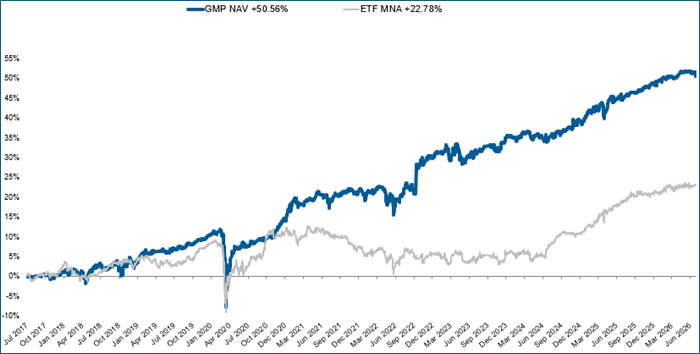
The Group presents returns compared to MNA. MNA's investment approach is designed to track the performance of the NYLI Merger Arbitrage Index, which seeks to employ a systematic investment process designed to identify opportunities in companies whose equity securities trade in developed markets, including the U.S., and which are involved in announced mergers, acquisitions and other buyout-related transactions. The Board considers MNA to be an appropriate comparator for the Group's investment strategy.
Principal Risks
The Group continues to have exposure to a variety of risks and uncertainties, and the Audit & Risk Committee has focused attention on identifying and mitigating key risks likely to crystallise in the current economic environment. The Board continues to prioritise a robust system of controls to minimise exposure to global macro events in particular, which remains highlighted as a generic risk as in recent Annual Reports.
The Directors confirm that they have carried out a further robust assessment of the principal risks facing the Group during the year, including those that would threaten its investment objective, business model, future performance, solvency or liquidity. The Group maintains a risk register which sets out the current and emerging risks facing the Group, the likelihood and potential impact of each risk and the controls established for mitigation. The risk register is reviewed by the Audit & Risk Committee on a regular basis throughout the financial year and was specifically refreshed in 2026 to introduce more stringent risk ratings for each risk and to reflect the impact of related mitigating controls.
The core principal risks set out in the 2025 Annual Report remain largely unchanged and are set out in the following table with an explanation of how they are mitigated. On review during the year, the Board re-rated several principal risks and considered the adequacy of mitigating controls in place across the Group's operations and those of its key third party providers. The Audit & Risk Committee has also specifically considered the risks associated with the Portfolio Manager's use of Contracts for Difference within the investment strategy which on review, were felt to continue to be appropriate.
The risk narrative in the table below includes a summary of the actions taken to position the Group to withstand the related effects for markets and investments:
|
Risk |
|
Mitigation |
|
Investment Portfolio Risks |
||
|
Decline in the U.S. equity markets or Excessive Portfolio Concentration |
By investing in a diversified portfolio and adhering to a carefully monitored series of investment restrictions, enabled by automated pre-trade compliance features and daily review of trade tickets. These strictures mandate that no single security purchase can, at the time of investment, account for more than 15% of the gross assets of the Group. The Board meets the portfolio management team quarterly at the Board meetings to review the risk factors and their effects on the portfolio, and a thorough analysis of the investment strategy is undertaken. |
|
|
Deal Failure Risk |
The increased scrutiny by U.S. and UK anti-trust authorities on M&A cross border transactions represents an additional source of deal failure risk which the Investment Manager can mitigate via appropriate portfolio diversification and careful stock picking. |
|
|
Counterparty Risk |
The Board and the Portfolio Manager regularly monitor the Group's exposure to its counterparties. This oversight is intended to minimise the likelihood of loss to the Group resulting from a counterparty's failure to meet its obligations. |
|
|
Global Macro Events Risks |
||
|
Sharp Interest Rate Changes |
The Portfolio Manager monitors the interest rate environment and how those changes would potentially impact the Group's investment strategy. |
|
|
Operational Risks |
||
|
Outsourcing The operational functions of the Group are largely outsourced to third parties. Systems disruptions, control failures, fraud or inadequate disaster recovery provisions at key service providers could adversely impact the Group. |
The Board receives regular reporting from the AIF Manager and the Portfolio Manager regarding the performance of the Group's key third-party service providers and the effectiveness of the Group's outsourced operating model. Where appropriate, the Board also receives reports directly from certain service providers in connection with their respective responsibilities. |
|
|
A cyberattack could also result in widespread disruption across the financial industry. |
Whilst the Board takes all reasonable endeavours to safeguard the Group from a cyberattack on this scale, complete mitigation of this external risk cannot be guaranteed; however the Board, together with its service providers remain vigilant to the likelihood of such an event in the current climate and have improved the Group's readiness to reduce disruptions to the Group's activities, in the event of such threat. |
|
|
Operational Risks (continued) |
||
|
Risk |
Mitigation |
|
|
Fraud and cybersecurity vulnerability could increase for key service providers. Such events are external to the management and beyond the control of the Group. |
The Board relies on assurances from the Group's key third-party providers that they have appropriate and adequate cybersecurity policies in place to mitigate the risk of a cyberattack. The Board keeps these policies under review by receiving regular presentations from the Heads of cybersecurity of its service providers, who describe in detail the efforts they take to secure the Group's data and to mitigate the risks of loss or potential damages that could result from such attacks. |
|
|
Unforeseen global events such as geopolitical crisis, war, act of terrorism or outbreak of pandemics could lead to dramatically increased market instability and Company share price volatility and a decline in cross-border M&A activity. |
Global economic, geopolitical, and financial conditions are constantly monitored. Diversification of Company assets is incorporated into the investment strategy and, if disruptive events occur, the Manager is prepared to adopt a temporary defensive position and invest some or all of the Group's portfolio in cash or cash equivalents, money market instruments, bonds, commercial paper, or other debt obligations with banks or other counterparties, with appropriate ratings as determined by an internationally recognised rating agency and approved by the Board. Another option is the investment in "government and public securities" as defined for the purposes of the Financial Conduct Authority Handbook. The Manager continues to carefully manage the Group's investments to protect shareholders' interests and to position the Group to benefit from future performance of markets in line with its key investment principles. |
|
|
Equity Market Volatility |
||
|
Equity Market Volatility, which may cause a widening of bid-ask spreads and a wider price discount to NAV. |
To address a discount, the Board may consider using share buybacks, through which shares would be repurchased when trading at a discount to NAV, subject to applicable shareholder authorities. The Group has continued its shareholder engagement programmes to increase its visibility and interaction with existing and potential investors. |
|
|
Financial Risks |
||
|
Comprise: (i) share price risk (comprising interest rate risk, currency risk and other price related risks); (ii) liquidity risk; (iii) credit risk and (iv) Derivative risk. |
Further details of these risks are disclosed in Note 12 to the financial statements together with a summary of the policies for managing these risks. |
|
|
Tax Risks |
||
|
The Group is no longer eligible to avail itself of Investment Trust Status as per Section 1158 of the Corporation Tax Act 2010 and is consequentially exposed to UK corporation tax payments. |
The Group has engaged reputable, external tax consultants with whom the management team consults with on a regular basis and from whom the Board now receives periodic updates to ensure the Group remains compliant with any tax-related payments and disclosures |
|
|
Risk |
Mitigation |
|
|
Corporate Governance and Regulatory Compliance Risks |
||
|
Damage to the Group's reputation through inadequate corporate governance arrangements |
The Board complies with the Association of Investment Companies ("AIC") Code of Corporate Governance, which has been endorsed by the Financial Reporting Council as an appropriate alternative to the UK Corporate Governance Code for investment companies. The Board and its Committees actively perform self-assessments of compliance through the annual effectiveness evaluations and receive regular advice from the Company Secretary in relation to any regulatory changes within the corporate governance landscape that may impact the Group. |
|
|
Failure to comply with legal and regulatory requirements. |
The Group receives and responds to guidance from both its external and internal advisors on compliance with the Listing Rules, the Financial Conduct Authority's Disclosure and Transparency Rules, UK Companies Act 2006, and other applicable regulations. The Board also monitors developments affecting the regulatory framework applicable to the Company as a traded investment company whose Ordinary Shares are admitted to trading on the Specialist Fund Segment of the London Stock Exchange. |
|
|
|
|
|
|
|
|
|
|
Emerging Risks |
|
Mitigation |
|
Geopolitical Risks |
||
|
Geopolitical risks have risen following several global conflicts. The impact of sanctions and the rise in commodity prices are likely to be primary influences on markets. Rising commodity prices and further disruption to supply chains shall exacerbate inflationary pressure and may also create a negative impact on global growth, with Europe at particular risk. |
The Board is keeping these evolving risks and market pressures under constant review and will continue to monitor the volatility around investee company valuations and implications for the Group's likely future dividend income stream. |
|
Viability Statement
Although the Group is not required to comply with the UK Corporate Governance Code, the Board has voluntarily included this Viability Statement having regard to the relevant provisions of the Code. The Directors have assessed the prospects of the Group over a longer period than the 12 months referred to in the 'Going Concern' guidelines and the Group's accounting policy.
The Board conducted this review focusing on a period of five years. This period was selected as it is aligned with the Group's investment objective of generating total return, consisting of capital appreciation and current income for the long term. In making this assessment the Board also considered the Group's principal risks and the evolution of the Group's business model following the acquisition of GSIL UK, together with the Group's liquidity, regulatory obligations, expected operating costs and capital resources.
Investment companies in the UK operate in a well established and robust regulatory environment and the Directors have assumed that:
· Investors will continue to want to invest in closed-end investment companies because the fixed capitalization structure is suited to pursuing the Portfolio Manager's proprietary long-term PMV with a CatalystTM investment strategy;
· The Group's remit of investing globally with an emphasis on securities traded in the U.S., and predominantly equity securities issued by companies of any market capitalization will continue to be attractive to investors.
· The UK's regulatory environment will continue as such and will remain an attractive global domicile for the Group's remit.
As with all investment vehicles, there is a risk that the performance of individual investments will vary and that capital may be lost, but this is not regarded as a threat to the viability of the Group.
Operationally, the Group retains title to all assets, and cash and securities are held with a custodian bank approved by the Portfolio Manager and the Board. The nature of the Group's investments means that solvency and liquidity risks are low because:
· The Group's portfolio is invested in readily realisable, listed securities;
· The structure of the Group means that, unlike an open-ended fund, it does not need to liquidate positions when shareholders wish to sell their shares; and
· The expenses of the Group are predictable and modest in comparison with the assets and there are no capital commitments currently foreseen which would alter that position.
· The taxation of the Group as a close investment company is predictable and modest in comparison with the return profile of the investment programme and as a result of regular consultation with shareholders, an effort to undertake the mitigation of such close status taxation, such as a re-domiciliation, is not expected in the next 12 months.
The Board continuously monitors the Group's investment portfolio, liquidity and gearing, along with levels of market activity, to appropriately minimise and mitigate consequential risks to capital and future income such as geopolitical risks, financial risks etc. Taking these factors into account, the Directors confirm that they have a reasonable expectation that the Group will continue to operate and meet its expenses. The Group's portfolio consists primarily of U.S. investments.
The Strategic Report for the year ended 30 June 2026 has been approved by the Board and signed on its behalf by:
John Birch
Chairman
14 August 2026
Board of Directors
The Directors of the Group who were in office during the year and up to the date of the signing of the financial statements were as follows:
John Birch - Chairman and Non-executive Director
Chair of the Management Engagement, Nomination and Conflicts Committees, member of the Remuneration Committee
John is the Managing Partner of The Cardinal Partners Global S.a.r.l. Previously he was Chief Operating Officer of Sentinel Asset Management, Inc. and Sentinel Administrative Services, Inc., both members of National Life Group. He has also held senior roles in State Street, American Skandia Investment Services, Inc., Gabelli Funds, Inc. and Gabelli International. He has an MA in Tax and over 30 years experience in asset management. John was appointed to the Board on 5 June 2017.
Marco M. Bianconi - Independent non-executive Director
Chair of the Audit & Risk Committee, member of the Conflicts and Remuneration Committees
Marco is Chief M&A and Investor Relations Officer at Cementir Holding N.V. an international Building Materials manufacturer quoted on the Italian Stock exchange. He previously served for five years as CFO of its parent company Caltagirone SpA. Prior to this he worked for eight years at Fidelity Investments in London as Portfolio Manager and Pan European Equity Analyst. Marco holds a number of non-executive roles within the Cementir group and has served as non-executive director at Henderson European Trust Plc from 2022 to 2025. Marco holds an MBA at NYU Stern School of Business, class 1996 and he is a Chartered Accountant since 1990. Marco was appointed to the Board on 5 June 2017.
John Newlands - Independent non-executive Director
Member of the Audit & Risk Committee
John has served more than twenty years in the City of London, most recently with Brewin Dolphin Limited as Head of Investment Companies Research from 2007 to 2017. He was a member of the Association of Investment Companies Statistics' Committee from 2000 to 2017. He has an MBA from Edinburgh University Business School and is a Chartered Electrical Engineer. He has written four books about financial history, the most recent charting the History of the Scottish American Investment Company Plc. He is a non executive director of CQS New City High Yield Fund and Chair of Develop North PLC and former Chair of the Investment Committee of Durham Cathedral. John was appointed to the Board on 8 February 2018.
Yuji Sugimoto - Independent non-executive Director
Member of the Nomination, Conflicts and Management Engagement Committees
Yuji has over 37 years experience in financial markets. He is a former Executive Director of Sumitomo Mitsui Banking Corporation in the US. Prior to this Yuji co-managed Japanese/Pan-Asian institutional research sales as a Managing Director at Lehman Brothers / Barclays. From 2003 to 2007 he managed a New York based Japanese equity hedge fund Sugimoto Capital Management LLC, which he founded. He started his career at Salomon Brothers working for 24 years in New York, London, Hong Kong and Tokyo in a number of institutional sales management positions as a Managing Director. He has a MBA from the University of Southern California and a B.A. in Economics from Columbia University. Yuji was appointed to the Board on 5 June 2017.
James Wedderburn - Independent non-executive Director
Chair of the Remuneration Committee and member of the Audit & Risk Committee
James has over 40 years experience in the investment industry. From 1999 to 2017 he was Director of the family office of Sir Peter Lampl, founder of the Sutton Trust social mobility charity, where he was responsible for all financial and investment matters and closely involved with the charity's finances. He worked previously at financial group Hamilton Lunn monitoring the global investments of ultra high net worth clients and, prior to that, was a fund manager at Invesco MIM and Samuel Montagu responsible for UK pension fund and charity clients. James spent his early career as a UK equity research analyst at Cazenove and Laing & Cruickshank after graduating from Oxford University. James was appointed to the Board on 15 November 2017.
During the year ended 30 June 2026, Marc Gabelli resigned as a Director of the Group. Subsequent to the year end, Gustavo Pifano was appointed as a Director. Following Marc Gabelli's resignation, the Board appointed John Birch to serve as Chairman until the conclusion of the forthcoming Annual General Meeting, at which time the Board intends to appoint Gustavo Pifano as Chairman.
Marc Gabelli - Former Non-executive Director and Former Co-Chairman
Former Chair of the Nomination Committee
Marc is a director and President of the Portfolio Manager's parent company, GGCP, a director of Associated Capital Group, Inc. "ACG" and is a Senior Portfolio Manager at Gabelli. As a fund manager, his focus is global value equity investments. He has managed several Morningstar five star mutual funds, and a Lipper #1 ranked global equity mutual fund. Marc is active in a variety of charitable educational efforts in the United States and United Kingdom. He has lived and worked in the U.K. at various times, beginning in 1990. He is a graduate of the Massachusetts Institute of Technology (M.I.T.) Sloan School of Management. Marc was appointed to the Board on 28 April 2017 and resigned on 31 March 2026.
Gustavo Pifano - Executive Director
Gustavo is a Portfolio Manager and Research Analyst at Gabelli Funds, LLC, based in London, where he co-manages value equity and event-driven portfolio assignments, including the Gabelli Equity Trust (NYSE: GAB) and the Gabelli Dividend & Income Trust (NYSE: GDV), providing him with extensive experience in listed closed-end funds and engagement with their boards and shareholders. His investment approach is grounded in the firm's Private Market Value with a Catalyst™ methodology and includes a focus on merger arbitrage and other special situations. His primary area of research is the consumer discretionary sector, with a focus on the global gaming industry. He is a member of the Guild of Investment Managers in the City of London. Gustavo holds a B.B.A. with Honors from the University of Miami and an M.B.A. from the University of Oxford. Gustavo was appointed to the Board on 14 August 2026.
Directors' Report
The Directors present the annual report and accounts of the Group for the year ended 30 June 2026. The financial statements have been prepared in accordance with UK-adopted International Accounting Standards and with the requirements of the Companies Act 2006 applicable to companies reporting under those standards.
Corporate governance statement
Full details are given in the Corporate Governance Report. The Corporate Governance Report forms part of this Directors' Report.
The Company
The Company was incorporated in England and Wales on 28 April 2017 with registered number 10747219. The Company is registered as an investment company as defined by Section 833 of the Companies Act 2006 (the "Companies Act") and operates as such.
The Company was admitted to the Specialist Fund Segment of the Main Market of the London Stock Exchange and trading on the Official List of the International Stock Exchange on 19 July 2017.
The Company's Listing Sponsor on the International Stock Exchange is Ocorian Administration (Guernsey) Limited. The Company also operates an additional market quote for its ordinary shares on the London Stock Exchange, denominated in sterling.
Going concern
The Directors, having taken account of the continuing uncertainty around investee company valuations and the implications of various geopolitical conflicts for the Group's future income streams, have determined that the Group's strategy, longer-term asset allocation, short-term liquidity and robust governance structure provide a sufficient basis for the Board to adopt the going concern basis for the Group for a period of no less than 12 months from the date these accounts are made available.
In forming this position, the Directors considered the Group's investment objectives, risk management policies, capital management policies and procedures, the nature of the portfolio and expenditure projections in detail. The Group is able to meet all of its liabilities from its assets and the ongoing charges are approximately 2% of assets. This Going Concern statement should be read in conjunction with the Group's Viability Statement.
Directors
The Directors of the Group in office at the date of this report and their biographies are set out in the preceding section.
Directors' retirements are subject to the Group's Articles of Association (the "Articles"). The Articles provide that the directors may appoint a person who is willing to act as a director and any director so appointed is required to retire at the next AGM after his or her appointment and is eligible for reappointment. All directors who held office at the time of the two preceding AGMs and who did not retire by rotation at either of them are also required to retire by rotation and are eligible for reappointment. In addition, each Director considered to be non-independent will retire and being eligible offer themselves for re-election on an annual basis.
The Board has agreed to follow the recommendations of the latest Corporate Governance Codes and ask all Directors of the Group to offer themselves for re-election annually. Therefore, all the Directors will retire at the forthcoming AGM and, being eligible will offer themselves for re-election.
Having considered the Directors' performance as part of the annual Board evaluation process the Board believes that it continues to be effective and that the Directors each bring an appropriate level of knowledge, experience, business, financial and asset management skills. The Board therefore recommends that shareholders vote in favour of each Director's proposed election at the AGM.
Mr. Gabelli, as a Director and President of Gabelli Group Capital Partners, the parent company of Gabelli Funds, LLC (the "Portfolio Manager"), is deemed to be interested in the Group's Portfolio Management Agreement, as is Mr Birch, who serves on the Boards of other funds in the Gabelli/GAMCO group of companies.
There were no other contracts subsisting during the year under review, or up to the date of this report, in which a Director of the Group is or was, materially interested and which is, or was, significant in relation to the Group's business.
None of the Directors has a service contract with the Group. The terms of their appointment are provided to them in a letter when they join the Board. No Director is entitled to compensation for loss of office on the takeover of the Group. The powers of the Directors are set out in the Corporate Governance Report.
Directors' conflicts of interest
Directors have a duty to avoid situations in which they have, or could have, a direct or indirect interest that conflicts, or may potentially conflict, with the Group's interests. This is in addition to the continuing duty that Directors owe the Group to disclose to the Board any transaction or arrangement under consideration by the Group in which they are interested.
Directors are required to disclose any conflicts and potential conflicts of interest upon appointment. A schedule of these is maintained by the Company Secretary and provided at each quarterly Board meeting. Directors are responsible for keeping these disclosures up to date and in particular to notify any new potential conflicts of interest, or changes to existing situations, to the Company Secretary.
In accordance with the Companies Act 2006 and the Group's Articles, the Directors can authorise such conflicts or potential conflicts of interest. In deciding whether to authorise any conflict, the Directors must consider their general duties under the Companies Act 2006, and their overriding obligation to act in a way they consider, in good faith, will be most likely to promote the Group's success.
In addition, the Directors are able to impose limits or conditions when giving authorisation to a conflict, or potential conflict of interest, if they think this is appropriate. The authorisation of any conflict matter, and the terms of any authorisation, may be reviewed by the Board at any time.
The Board believes that the procedures established to deal with conflicts of interest operated effectively during the year under review.
Directors' indemnities
In accordance with the Company's Articles of Association and the Companies Act 2006, the Directors and officers of the Group may be indemnified out of the assets of the Group against certain liabilities incurred in connection with the performance of their duties. The Articles also permit the Company to purchase and maintain directors' and officers' liability insurance. The Company maintained directors' and officers' liability insurance throughout the financial year and at the date of approval of these financial statements. Qualifying third-party indemnity provisions, as permitted by the Companies Act 2006, were in force throughout the financial year and remained in force at the date of approval of these financial statements.
Directors' Remuneration
The Group qualifies as an unquoted traded company for the purposes of the Companies Act 2006. Accordingly, the statutory Directors' Remuneration Report requirements applicable to quoted companies do not apply to the Group for the year ended 30 June 2026. Information relating to Directors' remuneration is included elsewhere in this Annual Report where required by applicable law.
Employee Costs
Staff costs during the year were comprised of Wages and salaries, Social security costs and Pension costs. The average monthly number of employees during the year has also been disclosed in accordance with the Companies Act 2006. These disclosures include employees of Gabelli Securities International UK Limited.
Share capital
Full details of the Group's issued share capital are given in Note 11 to the Financial Statements. Details of the voting rights in the Group's shares as at the date of this report are also given in Note 6 in the Notes to the Notice of Annual General Meeting.
The ordinary shares carry the right to receive dividends and have one voting right per share. There are no restrictions on the voting rights of the ordinary shares or any shares which carry specific rights with regard to the control of the Group.
At the year end and at the date of this report there were accordingly 3,502,874 ordinary shares held in treasury.
Share Repurchase
The Group has authority to buy back shares in the market and may cancel or hold ordinary shares acquired by way of market purchase in treasury.
The Directors will consider repurchasing shares in the market under an extension of the programme if they believe it to be in shareholders' interests. It is the Board's intention that any shares bought back by the Group will be held in treasury and will only be sold at prices at or above the prevailing NAV per share ensuring a positive overall effect for shareholders when shares are bought back at a discount and then sold at a price at or above the NAV per share.
The current authorities to buy back and sell shares from treasury and to issue shares will expire at the conclusion of the 2026 Annual General Meeting. The Directors are proposing that these authorities be renewed at the forthcoming Annual General Meeting.
Loyalty Programme
The Group has implemented a loyalty programme to incentivise long-term share ownership. The loyalty programme is open to all shareholders, who are entered in the Loyalty Register, a separate register maintained by the registrar to allow a shareholder to increase its voting power after holding shares for a continuous period of at least five years. Each shareholder so registered will be entitled to subscribe for one special voting loyalty share in respect of each ordinary share held. Special voting loyalty shares may also be used as consideration in connection with the acquisition of operating businesses in accordance with the Group's Investment Policy.
A shareholder may only exercise this right during the prescribed subscription period each calendar year, being between 1 and 14 December, by completing the appropriate subscription documentation and paying up the nominal value of the special voting loyalty shares. Subject to the receipt of valid subscriptions during the period and the satisfaction of certain requirements by the Group under the Companies Act and the Articles special voting loyalty shares would be issued on 31 December, or the preceding business day, should 31 December not be a business day.
Each ordinary shareholder and holder of special voting loyalty shares has the right to receive notice of, to attend, to speak at, and vote at general meetings of the Group. Each ordinary shareholder and holder of special voting loyalty shares who is present in person or by proxy at general meetings has one vote, whether on a show of hands or on a poll, in respect of each ordinary and special voting loyalty share held. At any general meeting ordinary shares and any special voting loyalty shares in the capital of the Group in issue would vote effectively one class.
The ordinary shares carry the right to receive dividends. The special voting loyalty shares are not entitled to participate in any dividend or distribution made or declared by the Group except for a fixed annual dividend equal to 0.00001% of their nominal value. On a winding up of the Group holders of special voting loyalty shares would be entitled to be repaid the capital paid up thereon pari passu with the repayment of the nominal amount of the ordinary shares. The special voting loyalty shares are not transferrable without the prior written consent of the Group.
There are no restrictions on the transfer of ordinary shares or on the exercise of voting rights attached to them, which are governed by the Group's Articles and relevant legislation. There are no shares which carry specific rights with regard to the control of the Group.
As at 30 June 2026, Associated Capital Group, Inc. held 6,179,100 special voting loyalty shares, representing the maximum number permitted under the Loyalty Programme.
Activities and Business Review
A review of the business and details of research activities can be found within the Strategic Report section of this Annual Report.
Alternative Investment Fund Managers
As an investment company that is managed and marketed in the United Kingdom, the Group is an Alternative Investment Fund ("AIF") falling within the scope of, and subject to the requirements of, the Alternative Investment Fund Managers Directive ("AIFMD"). The Group has appointed Gabelli Funds, LLC as its Alternative Investment Fund Manager ("AIFM") pursuant to the AIFMD.
Regulatory disclosures including the Key Investor Information Document are provided on the website.
Portfolio management and administration
Gabelli Funds, LLC ("Gabelli") was appointed as Portfolio Manager with effect from 15 June 2017 under a Portfolio Management Agreement (the "Agreement") with the Group under which portfolio management functions were delegated to Gabelli. Gabelli receives a management fee, payable monthly within 10 business days calculated at the rate of 0.85% of NAV accrued daily and calculated on each business day.
Gabelli is entitled to earn a performance fee under the Agreement in respect of each performance period, ending 30 June each year. For the year under review Gabelli was entitled to a performance fee of 20% of any outperformance of the net asset value total return, capped at 3% of the average NAV. For the year ended 30 June 2026 there was no performance fee to be paid (2025: $1.3 million).
Appointment of the Manager
The arrangements for the provision of portfolio management and other services to the Group are considered by the Board on an ongoing basis and a formal review is conducted annually. During the year, the Board considered the performance of Gabelli as Portfolio Manager by reference to the investment process, portfolio performance and how it had fulfilled its obligations under the terms of the Portfolio Management Agreement.
It is the opinion of the Board that the continuing appointment of Gabelli as Portfolio Manager, on the terms disclosed is in shareholders' interests as a whole. Among the reasons for this view is the depth, experience and investment process of Gabelli.
Facilitating Retail Investments
The Group conducts its affairs so that its shares can be recommended by independent financial advisers to ordinary retail investors in accordance with the FCA's rules in relation to non-mainstream pooled investments and intends to continue to do so for the foreseeable future.
The shares are excluded from the FCA's restrictions which apply to non-mainstream pooled investments because they are shares in an investment company.
Other third party service providers
Depositary and Custodian
The Company appointed State Street Trustees Limited as its Depositary under a Depositary Agreement dated 30 June 2017 between Carne, Gabelli and the Company. The main role of the Depositary under the AIFMD is to act as a central custodian with additional duties to monitor the operations of the Company, including cash flows and to ensure that the Company's assets are valued appropriately. The Depositary receives a fee payable at 0.025% per annum of the gross assets of the Company.
Under the Depositary Agreement, custody services in respect of the Company's assets have been delegated to State Street Bank and Trust Company. The Custodian receives a custody fee payable by the Company at rates depending on the number of trades and the location of securities held subject to a minimum annual fee payable of not less than $31,250 Custody fees of $45,000 were paid during the year under review (2025: $45,000). The depositary agreement is subject to 90 days' written notice of termination by any party.
Registrar
Computershare Investor Services Plc (the "Registrar") has been appointed as the Group's registrar pursuant to the Registrar Services Agreement. The Registrar is responsible for maintaining the Group's register of shareholders and also provides services in respect of the payment of dividends, provision of shareholder documentation and compliance with the Common Reporting Standard. Fees of $13,000 were paid to the Registrar during the year under review (2025: $13,000). Fees in respect of corporate actions will be agreed at the time of the corporate action.
Other Service Providers
Bridgehouse Company Secretaries Limited ("Bridgehouse") was formally appointed in May 2024 to take over as the Company Secretary from Kin Company Secretarial Limited ("Kin"). State Street Bank and Trust Company ("the Administrator") is responsible for the day-to-day administration of the Company including the maintenance of the Company's financial records and the calculation of the daily NAV.
The Bridgehouse agreement has no minimum term and is terminable by Bridgehouse or the Group on not less than one month's notice. Fees of $50,000 were paid for Company Secretarial services during the year under review (2025: $52,000).
Related Party Transactions
Gabelli Funds, LLC is a related party to the Group as it is considered to have significant influence over the Group. Gabelli Funds, LLC does not earn a fee for its role as AIFM; it earned $615,000 in portfolio management fees during the year ended 30 June 2026 (2025: $585,000).
Further details of related party transactions are provided in the note 16 to the financial statements.
Substantial shareholders
As at 30 June 2026, the Group had been advised by the following shareholders of their interests of 3% or more in the Group's ordinary issued share capital:
|
Shareholder |
% of Share Capital |
|
|
Associated Capital Group, Inc. |
92.69% |
|
As at the date of this report the Group had not been notified of any changes and all other shareholders have less than a 3% interest in the Group's ordinary issued share capital.
At 30 June 2026, Associated Capital Group, Inc. beneficially owned approximately 92.7% of the Group's issued ordinary share capital. The Group's ultimate controlling party is GGCP, Inc., which controls Associated Capital Group, Inc. The Directors consider these entities to be the Group's controlling parties for the purposes of IAS 24.
Results
The Group generated a profit for the year ended 30 June 2026 of $2,854,000 (2025: $4,345,000).
Dividends and dividend policy
Between inception and 30 June 2026, the Group returned $3.30 per share to shareholders, consistent with its dividend policy. Dividends are paid only when declared by the Board subject to the Board's assessment of the Group's financial position and only if the Group has sufficient income and distributable reserves to make the dividend payment, and the level of dividend may vary over time.
Articles of Association
The Group's Articles can only be amended by special resolution at a general meeting of the shareholders. No amendments are proposed at the 2026 AGM.
Change of Control
There are no agreements the Group is party to that might be affected by a change in control of the Group. There are no agreements between the Group and its Directors for compensation for loss of office that occurs as a result of a takeover bid.
Exercise of Voting Rights in Investee Companies
The exercise of voting rights attached to the Group's portfolio has been delegated to the Portfolio Manager.
Streamlined Energy and Carbon Reporting
The Group is categorised as a lower energy user under the HMRC Environmental Reporting Guidelines March 2019 and is therefore not required to make the detailed disclosures of energy and carbon information set out within the guidelines. The Group's energy and carbon information is therefore not disclosed in this report.
Greenhouse Gas Emissions
The Group's operations are principally office-based and substantially outsourced. The Group has no greenhouse gas emissions required to be reported under the Companies Act 2006 (Strategic Report and Directors' Report) Regulations 2013, nor does it have responsibility for any other emissions-producing sources required to be reported under those Regulations.
Modern Slavery Act 2015 (the "MSA")
The Group is an investment company and has only a few part-time executives. Accordingly, the Directors consider that the Group is not required to make a slavery and human trafficking statement under the MSA.
Employees, Social, Community, Human Rights and Environmental Matters
The Group is an investment company and has only a few part-time executives and accordingly it has no direct social, human rights or environmental impact from its operations. In carrying on its investment activities and relationship with suppliers the Group aims to conduct itself responsibly, ethically and fairly.
Board Diversity
The Company has considered the diversity reporting requirements applicable under DTR 7.2.8A-C. As an investment company whose Ordinary Shares are admitted to trading on the Specialist Fund Segment of the London Stock Exchange, the Board has also considered the UKLR diversity guidance but has determined that the voluntary disclosures are not applicable to the Company's governance structure.
Political donations
No political contributions or donations were made during the financial periods ended 30 June 2026 and 2025.
Annual General Meeting
The following information to be discussed at the forthcoming Annual General Meeting is important and requires your immediate attention. If you are in any doubt about the action you should take, you should seek advice from your stockbroker, bank manager, solicitor, accountant or other financial adviser authorised under the Financial Services and Markets Act 2000 (as amended).
If you have sold or transferred all of your ordinary shares in the Group, you should pass this document, together with any other accompanying documents, including the form of proxy, at once to the purchaser or transferee, or to the stockbroker, bank or other agent through whom the sale or transfer was effected, for onward transmission to the purchaser or transferee.
The Directors currently anticipate that this year's Annual General Meeting will be open to shareholders, but reserve the right to change arrangements for the meeting at short notice. Therefore shareholders are strongly encouraged to vote by proxy and to appoint the Chairman as their proxy. The following resolutions will be proposed to the AGM. Resolutions 13 and 14 are proposed to the meeting as special business of the meeting as ordinary resolutions. Resolutions 15-18 are proposed as special resolutions. Ordinary resolutions require a simple majority vote (above 50%) to be passed, whereas Special resolutions require at least a 75% majority vote to be passed.
Resolution 14
In accordance with the Investment Policy and as opportunities present themselves, the Group may take majority and minority positions which may require management of such investments. Resolution 14 seeks shareholder approval to authorise the Directors to exercise the Group's existing share allotment authorities, including the authorities granted under Resolution 13, to allot new Ordinary Shares and Special Voting Loyalty Shares for the purpose of making acquisitions.
Resolution 15 Authority to Allot shares
The Directors may only allot shares for cash if authorised to do so by shareholders in a general meeting. Resolution 15 seeks authority for the Directors to allot shares for cash up to an aggregate nominal amount of $26,214, which represents 20% of the total number of voting rights of the Group at the latest practicable date prior to publication of the Notice. The authority granted will expire at the conclusion of the Group's next Annual General Meeting, unless renewed prior to that date.
Resolution 17 Authority to buy back shares
Resolution 17 seeks to renew the authority previously granted to Directors to enable the Group to purchase up to 1,310,689 ordinary shares being 10% of the total number of voting rights of the Group at the latest practicable date. The Directors will only consider repurchasing shares in the market if they believe it to be in shareholders' interests and as a means of correcting any imbalance between supply and demand for the Group's shares. Under the Listing Rules of the Financial Conduct Authority ("FCA"), the maximum price which can be paid is the higher of (i) 5% above the average market value of the ordinary shares for the five business days immediately preceding the date on which the purchase is made and (ii) the higher of the price quoted for (a) the last independent trade of, and (b) the highest current independent bid for, any number of ordinary shares on the trading venue where the purchase is carried out. In making purchases, the Group will deal only with member firms of the London Stock Exchange. The authority granted will expire at the conclusion of the Group's next Annual General Meeting, unless renewed prior to that date.
Resolution 18 General Meetings on 14 clear days' notice
Resolution 18 seeks shareholder authority to call general meetings other than an AGM on 14 clear days' notice. The approval will be effective until the Group's next AGM, when it is intended that a similar resolution will be proposed. The Board will utilise this authority to provide flexibility when merited and would not use it as a matter of routine.
Recommendation
Your Board recommends all resolutions to shareholders as being in the best interests of the Group and its shareholders as a whole. The Directors therefore unanimously recommend that shareholders vote in favour of each resolution, as they intend to do in respect of their own beneficial holdings.
Directors' statement as to the disclosure of information to the auditors
In accordance with the requirement and definitions under section 418 of the Companies Act 2006, the Directors at the date of approval of this report confirm that:
· so far as they are aware, there is no relevant audit information of which the Group's auditors are unaware; and
· each Director has taken all the steps that they ought to have taken as a Director to make themselves aware of any relevant audit information and to establish that the Group's auditors are aware of that information.
Appointment of independent auditors
PricewaterhouseCoopers LLP, the independent external auditors of the Group, were appointed in 2017. Resolutions to reappoint PricewaterhouseCoopers LLP as the Group's auditors, and to authorise the Audit Committee to determine their remuneration will be proposed at the forthcoming AGM.
The Directors' Report was approved by the Board on 14 August 2026.
By order of the Board.
John Birch
Chairman
14 August 2026
Statement of Directors' Responsibilities in respect of the Financial Statements
We share this Report to Shareholders, encompassing the year ended 30 June 2026, and note certain developments subsequent to the year end. This period included several important changes for the Group, including:
· On 14 November 2025 the Group paid the interim dividend in respect of the financial year ended 30 June 2025 of $0.10 per ordinary share.
· On 5 March 2026 the Board declared the first interim dividend for the financial year ended 30 June 2026 of $0.10 per ordinary share. The dividend was paid on 27 March 2026 to shareholders of record on 13 March 2026.
· On 14 May 2026 the Board declared the second interim dividend for the financial year ended 30 June 2026 of $0.05 per ordinary share. The dividend was paid on 5 June 2026 to shareholders of record on 22 May 2026.
· Although the Group no longer meets the requirements of Section 1158 of the Corporation Tax Act 2010 to be an investment trust, it continues to conduct its affairs as an investment company.
· Subsequent to the year end, the Board appointed Gustavo Pifano as a Director to fill the vacancy created by the resignation of Marc Gabelli. In accordance with the Group's Articles of Association, Mr. Pifano will hold office until the forthcoming Annual General Meeting, at which he will stand for election by shareholders. Subject to his election, the Board intends to appoint Mr. Pifano as Chairman following the conclusion of the Annual General Meeting.
On behalf of the Board of Directors, we thank investors for entrusting a portion of their assets with the Group. We appreciate your confidence in the Gabelli long-term oriented investment method.
The Portfolio Manager's Review provides details of the important events that have occurred during the period and their impact on the financial statements.
Company Considerations
Deferred tax assets ('DTA') may be utilised to offset certain UK taxable profits and gains. Based on the anticipated continuation of the Group's investment activities, the recognised DTA is expected to be utilised against future taxable income, subject to applicable tax rules.
At 30 June 2026, Associated Capital Group, Inc. beneficially owned approximately 92.7% of the Group's issued ordinary share capital. The Group's ultimate controlling party is GGCP, Inc., which controls Associated Capital Group, Inc. The Directors consider these entities to be the Group's controlling parties for the purposes of IAS 24.
Investors should note that as a close company with Associated Capital Group, Inc. controlling greater than 90% of shares that Associated Capital Group, Inc. may be able to ensure the approval of shareholder resolutions.
Principal Risks and Uncertainties
The principal risks and uncertainties faced by the Group fall into the following broad categories: investment portfolio; global macro events; operational; market and share price; financial; corporate governance and regulatory compliance; taxation; emerging and geopolitical risks. The global macro event category includes specific market and operational risks associated with the geopolitical conflicts, which continue to cause uncertainty and disruption across global economies and markets. Information on each of these identified risk areas, including mitigating actions taken by the Group, was provided in the Strategic Report in the Group's Annual Report and Accounts for the year ended 30 June 2026.
The Directors together with the Manager will continue to monitor business continuity and resilience processes with the objective of mitigating any potential for ongoing of the various ongoing geopolitical conflicts.
Related Party Disclosure and Transactions
During the financial year, other than fees payable by the Group in the ordinary course of business, there have been no material transactions with related parties which have materially affected the financial position or the performance of the Group.
Going Concern
The Board have closely monitored the impact of the various geopolitical events as the related continuing uncertainty have short- and potentially medium-term implications for the Group's investment strategy. Additionally, the Board is monitoring the period ahead on the basis of the Group not having investment trust status and its implications on the Group's investment return profile over the longer term. In context, the Board continuously monitors the Group's investment portfolio, liquidity and gearing, along with levels of market activity, to appropriately minimise and mitigate consequential risks to capital and future income such as geopolitical risks, financial risks etc. Taking these factors into account, the Directors confirm that they have a reasonable expectation that the Group will continue to operate and meet its expenses as they fall due. For these reasons, the Directors consider there is reasonable evidence to continue to adopt the going concern basis in preparing the accounts as at 30 June 2026.
The Directors are responsible for preparing the Annual Report, the Directors' Report and the financial statements in accordance with applicable law and regulation. Company Law requires the Directors to prepare financial statements for each financial year. Under that law the Directors have prepared the financial statements in accordance with UK adopted international accounting standards in conformity with the requirements of the Companies Act 2006. Under company law the Directors must not approve the financial statements unless they are satisfied that they give a true and fair view of the state of affairs of the Group and of the profit or loss of the Group for that period.
In preparing the financial statements, the Directors are required to:
· select suitable accounting policies and then apply them consistently;
· state whether applicable UK-adopted international accounting standards in conformity with the requirements of the Companies Act 2006 have been followed, subject to any material departures disclosed and explained in the financial statements;
· make judgements and accounting estimates that are reasonable and prudent; and
· prepare the financial statements on the going concern basis unless it is inappropriate to presume that the Group will continue in business.
The Directors are also responsible for safeguarding the assets of the Group and hence for taking reasonable steps for the prevention and detection of fraud and other irregularities. The Directors are responsible for keeping adequate accounting records that are sufficient to show and explain the Group's transactions and disclose with reasonable accuracy at any time the financial position of the Group and enable them to ensure that the financial statements comply with the Companies Act 2006.
The Directors are responsible for the maintenance and integrity of the Group's website. Legislation in the United Kingdom governing the preparation and dissemination of financial statements may differ from legislation in other jurisdictions.
The Directors also considered the financial position and operations of GSIL UK, the Group's wholly-owned FCA-regulated subsidiary, and concluded that the subsidiary does not give rise to any material uncertainty regarding the Group's ability to continue as a going concern.
Directors' confirmations
The Directors consider that the annual report and accounts, taken as a whole, is fair, balanced and understandable and provides the information necessary for shareholders to assess the Group's position and performance, business model and strategy. In the case of each Director in office at the date the Director's Report is approved:
· so far as the Director is aware, there is no relevant audit information of which the Group's auditors are unaware; and
· they have taken all the steps that they ought to have taken as a Director in order to make themselves aware of any relevant audit information and to establish that the Group's auditors are aware of that information.
The annual financial report was approved by the Board on 14 August 2026 and the above responsibility statement was signed on its behalf by the Chairman.
By order of the Board.
John Birch
Chairman
14 August 2026
Corporate Governance Report
This Report sets out the role and activities of the Board and explains how the Group is governed.
Governance
Applicable Corporate Governance Code and compliance in year
As a company admitted to trading on the Specialist Fund Segment of the London Stock Exchange, the Board has adopted the Association of Investment Companies' Code of Corporate Governance (the "AIC Code") as the Company's corporate governance framework. The AIC Code has been endorsed by the Financial Reporting Council as an appropriate alternative to the UK Corporate Governance Code (the "UK Code") for investment companies. Accordingly, the Company reports against the AIC Code and, through its application, has regard to the principles and provisions of the UK Code where appropriate.
Although the Group is not required to comply with the UK Corporate Governance Code, the Board has voluntarily adopted governance practices that are appropriate for the Group's size, ownership structure and activities and which are consistent with the underlying principles of good corporate governance.
The Board considers that reporting against the principles and provisions of the AIC Code, which has been endorsed by the Financial Reporting Council, provides more relevant information to shareholders. The following analysis explains how the Group has complied with the principles and provisions of the AIC Code during the financial year.
The Board of Directors also recognise the critical importance of effective corporate governance to investors, potential investors and the Group's stakeholders, and the directors therefore give priority to high standards of corporate governance. The Board confirms that it complies with the recommendations of the AIC Code and the relevant provisions of the UK Code except as follows:
|
Summary of AIC Code Provision |
|
Compliance |
|
Performance in year |
|
The Chair should be independent on appointment |
x |
Although the Chairman is not deemed independent for the purposes of the AIC Code, given his qualifications and investment experience, and the significant commitment being made by the Gabelli Group to the Group, the Board believes that his appointment as Chairman is in the best interests of the Group and the shareholders as a whole. |
||
|
Appoint a Senior Independent Director ('SID') |
x |
The Board does not deem it necessary to appoint a SID given the nature of its activities as a listed investment company. The key responsibilities of the SID under the UK Code are completed by the Non-executive Directors. The performance of the Chairman is appraised annually by the Non-executive Directors. |
||
|
Identification of remuneration consultant in the Annual Report |
x |
The Remuneration Committee does not deem it necessary to appoint a remuneration consultant. |
||
|
Remuneration Committee composition |
x |
The Committee includes two independent non-executive Directors, satisfying the minimum requirement applicable to smaller companies. The Chairman is also a member and is not considered independent for AIC Code purposes. The Board considers his membership appropriate given his knowledge and experience of the Group; he does not participate in decisions regarding his own remuneration. |
The AIC Code is available on the AIC website (www.theaic.co.uk). It includes an explanation of how the AIC Code adapts the Principles and Provisions set out in the UK Code to make them relevant for investment companies. The UK Code is available from the Financial Reporting Council's website at frc.org.uk.
The Board
Overview of the Board
Until Marc Gabelli's resignation on 31 March 2026, the Board comprised six non-executive Directors. From 1 April 2026 through 30 June 2026, the Board comprised five non-executive Directors. Subsequent to the year end, Gustavo Pifano was appointed as an executive Director on 14 August 2026 and the Board currently comprises five non-executive Directors and one executive Director. All Directors have a wide range of other interests and are not dependent on the Group itself. Their biographical details, which are set out elsewhere in this report, demonstrate a breadth of investment, commercial and professional experience with an international perspective.
The Board has a formal schedule of matters specifically reserved for its decision, which are categorised under various headings, including strategy and management, internal controls and risk management, strategy and policy considerations, transactions, and finance.
The provision of the UK Code which relates to the combination of the roles of the chairman and chief executive does not apply as the roles are separate. The Board meets quarterly to review investment performance, financial reports, discuss strategy and has the overriding responsibility for assessing and reviewing the company's risk appetite. Board or Committee meetings are also held on an ad hoc basis and as required to consider any other material issues as they arise.
Representatives of the Portfolio Manager and Company Secretary attend each meeting. The Board, the AIFM, the Portfolio Manager, the Company Secretary and other key services providers operate in a cooperative and constructive relationship.
Chairman
The Board is satisfied that, other than his relationship with the Portfolio Manager, the Chairman does not have any appointments or interests that may create a conflict of interest with the Group's activities or interests. The Nomination Committee reviewed the performance of the Chairman and is satisfied that he has sufficient time to devote to the role and continues to discharge his responsibilities effectively. Subject to the election of Gustavo Pifano as Director by shareholders at the 2026 Annual General Meeting, the Board intends to appoint him as Chairman following the conclusion of the meeting.
Board Diversity
The Company has considered the diversity disclosure requirements applicable under the Financial Conduct Authority's Disclosure Guidance and Transparency Rules ("DTR") 7.2.8A to 7.2.8C. The Board also has regard to the Association of Investment Companies ("AIC") Code of Corporate Governance, which has been endorsed by the Financial Reporting Council as an appropriate alternative to the UK Corporate Governance Code for investment companies.
As at 30 June 2026 there were 5 male Directors, of multiple nationalities and ethnicities, and no female Directors on the Board. Whilst all future board appointments will be made on merit, the Directors have committed to keep the Board's gender diversity under review with a view to improving the ratio over time. The Board Diversity Policy can be found on the Group's website.
The tables below set out the numerical data on the ethnic background and the gender identity of the Board or Directors.
Table A: Gender Diversity Disclosures
|
Number of Board Members |
Percentage of the Board |
Number of senior positions on the Board and its Committees (CEO, CFO, SID and Chair(s)) |
||||
|
Men |
|
5 |
100% |
3 |
||
|
Women |
|
0 |
0% |
0 |
Table B: Ethnic Diversity Disclosures
|
Number of Board Members |
Percentage of the Board |
Number of senior positions on the Board and its Committees (CEO, CFO, SID and Chair(s)) |
||||
|
White British / White American or Other White Minority Groups |
|
4 |
80.0 |
3 |
||
|
Mixed / Multiple Ethnic Groups |
|
0 |
0 |
0 |
||
|
Asian / British Asian / American Asian |
|
1 |
20.0 |
0 |
Role of the Board
The Board is collectively responsible for the long-term success of the Group and is accountable to shareholders and the Group's wider stakeholders for the performance and governance of the Group. It is also ultimately responsible for setting and executing the Group's strategic aims, its purpose, culture and values. The authority of the Board in these areas is subject to the Articles and to such approval of the shareholders in a general meeting as may be required from time to time.
The Board also ensures that the necessary resources are in place to enable the Group's objectives to be met in accordance with the Group's investment objective, and that shareholder value is maximised within a framework of proper controls.
The Directors exercise the powers conferred by the Group's Articles of Association and UK Company Law to manage the Group's interest for the benefit of shareholders and stakeholders.
As an investment company the Group's day to day responsibilities are delegated to third party service providers.
Board activities and outcomes during the year
During the year, the Board applied its governance framework to a number of significant matters affecting the Group. These included oversight of the integration and consolidated financial reporting of GSIL UK following its acquisition, review of the Group's principal risks and internal control framework, ongoing monitoring of the Company's share price discount to NAV and consideration of Board composition and succession. These matters were considered in the context of the Group's investment objective, strategy and the interests of shareholders as a whole. The Board's oversight resulted in enhanced Group-level reporting following the acquisition of GSIL UK, continued development of the Group's internal control framework and the Board succession actions described elsewhere.
Purpose, Values and Culture
The Board takes its responsibilities under the AIC Code seriously and has accordingly sought to identify and promote each of: a corporate purpose, distinct values and a culture for the Group.
However, as a traded investment company, which has appointed third party service providers to operate its day to day business, the chosen purpose, values and culture are necessarily focused on the approach and activities of the Board of Directors.
Nevertheless, the Board prioritises the Group's primary investment objective, together with its proprietary Private Market Value with a Catalyst methodology, in defining its PMV with a Catalyst purpose. The Group's values and culture primarily reflect those of its experienced, independent and diverse individual board members, combined with the approach and professionalism of its appointed third party service providers.
The Board regularly monitors both the performance of the Group against its investment objective and proprietary methodology; and its individual directors and service providers to ensure continuing strong performance and integration with the Board's values and culture.
Employees, Social, Human Rights and Environmental Matters
The Group has limited, part-time executives but it has no direct social or community impact and limited environmental impact from its operations. However, the Group believes that it is in shareholders' interests to consider human rights issues, together with environmental, social and governance factors when selecting and retaining investments.
Directors' Appointment, Retirement and Succession
The rules concerning the appointment, retirement and rotation of Directors are set out in the Directors' Report. The Board believes that it has a reasonable balance of skills and experience. It recognises the value of the progressive refreshing of, and succession planning for, company boards, including for the Chairman. The Board's tenure and succession policy seeks to ensure that it maintains the balance of skills and experience required.
Directors must be able to demonstrate their commitment, in terms of time, to the Group. The Board is of the view that length of service does not itself impair a Director's ability to act independently or exercise good judgement, rather, a long serving Director can continue to offer valuable perspectives and experience.
When Directors are appointed they go through an induction programme organised by the Portfolio Manager to familiarise them with the specifics of the portfolio. Directors are also provided with key information on the Group's policies, regulatory and statutory requirements and internal controls on a regular basis.
Committees of the Board
The Board has established an Audit & Risk Committee, Nomination Committee, Remuneration Committee, Management Engagement Committee and a Conflicts Committee. Each Committee has defined terms of reference and duties.
Audit & Risk Committee
The Audit & Risk Committee is chaired by Marco Bianconi and consists of James Wedderburn and John Newlands and Marco Bianconi. The Audit & Risk Committee provides oversight of the financial reporting process to ensure that the information provided to the shareholders is fair, balanced and understandable and allows an accurate assessment of the Group's financial position. The Committee also reviews the robustness of the systems of internal controls, monitors the quality, effectiveness and objectivity of the external audit process and monitors the key risks facing the Group.
Nomination Committee
The Nomination Committee is chaired by John Birch and consists of John Birch and Yuji Sugimoto. The Nomination Committee is responsible for reviewing Board succession, the policy on directors' tenure, the performance of the Board and its Committees and the appointment of new Directors. When voting on candidates for the appointment of new directors, only independent directors will vote.
Remuneration Committee
The Remuneration Committee is responsible for setting the Directors' remuneration in conjunction with the Chairman and will take into consideration the Group's peer group and the potential to appoint external remuneration consultants when making decisions.
The Remuneration Committee comprises two independent non-executive Directors, James Wedderburn and Marco Bianconi, together with John Birch, Chairman of the Board. As a smaller company for the purposes of the AIC Code, the Company meets the minimum requirement for two independent non-executive Directors on the Committee. As Mr. Birch is not considered independent for the purposes of the AIC Code, his membership of the Committee represents a departure from Provision 37. The Board considers his membership appropriate given his knowledge and experience of the Group. Mr. Birch does not participate in decisions concerning his own remuneration.
Management Engagement Committee
The Management Engagement Committee is chaired by John Birch and consists of John Birch and Yuji Sugimoto. The Management Engagement Committee is responsible for ensuring that the provisions of the Portfolio Management Agreement remain competitive and in the best interest of shareholders and to review the performance of the Manager, Portfolio Manager and other third-party service providers to the Group. Details of the management arrangements are set out in the Directors' Report.
Conflicts Committee
The Conflicts Committee is chaired by John Birch and consists of Marco Bianconi and Yuji Sugimoto. The Conflicts Committee is responsible for considering the potential conflicts of interest that may arise in relation to the operation of the Group with regard to the Directors, the AIF Manager, the Portfolio Manager and other service providers of the Group.
Board Evaluation
The Board undertook an annual self-evaluation of its performance, that of its committees and individual Directors, including the Chairman. The reviews were led by the Chairman, in the case of the Board, and the Chairman of each committee otherwise.
Each Chairman determined the scope and format for the review, which generally confirmed the directors' view that the Board and its governance continued to function well with few issues.
There were no significant actions arising from the evaluation process and it was agreed that the composition of the Board, at that time, reflected a suitable mix of skills and experience, and that the Board as a whole, the individual Directors and its committees were performing in accordance with the provisions of the AIC Code other than where explained in this Report. The Board determined to keep the composition of the Board under review to ensure an appropriate balance of skills, experience, independence and diversity, having regard to the Company's governance framework and future succession planning.
The Chairman considered whether external facilitation of the evaluation would be appropriate and concluded that, having regard to the size and structure of the Group and the Board, an internally facilitated evaluation remained proportionate and effective for the year under review. The Board will continue to consider the use of external facilitation in future years.
Risk Management
Directors' liability insurance
During the year the Group has renewed and maintained appropriate Directors & Officers' insurance on behalf of the Board.
Internal controls
The Board has overall responsibility for the Group's systems of internal controls and for reviewing their effectiveness. In common with the majority of investment companies, the Board has determined that the most efficient and effective management of the Group is achieved by the Directors determining the investment strategy, and the Portfolio Manager being responsible for the day-to-day investment management decisions on behalf of the Group.
Accounting, company secretarial and custodial services have also been delegated to third party service providers who specialise in these areas and can provide, because of their size and specialisation, economies of scale, segregation of duties, and all that is required to provide proper systems of internal control within a regulated environment.
As the Group has only newly appointed executives and its operational functions are undertaken by third parties, the Audit & Risk Committee does not consider it necessary for the Group to establish its own internal audit function. Instead, the Audit & Risk Committee examines internal control reports received from its principal service providers to satisfy itself as to the controls in place.
The internal controls aim to ensure that assets of the Group are safeguarded, proper accounting records are maintained, and the financial information used within the business and for publication is reliable. The need for an internal audit function is reviewed annually by the Committee.
The system therefore manages, rather than eliminates risk of failure to achieve the Group's business objectives and provides reasonable, but not absolute assurance against material misstatement or loss.
Provision 34 of the 2024 AIC Code will apply to the Company for the financial year ending 30 June 2027. During the year, the Board commenced preparations for implementation, including reviewing the Group's internal control framework, identifying material controls and enhancing its oversight processes in preparation for compliance with the new requirements.
Shareholder relations and Annual General Meeting
The primary medium by which the Group communicates with its shareholders is through the Annual and Half Yearly Reports which aim to provide shareholders with a clear understanding of the Group's activities and results in the relevant financial period. This information is supplemented by the daily calculation and publication of the NAV per share to a regulatory information service.
The Annual and other General Meetings provide an opportunity for shareholders to engage with the Board of Directors, and the individual directors and the Investment Manager regularly communicate with significant shareholders to discuss company updates and other key events.
All shareholders are ordinarily encouraged to attend and vote at the Group's Annual General Meeting. However, it is explained in the Notice of Annual General Meeting that whilst the Directors anticipate the meeting in 2026 being open to shareholders, the Directors reserve the right to change arrangements at short notice. Shareholders are strongly encouraged to vote by proxy and to appoint the Chairman as their proxy. The Board and representatives of the Portfolio Manager are similarly usually available at the Annual General Meeting to discuss issues affecting the Group. They will be happy to answer any questions provided in writing prior to the meeting this year.
The Notice of Annual General Meeting is set out at the end of this report and details the business of the meeting. Any item not of an entirely routine nature is explained in the Directors' Report. The Notice of Annual General Meeting and any related papers are sent to shareholders at least 21 clear days before the meeting.
Substantial Shareholdings
A summary of the significant shareholders that have been notified to the Board as at the date of this report can be found in the Directors' Report.
Anti-Bribery Policy
The Group has zero tolerance towards bribery and is committed to carrying out business fairly, honestly and openly. The Board takes its responsibility to prevent bribery seriously and its service providers are contacted to regularly confirm their antibribery policies and controls.
Criminal Finances Act 2017
The Board has a zero tolerance approach to the facilitation of tax evasion.
On behalf of the Board.
John Birch
Chairman
14 August 2026
Report of the Audit & Risk Committee
As Chair of the Audit & Risk Committee, I am pleased to present the Report of the Audit & Risk Committee for the year ended 30 June 2026.
Role of the Committee
The Group has established a separately chaired Audit & Risk Committee (the "Committee") to ensure that the interests of shareholders are properly protected in relation to financial reporting, internal controls and risk mitigation.
The Committee meets on a quarterly basis in preparation for the publication of both the annual and half yearly results, and otherwise as necessary. During the period under review the Committee met four times.
Composition of the Committee
The Committee consisted of three Directors during the year under review and the Committee composition was unchanged year over year.
The Committee as a whole has competence relevant to investment companies and is able to discharge its responsibilities effectively, with each Director having appropriate financial experience and as such contributing strongly to the Committee's operation.
The Group's Auditors are invited to attend meetings of the Committee on a regular basis. Representatives of the Portfolio Manager and other external advisors, including the Administrator, may also be invited to attend if deemed necessary by the Audit & Risk Committee.
Committee Responsibilities
The key responsibilities of the Audit & Risk Committee are to provide oversight of the financial reporting process to ensure that the information provided to the shareholders is fair, balanced and understandable and allows accurate assessment of the Group's position. The Committee also reviews the robustness of the systems of internal controls, monitors the quality, effectiveness and objectivity of the external audit process and monitors the key risks facing the Group.
The Committee's terms of reference are available on the Group's website.
During the year the principal activities of the Committee included:
· A comprehensive review of the full year, half year reports and annual report and accounts, considered the disclosures made in relation to internal controls, risk management, viability, going concern, related parties, and whether the reports are fair, balanced and understandable and whether it provides the information necessary for shareholders to assess the Group's position and performance, business model and strategy;
· A review of the effectiveness of the external audit process, including the scope, execution, level of materiality, together with the independence, objectivity and efficiency of the external auditors and the quality of the audit engagement team;
· A review and approval of the external audit plan together with the annual audit fee;
· A review and assessment of the main risks faced by the Group, also considering that it is deemed a "close company" from a UK tax perspective, being subject to UK corporation tax;
· Monitoring developments in the Group's risk management processes;
· A review of the appropriateness of the Group's accounting policies;
· A review and analysis of the Group's main third-party service providers assurance reports and comfort letters on the adequacy and effectiveness of their internal controls processes and risk management systems. This initiative included a review of the key technology risks facing the Group and its main service providers, including, but not limited to policies, practices and safeguards, cybersecurity and fraud, identification, assessment, monitoring, mitigation and the overall management of those risks
· A review of the adequacy and security of the Group's arrangements with its contractors and external parties to raise concerns, in confidence, about possible wrongdoing in financial reporting or other matters. The Committee considered that the arrangements remained appropriate and proportionate.
· During the year, the Committee reviewed the consolidated financial reporting following the acquisition of GSIL UK, including the consolidation process, significant accounting judgements, internal controls over financial reporting, intercompany eliminations and the external audit approach.
Significant Issues and Audit Risk
During the year, the Audit & Risk Committee also considered a number of significant issues and areas of key audit risk in respect of the Annual Report and Accounts. The Committee reviewed the external audit plan at an early stage and concluded that the appropriate areas of audit risk relevant to the Group had been put in place to obtain a reasonable assurance that the financial statements as a whole would be free of material misstatement.
The Committee reviewed those items in the Group's financial statements that have the potential to significantly impact reporting and identified the management override of controls and the risk of fraud in income definition.
The following table sets out the key areas of risk identified and explains how these were addressed.
|
Significant issue |
|
How the issue was addressed |
|
Valuation and existence of investments |
|
The AIFM performs the valuation of the Group's assets in accordance with its responsibilities under the AIFMD rules. Ownership of listed investments is verified by reconciliation to the Custodian's records. Ownership of CFDs is verified by reconciliation to the counterparty's records. |
|
Recognition of income |
|
Income received is accounted for in line with the Group's accounting policies, as set out in the notes to the financial statements. |
|
Maintaining internal controls |
|
The Committee receives regular reports on internal controls from the Administrator and the Investment Manager and has access to the relevant personnel of both State Street and Gabelli Funds, LLC who have a responsibility for risk management and internal audit.
|
|
Performance fee |
|
No performance fee was incurred during the year. The Committee nevertheless reviewed the operation of the performance fee provisions under the Portfolio Management Agreement and confirmed that no performance fee was payable. |
|
Resource risk |
|
The Group has limited, part-time employees and almost all of its day-to-day activities are delegated to third party suppliers. The Board monitors the performance of third-party suppliers on an ongoing basis. |
External audit
The Committee conducted a review of PricewaterhouseCoopers LLP's independence and audit process effectiveness as part of its review of the financial reporting for the year ended 30 June 2026. In considering the effectiveness, the Committee reviewed the audit plan, the level of materiality, key financial reporting risks, and the auditors' findings.
The Committee also considered the execution of the audit against the plan, as well as the auditors' reporting to the Committee in respect of the financial statements for the year. Based on this, the Committee was satisfied with the quality of the external audit process, with appropriate focus and challenge on the key audit risks.
The Committee advises the Board on the appointment of the external auditors and on their remuneration. It keeps under review the cost effectiveness and the independence and objectivity of the external auditors, mindful of controls in place to ensure the latter. To this end, the Committee has implemented a policy on the engagement of the external auditors to supply non-audit services.
The Committee was satisfied that the objectivity and independence of the auditors was not impaired as no non-audit services were undertaken during the year. Accordingly, the Committee recommended to the Board that shareholder approval be sought at the forthcoming AGM for the appointment of PricewaterhouseCoopers LLP as the Group's auditors for the ensuing financial year, and for the Committee to determine the auditors' remuneration.
Audit Tendering
PricewaterhouseCoopers LLP was appointed as auditors with effect from the Group's launch in July 2017. The Group is required to put the external audit out to tender at least every ten years, and at least every twenty years to change the auditors. The Group will be required to put the audit out to tender, at the latest following the 2027 year end. The Audit & Risk Committee will consider annually the need to tender as a consequence of audit quality or independence.
There are no contractual obligations that restrict the Group's choice of auditors.
During the year ended 30 June 2026 nil was paid to the auditors for non-audit services (2025: nil).
Internal Audit function
As the Group has only a few part-time employees and almost all of its operational functions are undertaken by third parties, the Committee does not consider it necessary for the Group to establish its own internal audit function. Instead, the Committee examines internal control reports received from its principal service providers to satisfy itself as to the controls in place.
The internal controls aim to ensure that assets of the Group are safeguarded, proper accounting records are maintained, and the financial information used within the business and for publication is reliable. The need for an internal audit function is reviewed annually by the Committee.
Whistleblowing, anti-bribery and corruption
The Group has only a few part-time employees; therefore no policies relating to whistleblowing, anti-bribery, or corruption are considered necessary. Notwithstanding this, the Group seeks at all times to conduct its business with the highest standards of integrity and honesty. Gabelli Funds, LLC is committed to complying with all applicable legal and regulatory requirements relating to accounting and auditing controls and procedures. Staff members of Gabelli Funds, LLC are encouraged to report complaints and concerns regarding accounting or auditing matters through available channels described in the Portfolio Manager's Whistleblower Policy.
Marco Bianconi
Chair of the Audit & Risk Committee
14 August 2026
Independent auditors' report to the members of Gabelli Merchant Partners Plc
Report on the audit of the financial statements
Opinion
In our opinion, Gabelli Merchant Partners Plc's group financial statements and parent company financial statements (the "financial statements"):
· give a true and fair view of the state of the group's and of the parent company's affairs as at 30 June 2026 and of the group's and parent company's profit and the group's and parent company's cash flows for the year then ended;
· have been properly prepared in accordance with UK-adopted international accounting standards; and
· have been prepared in accordance with the requirements of the Companies Act 2006.
We have audited the financial statements, included within the Annual Report and Accounts (the "Annual Report"), which comprise:
· the Consolidated and Parent Company statement of financial position as at 30 June 2026;
· the Consolidated and Parent Company statement of comprehensive income for the year then ended;
· the Consolidated and Parent Company statement of changes in equity for the year then ended;
· the Consolidated and Parent Company statement of cash flows for the year then ended; and
· the notes to the financial statements, comprising material accounting policy information and other explanatory information.
Our opinion is consistent with our reporting to the Audit & Risk Committee.
Basis for opinion
We conducted our audit in accordance with International Standards on Auditing (UK) ("ISAs (UK)") and applicable law. Our responsibilities under ISAs (UK) are further described in the Auditors' responsibilities for the audit of the financial statements section of our report. We believe that the audit evidence we have obtained is sufficient and appropriate to provide a basis for our opinion.
Independence
We remained independent of the group in accordance with the ethical requirements that are relevant to our audit of the financial statements in the UK, which includes the FRC's Ethical Standard, as applicable to listed public interest entities, and we have fulfilled our other ethical responsibilities in accordance with these requirements.
To the best of our knowledge and belief, we declare that non-audit services prohibited by the FRC's Ethical Standard were not provided.
We have provided no non-audit services to the parent company or its controlled undertakings in the period under audit.
Our audit approach
Overview
Audit scope
· Gabelli Merchant Partners Plc is an investment company and engages Gabelli Funds, LLC (the "Manager") to manage its assets. It has one consolidated subsidiary; Gabelli Securities International UK Limited.
· We conducted our audit of the Parent Company using information from State Street Global Services (the "Administrator") to whom the Manager has, with the consent of the Directors, delegated the provision of certain administrative functions.
· We tailored the scope of our audit taking into account the types of investments within the Parent Company, the involvement of the third parties referred to above, the accounting processes and controls, and the industry in which the company operates.
· We obtained an understanding of the control environment in place at both the Manager and the Administrator, and adopted a fully substantive testing approach using reports obtained from the Administrator.
· We used information from the Manager for the purposes of auditing material balances of Gabelli Securities International UK Limited, as a consolidated subsidiary of the Group.
Key audit matters
· Valuation and existence of investments (group and parent)
· Income from investments (group and parent)
Materiality
· Overall group materiality: $741,560 (2025: $727,000) based on 1% of net assets.
· Overall parent company materiality: $704,480 (2025: $690,650) based on 1% of net assets, capped at 95%.
· Performance materiality: $556,170 (2025: $545,250) (group) and $528,360 (2025: $517,980) (parent company).
The scope of our audit
As part of designing our audit, we determined materiality and assessed the risks of material misstatement in the financial statements.
Key audit matters
Key audit matters are those matters that, in the auditors' professional judgement, were of most significance in the audit of the financial statements of the current period and include the most significant assessed risks of material misstatement (whether or not due to fraud) identified by the auditors, including those which had the greatest effect on: the overall audit strategy; the allocation of resources in the audit; and directing the efforts of the engagement team. These matters, and any comments we make on the results of our procedures thereon, were addressed in the context of our audit of the financial statements as a whole, and in forming our opinion thereon, and we do not provide a separate opinion on these matters.
This is not a complete list of all risks identified by our audit.
Acquisition and consolidation of Gabelli Securities International UK Limited 'GSIL' (group), which was a key audit matter last year, is no longer included because of it not being relevant for the 2026 financial statements. Otherwise, the key audit matters below are consistent with last year.
|
Key audit matter |
|
How our audit addressed the key audit matter |
|
Valuation and existence of investments (group and parent) Refer to Accounting Policies, Note 2(h) and Notes to Consolidated Financial Statements, Note 3. The investment portfolio at year-end consisted of listed equity investments and derivatives (contracts for difference) totalling $68,389,000. We focused on the valuation and existence of investments because investments represent the principal element of the net asset value as disclosed in the Consolidated and Parent Company statement of financial position. We also focused on the accounting policy for the valuation of investments as set out in the accounting standards as incorrect application could indicate a misstatement in the valuation of investments. |
|
· We assessed the accounting policy for the valuation of investments for compliance with accounting standards and performed testing to check that investments are accounted for in accordance with this stated accounting policy. · We tested the valuation of the listed equity investments by agreeing the prices used in the valuation to independent third party sources. · We tested the existence of the investment portfolio by agreeing listed equity investment holdings to an independent custodian confirmation. · For derivatives, we involved our valuation specialists in testing a sample of the valuation of these investments and assessing the valuation methodologies and key assumptions applied by management. · We tested the existence of derivatives by using broker statements obtained through the administrator. · We have no matters to report in respect of this work. |
|
Key audit matter |
|
How our audit addressed the key audit matter |
|
Income from investments (group and parent) Income from investments comprises investment income of $2,206,000 and net realised and unrealised gains on investments of $2,970,000, as disclosed in the Statement of Comprehensive Income. Refer to Accounting Policies, Note 2(f) and 2(h) and Notes to Consolidated Financial Statements, Note 5. We focused on the accuracy, occurrence and completeness of dividend income and interest income, and occurrence of net capital gains as inaccurate recognition of income could have a material impact on the company's net asset value and dividend cover. |
|
· We assessed whether the accounting policies implemented were in accordance with accounting standards, and that income has been accounted for in accordance with the stated accounting policy. · We tested the accuracy of investment income by agreeing the dividend receipts from investments to independent market data. · To test for occurrence, we confirmed that a sample of dividends recorded had occurred in the market. · To test for completeness, we tested that the appropriate dividends had been received in the year by reference to independent data of dividends declared for a sample of listed investments during the year. · We tested income on short-term investments by agreeing fixed interest receipts to bank statements, ensuring that the amount received aligned with the contractual terms of the investments, and assessed the timing of income recognition for compliance with applicable accounting standards. · Net realised and unrealised gains on investments: o We tested the valuation of the portfolio at the year-end (on a sample basis for derivatives), together with testing the reconciliation of opening and closing investments. o For realised gains/losses, we tested a sample of disposals by agreeing the proceeds to bank statements and we re-performed the calculation of a sample of realised gains/losses. · We have no matters to report in respect of this work.
|
How we tailored the audit scope
We tailored the scope of our audit to ensure that we performed enough work to be able to give an opinion on the financial statements as a whole, taking into account the structure of the group and the parent company, the accounting processes and controls, and the industry in which they operate.
As part of designing our audit, we determined materiality and assessed the risks of material misstatement in the financial statements. In particular, we looked at where the Directors made subjective judgements, for example in respect of significant accounting estimates that involved making assumptions and considering future events that are inherently uncertain.
The impact of climate risk on our audit
In planning our audit, we made enquiries of the Directors and Manager to understand the extent of the potential impact of climate change risk on the Group's financial statements. Both concluded that the impact on the measurement and disclosures within the financial statements is not material because the Company's investment portfolio is primarily made up of Level 1 quoted securities which are valued at fair value based on market prices. We found this to be consistent with our understanding of the Company's investment activities.
Materiality
The scope of our audit was influenced by our application of materiality. We set certain quantitative thresholds for materiality. These, together with qualitative considerations, helped us to determine the scope of our audit and the nature, timing and extent of our audit procedures on the individual financial statement line items and disclosures and in evaluating the effect of misstatements, both individually and in aggregate on the financial statements as a whole.
Based on our professional judgement, we determined materiality for the financial statements as a whole as follows:
|
Financial statements - group |
Financial statements - parent company |
|
|
Overall materiality |
$741,560 (2025: $727,000). |
$704,480 (2025: $690,650). |
|
How we determined it |
1% of net assets |
1% of net assets |
|
Rationale for benchmark applied |
We believe that net assets is the primary measure used by shareholders in assessing the performance of the group and is a generally accepted auditing benchmark for investment company audits. |
We believe that net assets is the primary measure used by shareholders in assessing the performance of the company and is a generally accepted auditing benchmark for investment company audits. While performing our work, we applied the lower threshold of 95% of the group's materiality for the component materiality level allocated to the parent company for the purposes of the audit of the Group financial statements. |
The group is comprised of two legal entities; Gabelli Securities International UK Limited and Gabelli Merchant Partners Plc. In establishing the overall approach to our audit, we assessed the risk of material misstatement, taking into account the nature, likelihood and potential magnitude of any misstatement. Due to the nature of financial information and processes, the Group audit team conducted all work, with supplementary procedures performed at the Group level. These included audit procedures over the consolidation and consolidation adjustments, ensuring sufficient coverage and appropriate audit evidence for our opinion on the group's financial statements as a whole.
We use performance materiality to reduce to an appropriately low level the probability that the aggregate of uncorrected and undetected misstatements exceeds overall materiality. Specifically, we use performance materiality in determining the scope of our audit and the nature and extent of our testing of account balances, classes of transactions and disclosures, for example in determining sample sizes. Our performance materiality was 75% (2025: 75%) of overall materiality, amounting to $556,170 (2025: $545,250) for the group financial statements and $528,360 (2025: $517,980) for the parent company financial statements.
In determining the performance materiality, we considered a number of factors - the history of misstatements, risk assessment and aggregation risk and the effectiveness of controls - and concluded that an amount at the upper end of our normal range was appropriate.
We agreed with the Audit & Risk Committee that we would report to them misstatements identified during our audit above $37,070 (group audit) (2025: $36,350) and $35,220 (parent company audit) (2025: $34,530) as well as misstatements below those amounts that, in our view, warranted reporting for qualitative reasons.
Conclusions relating to going concern
Our evaluation of the directors' assessment of the group's and the parent company's ability to continue to adopt the going concern basis of accounting included:
· Reviewing the Directors' assessment of the Group's and parent company's financial position in the context of their ability to meet future expected operating expenses, their assessment of liquidity as well as their review of the operational resilience of the Group and oversight of key third-party service providers;
· Assessing the implications of potential significant reductions in Net Asset Value as a result of market performance on the ongoing ability of the Group and parent company to operate; and
· evaluating the Directors' updated risk assessment and considering whether it addressed relevant threats, including wider macroeconomic uncertainty.
Based on the work we have performed, we have not identified any material uncertainties relating to events or conditions that, individually or collectively, may cast significant doubt on the group's and the parent company's ability to continue as a going concern for a period of at least twelve months from when the financial statements are authorised for issue.
In auditing the financial statements, we have concluded that the directors' use of the going concern basis of accounting in the preparation of the financial statements is appropriate.
However, because not all future events or conditions can be predicted, this conclusion is not a guarantee as to the group's and the parent company's ability to continue as a going concern.
In relation to the directors' reporting on how they have applied the UK Corporate Governance Code, we have nothing material to add or draw attention to in relation to the directors' statement in the financial statements about whether the directors considered it appropriate to adopt the going concern basis of accounting.
Our responsibilities and the responsibilities of the directors with respect to going concern are described in the relevant sections of this report.
Reporting on other information
The other information comprises all of the information in the Annual Report other than the financial statements and our auditors' report thereon. The directors are responsible for the other information. Our opinion on the financial statements does not cover the other information and, accordingly, we do not express an audit opinion or, except to the extent otherwise explicitly stated in this report, any form of assurance thereon.
In connection with our audit of the financial statements, our responsibility is to read the other information and, in doing so, consider whether the other information is materially inconsistent with the financial statements or our knowledge obtained in the audit, or otherwise appears to be materially misstated. If we identify an apparent material inconsistency or material misstatement, we are required to perform procedures to conclude whether there is a material misstatement of the financial statements or a material misstatement of the other information. If, based on the work we have performed, we conclude that there is a material misstatement of this other information, we are required to report that fact. We have nothing to report based on these responsibilities.
With respect to the Strategic report and Directors' Report, we also considered whether the disclosures required by the UK Companies Act 2006 have been included.
Based on our work undertaken in the course of the audit, the Companies Act 2006 requires us also to report certain opinions and matters as described below.
Strategic report and Directors' Report
In our opinion, based on the work undertaken in the course of the audit, the information given in the Strategic report and Directors' Report for the year ended 30 June 2026 is consistent with the financial statements and has been prepared in accordance with applicable legal requirements.
In light of the knowledge and understanding of the group and parent company and their environment obtained in the course of the audit, we did not identify any material misstatements in the Strategic report and Directors' Report.
Corporate governance statement
ISAs (UK) require us to review the directors' statements in relation to going concern, longer-term viability and that part of the corporate governance statement relating to the parent company's compliance with the provisions of the UK Corporate Governance Code, which the Listing Rules of the Financial Conduct Authority specify for review by the auditor. Our additional responsibilities with respect to the corporate governance statement as other information are described in the Reporting on other information section of this report.
Based on the work undertaken as part of our audit, we have concluded that each of the following elements of the corporate governance statement, included within the Corporate Governance Report is materially consistent with the financial statements and our knowledge obtained during the audit, and we have nothing material to add or draw attention to in relation to:
· The directors' confirmation that they have carried out a robust assessment of the emerging and principal risks;
· The disclosures in the Annual Report that describe those principal risks, what procedures are in place to identify emerging risks and an explanation of how these are being managed or mitigated;
· The directors' statement in the financial statements about whether they considered it appropriate to adopt the going concern basis of accounting in preparing them, and their identification of any material uncertainties to the group's and parent company's ability to continue to do so over a period of at least twelve months from the date of approval of the financial statements;
· The directors' explanation as to their assessment of the group's and parent company's prospects, the period this assessment covers and why the period is appropriate; and
· The directors' statement as to whether they have a reasonable expectation that the parent company will be able to continue in operation and meet its liabilities as they fall due over the period of its assessment, including any related disclosures drawing attention to any necessary qualifications or assumptions.
Our review of the directors' statement regarding the longer-term viability of the group and parent company was substantially less in scope than an audit and only consisted of making inquiries and considering the directors' process supporting their statement; checking that the statement is in alignment with the relevant provisions of the UK Corporate Governance Code; and considering whether the statement is consistent with the financial statements and our knowledge and understanding of the group and parent company and their environment obtained in the course of the audit.
In addition, based on the work undertaken as part of our audit, we have concluded that each of the following elements of the corporate governance statement is materially consistent with the financial statements and our knowledge obtained during the audit:
· The directors' statement that they consider the Annual Report, taken as a whole, is fair, balanced and understandable, and provides the information necessary for the members to assess the group's and parent company's position, performance, business model and strategy;
· The section of the Annual Report that describes the review of effectiveness of risk management and internal control systems; and
· The section of the Annual Report describing the work of the Audit & Risk Committee.
We have nothing to report in respect of our responsibility to report when the directors' statement relating to the parent company's compliance with the Code does not properly disclose a departure from a relevant provision of the Code specified under the Listing Rules for review by the auditors.
Responsibilities for the financial statements and the audit
Responsibilities of the directors for the financial statements
As explained more fully in the Statement of Directors' Responsibilities in respect of the Financial Statements, the directors are responsible for the preparation of the financial statements in accordance with the applicable framework and for being satisfied that they give a true and fair view. The directors are also responsible for such internal control as they determine is necessary to enable the preparation of financial statements that are free from material misstatement, whether due to fraud or error.
In preparing the financial statements, the directors are responsible for assessing the group's and the parent company's ability to continue as a going concern, disclosing, as applicable, matters related to going concern and using the going concern basis of accounting unless the directors either intend to liquidate the group or the parent company or to cease operations, or have no realistic alternative but to do so.
Auditors' responsibilities for the audit of the financial statements
Our objectives are to obtain reasonable assurance about whether the financial statements as a whole are free from material misstatement, whether due to fraud or error, and to issue an auditors' report that includes our opinion. Reasonable assurance is a high level of assurance, but is not a guarantee that an audit conducted in accordance with ISAs (UK) will always detect a material misstatement when it exists. Misstatements can arise from fraud or error and are considered material if, individually or in the aggregate, they could reasonably be expected to influence the economic decisions of users taken on the basis of these financial statements.
Irregularities, including fraud, are instances of non-compliance with laws and regulations. We design procedures in line with our responsibilities, outlined above, to detect material misstatements in respect of irregularities, including fraud. The extent to which our procedures are capable of detecting irregularities, including fraud, is detailed below.
Based on our understanding of the group and industry, we identified that the principal risks of non-compliance with laws and regulations related to breaches of the Corporation Tax Act 2010, and we considered the extent to which non-compliance might have a material effect on the financial statements. We also considered those laws and regulations that have a direct impact on the financial statements such as the Companies Act 2006. We evaluated management's incentives and opportunities for fraudulent manipulation of the financial statements (including the risk of override of controls), and determined that the principal risks were related to posting of inappropriate journal entries to increase the net asset value of the company and/or unusual account combinations for revenue. Audit procedures performed by the engagement team included:
· Discussions with the Directors, the Manager and the Administrator, including consideration of known or suspected instances of non-compliance with laws and regulation and fraud;
· Evaluation of the controls implemented by the Manager and the Administrator designed to prevent and detect irregularities;
· Assessment of the company's compliance with the Corporation Tax Act 2010, including recalculation of numerical aspects of the tax expense;
· Identifying and testing journal entries which meet our risk criteria;
· Reviewing relevant meeting minutes, including those of the Audit & Risk Committee; and
· Designing audit procedures to incorporate unpredictability around the nature, timing or extent of our testing.
There are inherent limitations in the audit procedures described above. We are less likely to become aware of instances of non-compliance with laws and regulations that are not closely related to events and transactions reflected in the financial statements. Also, the risk of not detecting a material misstatement due to fraud is higher than the risk of not detecting one resulting from error, as fraud may involve deliberate concealment by, for example, forgery or intentional misrepresentations, or through collusion.
Our audit testing might include testing complete populations of certain transactions and balances, possibly using data auditing techniques. However, it typically involves selecting a limited number of items for testing, rather than testing complete populations. We will often seek to target particular items for testing based on their size or risk characteristics. In other cases, we will use audit sampling to enable us to draw a conclusion about the population from which the sample is selected.
A further description of our responsibilities for the audit of the financial statements is located on the FRC's website at: www.frc.org.uk/auditorsresponsibilities. This description forms part of our auditors' report.
Use of this report
This report, including the opinions, has been prepared for and only for the parent company's members as a body in accordance with Chapter 3 of Part 16 of the Companies Act 2006 and for no other purpose. We do not, in giving these opinions, accept or assume responsibility for any other purpose or to any other person to whom this report is shown or into whose hands it may come save where expressly agreed by our prior consent in writing.
Other required reporting
Companies Act 2006 exception reporting
Under the Companies Act 2006 we are required to report to you if, in our opinion:
· we have not obtained all the information and explanations we require for our audit; or
· adequate accounting records have not been kept by the parent company, or returns adequate for our audit have not been received from branches not visited by us; or
· certain disclosures of directors' remuneration specified by law are not made; or
· the parent company financial statements are not in agreement with the accounting records and returns.
We have no exceptions to report arising from this responsibility.
Appointment
We were first appointed by the parent company for the financial year ended 30 June 2018. Our uninterrupted engagement covers 9 financial years.
Other matter
The company is required by the Financial Conduct Authority Disclosure Guidance and Transparency Rules to include these financial statements in an annual financial report prepared under the structured digital format required by DTR 4.1.15R - 4.1.18R and filed on the National Storage Mechanism of the Financial Conduct Authority. This auditors' report provides no assurance over whether the structured digital format annual financial report has been prepared in accordance with those requirements.
Sarah Chandler (Senior Statutory Auditor)
for and on behalf of PricewaterhouseCoopers LLP
Chartered Accountants and Statutory Auditors
London
14 August 2026
Consolidated and Parent Company statement of comprehensive income
for the year ended 30 June 2026
|
Group |
Company |
||||||||||||||||
|
($000) |
Notes |
2026 |
1 |
2025 |
1 |
2026 |
2025 |
||||||||||
|
Income |
|||||||||||||||||
|
Investment income |
5 |
2,206 |
|
1,489 |
2,163 |
1,451 |
|||||||||||
|
Total investment income |
2,206 |
|
1,489 |
2,163 |
1,451 |
||||||||||||
|
|
|
|
|||||||||||||||
|
Gains on investments |
|
|
|
||||||||||||||
|
Net realised and unrealised gains on investments |
3,13 |
2,970 |
|
7,018 |
2,970 |
7,018 |
|||||||||||
|
Equity earnings in subsidiary |
19 |
- |
|
- |
158 |
121 |
|||||||||||
|
Net realised and unrealised currency gains on investments |
96 |
|
- |
96 |
- |
||||||||||||
|
Net gains on investments |
3,066 |
|
7,018 |
3,224 |
7,139 |
||||||||||||
|
|
|
|
|||||||||||||||
|
Advisory and distribution |
|
|
|
||||||||||||||
|
Investment advisory revenue |
3,328 |
|
1,798 |
- |
- |
||||||||||||
|
Distribution revenue |
1,427 |
|
740 |
- |
- |
||||||||||||
|
Other revenue from affiliate |
323 |
|
192 |
- |
- |
||||||||||||
|
Total advisory and distribution |
5,078 |
|
2,730 |
- |
- |
||||||||||||
|
Total revenues |
10,350 |
|
11,237 |
5,387 |
8,590 |
||||||||||||
|
|
|
|
|||||||||||||||
|
Expenses |
|
|
|
||||||||||||||
|
Portfolio management fee |
6 |
(615 |
) |
(585 |
) |
(615 |
) |
(585 |
) |
||||||||
|
Performance fee |
6,14 |
- |
|
(1,301 |
) |
- |
(1,301 |
) |
|||||||||
|
Other expenses |
6 |
(6,025 |
) |
(3,936 |
) |
(1,062 |
) |
(1,291 |
) |
||||||||
|
Total expenses |
(6,640 |
) |
(5,822 |
) |
(1,677 |
) |
(3,177 |
) |
|||||||||
|
Net return before finance costs and tax |
3,710 |
|
5,415 |
3,710 |
5,413 |
||||||||||||
|
Interest expense and similar charges |
(6 |
) |
(4 |
) |
(6 |
) |
(2 |
) |
|||||||||
|
Profit before taxation |
3,704 |
|
5,411 |
3,704 |
5,411 |
||||||||||||
|
Income tax expense |
8 |
(850 |
) |
(1,066 |
) |
(850 |
) |
(1,066 |
) |
||||||||
|
Profit for the year |
2,854 |
|
4,345 |
2,854 |
4,345 |
||||||||||||
|
|
|
|
|
||||||||||||||
|
Profit per share (basic and diluted) |
9 |
$ |
0.41 |
|
$ |
0.63 |
|
||||||||||
There were no items related to other comprehensive income for the years ended 30 June 2026 and 2025.
The notes form part of these financial statements.
1 Advisory revenue and the related advisory and distribution expenses for the year ended 30 June 2025 include the results of GSIL UK from the date of acquisition on 1 November 2024, representing eight months of activity, compared with a full twelve months of activity for the year ended 30 June 2026.
Consolidated and Parent Company statement of changes in equity
for the year ended 30 June 2026
|
|
Group For the year ended 30 June 2026 |
|||||||||||||||||||
|
($000) |
|
Note |
|
|
Called up Share Capital |
|
|
Special Distributable Reserve |
1 |
|
Retained Reserves |
|
|
Total Equity |
|
|||||
|
Balance as at 1 July 2025 |
|
|
|
|
|
|
104 |
|
|
|
42,349 |
|
|
|
30,262 |
|
|
|
72,715 |
|
|
Profit for the year |
|
|
|
|
|
|
- |
|
|
|
- |
|
|
|
2,854 |
|
|
|
2,854 |
|
|
Dividends paid |
|
|
7 |
|
|
|
- |
|
|
|
(1,732 |
) |
|
|
- |
|
|
|
(1,732 |
) |
|
Balance as at 30 June 2026 |
|
|
|
|
|
|
104 |
|
|
|
40,617 |
|
|
|
33,116 |
|
|
|
73,837 |
|
|
|
Company For the year ended 30 June 2026 |
|||||||||||||||||||
|
($000) |
|
Note |
|
|
Called up Share Capital |
|
|
Special Distributable Reserve |
1 |
|
Retained Reserves |
|
|
Total Equity |
|
|||||
|
Balance as at 1 July 2025 |
|
|
|
|
|
|
104 |
|
|
|
42,349 |
|
|
|
30,262 |
|
|
|
72,715 |
|
|
Profit for the year |
|
|
|
|
|
|
- |
|
|
|
- |
|
|
|
2,854 |
|
|
|
2,854 |
|
|
Dividends paid |
|
|
7 |
|
|
|
- |
|
|
|
(1,732 |
) |
|
|
- |
|
|
|
(1,732 |
) |
|
Balance as at 30 June 2026 |
|
|
|
|
|
|
104 |
|
|
|
40,617 |
|
|
|
33,116 |
|
|
|
73,837 |
|
|
Group For the year ended 30 June 2025 |
||||||||||||||||||||
|
($000) |
Note |
Called up Share Capital |
Special Distributable Reserve |
1 |
Retained Reserves |
Total Equity |
||||||||||||||
|
Balance as at 1 July 2024 |
103 |
42,593 |
25,917 |
68,613 |
||||||||||||||||
|
Ordinary shares created |
1 |
1,003 |
- |
1,004 |
||||||||||||||||
|
Profit for the year |
- |
- |
4,345 |
4,345 |
||||||||||||||||
|
Dividends paid |
7 |
- |
(1,247 |
) |
- |
(1,247 |
) |
|||||||||||||
|
Balance as at 30 June 2025 |
104 |
42,349 |
30,262 |
72,715 |
||||||||||||||||
|
Company For the year ended 30 June 2025 |
||||||||||||||||||||
|
($000) |
Note |
Called up Share Capital |
Special Distributable Reserve |
1 |
Retained Reserves |
Total Equity |
||||||||||||||
|
Balance as at 1 July 2024 |
103 |
42,593 |
25,917 |
68,613 |
||||||||||||||||
|
Ordinary shares created |
1 |
1,003 |
- |
1,004 |
||||||||||||||||
|
Profit for the year |
- |
- |
4,345 |
4,345 |
||||||||||||||||
|
Dividends paid |
7 |
- |
(1,247 |
) |
- |
(1,247 |
) |
|||||||||||||
|
Balance as at 30 June 2025 |
104 |
42,349 |
30,262 |
72,715 |
||||||||||||||||
The notes form part of these financial statements.
1 The Special Distributable Reserve principally comprises distributable reserves created following the reduction of share premium approved by the High Court together with $1,003 thousand arising from the issuance of shares in connection with the acquisition of GSIL UK in the year ended 30 June 2025.
Consolidated and Parent Company statement of financial position
As at 30 June 2026
|
Group |
Company |
||||||||||||||||
|
($000) |
Note |
2026 |
2025 |
2026 |
2025 |
||||||||||||
|
Non-current assets |
|||||||||||||||||
|
Investments held at fair value through profit or loss |
3 |
68,389 |
|
68,117 |
68,389 |
|
68,117 |
||||||||||
|
Investment in subsidiary |
19 |
- |
|
- |
1,283 |
|
1,125 |
||||||||||
|
Deferred tax asset1 |
8 |
971 |
|
1,781 |
971 |
|
1,781 |
||||||||||
|
|
69,360 |
|
69,898 |
70,643 |
|
71,023 |
|||||||||||
|
Current assets |
|
|
|
|
|
||||||||||||
|
Cash and cash equivalents |
10 |
6,245 |
|
5,092 |
4,524 |
|
3,880 |
||||||||||
|
Receivable for investment sold |
|
12 |
|
178 |
12 |
|
178 |
||||||||||
|
Receivables from affiliates |
15 |
430 |
|
551 |
- |
|
- |
||||||||||
|
Other receivables |
15 |
214 |
|
168 |
205 |
|
152 |
||||||||||
|
|
6,901 |
|
5,989 |
4,741 |
|
4,210 |
|||||||||||
|
Current liabilities |
|
|
|
|
|
||||||||||||
|
Portfolio management fee payable |
|
(50 |
) |
(50 |
) |
(50 |
) |
(50 |
) |
||||||||
|
Performance fee payable |
|
- |
|
(1,301 |
) |
- |
|
(1,301 |
) |
||||||||
|
Payables to affiliates |
15 |
(284 |
) |
(249 |
) |
- |
|
- |
|||||||||
|
Payable for investment purchased |
|
(589 |
) |
(315 |
) |
(589 |
) |
(315 |
) |
||||||||
|
Other payables |
15 |
(1,237 |
) |
(935 |
) |
(644 |
) |
(530 |
) |
||||||||
|
Bank overdrafts |
|
(2 |
) |
(54 |
) |
(2 |
) |
(54 |
) |
||||||||
|
Net current assets |
|
4,739 |
|
3,085 |
3,456 |
|
1,960 |
||||||||||
|
|
|
|
|
||||||||||||||
|
Non-current liabilities |
|
|
|
|
|
||||||||||||
|
Investments held at fair value through profit or loss |
3 |
(210 |
) |
(216 |
) |
(210 |
) |
(216 |
) |
||||||||
|
Offering fees payable |
|
(52 |
) |
(52 |
) |
(52 |
) |
(52 |
) |
||||||||
|
|
|
|
|
||||||||||||||
|
Net assets |
|
73,837 |
|
72,715 |
73,837 |
|
72,715 |
||||||||||
|
|
|
|
|
||||||||||||||
|
Share capital and reserves |
|
|
|
|
|
||||||||||||
|
Called-up share capital |
11 |
104 |
|
104 |
104 |
|
104 |
||||||||||
|
Special distributable reserve |
40,617 |
|
42,349 |
40,617 |
|
42,349 |
|||||||||||
|
Retained reserves |
33,116 |
|
30,262 |
33,116 |
|
30,262 |
|||||||||||
|
Total shareholders' funds |
73,837 |
|
72,715 |
73,837 |
|
72,715 |
|||||||||||
1 The 2025 comparatives for Group and Company have been restated to reclassify the deferred tax asset balance from current assets to non-current assets. The total current and non-current assets have been restated accordingly. See note 8 for additional information. The reclassification had no impact on net assets, profit or shareholders' funds.
The notes form part of these financial statements.
These financial statements were approved by the Board of Directors and authorised for issue on 14 August 2026 and are signed on its behalf by:
John Birch
Chairman
Gabelli Merchant Partners Plc is registered in England and Wales under Company Number: 10747219
Consolidated and Parent Company statement of cash flows
for the year ended 30 June 2026
|
Group |
Company |
||||||||||||||||
|
($000) |
2026 |
2025 |
2026 |
2025 |
|||||||||||||
|
Cash flows from operating activities |
|||||||||||||||||
|
Profit before tax |
3,704 |
|
5,411 |
3,704 |
|
5,411 |
|||||||||||
|
|
|
|
|
||||||||||||||
|
Adjustments for: |
|
|
|
|
|||||||||||||
|
Gains on investments |
(2,970 |
) |
(7,018 |
) |
(3,128 |
) |
(7,139 |
) |
|||||||||
|
|
|
|
|
||||||||||||||
|
Purchases of investments |
(225,000 |
) |
(183,396 |
) |
(225,000 |
) |
(183,396 |
) |
|||||||||
|
Sales of investments |
228,132 |
|
180,519 |
228,132 |
|
180,519 |
|||||||||||
|
Increase in receivables |
(46 |
) |
(25 |
) |
(53 |
) |
(22 |
) |
|||||||||
|
(Decrease)/Increase in payables |
(993 |
) |
1,405 |
(1,181 |
) |
1,434 |
|||||||||||
|
Decrease/(increase) in affiliated receivables |
121 |
|
(181 |
) |
- |
|
- |
||||||||||
|
Decrease in affiliated payables |
35 |
|
(5 |
) |
- |
|
- |
||||||||||
|
Foreign withholding taxes on dividends |
(40 |
) |
(73 |
) |
(40 |
) |
(73 |
) |
|||||||||
|
Net inflows/(outflows) from operating activities |
2,943 |
|
(3,363 |
) |
2,434 |
|
(3,266 |
) |
|||||||||
|
|
|
|
|
||||||||||||||
|
Cash flows from investing activities |
|
|
|
|
|||||||||||||
|
Acquisition of subsidiary, net of cash acquired |
- |
|
1,309 |
- |
|
- |
|||||||||||
|
Net inflows from investing activities |
- |
|
1,309 |
- |
|
- |
|||||||||||
|
|
|
|
|
||||||||||||||
|
Cash flows from financing activities |
|
|
|
|
|||||||||||||
|
Dividends paid |
(1,732 |
) |
(1,247 |
) |
(1,732 |
) |
(1,247) |
||||||||||
|
Interest paid |
(6 |
) |
(2 |
) |
(6 |
) |
(2) |
||||||||||
|
Net outflows from financing activities |
(1,738 |
) |
(1,249 |
) |
(1,738 |
) |
(1,249) |
||||||||||
|
|
|
|
|
||||||||||||||
|
Net increase/(decrease) in cash and cash equivalents |
1,205 |
|
(3,303 |
) |
696 |
|
(4,515) |
||||||||||
|
Cash and cash equivalents at the start of the period |
5,038 |
|
8,341 |
3,826 |
|
8,314 |
|||||||||||
|
Cash and cash equivalents at the end of the period1,2 |
6,243 |
|
5,038 |
4,522 |
|
3,826 |
|||||||||||
1 As at 30 June 2026, $3,925 (2025: $3,382) was held as collateral at UBS securities LLC for Contracts for Difference, and was restricted.
2 As at 30 June 2026, Cash and cash equivalents at the end of the period includes Cash and cash equivalents of $6,245 and Bank overdrafts of $2 for the Group and $4,524 and Bank overdrafts of $2 for the Parent Company (2025: $5,092 and Bank overdrafts of $54 for the Group and $3,880 and Bank overdrafts of $54 for the Company).
During 2025, the Group acquired 100% of GSIL UK in exchange for ordinary shares of the Company. The acquisition consideration was satisfied entirely through the issuance of the Company's ordinary shares and therefore did not result in a cash outflow by the Parent Company. The amount presented within investing activities in the Group's 2025 Consolidated Statement of Cash Flows represented the cash and cash equivalents of GSIL UK acquired upon consolidation.
The notes form part of these financial statements.
NOTES TO CONSOLIDATED FINANCIAL STATEMENTS
1. General information
Gabelli Merchant Partners Plc (the "Parent Company", or the "Company") is a public limited company incorporated and domiciled in England and Wales. The Company was incorporated on 28 April 2017 and is limited by shares. The consolidated financial statements for the Group for the year ended 30 June 2026 comprise the Company and its subsidiary, Gabelli Securities International UK Limited ("GSIL UK" and together referred to as the "Group").
2. Accounting policies
(a) Basis of preparation
The financial statements have been prepared in accordance with UK-adopted International Accounting Standards and with the requirements of the Companies Act 2006 applicable to companies reporting under those standards. The financial statements have been prepared under the historical cost convention, as modified by the revaluation of financial assets and financial liabilities (including derivative financial instruments) at fair value through profit or loss.
In preparing these financial statements, the Directors have also had regard to the recommendations of the Association of Investment Companies ("AIC") Statement of Recommended Practice ("SORP") for Investment Companies. No specific accounting treatments or presentation requirements of the AIC SORP have been applied that are additional to the requirements of UK-adopted International Accounting Standards.
The principal accounting policies adopted by the Group and Company are set out below.
(b) Basis of consolidation
The Group financial statements consolidate, under IFRS10, the financial statements of the Company and its wholly owned subsidiary, GSIL UK, drawn up to the same accounting date.
The Group continues to meet the definition of an investment entity under IFRS 10 Consolidated Financial Statements. In accordance with IFRS 10.32, the Company has consolidated GSIL UK, a wholly owned subsidiary, whose primary activity is the provision of investment-related services to third-parties. While this subsidiary does not itself qualify as an investment entity, the services it provides are considered significant. As such, the Company has consolidated GSIL UK in these financial statements from 1 November 2024, being the date on which the Company obtained control, and will continue to be consolidated until the date that such control ceases. Control comprises the power to govern the financial and operating policies of the investee so as to obtain benefit from its activities and is achieved through direct or indirect ownership of voting rights. The financial statements of the subsidiary is prepared for the same reporting year as the Company, using consistent accounting policies. All inter-company balances and transactions, including unrealised profits from them, are eliminated in consolidation. All other investments continue to be measured at fair value through profit or loss, in line with the requirements for investment entities under IFRS 10.31.
The Group accounted for the acquisition of GSIL UK, an entity under common control of Associated Capital Group, Inc., under the predecessor accounting method as the transaction did not meet the definition of a business combination pursuant to IFRS 3 - Business Combinations and was a transfer of interests between entities under common control. Furthermore, the Group applied the prospective presentation method under the predecessor accounting method. The predecessor accounting method is generally used for group reorganisations and reflects the continuity of control.
(c) Segmental reporting
The Directors are of the opinion that the Group is engaged in a single segment of business.
(d) Going concern
The Directors confirm that they have a reasonable expectation that the Group will continue to operate and meet its expenses as they fall due for a period no less than 12 months from the signing of the balance sheet. The Directors consider there is reasonable evidence to continue to adopt the going concern basis in preparing the accounts as at 30 June 2026. In forming this position, the Directors considered the Group's investment objectives, risk management policies, capital management policies and procedures, the nature of the portfolio and expenditure projections in detail. Further information regarding the Directors' assessment of going concern and the Group's longer-term viability is set out in the Viability Statement and Statement of Directors' Responsibilities.
(e) Statement of estimation uncertainty
In the application of the Group's accounting policies, the Investment Manager is required to make judgements, estimates, and assumptions about carrying values of assets and liabilities that are not always readily apparent from other sources. The estimates and associated assumptions are based on historical experience and other factors that are considered to be relevant. Actual results may vary from these estimates. There have been no significant judgements, estimates, or assumptions for the period.
(f) Income recognition
Revenue from investments (other than special dividends), including taxes deducted at source, is included in revenue by reference to the date on which the investment is quoted ex-dividend, or where no ex-dividend date is quoted, when the Group's right to receive payment is established. Franked investment income is stated net of the relevant tax credit. Other income includes any taxes deducted at source. Scrip dividends are treated as unfranked investment income; any excess in value of the shares received over the amount of the cash dividend is recognised in the Consolidated and Parent Company statement of comprehensive income.
Interest income is accounted for on an accrual basis by reference to the principal outstanding and at the effective interest rate applicable, which is the rate that exactly discounts estimated future cash receipts through the expected life of the financial asset to that asset's net carrying amount.
(g) Expenses
The management fees are recorded as expense in the Consolidated and Parent Company statement of comprehensive income. Interest receivable and payable and management expenses are treated on an accruals basis. Other expenses are recognised on an accrual basis. Transaction costs directly attributable to the acquisition or disposal of investments measured at fair value through profit or loss are recognised as expenses in the Consolidated and Parent Company statement of comprehensive income as incurred.
(h) Investments held at fair value through profit or loss
Investments have been designated upon initial recognition at fair value through profit or loss. Investments are recognised and de-recognised at trade date where a purchase or sale is under a contract whose terms require delivery within the time frame established by the market concerned, and are initially measured at fair value. Subsequent to initial recognition, investments are valued at fair value. U.S. Treasuries held for investment diversification purposes are not included as cash equivalents and are valued at their amortised cost. Movements in the fair value of investments and gains/losses on the sale of investments are taken to the Consolidated and Parent Company statement of comprehensive income.
The Company's investments are classified as held at fair value through profit or loss in accordance with applicable International Financial Standards. Financial assets and financial liabilities are recognised in the Consolidated and Parent Company statement of financial position when the Company becomes a party to the contractual provisions of the instrument. The Company shall offset financial assets and financial liabilities if it has a legally enforceable right to set off the recognised amounts and interests and intends to settle on a net basis. Financial assets and liabilities are derecognised when the Company settles its obligations relating to the instrument.
Contracts for Difference (CFDs)
CFDs are recognised in the Consolidated and Parent Company statement of financial position at the accumulated unrealised gain or loss as an asset or liability, respectively. This represents the difference between the nominal book cost and market value of each position held. Movements in the unrealised gains/losses are taken to the Consolidated and Parent Company statement of comprehensive income.
(i) Cash and cash equivalents
The Group may invest part of its net assets in cash and cash equivalents, money market instruments, bonds, commercial papers or other debt obligations with banks or other counterparties, having at least a single-A (or equivalent) credit rating from an internationally recognised rating agency or government and other public securities, if the Portfolio Manager believes that it would be in the best interests of the Group and its shareholders. This may be the case, for example, where the Portfolio Manager believes that adverse market conditions justify a temporary defensive position. Any cash or surplus assets may also be temporarily invested in such instruments pending investment in accordance with the Group's investment policy. Cash balances are translated to the reporting currency at the prevailing exchange rate as of the valuation date.
(j) Transaction costs
Transaction costs directly attributable to the purchase or disposal of investments measured at fair value through profit or loss are recognised in the Consolidated and Parent Company statement of comprehensive income as incurred.
(k) Foreign currency
Foreign currencies are translated at the rates of exchange ruling on the period end date. Revenue received/receivable and expenses paid/payable in foreign currencies are translated at the rates of exchange ruling at the transaction date.
(l) Fair value
The Group's portfolio investments and derivative financial instruments are measured at fair value through profit or loss in accordance with IFRS 9 and IFRS 13. Other financial assets and financial liabilities, including cash and cash equivalents, receivables and payables, are measured at amortised cost where applicable. In the Parent Company financial statements, the investment in GSIL UK is accounted for using the equity method in accordance with IAS 27. The investment in GSIL UK is eliminated on consolidation and therefore is not recognised as an asset in the Group financial statements.
(m) Taxation
The tax effect of different items of income/gains and expenditure/losses is allocated under the marginal method, using the Group's effective rate of tax. Deferred tax is recognised in respect of temporary differences between the carrying amounts of assets and liabilities in the financial statements and their corresponding tax bases, together with unused tax losses and credits, to the extent required by IAS 12. Deferred tax assets are recognised only to the extent that it is probable that future taxable profits will be available against which the deductible temporary differences and unused tax losses can be utilised. Deferred tax is measured using tax rates enacted or substantively enacted at the reporting date and is not discounted.
At 30 June 2026, after offset against income taxable on receipt, there was a deferred tax asset ("DTA") of $0.97 million (2025: $1.78 million) in relation to surplus tax reliefs. After the loss of its Investment Trust Status it is now possible for the Group to utilise this DTA in order to shelter capital gains from UK Corporation Tax. In order for the DTA to remain available, the Group must maintain its investment business moving forward. The Group's activities are such that it will have an investment business for UK tax purposes. In particular, the Investment Trust rules require that "substantially all of the business of the Investment Trust company consists of investing its funds in shares, land or other assets with the aim of spreading investment risk and giving members of the company the benefit of the results of the management of its funds". This may be considered analogous to having an investment business. Therefore, given (i) the Group previously received approval from HMRC that this requirement was met, and (ii) the activity of the company is not intended to change, the Group will continue having an investment business and will meet the conditions to carry forward and use its excess management expenses in current and future periods. As such the Group has included the DTA in the financial statements.
(n) Functional and presentation currency
The functional and presentation currency of the Group is the U.S. dollar.
(o) GSIL UK revenues and expenses
Effective from the date of acquisition in 2024, GSIL UK revenues and expenses are included in the Consolidated and Parent Company statement of comprehensive income. GSIL UK is contracted by Gabelli Funds, LLC to provide certain investment advisory and distribution services to an affiliated fund, accordingly Gabelli Funds, LLC pays GSIL 100% of such revenues from the fund. Distribution expenses relate to marketing expenses incurred by GSIL UK in performing these services. Further, GSIL UK has delegated the investment advisory services to an affiliate of Associated Capital Group, Inc., the cost of these services is reflected in Advisory revenue paid away to affiliate.
(p) Acquisition of GSIL UK
Under the predecessor method, the assets and liabilities of GSIL UK were recognised at their existing carrying amounts from the consolidated financial statements of the former parent, and no goodwill was recognised. In the Parent Company financial statements, the investment in GSIL UK is accounted for using the equity method in accordance with IAS 27. The carrying amount is adjusted for the Parent Company's share of GSIL UK's profit or loss and other movements in its net assets. The investment is eliminated on consolidation in the Group financial statements.
(q) Assessment of Investment Entity Status
Following the acquisition of GSIL UK during the prior financial year, the Directors reassessed whether the Company continued to meet the definition of an investment entity under IFRS 10. In making this assessment, the Directors considered the Company's purpose, investment activities and the nature of the services provided by GSIL UK.
The Directors concluded that the Company continues to meet the definition of an investment entity. GSIL UK does not itself qualify as an investment entity; however, because its principal activities comprise the provision of investment-related services, the Company consolidates GSIL UK in accordance with IFRS 10. All other subsidiaries or investments within the scope of the investment-entity exception are measured at fair value through profit or loss, as applicable.
(r) New and amended accounting standards
IFRS 18, Presentation and Disclosure in Financial Statements, was issued in April 2024 and is effective for annual reporting periods beginning on or after 1 January 2027, with earlier application permitted. IFRS 18 will replace IAS 1 and introduces new requirements relating principally to the presentation of the statement of profit or loss, management-defined performance measures and the aggregation and disaggregation of financial information. The Group has not early adopted IFRS 18 and is assessing its potential impact on the presentation and disclosures in its financial statements.
There are no other standards or amendments issued but not yet effective that are expected to have a material impact on the Group's financial statements.
(s) Comparative presentation
Certain comparative amounts have been reclassified to conform to the current-year presentation. In particular, the deferred tax asset at 30 June 2025 has been reclassified from current to non-current assets. The reclassification had no impact on net assets, profit or shareholders' funds.
3. Investments held at fair value through profit or loss
The financial assets measured at fair value through profit or loss in the financial statements are grouped into the fair value hierarchy as follows:
|
Group and Company As at 30 June 2026 |
|
|||||||||||||||
|
Level 1 |
|
|
Level 2 |
|
|
Level 3 |
|
|
Total |
|
||||||
|
|
$000 |
|
|
|
$000 |
|
|
|
$000 |
|
|
|
$000 |
|
||
|
Financial assets at fair value through profit or loss |
|
|
|
|
|
|
|
|
|
|
|
|
|
|
|
|
|
Quoted equities |
|
33,988 |
|
|
|
- |
|
|
|
- |
|
|
|
33,988 |
|
|
|
Contingent value rights |
|
335 |
|
|
|
- |
|
|
|
- |
|
|
|
335 |
|
|
|
Derivatives |
|
- |
|
|
|
311 |
|
|
|
- |
|
|
|
311 |
|
|
|
U.S. Treasuries |
|
- |
|
|
|
33,755 |
|
|
|
- |
|
|
|
33,755 |
|
|
|
Gross fair value |
|
|
|
|
|
|
|
|
|
|
|
|
|
68,389 |
|
|
|
Financial liabilities at fair value through profit or loss |
|
|
|
|
|
|
|
|
|
|
|
|
|
|
|
|
|
Derivatives |
|
- |
|
|
|
(210 |
) |
|
|
- |
|
|
|
(210 |
) |
|
|
Net fair value |
|
34,323 |
|
|
|
33,856 |
|
|
|
- |
|
|
|
68,179 |
|
|
|
Group and Company As at 30 June 2025 |
||||||||||||||||
|
Level 1 |
Level 2 |
Level 3 |
Total |
|||||||||||||
|
$ |
000 |
$ |
000 |
$ |
000 |
$ |
000 |
|||||||||
|
Financial assets at fair value through profit or loss |
|
|||||||||||||||
|
Quoted equities |
36,885 |
- |
- |
36,885 |
||||||||||||
|
Contingent value rights |
114 |
- |
- |
114 |
||||||||||||
|
Derivatives |
- |
182 |
- |
182 |
||||||||||||
|
U.S. Treasuries |
- |
30,936 |
- |
30,936 |
||||||||||||
|
Gross fair value |
68,117 |
|||||||||||||||
|
Financial liabilities at fair value through profit or loss |
||||||||||||||||
|
Derivatives |
- |
(216 |
) |
- |
(216 |
) |
||||||||||
|
Net fair value |
36,999 |
30,902 |
- |
67,901 |
||||||||||||
There were no transfers between levels for all periods presented.
Fair value hierarchy IFRS 13 requires the Group to classify its financial instruments held at fair value using a hierarchy that reflects the significance of the inputs used in the valuation methodologies. These are as follows:
· Level 1 - quoted prices in active markets for identical investments;
· Level 2 - other significant observable inputs (including quoted prices for similar investments, interest rates, prepayments, credit risk, etc.); and
· Level 3 - significant unobservable inputs
Analysis of changes in market value and book cost of portfolio investments in year
|
|
Group and Company Year ended 30 June |
||||||||||||||||
|
($000) |
2026 |
2025 |
|||||||||||||||
|
|
|||||||||||||||||
|
Opening book cost |
70,401 |
63,759 |
|||||||||||||||
|
Opening unrealised losses on investments |
(2,500 |
) |
(6,621 |
) |
|||||||||||||
|
Opening market value |
67,901 |
57,138 |
|||||||||||||||
|
Additions at cost |
225,274 |
183,051 |
|||||||||||||||
|
Disposals proceeds received |
(227,966 |
) |
|
(179,306 |
) |
||||||||||||
|
Gains on investments |
2,970 |
7,018 |
|||||||||||||||
|
Market value of investments |
68,179 |
67,901 |
|||||||||||||||
|
Closing book cost |
70,097 |
70,401 |
|||||||||||||||
|
Closing unrealised losses on investments |
(1,918 |
) |
(2,500 |
) |
|||||||||||||
|
Closing market value |
68,179 |
67,901 |
|||||||||||||||
The Group and Company received $227,966 (2025 Group and Company: $179,306) from investments sold in the year. The book cost of these investments when they were purchased was $225,578 for the Group and Company (2025 Group and Company: $172,288). Further explanation of the disposal proceeds received in the year can be found in the Net realised and unrealised gains on investments section.
Net realised and unrealised gains on investments
|
|
Group and Company Year ended 30 June |
||||||||||||||||
|
($000) |
2026 |
2025 |
|||||||||||||||
|
|
|||||||||||||||||
|
Realised gains on investments |
2,388 |
2,897 |
|||||||||||||||
|
Movement in unrealised gains on investments |
582 |
4,121 |
|||||||||||||||
|
Net realised and unrealised gains on investments |
2,970 |
7,018 |
|||||||||||||||
4. Transaction costs
During the year commissions and other expenses were incurred in acquiring or disposing of investments classified at fair value through profit or loss. The total costs were as follows:
|
|
Group and Company Year ended 30 June |
||||||||||||||||
|
($000) |
2026 |
2025 |
|||||||||||||||
|
|
|||||||||||||||||
|
Purchases |
49 |
75 |
|||||||||||||||
|
Sales |
12 |
25 |
|||||||||||||||
|
Total |
61 |
100 |
|||||||||||||||
5. Investment income
|
Group Year ended 30 June |
Company Year ended 30 June |
||||||||||||||||
|
($000) |
2026 |
2025 |
2026 |
2025 |
|||||||||||||
|
Income from investments |
|||||||||||||||||
|
Overseas equities |
266 |
612 |
266 |
612 |
|||||||||||||
|
Income on short term investments1 |
1,503 |
728 |
1,503 |
728 |
|||||||||||||
|
Other income2 |
437 |
149 |
394 |
111 |
|||||||||||||
|
Total income |
2,206 |
1,489 |
2,163 |
1,451 |
|||||||||||||
1 Income on short-term investments represents the return primarily on U.S. Treasury Bills. Further information can be found in Note 10.
2 Includes swap income of $402,000 (2026 Group and Company) and $73,000 (2025 Group and Company), respectively.
6. Expenses
|
Group Year ended 30 June |
Company Year ended 30 June |
||||||||||||||||
|
($000) |
2026 |
2025 |
2026 |
2025 |
|||||||||||||
|
Expenses |
|||||||||||||||||
|
Advisory revenue paid away to affiliate1 |
(3,329 |
) |
(1,776 |
) |
- |
- |
|||||||||||
|
Performance Fee2 |
- |
|
(1,301 |
) |
- |
(1,301 |
) |
||||||||||
|
Distribution expense1 |
(1,427 |
) |
(740 |
) |
- |
- |
|||||||||||
|
Portfolio Management Fee |
(615 |
) |
(585 |
) |
(615 |
) |
(585 |
) |
|||||||||
|
Contracts for Difference |
(296 |
) |
(509 |
) |
(296 |
) |
(509 |
) |
|||||||||
|
Directors' Remuneration |
(158 |
) |
(158 |
) |
(158 |
) |
(158 |
) |
|||||||||
|
Audit Fees |
(110 |
) |
(110 |
) |
(100 |
) |
(100 |
) |
|||||||||
|
Other |
(46 |
) |
(46 |
) |
(46 |
) |
(46 |
) |
|||||||||
|
Salaries and benefits1 |
(125 |
) |
|
(72 |
) |
- |
|
- |
|||||||||
|
Transaction costs on derivatives |
(61 |
) |
(66 |
) |
(61 |
) |
(66 |
) |
|||||||||
|
General and administrative1 |
(72 |
) |
(47 |
) |
- |
|
- |
||||||||||
|
Transaction Charges - State Street |
(54 |
) |
(54 |
) |
(54 |
) |
(54 |
) |
|||||||||
|
Company Secretary Fees |
(50 |
) |
(52 |
) |
(50 |
) |
(52 |
) |
|||||||||
|
Legal Fees |
(50 |
) |
(50 |
) |
(50 |
) |
(50 |
) |
|||||||||
|
AIFM Support Services |
(48 |
) |
(48 |
) |
(48 |
) |
(48 |
) |
|||||||||
|
Administration Fees - State Street |
(46 |
) |
(46 |
) |
(46 |
) |
(46 |
) |
|||||||||
|
Custodian/Depositary Fees - State Street |
(45 |
) |
(45 |
) |
(45 |
) |
(45 |
) |
|||||||||
|
Tax Services |
(33 |
) |
(42 |
) |
(33 |
) |
(42 |
) |
|||||||||
|
Printing |
(17 |
) |
(17 |
) |
(17 |
) |
(17 |
) |
|||||||||
|
Registrar - Computershare |
(13 |
) |
(13 |
) |
(13 |
) |
(13 |
) |
|||||||||
|
Regulatory Filing Fees - AIFMD |
(13 |
) |
(13 |
) |
(13 |
) |
(13 |
) |
|||||||||
|
LSE RNS fees |
(12 |
) |
(12 |
) |
(12 |
) |
(12 |
) |
|||||||||
|
Ongoing LSE and UKLA Fees |
(10 |
) |
(10 |
) |
(10 |
) |
(10 |
) |
|||||||||
|
Directors' Expenses |
(10 |
) |
(10 |
) |
(10 |
) |
(10 |
) |
|||||||||
|
Total expenses |
|
(6,640 |
) |
(5,822 |
) |
(1,677 |
) |
(3,177 |
) |
||||||||
1 These are expenses of GSIL UK which have been consolidated into the Group since 1 November 2024. Accordingly, the current year reflects a full twelve months of GSIL UK operating activity, whereas the comparative period reflects only the period from 1 November 2024 to 30 June 2025. GSIL UK has delegated investment advisory services to an affiliate of Associated Capital Group, Inc., the cost of these services rendered to an affiliated fund is reflected in Advisory revenue paid away to affiliate. Distribution expenses relate to marketing expenses paid to third parties incurred by GSIL UK for an affiliated fund.
2 Refer to Note 14.
The average monthly number of persons employed by the Group during the year was 3 (2025: 3). The Parent Company had no employees during the year.
|
Auditor's remuneration ($000) |
2026 |
2025 |
|||||||||||||||
|
|
|||||||||||||||||
|
Fees payable to the Company's auditor for the audit of the Parent Company and consolidated financial statements |
100 |
100 |
|||||||||||||||
|
|
|||||||||||||||||
|
Fees payable for the audit of the Company's subsidiary1 |
10 |
10 |
|||||||||||||||
|
|
|||||||||||||||||
|
Total audit fees |
110 |
110 |
|||||||||||||||
|
|
|||||||||||||||||
|
Non-audit services |
- |
- |
|||||||||||||||
1 The audit of the subsidiary is performed by a separate audit firm.
Portfolio Management Fee
Under the terms of the Portfolio Management Agreement, the Portfolio Manager will be entitled to a management fee ("Management Fee"), together with reimbursement of reasonable expenses incurred by it in the performance of its duties under the Portfolio Management Agreement, other than the salaries of its employees and general overhead expenses attributable to the provision of the services under the Portfolio Management Agreement. The Management Fee shall be accrued daily and calculated on each Business Day at a rate equivalent to 0.85% of NAV per annum.
AIFM fees
The Group previously appointed Gabelli Funds, LLC to serve as Alternative Investment Fund Manager pursuant to the AIFMD. Gabelli Funds, LLC does not earn a fee for its role as AIFM; it earned $615,000 in portfolio management fees during the year ended 30 June 2026 (2025: $585,000). Carne provided certain support services to the AIFM such as due diligence and reporting for which it earned fees of $48,000 in both 2026 and 2025.
7. Equity dividends
|
|
Group and Company Year ended 30 June |
||||||||||||||||
|
($000) |
2026 |
2025 |
|||||||||||||||
|
Dividends paid |
1,732 |
1,247 |
|||||||||||||||
During the year ended 30 June 2026 dividends paid per share totalled $0.25 (2025: $0.18 per share).
8. Taxation on ordinary activities
Deferred Tax Assets
The Company continues to operate as an investment company but no longer qualifies as an investment trust for UK tax purposes under section 1158 of the Corporation Tax Act 2010. Accordingly, the Company and the Group are subject to UK corporation tax on taxable profits and gains in the ordinary course of business. The tax charge for the year has been calculated in accordance with IAS 12 and reflects the tax consequences of the Group's activities during the period.
The 2025 comparative has been restated to reclassify the deferred tax asset from current to non-current assets in accordance with IAS 1 paragraph 56. Accordingly, non-current assets have increased by $1.78 million and net current assets have decreased by $1.78 million.
At 30 June 2026, the recognised deferred tax asset was $1.0 million, equivalent to $0.14 per Ordinary Share. The deferred tax asset comprised:
· $0.50 million relating to deductible temporary differences of $2.01 million arising from unrealised losses included in the carrying value of the investment portfolio at the reporting date; and
· $0.50 million relating to carried-forward excess management expenses of $1.9 million.
The unrealised investment loss component reflects deductible temporary differences arising from the difference between the accounting carrying values of the relevant investments and their corresponding tax bases at 30 June 2026. The carried-forward expense component arose because cumulative deductible management expenses exceeded taxable income in prior and current periods. These amounts are stated after utilisation against taxable profits arising during the year.
The Directors consider it probable that sufficient future taxable profits and gains will be available to utilise these deferred tax assets. The Directors' assessment is based principally on the Group's expectation of generating future taxable investment gains and taxable operating income in the ordinary course of business. Accordingly, the deferred tax assets have been recognised in accordance with IAS 12. Their utilisation remains subject to the normal UK corporate tax loss restriction rules applicable to carried-forward losses, which generally limit utilisation in any period to £5 million plus 50% of taxable profits in excess of that amount.
The tax profile of the Group and the Parent Company is substantially aligned. The Parent Company's investment in GSIL UK does not give rise to a material taxable temporary difference requiring recognition under IAS 12.
The Group had no material unrecognised deferred tax assets at 30 June 2026 (2025: Nil). Deferred tax expense is due to the partial utilization of the deferred tax in the offset of current income, resulting in no cash tax due.
|
|
Group and Company Year ended 30 June |
||||||||||||||||
|
Analysis of the deferred tax asset in the year ($000) |
2026 |
2025 |
|||||||||||||||
|
Opening deferred tax asset balance |
1,781 |
|
2,774 |
||||||||||||||
|
Deferred tax expense in partial utilisation of the asset |
(810 |
) |
(993 |
) |
|||||||||||||
|
Ending deferred tax asset balance |
971 |
|
1,781 |
||||||||||||||
|
|
Group and Company Year ended 30 June |
||||||||||||||||
|
Analysis of the charge in the year ($000) |
2026 |
2025 |
|||||||||||||||
|
Deferred tax expense |
(810 |
) |
(993 |
) |
|||||||||||||
|
Irrecoverable overseas tax |
(40 |
) |
(73 |
) |
|||||||||||||
|
Total tax expense |
(850 |
) |
(1,066 |
) |
|||||||||||||
|
|
Group and Company Year ended 30 June |
||||||||||||||||
|
($000) |
2026 |
2025 |
|||||||||||||||
|
Analysis of the charge in the year |
|||||||||||||||||
|
Profit before taxation |
3,704 |
5,411 |
|||||||||||||||
|
|
|||||||||||||||||
|
UK Corporation tax at effective rate of 25% |
(926 |
) |
|
(1,353 |
) |
||||||||||||
|
Effects of: |
|
||||||||||||||||
|
Unrealised gains not yet taxable |
146 |
360 |
|||||||||||||||
|
Other adjustments |
(29 |
) |
- |
||||||||||||||
|
Irrecoverable overseas tax |
(40 |
) |
(73 |
) |
|||||||||||||
|
Total tax charge for the year |
(850 |
) |
(1,066 |
) |
|||||||||||||
9. Earnings per share
Earnings per ordinary share is calculated with reference to the following amounts:
|
|
Group and Company Year ended 30 June |
||||||||||||||||
|
($000) |
2026 |
2025 |
|||||||||||||||
|
|
|||||||||||||||||
|
Profit attributable to ordinary shareholders |
2,854 |
4,345 |
|||||||||||||||
|
Weighted average number of shares in issue during year |
6,927,785 |
6,859,611 |
|||||||||||||||
|
Total return per ordinary share |
$ |
0.41 |
$ |
0.63 |
|||||||||||||
10. Cash and cash equivalents
|
Group As at 30 June |
Company As at 30 June |
||||||||||||||||
|
($000) |
2026 |
2025 |
2026 |
2025 |
|||||||||||||
|
Cash and cash equivalents |
|||||||||||||||||
|
Cash1 |
4,524 |
|
3,880 |
4,524 |
3,880 |
||||||||||||
|
Cash held at consolidated subsidiary |
1,082 |
|
68 |
- |
- |
||||||||||||
|
Affiliated money market fund held by GSIL UK2 |
639 |
|
1,144 |
- |
- |
||||||||||||
|
Total cash and cash equivalents |
6,245 |
|
5,092 |
4,524 |
3,880 |
||||||||||||
1 U.S. Treasuries held in the portfolio are not included as cash equivalents.
2 The balance includes investments in an affiliated money market fund which are redeemable on demand and are considered cash equivalents for the purposes of IAS 7.
The Board and Investment Manager oversee investments held in cash and cash equivalents in accordance with the Investment Policy.
11. Called up share capital
|
|
Group and Company As at 30 June |
||||||||||||||||
|
($000) |
2026 |
2025 |
|||||||||||||||
|
Allotted, called up and fully paid: |
|||||||||||||||||
|
6,927,785 (2025: 6,927,785) Ordinary shares of $ 0.01 each |
69 |
69 |
|||||||||||||||
|
Treasury shares: |
|
||||||||||||||||
|
3,502,874 (2025: 3,502,874) Ordinary shares of $ 0.01 each |
35 |
35 |
|||||||||||||||
|
Total shares |
104 |
104 |
|||||||||||||||
12. Financial risk management
The Group's financial instruments comprise securities and other investments, cash balances, receivables, and payables that arise directly from its operations; for example, in respect of sales and purchases awaiting settlement, and receivables for accrued income. The Group also has the ability to enter into derivative transactions in the form of forward foreign currency contracts, futures, and options, for the purpose of managing currency and market risks arising from the Group's activities. The main risks the Group faces from its financial instruments are (i) market price risk (comprising interest rate risk, currency risk, and other price risk), (ii) liquidity risk, and (iii) credit risk. The Board regularly reviews, and agrees upon, policies for managing each of these risks. The Portfolio Manager's policies for managing these risks are summarised below and have been applied throughout the year. The numerical disclosures exclude short-term receivables and payables, other than for currency disclosures.
(i) Market price risk
The fair value or future cash flows of a financial instrument held by the Group may fluctuate because of changes in market prices. This market risk comprises three elements - interest rate risk, currency risk, and other price risk.
Interest rate risk
Interest rate movements may affect the level of income receivable and payable on cash deposits. The possible effects on fair value and cash flows that could arise as a result of changes in interest rates are taken into account when making investment decisions.
Interest risk profile
The interest rate risk profile of the portfolio of financial assets and liabilities at the year-end date was as follows:
|
Group As at 30 June 2026 |
|
|||||||||||||||
|
Interest |
|
|
Local |
|
Foreign |
|
|
US Dollar |
|
|||||||
|
rate |
|
|
currency |
|
exchange |
|
|
equivalent |
|
|||||||
|
Assets: |
% |
|
|
|
000 |
|
rate |
|
|
|
$000 |
|
||||
|
US dollar |
|
1.69 |
|
|
|
6,167 |
|
|
1.00 |
|
|
|
6,167 |
|
||
|
Canadian dollar |
|
0.19 |
|
|
|
3 |
|
|
1.42 |
|
|
|
2 |
|
||
|
Euro currency |
|
0.30 |
|
|
|
10 |
|
|
0.87 |
|
|
|
12 |
|
||
|
GBP Sterling |
|
0.42 |
|
|
|
43 |
|
|
0.75 |
|
|
|
58 |
|
||
|
Swiss franc |
|
0.00 |
|
|
|
3 |
|
|
0.81 |
|
|
|
4 |
|
||
|
Total |
|
|
|
|
|
|
|
|
|
|
6,243 |
|||||
|
Group As at 30 June 2025 |
||||||||||||||||
|
Interest |
Local |
Foreign |
US Dollar |
|||||||||||||
|
rate |
currency |
exchange |
equivalent |
|||||||||||||
|
Assets: |
% |
000 |
rate |
$000 |
||||||||||||
|
US dollar |
2.08 |
4,990 |
1.00 |
4,990 |
||||||||||||
|
Canadian dollar |
0.25 |
3 |
1.36 |
3 |
||||||||||||
|
Euro currency |
0.30 |
4 |
0.85 |
5 |
||||||||||||
|
GBP Sterling |
0.48 |
37 |
0.73 |
50 |
||||||||||||
|
Norwegian krone |
0.00 |
(118 |
) |
10.12 |
(12 |
) |
||||||||||
|
South African rand |
0.00 |
(39 |
) |
17.77 |
(2 |
) |
||||||||||
|
Swiss franc |
0.00 |
3 |
0.80 |
4 |
||||||||||||
|
Total |
5,038 |
|||||||||||||||
|
Company As at 30 June 2026 |
|
|||||||||||||||
|
Interest |
|
|
Local |
|
Foreign |
|
|
US Dollar |
|
|||||||
|
rate |
|
|
currency |
|
exchange |
|
|
equivalent |
|
|||||||
|
Assets: |
% |
|
|
|
000 |
|
rate |
|
|
|
$000 |
|
||||
|
US dollar |
|
1.06 |
|
|
|
4,511 |
|
|
1.00 |
|
|
|
4,511 |
|
||
|
Canadian dollar |
|
0.19 |
|
|
|
3 |
|
|
1.42 |
|
|
|
2 |
|
||
|
Euro currency |
|
0.30 |
|
|
|
(1 |
) |
|
0.87 |
|
|
|
(1 |
) |
||
|
GBP Sterling |
|
0.42 |
|
|
|
4 |
|
|
0.75 |
|
|
|
6 |
|
||
|
Swiss franc |
|
0.00 |
|
|
|
3 |
|
|
0.81 |
|
|
|
4 |
|
||
|
Total |
|
|
|
|
|
|
|
|
|
|
4,522 |
|||||
|
Company |
||||||||||||||||
|
As at 30 June 2025 |
||||||||||||||||
|
Interest |
Local |
Foreign |
US Dollar |
|||||||||||||
|
rate |
currency |
exchange |
equivalent |
|||||||||||||
|
Assets: |
% |
000 |
rate |
$ |
000 |
|||||||||||
|
US dollar |
1.36 |
3,846 |
1.00 |
3,846 |
||||||||||||
|
Canadian dollar |
0.25 |
3 |
1.36 |
3 |
||||||||||||
|
Euro currency |
0.30 |
(18 |
) |
0.85 |
(21 |
) |
||||||||||
|
GBP Sterling |
0.48 |
6 |
0.73 |
8 |
||||||||||||
|
Norwegian krone |
0.00 |
(118 |
) |
10.12 |
(12 |
) |
||||||||||
|
South African rand |
0.00 |
(39 |
) |
17.77 |
(2 |
) |
||||||||||
|
Swiss franc |
0.00 |
3 |
0.80 |
4 |
||||||||||||
|
Total |
|
3,826 |
||||||||||||||
Interest rate sensitivity
The sensitivity analysis below has been determined based on the exposure to interest rates for both derivative and non-derivative instruments at the year-end date and the stipulated change taking place at the beginning of the financial year and held constant throughout the reporting period in the case of instruments that have floating rates. If interest rates had been 10 (2025: 10) basis points higher or lower and all other variables were held constant, the Group's profit or loss for the reporting year to 30 June 2026 would increase/decrease by $5,000 (2025: $4,000). This is mainly attributable to the Group's exposure to interest rates on its floating rate cash balances.
Currency risk
The Group's investment portfolio is invested predominantly in US dollar securities. The year end may be affected by fluctuations in foreign exchange rates. It is not the Group's policy to hedge this risk on a continuing basis but the Group may, from time to time, match specific overseas investments with foreign currency borrowings.
Currency risk exposure by currency of denomination:
|
Group and Company |
|
|||||||||||
|
As at 30 June 2026 |
|
|||||||||||
|
Net |
|
|
Net monetary |
|
|
Total currency |
|
|||||
|
Investments |
|
|
assets |
|
|
exposure |
|
|||||
|
|
$000 |
|
|
|
$000 |
|
|
|
$000 |
|
||
|
Australian dollar |
|
15 |
|
|
|
9 |
|
|
|
24 |
|
|
|
Canadian dollar |
|
1,845 |
|
|
|
(1,933 |
) |
|
|
(88 |
) |
|
|
Euro currency |
|
- |
|
|
|
23 |
|
|
|
23 |
|
|
|
GBP Sterling |
|
11 |
|
|
|
18 |
|
|
|
29 |
|
|
|
Hong Kong dollar |
|
238 |
|
|
|
(248 |
) |
|
|
(10 |
) |
|
|
Swedish krona |
|
- |
|
|
|
9 |
|
|
|
9 |
|
|
|
Swiss franc |
|
- |
|
|
|
4 |
|
|
|
4 |
|
|
|
Total non US Investments |
|
2,109 |
|
|
|
(2,118 |
) |
|
|
(9 |
) |
|
|
US dollar |
|
67,372 |
|
|
|
6,474 |
|
|
|
73,846 |
|
|
|
Total |
|
69,481 |
|
|
|
4,356 |
|
|
|
73,837 |
||
|
Group and Company |
||||||||||||
|
As at 30 June 2025 |
||||||||||||
|
Net |
Net monetary |
Total currency |
||||||||||
|
Investments |
assets |
exposure |
||||||||||
|
$000 |
$000 |
$000 |
||||||||||
|
Australian dollar |
- |
(5 |
) |
(5 |
) |
|||||||
|
Canadian dollar |
1,956 |
(1,959 |
) |
(3 |
) |
|||||||
|
Euro currency |
- |
(23 |
) |
(23 |
) |
|||||||
|
GBP Sterling |
11 |
(314 |
) |
(303 |
) |
|||||||
|
Hong Kong dollar |
252 |
(245 |
) |
7 |
||||||||
|
Japanese yen |
- |
9 |
9 |
|||||||||
|
Norwegian krone |
- |
27 |
27 |
|||||||||
|
South African rand |
- |
2 |
2 |
|||||||||
|
Swedish krona |
- |
(4 |
) |
(4 |
) |
|||||||
|
Swiss franc |
- |
4 |
4 |
|||||||||
|
Total non US Investments |
2,219 |
(2,508 |
) |
(289 |
) |
|||||||
|
US dollar |
66,840 |
6,164 |
73,004 |
|||||||||
|
Total |
69,059 |
3,656 |
72,715 |
|||||||||
Currency sensitivity
The following table details the Group's sensitivity to a 10% increase and decrease in US dollars against the relevant foreign currencies and the resultant impact that any such increase or decrease would have on net return before tax and equity shareholders' funds. The sensitivity analysis includes only outstanding foreign currency denominated monetary items and adjusts their translation at the year end for a 10% change in foreign currency rates.
|
As at |
As at |
|||||||
|
30 June 2026 |
30 June 2025 |
|||||||
|
$000 |
$000 |
|||||||
|
Australian dollar |
2 |
(1 |
) |
|||||
|
Canadian dollar |
(9 |
) |
- |
|||||
|
Euro currency |
2 |
(2 |
) |
|||||
|
GBP Sterling |
3 |
(30 |
) |
|||||
|
Hong Kong dollar |
(1 |
) |
1 |
|||||
|
Japanese yen |
- |
1 |
||||||
|
Norwegian krone |
- |
2 |
||||||
|
Swedish krona |
1 |
- |
||||||
The relevant US dollar exchange rates as at 30 June 2026 were: Australian dollar (1:1.4434), Canadian dollar (1:1.4186), Euro currency (1:0.8746), GBP Sterling (1:0.7534), Hong Kong dollar (1:7.8421) and Swedish krona (1:9.6782).
Other price risk
Other price risks, i.e., changes in market prices other than those arising from interest rate or currency risk, may affect the value of the quoted investments.
The Investment Manager actively monitors market prices throughout the year and reports to the Board, which meets regularly in order to review investment strategy. The investments held by the Group are listed on a recognised stock exchange.
Other price risk sensitivity
If market prices at the year end date had been 15% higher or lower while all other variables remained constant, the return attributable to ordinary shareholders for the year ended 30 June 2026 would have increased/decreased by $10,227,000. The calculations are based on the portfolio valuations as at the year end date, and are not representative of the year as a whole.
(ii) Liquidity risk
This is the risk that the Group will encounter difficulty in meeting obligations associated with financial liabilities. All creditors are payable within 3 months. Liquidity risk is not considered to be significant as the Group's assets comprise mainly readily realisable securities, which can be sold to meet funding commitments if necessary. Due to their short-term nature, the carrying amounts of trade and other payables approximate their fair values.
(iii) Credit risk
This is the risk of failure of the counterparty to a transaction to discharge its obligations under that transaction that could result in the Group suffering a loss.
The table below shows the counterparty risk as at the Balance Sheet date:
|
Derivative |
||||||||||||
|
exposure: CFDs |
Collateral posted |
Net exposure |
||||||||||
|
$000 |
$000 |
$000 |
||||||||||
|
Counterparty |
|
|
|
|
|
|
|
|
|
|||
|
UBS Securities, LLC |
101 |
(3,925 |
) |
(3,824 |
) |
|||||||
|
Total |
|
101 |
|
(3,925 |
) |
|
(3,824 |
) |
||||
Net exposure represents the mark-to-market value of derivative contracts after taking into account any cash collateral held. Negative net exposure represents the Group's exposure to counterparty credit risk after collateral. Positive net exposure represents amounts payable by the Group and therefore does not give rise to credit exposure.
The risk is managed as follows:
· Investment transactions are carried out mainly with brokers whose credit ratings are reviewed periodically by the Portfolio Manager.
· Most transactions are made delivery versus payment on recognised exchanges.
· Cash is held at State Street Bank and Trust which has a credit rating by Standard and Poor's on short-term deposits of A-1+ and long-term deposits AA-.
The carrying amounts of the Group's financial assets recognised in the Consolidated and Parent Company statement of financial position best represent the Group's maximum exposure to credit risk at the reporting date.
Capital management policies and procedures
The Group's capital management objectives are:
· to ensure that the Group will be able to continue as a going concern; and
· to maximise the revenue and capital return to its equity shareholders through an appropriate balance of equity capital and debt.
The Board monitors and reviews the broad structure of the Group's capital on an ongoing basis. The Board considers the Group's capital requirements in the context of both the Special Distributable and Revenue reserves being treated as distributable, as permitted by current accounting standards for traded investment companies. The distributable reserves can be used to fund dividends and share repurchase programmes. This review includes the nature and planned level of gearing, which takes account of the Portfolio Manager's views on the market and the extent to which revenue in excess of that which is required to be distributed under the investment trust rules should be retained.
Alternative Investment Fund Managers' ('AIFM') Directive In accordance with the Alternative Investment Fund Managers' Directive ("AIFMD"), the Company has appointed Gabelli Funds, LLC as its Alternative Investment Fund Manager (the "AIFM"), to provide portfolio management and risk management services to the Group in accordance with the investment management agreement.
Leverage
Leverage is calculated using two methods: i) Gross method and ii) Commitment method. For further details please see the Glossary.
The Group's maximum leverage levels at 30 June 2026 are shown below:
|
Gross |
Commitment |
|||||||
|
Leverage exposure |
method |
method |
||||||
|
Maximum permitted limit |
500 |
% |
250 |
% |
||||
|
Actual |
119 |
% |
122 |
% |
||||
The leverage limits are set by the AIFM and approved by the Board and are in line with the maximum leverage levels permitted in the Group's Articles of Association. The AIFM is also required to comply with the gearing parameters set by the Board in relation to borrowings.
Capital Management
The Group's objective when managing capital is to safeguard its ability to continue as a going concern while maintaining sufficient financial flexibility to pursue its investment objectives and meet its obligations as they fall due. The Group considers its capital to comprise shareholders' equity.
The Board monitors the Group's capital position on an ongoing basis and reviews the level of capital in conjunction with the Group's investment strategy, liquidity requirements and regulatory obligations. The Group was not subject to any externally imposed capital requirements during the year.
13. Derivatives risk - Group and Company
The Group's investment policy may involve the use of derivatives (including, without limitation, forward foreign exchange contracts, equity contracts for difference swap agreements ("CFDs"), securities sold short and/or structured financial instruments). The Group may use both exchange-traded and over-the-counter derivatives as part of its investment activity. The cost of investing whilst utilising derivatives may be higher than investing in the securities alone (whether directly or through nominees) as the Group will have to bear the additional costs of purchasing and holding such derivatives, which could have a material adverse effect on the Group's returns. The low initial margin deposits normally required to establish a position in such instruments permit a high degree of leverage. As a result, depending on the type of instrument, a relatively small movement in the price of a contract may result in a profit or a loss which is high in proportion to the amount of funds actually placed as initial margin and may result in unquantifiable further losses exceeding any margin deposited. In addition, daily limits on price fluctuations and speculative position limits on exchanges may prevent prompt liquidation of positions resulting in potentially greater losses.
The use of derivatives may expose the Group to a higher degree of risk. These risks may include credit risk with regard to counterparties with whom the Group trades, the risk of settlement default, lack of liquidity of the derivative, imperfect tracking between the change in value of the derivative and the change in value of the underlying asset that the Group is seeking to track and greater transaction costs than investing in the underlying assets directly. Additional risks associated with investing in derivatives may include a counterparty breaching its obligations to provide collateral, or, due to operational issues (such as time gaps between the calculation of risk exposure to a counterparty's provision of additional collateral or substitutions of collateral or the sale of collateral in the event of a default by a counterparty), there may be instances where credit exposure to its counterparty under a derivative contract is not fully collateralised. The use of derivatives may also expose the Group to legal risk, which is the risk of loss due to the unexpected application of a law or regulation, or because a court declares a contract not legally enforceable.
The use of CFDs is a highly specialised activity that involves investment techniques and risks different from those associated with ordinary portfolio security transactions. In a CFD, a set of future cash flows is exchanged between two counterparties. One of these cash flow streams will typically be based on a reference interest rate combined with the performance of a notional value of shares of a stock. The other will be based on the performance of the shares of a stock. Depending on the general state of short-term interest rates and the returns on the Group's portfolio securities at the time a CFD transaction reaches its scheduled termination date, there is a risk that the Group will not be able to obtain a replacement transaction or that terms of the replacement will not be as favourable as on the expiring transaction. At 30 June 2026 the Group held CFDs, as shown in the following table:
|
As at 30 June 2026 |
||||||
|
Unrealised |
||||||
|
Trade |
Shares |
gain/(loss) |
||||
|
Security name |
currency |
(000) |
$000 |
|||
|
Abivax SA |
USD |
* |
12 |
|||
|
Advanced Medical Solutions |
GBP |
45 |
** |
|||
|
Allfunds Group plc |
EUR |
74 |
(6) |
|||
|
American Water Works Co Inc |
USD |
1 |
** |
|||
|
Animalcare Group plc |
GBP |
28 |
1 |
|||
|
Bakkavor Group plc |
GBP |
57 |
** |
|||
|
Banca Monte dei Paschi di Siena SpA |
EUR |
5 |
2 |
|||
|
Banco Santander SA-Spon ADR |
USD |
25 |
(21) |
|||
|
Beazley plc |
GBP |
49 |
2 |
|||
|
Boston Scientific Corp |
USD |
4 |
16 |
|||
|
Brink's Co |
USD |
1 |
3 |
|||
|
Ceconomy AG |
EUR |
39 |
4 |
|||
|
Charter Communications Inc |
USD |
4 |
14 |
|||
|
Choice Properties REIT |
CAD |
2 |
** |
|||
|
Cintas Corp |
USD |
1 |
7 |
|||
|
Clearview Wealth Ltd |
AUD |
100 |
1 |
|||
|
Delivery Hero SE |
EUR |
1 |
** |
|||
|
Deutsche Boerse AG |
EUR |
1 |
8 |
|||
|
Egetis Therapeutics AB |
SEK |
132 |
9 |
|||
|
Equity Residential |
USD |
1 |
(1) |
|||
|
Eurogroup Laminations Spa |
EUR |
16 |
(2) |
|||
|
Fnac Darty SA |
EUR |
3 |
** |
|||
|
Fox Corp |
USD |
8 |
115 |
|||
|
Genkyotex SA |
EUR |
7 |
** |
|||
|
GFL Environmental Inc |
CAD |
2 |
(3) |
|||
|
Global Interconnection Group |
GBP |
17 |
(18) |
|||
|
Grifols SA |
USD |
7 |
** |
|||
|
Inpost SA |
EUR |
55 |
8 |
|||
|
International Personal Finance |
GBP |
77 |
1 |
|||
|
Intertek Group plc |
GBP |
4 |
2 |
|||
|
Intesa Sanpaolo |
EUR |
8 |
(2) |
|||
|
Ionq Inc |
USD |
2 |
8 |
|||
|
Iveco Group NV |
EUR |
44 |
1 |
|||
|
JTC plc |
GBP |
43 |
2 |
|||
|
Juventus Football Club SpA |
EUR |
11 |
(1) |
|||
|
Kimberly-Clark Corp |
USD |
7 |
(52) |
|||
|
Kloeckner & Co SE |
EUR |
22 |
(2) |
|||
|
Live Nation Entertainment Inc |
USD |
2 |
(26) |
|||
|
Mayne Pharma Group Ltd |
AUD |
29 |
6 |
|||
|
Metro AG |
EUR |
11 |
2 |
|||
|
Nagarro SE |
EUR |
1 |
(2) |
|||
|
Nextera Energy Inc |
USD |
6 |
(10) |
|||
|
Permanent TSB Group Holdings |
EUR |
138 |
7 |
|||
|
Pinewood Technologies Group |
GBP |
26 |
9 |
|||
|
Poste Italiane SpA |
EUR |
8 |
(9) |
|||
|
Primary Health Properties |
GBP |
140 |
8 |
|||
|
PRS REIT plc |
GBP |
151 |
2 |
|||
|
Qube Holdings Ltd |
AUD |
107 |
1 |
|||
|
Qxo Inc |
USD |
1 |
1 |
|||
|
Recordati Industria Chimica |
EUR |
1 |
** |
|||
|
Saipem Spa |
EUR |
134 |
39 |
|||
|
Schroders plc |
GBP |
73 |
4 |
|||
|
Senior plc |
GBP |
125 |
2 |
|||
|
Space Exploration Technologies Corp |
GBP |
1 |
(6) |
|||
|
Spear Investment WT |
USD |
39 |
** |
|||
|
Subsea 7 SA |
EUR |
21 |
(34) |
|||
|
Tate & Lyle plc |
EUR |
28 |
(3) |
|||
|
Telecom Italia SpA |
GBP |
38 |
10 |
|||
|
Treatt plc |
EUR |
45 |
1 |
|||
|
Ubisoft Entertainment |
GBP |
2 |
1 |
|||
|
Union Pacific Corp |
EUR |
3 |
2 |
|||
|
Voyah Automobile Technology |
USD |
54 |
(12) |
|||
|
Total unrealised gain on derivatives |
101 |
|||||
* Fewer than 500 shares.
** Less than $500.
14. Performance fee - Group and Company
Subject to the satisfaction of the Performance Conditions, the Portfolio Manager shall be entitled under the Portfolio Management Agreement, in respect of each Performance Period, to receive 20% of the Total Return relating to such Performance Period, provided that such amount shall not exceed 3% of the Average NAV.
Performance Conditions
The Portfolio Manager's entitlement to a Performance fee in respect of any Performance Period shall be conditional on the Closing NAV per Share in respect of the Performance Period (adjusted for any changes to the NAV per Share through dividend payments, Share repurchases (howsoever effected) and Share issuances since Admission) being in excess of the Performance Hurdle and High Water Mark. The Performance Hurdle is equal to the Starting NAV per Share increased by two times the rate of return on 13 week Treasury Bills published by the US Department of the Treasury over the Performance Period, less the Starting NAV per Share; multiplied by the weighted average of the number of Shares in issue (excluding any Shares held in treasury) at the end of each day during the Performance Period. For the year ended 30 June 2026, no Performance fee was paid (2025: $1,300,582). As at 30 June 2026, no amount was outstanding to the Portfolio Manager in respect of the performance fee, reflecting the performance period matching the Company's financial year (2025: $1,300,582).
15. Other assets and liabilities
The categories of other receivables and other payables include:
|
Group As at 30 June |
Company As at 30 June |
||||||||||||||||
|
($000) |
2026 |
2025 |
2026 |
2025 |
|||||||||||||
|
Other receivables |
|||||||||||||||||
|
Receivables from affiliates |
430 |
551 |
- |
- |
|||||||||||||
|
All other receivables1 |
214 |
168 |
205 |
152 |
|||||||||||||
|
Total other receivables |
644 |
719 |
205 |
152 |
|||||||||||||
|
|
|
||||||||||||||||
|
Other payables |
|
|
|||||||||||||||
|
FX currency sold |
1 |
12 |
1 |
12 |
|||||||||||||
|
Custodian fees |
13 |
36 |
13 |
36 |
|||||||||||||
|
Accounting fees |
29 |
32 |
29 |
32 |
|||||||||||||
|
Audit fees |
100 |
123 |
100 |
123 |
|||||||||||||
|
Payables to affiliates |
284 |
249 |
- |
- |
|||||||||||||
|
Commissions payable |
585 |
397 |
- |
- |
|||||||||||||
|
All other payables |
509 |
335 |
501 |
327 |
|||||||||||||
|
Total other payables |
1,521 |
1,184 |
644 |
530 |
|||||||||||||
1 At 30 June 2026 and 2025, all other receivables included prepaid expenses and dividend and swap income.
16. Related party disclosure - Group and Company
Directors
Each of the Directors is entitled to receive a fee from the Group at such rate as may be determined in accordance with the Articles of Incorporation. The Directors' remuneration is $30,000 per annum for each Director, other than:
· the Chairman, who will receive an additional $1,000 per annum;
· the Chairman of the Audit & Risk Committee, who will receive an additional $5,000 per annum; and
· the Members of the Audit & Risk Committee, who will receive an additional $1,000 per annum.
Each of the Directors is also entitled to be paid all reasonable expenses properly incurred by them in connection with the performance of their duties. These expenses will include those associated with attending general meetings, Board or committee meetings and legal fees. The Board may determine that additional remuneration may be paid, from time to time, to any one or more Directors in the event such Director or Directors are requested by the Board to perform extra or special services on behalf of the Group.
Directors' emoluments
Aggregate emoluments of the Directors for the year ended 30 June 2026 amounted to $158,000 (2025: $158,000). The emoluments of the highest paid Director amounted to $35,000 (2025: $35,000). No pension contributions were made in respect of the Directors during the year (2025: nil). No Director received compensation for loss of office, share-based payments or long-term incentive awards during the year (2025: nil). The Directors are considered to be key management personnel of the Group. The remuneration of key management personnel, comprising the Directors, is set out above.
Other
The Portfolio management fee for the period ended 30 June 2026 paid by the Group to the Portfolio Manager is presented in the Consolidated and Parent Company statement of comprehensive income. Details of the Portfolio Management fee paid during the period are disclosed in Note 6. Details of the Performance fee paid during the year are disclosed in Note 14.
As at 30 June 2026, Associated Capital Group, Inc., an affiliate of the AIFM and Portfolio Manager, held 6,420,865 Ordinary Shares in the Group. Associated Capital Group, Inc. also held 6,179,100 Special Voting Loyalty Shares, as defined in the Glossary, which increased its voting interest. For the years ended 30 June 2026 and 2025, the Group paid dividends of $1.6 million and $1.1 million, respectively, to Associated Capital Group, Inc. commensurate with its ownership interest.
At 30 June 2026, Associated Capital Group, Inc. beneficially owned approximately 92.7% of the Company's issued ordinary share capital. The Company's ultimate controlling party is GGCP, Inc., which controls Associated Capital Group, Inc. The Directors consider these entities to be the Company's controlling parties for the purposes of IAS 24.
Investors should note that as a close company with Associated Capital Group, Inc. controlling greater than 90% of shares, Associated Capital Group, Inc. may be able to ensure the approval of shareholder resolutions.
Further details of related parties and transactions, including with the Group's AIFM Gabelli Funds, LLC, are disclosed in the Directors' Report and in Note 19.
Connected party transactions
All connected party transactions are carried out at arm's length. There were no such transactions during the year ended 30 June 2026.
17. Contingent liabilities and commitments - Group and Company
As at 30 June 2026, the Group had no contingent liabilities or commitments (30 June 2025: nil).
18. Historical share and NAV information - Group and Company
|
30 June 2026 |
30 June 2025 |
|||||||
|
Total Shares¹ |
6,927,785 |
6,927,785 |
||||||
|
Total NAV ($000) |
73,837 |
72,715 |
||||||
|
NAV per share |
$ |
10.66 |
$ |
10.50 |
||||
1 Data excludes 3,502,874 shares held in treasury as of 30 June 2026.
19. Investment in subsidiary
In November 2024, the Company closed the acquisition of its affiliated UK investment manager, GSIL UK, a limited company organised and existing under the laws of England and Wales. The registered office of GSIL UK is 3 St. James's Place, London, SW1A 1NP. To finance the transaction, the Company issued 96,493 ordinary shares at a price of $10.41 per share in exchange for 100% of the issued ordinary share capital of GSIL UK. Refer to Note 2(b) for the Group's accounting policy in respect of the consolidation of GSIL UK.
The following table presents the movement in the Company's equity-accounted investment during the current and prior year:
|
($000s) |
Company |
|||||||
|
Balance at 1 July 2024 |
- |
|||||||
|
Acquisition - 1 November 2024 |
1,004 |
|||||||
|
Share of GSIL UK profit/loss 2025 |
121 |
|||||||
|
Balance at 30 June 2025 |
1,125 |
|||||||
|
Share of GSIL UK profit/loss 2026 |
158 |
|||||||
|
Balance at 30 June 2026 |
1,283 |
|||||||
GSIL UK's primary operational role is to provide an FCA-regulated platform and distribution infrastructure for affiliated fund services. For the year ended 30 June 2026, the Company recognised $158 thousand (2025: $121 thousand) of equity income on its holding of GSIL UK. No distributions were received during either period. Advisory and distribution revenues of $5,078k and other expenses of $4,963k included in the Group's consolidated results represent GSIL UK's material operations. The subsidiary has net current assets of $1,283k (2025 $1,004k). The Directors have assessed the investment for indicators of impairment under IAS 36. No impairment indicators were identified.
20. Post balance sheet events - Group and Company
On 14 August 2026, the Group declared an interim dividend for the fiscal year ended 30 June 2026 of $0.05 per ordinary share, representing an aggregate distribution of approximately $348 thousand, payable on 18 September 2026 to holders of ordinary shares on the register at the close of business on 4 September 2026. As the dividend was declared after the reporting date, it has not been recognised as a liability at 30 June 2026.
Glossary
Alternative Investment Fund Managers Directive ("AIFMD")
Agreed by the European Parliament and the Council of the European Union and adopted into UK legislation, the AIFMD classifies certain investment vehicles, including investment companies, as Alternative Investment Funds ("AIFS") and requires them to appoint an Alternative Investment Fund Manager ("AIFM") and Depositary to manage and oversee the operations of the investment vehicle. The Board of the Group retains responsibility for strategy, operations and compliance and the Directors retain a fiduciary duty to shareholders.
Alternative Performance Measures
Net Asset Value total return, which is calculated based on the net asset value per share at 30 June 2026, compared to the Net Asset Value per share as at 30 June 2025, adjusted for dividends paid, and assumes that dividends are reinvested. Share price total return, which is calculated based on the share price as at 30 June 2026, compared to the share price as at 30 June 2025, adjusted for dividends paid, and assumes that all dividends are reinvested. Discount to net asset value, which is calculated by dividing the difference between the share price and net asset value per share, by the net asset value per share.
Association of Investment Companies ("AIC")
The Group is a member of the AIC which is the trade body for investment companies and represents the industry in relation to various matters which impact the regulation of such entities.
Close Company
Subject to certain exceptions, a close company is broadly a company which is under the control of five or fewer participators or any number of participators if those participators are directors, or more than half the assets of which would be distributed to five or fewer participators, or to participators who are directors, in the event of the winding up of the company.
Connected Party
A connected party to the Group includes the Administrator, the Depositary, the AIFM, the Portfolio Managers of the relevant sub-funds of the Group, the Board and the respective holding companies (if any), subsidiaries and affiliates of each (each a "Connected Party").
Contract for Difference ("CFD")
A financial instrument in which a set of future cash flows is exchanged between two counterparties. One of these cash flow streams will typically be based on a reference interest rate combined with the performance of a notional value of shares of a stock. The other will be based on the performance of the shares of a stock. CFDs are open-ended with no fixed termination date, in contrast to swaps, which utilise fixed termination dates.
Custodian
The Custodian is responsible for ensuring the safe custody of the Group's assets and that all transactions in the underlying holdings are transacted in an accurate and timely manner.
Dealing Information
The Company's Ordinary Shares trade on the Specialist Fund Segment of the London Stock Exchange. Secondary liquidity for the Company's Ordinary Shares is available via the trading system known as SETSqx, which is an auction based trading process. It is quote based throughout the day, until the auctions at U.K. times: 8am, 9am, 11am, 2pm and 4:35pm, when buyers and sellers can cross orders with each other. As there is no market maker, absent a "match" in prices, a trade would not occur. The closing market price is based on the last actual trade on the day or from any previous trading session when the last trade occurred. Thus there would have to be a match at the prescribed auction times to "meet" on price and quantity for an execution to occur.
Depositary
From July 2014 all AIFs were required to appoint a Depositary who has responsibility for overseeing the operations of the Group including safekeeping, cash monitoring and verification of ownership and valuation of the underlying holdings and is responsible for the appointment of a custodian. The Depositary is strictly liable for the loss of any investments or other assets in its custody unless it has notified that it has discharged its liability in certain markets. The Depositary has confirmed that it has not discharged liability in relation to any of the Group's assets.
Dividend Dates
When declared or recommended, each dividend will have three key dates applied to it. The payment date is the date on which shareholders will receive their dividend, either by BACS transfer or by receipt of a dividend cheque. The record date applied to the dividend is used as a cut-off for the Group's registrars to know which shareholders should be paid a dividend. Only shareholders on the register of members at the close of business on the record date will receive the dividend. The ex-dividend date is the business day before the record date and is the date upon which the Group's net asset value will be disclosed ex-dividend.
Dividend Yield
The annual dividend expressed as a percentage of the share price.
Fifth Anniversary Tender Offer
The tender offer to purchase certain of the Group's Ordinary Shares from Shareholders whose names were entered into the Loyalty Register on Admission and who continuously remained on the Loyalty Register from Admission to the launch of the Fifth Anniversary Tender Offer.
Additional Fifth Anniversary Tender Offer
The tender offer to purchase certain of the Group's Ordinary Shares from Shareholders whose names were entered into the Loyalty Register at the time of the November 2017 Tap Admission and who continuously remained on the Loyalty Register from the November 2017 Tap Admission to the launch of the Additional Fifth Anniversary Tender Offer.
Gearing (including Actual and Nominal Gearing)
The net gearing percentage reflects the amount of borrowings (i.e. bank loans or overdrafts) the Group has used to invest in the market less cash and investments in cash funds, divided by net assets. Nominal gearing is the total notional amount of assets plus total notional amount of liabilities, divided by equity. Actual gearing is calculated under two methodologies: the gross method, which includes the market value of positions and the gross exposure of derivatives, and excludes cash and cash equivalents; and the commitment method, which includes the value of cash and cash equivalents. Nominal CFD gearing is the gross nominal value of CFD positions, as a percentage of shareholders' equity.
High Water Mark
The closing Net Asset Value (NAV) per share in respect of the last performance period in respect of which a performance fee was payable to the Portfolio Manager (adjusted for any changes to the NAV per share through dividend payments, share repurchases, and share issuances from admission to the end of such performance period).
Leverage
Leverage is the ratio between a fund's Total Exposure and its Net Asset Value, expressed as a percentage. For the purposes of the AIFM Directive, leverage can be calculated using two methods: (i) the gross method; and (ii) the commitment method. Under the gross method, Total Exposure is the algebraic sum of all investment positions (long and short), excluding cash and cash equivalents and converting derivative instruments into the equivalent position in the underlying asset. Under the commitment method, Total Exposure is the algebraic sum of all investment positions (long and short), plus cash and cash equivalents, minus hedging arrangements and offsetting instruments between eligible assets.
Liquidity
In the context of the liquidity of shares in the stock market, this refers to the availability of buyers in the market for the share in question. Where the market in a particular share is described as liquid, that share will be in demand and holders wishing to sell their shares should find ready buyers. Conversely, where the market in a share is illiquid the difficulty of finding a buyer will tend to depress the price that might be negotiated for a sale.
Loyalty Programme
The Group has implemented a loyalty programme to incentivise long-term share ownership. The loyalty programme is open to all shareholders, who are entered in the Loyalty Register, a separate register maintained by the registrar to allow a shareholder to increase its voting power after holding shares for a continuous period of at least five years. Each shareholder so registered will be entitled to subscribe for one special voting loyalty share in respect of each ordinary share held. These shares can also be used as a form of consideration when entering into one or more agreements to acquire operating businesses in accordance with the Investment Policy, subject to applicable shareholder approvals.
Loyalty Register
The register of Qualifying Registered Shareholders maintained by the Registrars in accordance with the Group's loyalty programme.
Net Asset Value ("NAV") per ordinary share
The value of the Group's assets (i.e. investments, cash held and debtors) less any liabilities (i.e. bank borrowings, debt securities and creditors) for which the Group is responsible, divided by the number of shares in issue. The aggregate NAV is also referred to as total shareholders' funds on the Consolidated and Parent Company statement of financial position. The NAV is published daily.
|
|
Group and Company Year ended 30 June |
||||||||||||||||
|
2026 |
2025 |
||||||||||||||||
|
Total shareholders' funds ($000) |
$ |
73,837 |
$ |
72,715 |
|||||||||||||
|
Total shares (000) |
6,928 |
6,928 |
|||||||||||||||
|
Net asset value per ordinary share |
$ |
10.66 |
$ |
10.50 |
|||||||||||||
Net Asset Value per ordinary share, total return
Represents the theoretical return on the NAV per ordinary share, assuming that dividends paid to shareholders were reinvested at the NAV per ordinary share at the close of business on the day shares were quoted ex-dividend.
|
|
Group and Company Year ended 30 June |
||||||||||||||||
|
2026 |
2025 |
||||||||||||||||
|
NAV at the start of the year |
$ |
10.50 |
$ |
10.04 |
|||||||||||||
|
NAV at the end of the year |
10.66 |
10.50 |
|||||||||||||||
|
Effect of dividends1 |
0.26 |
0.19 |
|||||||||||||||
|
NAV at year end including the effect of dividends |
10.92 |
10.69 |
|||||||||||||||
|
NAV total return |
3.98 |
% |
6.51 |
% |
|||||||||||||
1 Assumed reinvested at the time of shares going ex-dividend.
Ongoing Charges
Are operating expenses incurred in the running of the Company, excluding financing costs. These are expressed as a percentage of the average net asset value during the year and this is calculated in accordance with guidance issued by the Association of Investment Companies.
Performance Fee
A detailed explanation of the calculation methodology for the Performance Fee payable to the Investment Manager can be found in Note 14.
Performance Hurdle
In relation to each performance period, the hurdle is represented by "A" multiplied by "B", where: "A" is equal to the starting NAV per share increased by two times the rate of return on 13 week Treasury Bills published by the US Department of the Treasury over the performance period, less the starting NAV per share; and "B" is the weighted average of the number of shares in issue (excluding any shares held in treasury) at the end of each day during the performance period. The Remuneration Committee has determined that this is the most appropriate means of benchmarking the Manager's performance.
Premium/(Discount)
The amount by which the market price per share of an investment company is either higher premium or lower (discount) than the NAV per share, expressed as a percentage of the NAV per share.
Prospectus
The prospectus published by the Group on 15 June 2017 in connection with the placing of up to 20,000,000 Ordinary Shares at $10 per Ordinary Share.
Related Party
Related party disclosures are required under International Financial Reporting Standards (IAS 24). A common definition of a related party is if one party has the ability to control the other party or exercise significant influence over the other party in making financial or operational decisions and defined as:
i. Two or more parties are related parties when at any time during the financial period:
ii. one party has direct or indirect control of the other party; or the parties are subject to common control from the same source; or
iii. one party has influence over the financial and operating policies of the other party to an extent that that other party might be inhibited from pursuing at all times its own separate interests; or
iv. the parties, in entering a transaction, are subject to influence from the same source to such an extent that one of the parties to the transaction has subordinated its own separate interests.
Share Price Total Return
Represents the theoretical return to a shareholder, on a closing market price basis, assuming that all dividends received were reinvested, without transaction costs, into the ordinary shares of the Group at the close of business on the day the shares were quoted ex-dividend.
|
|
Group and Company Year ended 30 June |
||||||||||||||||
|
2026 |
2025 |
||||||||||||||||
|
Share price at the start of the year |
$ |
9.05 |
$ |
9.00 |
|||||||||||||
|
Share price at the end of the year |
$ |
8.60 |
$ |
9.05 |
|||||||||||||
|
Effect of dividends1 |
$ |
0.26 |
$ |
0.23 |
|||||||||||||
|
Share price at year end including the effect of dividends |
$ |
8.86 |
$ |
9.28 |
|||||||||||||
|
Share price total return |
-2.21 |
% |
3.11 |
% |
|||||||||||||
1 Assumed reinvested at the time of shares going ex-dividend.
Shareholder
Owner of the Group's Ordinary Shares.
Special Voting Loyalty Shares
Redeemable non-participating voting shares of a nominal value of $0.01 each in the capital of the Group (if any) having the rights and privileges and being subject to the restrictions contained in the Articles. Each Registered Holder of an ordinary share who remains registered in the Loyalty Register in respect such Ordinary Share for a continuous uninterrupted period of at least five years (the "Qualifying Period") and is not an ineligible shareholder and/or is not disqualified shall be entitled to subscribe for one Special Voting Loyalty Share in respect of such ordinary share. (1) As to voting: The holders of Special Voting Loyalty Shares shall have the right to receive notice of, to attend, and to vote at all general meetings of the Group. (2) As to dividends and distributions: The Special Voting Loyalty Shares are not entitled to participate in any dividend or distribution made or declared by the Group, except for a fixed annual dividend equal to 0.00001 per cent. of their nominal value. (3) On a winding up or other return of capital: On a winding up of the Group, the holder of a Special Voting Loyalty Share shall be entitled to be repaid the capital paid up thereon pari passu with the repayment of the nominal amount of the ordinary shares.
Total Return Performance
This is the return on the share price or NAV taking into account both the rise and fall of share prices and the dividends paid to shareholders. Any dividends received by a shareholder are assumed to have been reinvested in either additional shares (for share price total return) or the Group's assets (for NAV total return).
Group Information
|
Registered Name Gabelli Merchant Partners Plc
|
Legal & Financial Advisers to the Group |
|
Registered Office 3 St. James's Place, London SW1A 1NP
|
Dickson Minto W.S. 16 Charlotte Square Edinburgh EH2 4DF |
|
Board of Directors Gustavo Pifano Marco M. Bianconi John Birch John Newlands Yuji Sugimoto James Wedderburn Marc Gabelli (through 31 March 2026)
|
Skadden, Arps, Slate, Meagher & Flom (UK) LLP 22 Bishopsgate London EC2N 4BQ |
|
Portfolio Manager and Alternative Investment Fund Manager Gabelli Funds, LLC One Corporate Center Rye, NY 10580-1422 United States
|
The Group is a member of The Association of Investment Companies ("AIC"), which publishes a number of useful fact sheets and email updates for investors interested in investment companies. |
|
Company Secretary Bridgehouse Company Secretaries Limited Suite 2:06, Bridge House, 181 Queen Victoria Street, London, EC4V 4EG
|
Information to Shareholders Contact Information and Website Please visit us on the Internet. Our homepage at www.gabelli.co.uk includes useful information about the Group, such as daily prices, factsheets, announcements, and current and historic half year and annual reports. |
|
Independent Auditors PricewaterhouseCoopers LLP 7 More London Riverside London SE1 2RT
|
We welcome your comments and questions at +44 (0) 20 3206 2100 or via e-mail at info@gabelli.co.uk. |
|
Administrator and Custodian State Street Bank and Trust Company 20 Churchill Place Canary Wharf London E14 5HJ
|
General Information SEDOL/ISIN: BD8P074/GB00BD8P0741 London Stock Exchange (TIDM) Code: GMP Legal Entity Identifier (LEI): 5493006X09N8HK0V1U37 |
|
Depositary State Street Trustees Ltd 20 Churchill Place Canary Wharf London E14 5HJ
|
The Group's registrar is Computershare Investor Services PLC. Computershare's website address is investorcentre.co.uk and certain details relating to your holding can be checked through this website. Alternatively, Computershare can be contacted on 0370 707 1390. |
|
Registrar and Receiving Agent Computershare Investor Services Plc The Pavilions Bridgwater Road Bristol BS99 6ZZ
|
Change of name or address must be notified through the website or sent to The Pavilions, Bridgwater Road, Bristol BS99 6ZZ. |
Annual General Meeting
Notice of Annual General Meeting
Notice is hereby given that the seventh Annual General Meeting (the "AGM") of the Group will be held at GAMCO (UK), 3 St. James's Place London SW1A 1NP United Kingdom on Tuesday 15 September 2026 at 14:00 (BST) to consider and, if thought fit, pass the following resolutions, of which resolutions numbered 1 to 14 (inclusive) will be proposed as Ordinary Resolutions, and resolutions numbered 15 to 18 (inclusive) will be proposed as Special Resolutions.
The Directors currently anticipate that this year's Annual General Meeting will be open to shareholders, but reserve the right to change arrangements for the meeting at short notice. Therefore shareholders are strongly encouraged to vote by proxy and to appoint the Chairman as their proxy.
Ordinary Business
1. To receive the Group's audited financial statements, the Strategic Report and the reports of the Directors of the Group (the "Directors") for the year ended 30 June 2026 (the "Annual Report") together with the report of the auditors.
2. To approve the Directors' remuneration for the year ended 30 June 2026.
3. To approve the directors' remuneration policy, which takes effect immediately after the end of the annual general meeting.
4. To approve the Group's dividend policy to pay dividends out of profits. The dividends declared in respect of the financial year ended 30 June 2026 totalled $0.20 per share.
5. To elect Gustavo Pifano as a Director.
6. To re-elect Marco Bianconi as a Director.
7. To re-elect John Birch as a Director.
8. To re-elect John Newlands as a Director.
9. To re-elect Yuji Sugimoto as a Director.
10. To re-elect James Wedderburn as a Director.
11. To re-appoint PricewaterhouseCoopers LLP as auditors of the Group to hold office until the conclusion of the next AGM of the Group.
12. To authorise the Audit & Risk Committee to determine the remuneration of the auditors.
Special Business
Ordinary Resolution
13. THAT in addition to all existing authorities:
a. the Directors of the Group be and are hereby generally and unconditionally authorised in accordance with section 551 of the Companies Act 2006 (the "Act") to exercise all the powers of the Group to allot ordinary shares in the capital of the Group (the "Ordinary Shares") up to an aggregate nominal value of $46,185, such authority to expire at the conclusion of next year's AGM (unless the authority is previously revoked, varied or extended by the Group in general meeting) but so that this authority shall allow the Group to make, before the expiry of this authority, offers or agreements which would or might require equity securities to be allotted after such expiry and the Directors of the Group may allot equity securities pursuant to any such offer or agreement as if the authority had not expired; and
b. the Directors of the Group be and are hereby generally and unconditionally authorised in accordance with section 551 of the Act to exercise all the powers of the Group to allot Ordinary Shares up to an aggregate nominal value of $511,910.30, such authority to expire on the fifth anniversary of the date of the passing of this resolution (unless the authority is previously revoked, varied or extended by the Group in general meeting) but so that this authority shall allow the Group to make, before the expiry of this authority, offers or agreements which would or might require equity securities to be allotted after such expiry and the Directors of the Group may allot equity securities pursuant to any such offer or agreement as if the authority had not expired.
c. the Directors of the Group be and are hereby generally and unconditionally authorised in accordance with section 551 of the Act to exercise all the powers of the Group to allot Special Voting Loyalty Shares up to an aggregate nominal value of $511,910.30, such authority to expire on the fifth anniversary of the date of the passing of this resolution (unless the authority is previously revoked, varied or extended by the Group in general meeting).
14. THAT the Directors of the Group be and are hereby authorised to exercise all powers of the Group, as granted by all existing authorities (including by resolution 13 above), to allot new Ordinary Shares and Special Voting Loyalty shares for purposes of making acquisitions.
Special Resolutions
15. THAT, in addition to all existing authorities, the Directors of the Group be and are hereby empowered in accordance with section 570 of the Act, to allot equity securities (as defined in section 560 of the Act) for cash under the authority given by resolution 13(a) and, in accordance with section 573 of the Act, to sell any Ordinary Shares held by the Group as treasury shares ("treasury shares") for cash, in each case, as if section 561 of the Act did not apply to any such allotment or sale, such power in respect of the authority given by resolution 13(a) to be limited:
a. to the allotment of equity securities and sale of treasury shares in connection with an offer of, or invitation to apply for, equity securities:
i. to holders of Ordinary Shares in the capital of the Group in proportion (as nearly as may be practicable) to their existing holdings; and
ii. to holders of other equity securities in the capital of the Group, as required by the rights of those securities or, subject to such rights, as the Directors otherwise considers necessary, and so that the Directors may impose any limits or restrictions and make any arrangements which it considers necessary or appropriate to deal with treasury shares, fractional entitlements, record dates, legal, regulatory or practical problems in or under the laws of any territory or the requirements of any regulatory body or stock exchange; and
b. otherwise than pursuant to resolution 15(a) above, to the allotment of equity securities and sale of treasury shares up to an aggregate nominal amount of $26,214 (being 20% of the total number of voting rights of the Group at the latest practicable date prior to the publication of this Notice);
c. such that no allotment of securities shall be made which would result in Ordinary Shares being issued or sold from treasury at a price which is less than the Group's net asset value per Ordinary Share at the latest practicable date before such allotment of equity securities as determined by the Directors in their reasonable discretion; and
d. such power, unless renewed, to apply until the expiry of the powers in resolution 13(a) but, in each case, during this period the Group may make offers, and enter into agreements, which would, or might, require equity securities to be allotted (and treasury shares to be sold) after the power ends and the Directors may allot equity securities (and sell treasury shares) under any such offer or agreement as if the power had not ended.
16. THAT, in addition to all existing authorities, the Directors of the Group be and are hereby empowered, pursuant to sections 570 and 573 of the Act, to allot or make offers or agreements to allot equity securities (as defined in section 560 of the Act) for cash pursuant to the authority referred to in resolution 13(b) above as if section 561 of the Act did not apply to any allotment which is the subject of, and provided that this power shall expire upon the expiry of, the authority conferred by resolution 13(b) above (unless the authority is previously revoked, varied or extended by the Group in general meeting), but so that this authority shall allow the Group to make, before the expiry of this authority, offers or agreements which would or might require equity securities to be allotted after such expiry and the Directors of the Group may allot equity securities pursuant to any such offer or agreement as if the authority had not expired.
17. THAT, in addition to all existing authorities, the Group be authorised for the purposes of section 701 of the Act to make one or more market purchases (as defined in section 693(4) of the Act) of its Ordinary Shares, provided that:
a. the maximum number of Ordinary Shares hereby authorised to be purchased is 1,310,689 (being 10% of the total number of voting rights of the Group at the latest practicable date prior to the publication of this Notice);
b. the minimum price (exclusive of expenses) which may be paid for an Ordinary Share is the nominal amount of that share; and
c. the maximum price (exclusive of expenses) which may be paid for an Ordinary Share is the higher of:
i. an amount equal to 5% above the average of the middle market quotations for an Ordinary Share as derived from the Daily Official List of the London Stock Exchange plc for the five business days immediately preceding the day on which that Ordinary Share is
ii. contracted to be purchased; and
iii. an amount equal to the higher of the price of the last independent trade and the highest current independent bid on the trading venues where the purchase is carried out at the relevant time, such authority, unless renewed or extended, to apply until the conclusion of next year's AGM but during this period the Group may enter into a contract to purchase Ordinary Shares, which would, or might, be completed or executed wholly or partly after the authority ends and the Group may purchase Ordinary Shares pursuant to any such contract as if the authority had not ended.
18. THAT a general meeting of the Group other than an Annual General Meeting may be called on not less than 14 clear days' notice.
By order of the Board.
John Birch
Chairman
14 August 2026
Registered Office:
3 St. James's Place
London
England
SW1A 1NP
Notes to the Notice of the AGM
The Annual General Meeting is currently anticipated to be open to members this year. All members are entitled to vote at the meeting by providing a form of proxy. Members are strongly advised to appoint the Chairman of the meeting as their proxy.
Proxy appointment
1. A member is entitled to appoint another person as his proxy to exercise all or any of his rights to attend and to speak and vote at the AGM, or any adjournment thereof. A proxy need not be a shareholder of the Group. A shareholder may appoint more than one proxy in relation to the AGM provided that each proxy is appointed to exercise the rights attached to a different share or shares held by that shareholder.
2. A form of proxy is enclosed. The appointment of a proxy will not prevent a member from subsequently attending and voting at the meeting in person.
3. To appoint a proxy, the form of proxy and any power of attorney or other authority (if any) under which it is executed (or a duly certified copy of any such power or authority), must be either (a) sent to the Group's Registrar, Computershare Investor Services PLC, at The Pavilions, Bridgwater Road, Bristol, BS99 6ZY, or (b) the proxy appointment must be lodged using the CREST Proxy Voting Service in accordance with Note 8 below, in either case so as to be received no later than 2.00pm (BST) on 11 September 2026 (or, if the meeting is adjourned, no later than 48 hours (excluding any part of a day that is not a working day) before the time of any adjourned meeting).
Joint shareholders
4. In the case of joint holders of a share the vote of the senior who tenders a vote, whether in person or by proxy, shall be accepted to the exclusion of the votes of the other joint holders, and for this purpose seniority shall be determined by the order in which the names appear in the register of members in respect of the share.
Nominated persons
5. The right to appoint a proxy does not apply to persons whose shares are held on their behalf by another person and who have been nominated to receive communications from the Group in accordance with section 146 of the Act ("Nominated Persons"). Nominated Persons may have a right under an agreement with the member who holds the shares on their behalf to be appointed (or to have someone else appointed) as a proxy. Alternatively, if Nominated Persons do not have such a right or do not wish to exercise it, they may have a right under such an agreement to give instructions to the person holding the shares as to the exercise of voting rights.
Information about shares and voting
6. Holders of Ordinary Shares are entitled to attend and vote at general meetings of the Group. The total number of issued Ordinary Shares in the Group on 31 July 2026, which is the latest practicable date before the publication of this Notice is 6,927,785 Shares (excluding shares held in treasury).
Right to attend and vote
7. Entitlement to attend and vote at the meeting, and the number of votes which may be cast at the meeting, will be determined by reference to the Group's register of members as at the close of business on 11 September 2026, or, if the meeting is adjourned, no later than 48 hours (excluding any part of a day that is not a working day) before the time fixed for the adjourned meeting (as the case may be). In each case, changes to the register of members after such time will be disregarded.
CREST members
8. CREST members who wish to appoint a proxy or proxies through the CREST electronic proxy appointment service may do so for the meeting (and any adjournment of the meeting) by following the procedures described in the CREST Manual available on the website of Euroclear UK and Ireland Limited ("Euroclear") at www.euroclear.com. CREST Personal Members or other CREST sponsored members (and those CREST members who have appointed a voting service provider) should refer to their CREST sponsor or voting service provider, who will be able to take the appropriate action on their behalf.
In order for a proxy appointment or instruction made by means of CREST to be valid, the appropriate CREST message (a "CREST Proxy Instruction") must be properly authenticated in accordance with Euroclear's specifications and must contain the information required for such instructions, as described in the CREST Manual. The message (regardless of whether it constitutes the appointment of a proxy or an amendment to the instruction given to a previously appointed proxy) must, in order to be valid, be transmitted so as to be received by Computershare Investor Services PLC Participant ID 3RA50 by the latest time(s) for receipt of proxy appointments specified in Note 3 above. For this purpose, the time of receipt will be taken to be the time (as determined by the timestamp applied to the message by the CREST Applications Host) from which the issuer's agent is able to retrieve the message by enquiry to CREST in the manner prescribed by CREST. After this time any change of instructions to a proxy appointed through CREST should be communicated to him by other means.
CREST members (and, where applicable, their CREST sponsors or voting service providers) should note that Euroclear does not make available special procedures in CREST for any particular messages. Normal system timings and limitations will therefore apply in relation to the input of CREST Proxy Instructions. It is the responsibility of the CREST member concerned to take (or, if the CREST member is a CREST personal member or sponsored member or has appointed a voting service provider, to procure that his CREST sponsor or voting service provider takes) such action as shall be necessary to ensure that a message is transmitted by means of the CREST system by any particular time. In this connection, CREST members (and, where applicable, their CREST sponsors or voting service providers) are referred, in particular, to those sections of the CREST Manual concerning practical limitations of the CREST system and timings. The Group may treat as invalid a CREST Proxy Instruction in the circumstances set out in Regulation 35(5) (a) of the Uncertificated Securities Regulations 2001.
Corporate representatives
9. Any corporation which is a member can appoint one or more corporate representatives who may exercise on its behalf all of its powers as a member provided that they do not do so in relation to the same shares.
Audit concerns
10. Shareholders should note that, under section 527 of the Act, members meeting the threshold requirements set out in that section have the right to require the Group to publish on a website a statement setting out any matter relating to: (i) the audit of the Group's accounts (including the auditors report and the conduct of the audit) that are to be laid before the AGM for the financial year ended 30 June 2026; or (ii) any circumstance connected with auditors of the Group appointed for the financial year ended 30 June 2026 ceasing to hold office since the previous meeting at which annual accounts and reports were laid. The Group may not require the shareholders requesting any such website publication to pay its expenses in complying with sections 527 or 528 (requirements as to website availability) of the Act. Where the Group is required to place a statement on a website under section 527 of the Act, it must forward the statement to the Group's auditors not later than the time when it makes the statement available on the website. The business which may be dealt with at the AGM for the relevant financial year includes any statement that the Group has been required under section 527 of the Act to publish on a website.
Questions
11. Any member attending the AGM has the right to ask questions. The Group must cause to be answered any such question relating to the business being dealt with at the meeting but no such answer need be given if (a) to do so would interfere unduly with the preparation for the meeting or involve the disclosure of confidential information, (b) the answer has already been given on a website in the form of an answer to a question, or (c) it is undesirable in the interests of the Group or the good order of the meeting that the question be answered.
Members' right to request a resolution to be proposed at the Meeting
12. Under sections 338 and 338A of the Companies Act 2006, members meeting the threshold requirements in those sections have the right to require the Group:
i. to give, to members of the Group entitled to receive notice of the meeting, notice of a resolution which may properly be moved and is intended to be moved at the meeting; and/or
ii. to include in the business to be dealt with at the meeting any matter (other than a proposed resolution) which may be properly included in the business.
A resolution may properly be moved or a matter may properly be included in the business unless:
a. (in the case of a resolution only) it would, if passed, be ineffective (whether by reason of inconsistency with any enactment or the Group's constitution or otherwise);
b. it is defamatory of any person; or
c. it is frivolous or vexatious.
Such a request may be in hard copy form or in electronic form, and must identify the resolution of which notice is to be given or the matter to be included in the business, must be authorised by the person or persons making it, must be received by the Group not later than four weeks before the AGM, and (in the case of a matter to be included in the business only) must be accompanied by a statement setting out the grounds for the request.
Website information
13. A copy of this notice and other information required by section 311A of the Act can be found at www.gabelli.co.uk/investment-products/gabelli-merchant-partners.
Use of electronic address
14. Members may not use any electronic address provided in either this notice of meeting or any related documents (including the enclosed form of proxy) to communicate with the Group for any purposes other than those expressly stated.
Documents available for inspection
15. Copies of the letters of appointment of the non-executive Directors may be inspected during normal business hours on any weekday (Saturdays, Sundays and public holidays excepted) at the registered office of the Group at 3 St. James's Place, London SW1A 1NP, United Kingdom, up to and including the date of the AGM, and, if possible, on the date itself at the AGM venue 15 minutes before the meeting until it ends.
Communication
16. Except as provided above, shareholders who have general queries about the AGM should use the following means of communication (no other methods of communication will be accepted):
· by calling the Registrar's helpline on: +44 (0)370 707 1390, or
· by writing to the Registrar, Computershare Investor Services PLC, The Pavilions, Bridgwater Road, Bristol BS99 6ZZ, or
· by email to the Registrar
web.queries@computershare.co.uk
Gabelli Merchant Partners Plc Loyalty Programme
The Group has a Loyalty Programme in place for its long‑term shareholders. Please see the Directors' Report for benefits and eligibility requirements.
Contact the Group
www.gabelli.co.uk/investment-products/gabelli-merchant-partners/
gmpassist@gabelli.com
+44 20 3206 2100
+1 914 921 5135
+39 02 3057 8299
Appendix
AIFMD Remuneration Disclosures
Gabelli Funds, LLC
In accordance with the AIFMD and FCA Rules, Gabelli Funds, LLC's remuneration policy and remuneration disclosures in respect of the year ended 30 June 2026 are available from Gabelli Funds, LLC on request.
This information is provided by RNS, the news service of the London Stock Exchange. RNS is approved by the Financial Conduct Authority to act as a Primary Information Provider in the United Kingdom. Terms and conditions relating to the use and distribution of this information may apply. For further information, please contact rns@lseg.com or visit www.rns.com.
RNS may use your IP address to confirm compliance with the terms and conditions, to analyse how you engage with the information contained in this communication, and to share such analysis on an anonymised basis with others as part of our commercial services. For further information about how RNS and the London Stock Exchange use the personal data you provide us, please see our Privacy Policy.
ENDRNS may use your IP address to confirm compliance with the terms and conditions, to analyse how you engage with the information contained in this communication, and to share such analysis on an anonymised basis with others as part of our commercial services. For further information about how RNS and the London Stock Exchange use the personal data you provide us, please see our Privacy Policy.