

1,000 times faster operations bring reliable quantum computing a step closer
So far, quantum computers have been held back by their extreme sensitivity to errors and external disturbances. The longer a quantum operation takes, the greater the risk that computational errors will occur. Now, researchers at Chalmers University of Technology, in Sweden, have developed a new method that allows a wide range of advanced quantum operations to be carried out more than a thousand times faster. The breakthrough addresses a well-known bottleneck in the field and paves the way for fault-tolerant quantum computing.
Quantum computers are expected to drive breakthroughs in fields ranging from drug discovery and energy systems to cryptography, artificial intelligence and logistics. Yet before this potential can be realised, quantum computers must become far more reliable than they are today.
One of the biggest challenges is the computational errors that arise when quantum computers process information. These errors can be triggered by even the slightest environmental disturbances, such as electrical noise, cosmic radiation or overheating. Conventional computers are also susceptible to such errors, but well-established error-correction techniques allow them to be detected and fixed quickly. For quantum computers, however, the challenge is far greater.
"The fundamental building blocks of quantum computers, known as qubits, are so sensitive that even the smallest disturbance can cause the quantum state to deviate from the target, resulting in the loss of information. If too many errors accumulate before they can be corrected, the computation can fail," says Lei Du, researcher in Applied Quantum Physics at Chalmers University of Technology in Sweden, and lead author of the theoretical study published in the journal Physical Review Letters.
Alternative storage for better protection
In the search for more resilient and fault-tolerant quantum computing, researchers are exploring new ways to safeguard fragile quantum information. One promising approach involves the use of so-called bosonic quantum codes*.
"Rather than storing quantum information in individual qubits, bosonic codes encode information in the microwave fields found within superconducting circuits. This approach has been shown to provide stronger protection against certain types of errors," explains Tangyou Huang, researcher in Quantum Technology at Chalmers and co-author of the study.
Quantum operations a thousand times faster
Quantum operations based on bosonic quantum codes are notoriously difficult to create and control. Previous approaches that build up such quantum states each individual piece at a time, have required quantum systems to be guided through thousands of repeated driving cycles, a time-consuming process that leaves more opportunity for errors to occur. The longer the process takes, the greater the risk that disturbances will disrupt the computation.
Now, Chalmers researchers Lei Du and Tangyou Huang have developed an entirely new approach. Instead of building up quantum states step by step, they have devised a method that can perform these operations dramatically faster.
"Our method shows that a diverse range of quantum operations on bosonic states can be completed within a single driving cycle, rather than the several thousand cycles that have been required previously. This makes the operations both faster and more efficient, while reducing the risk that disturbances will corrupt the information before the process is finished. It represents an important step towards fault-tolerant quantum computers," says Lei Du.
Overcoming a key bottleneck on the road to fault-tolerant quantum computing
At the heart of the researchers' approach are so-called Quantum lattice gates, a new universal quantum gate set that was first proposed recently by the same research team. Functioning much like shortcut commands, these gates allow the desired operation to be completed within a single driving cycle, making the process both simpler and less prone to errors.
"You can think of it like building a large Lego castle. Instead of assembling it brick by brick and risking mistakes along the way, quantum lattice gates act like pre-built Lego modules that can be connected quickly and efficiently," says Tangyou Huang.
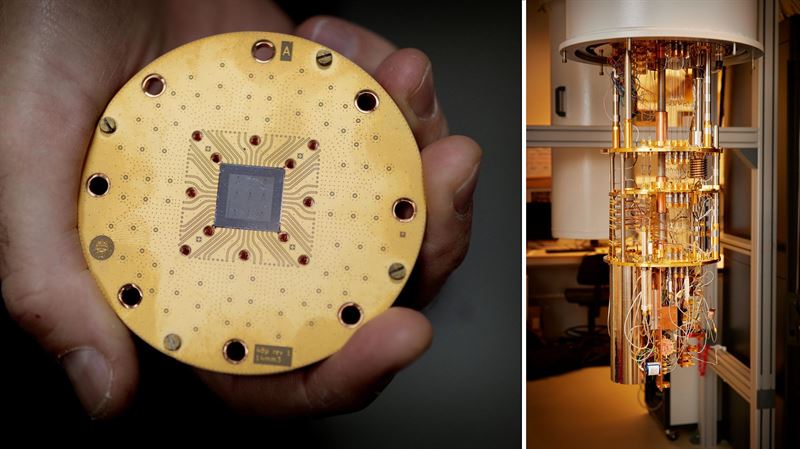
The method is particularly suited to superconducting quantum computers, one of the leading platforms in the global race towards large-scale quantum computing. It is also the technology being used at Chalmers University of Technology, where a 100-qubit quantum computer is currently under development.
"A key advantage of our approach is that it can be implemented using existing superconducting quantum circuit platforms. We are already discussing possible experimental realisations with colleagues at Chalmers, and we hope to see a demonstration of the method in the near future," says Tangyou Huang.
"Our results address one of the major bottlenecks in the field: how to quickly and reliably create and control the error-correcting quantum states that could play an important role in future quantum computers," says Lei Du.
More about bosonic codes, quantum lattice gates and Floquet control:
*Bosonic quantum codes store quantum information in the states of, for example, microwave or optical resonators rather than in individual qubits. They are considered promising tools for quantum error correction because they can provide built-in protection against certain types of errors.
To process this information, quantum operations are required. Quantum lattice gates are a recently proposed set of elementary building blocks for controlling bosonic quantum states. By designing these gates, a wide range of more complex quantum operations can be implemented.
One way to realise these operations, is through Floquet control, in which a quantum system is driven by periodic control signals. Previous Floquet-based methods have often relied on slow processes requiring many driving cycles. The new method developed at Chalmers can instead implement quantum lattice gates directly within a single driving cycle, making some operations more than a thousand times faster.
More about the research:
The scientific paper “Single-Period Floquet Control of Bosonic Codes with Quantum Lattice Gates” has been published in Physical Review Letters. The authors are Tangyou Huang, Lei Du and Lingzhen Guo. The researchers are affiliated with Chalmers University of Technology in Sweden, and Tianjin University in China.
The research was funded by the National Natural Science Foundation of China (NSFC), the Wallenberg Centre for Quantum Technology (WACQT), and the Knut and Alice Wallenberg Foundation.
For more information, please contact:
Lei Du, Staff Scientist in Applied Quantum Physics, Department of Microtechnology and Nanoscience, Chalmers University of Technology, Sweden, lei.du@chalmers.se, +46 (0)70 922 82 75.
Tangyou Huang, Staff Scientist in Quantum Technology, Department of Microtechnology and Nanoscience, Chalmers University of Technology, Sweden, tangyou@chalmers.se, +46 (0)70 144 95 16.
Both researchers speak English and Chinese (Mandarin). Chalmers has podcast studios and video production equipment on site and can assist with requests for TV, radio, or podcast interviews.
Top image on the page:
The new method has the potential to accelerate quantum computations by a factor of a thousand, bringing fault-tolerant quantum computers a significant step closer.
Photo: Chalmers University of Technology | Malin Arnesson and Anna-Lena Lundquist.
Caption for attached illustration:
New method for ultrafast quantum operations. The researchers’ method converts a desired quantum operation into a tailor-made sequence of control pulses (illustrated by the two vertical planes on the left). These control pulses rapidly steer the quantum system (represented by the cone) toward the desired state (shown on the plane at the bottom of the illustration). The method is designed for use in superconducting quantum computers, a platform that is currently among the leading candidates for large-scale quantum computing.
Illustration: Chalmers University of Technology | The illustration was created by Tangyou Huang and Lei Du using the AI tool ChatGPT.
Henrik Dahlberg
Head of Media Relations
+46 31 772 1940
henrik.dahlberg@chalmers.se
________________
Chalmers University of Technology in Gothenburg, Sweden, conducts research and education in technology and natural sciences at a high international level. The university has 3100 employees and 10,000 students, and offers education in engineering, science, maritime studies and architecture.
With scientific excellence as a basis, Chalmers promotes knowledge and technical solutions for a sustainable world. Through global commitment and entrepreneurship, we foster an innovative spirit, in close collaboration with wider society.
Chalmers was founded in 1829 and has the same motto today as it did then: Avancez – forward.
Follow us on LinkedIn. Like us on Facebook. Follow us on Instagram and tiktok.
---
Images provided in Chalmers University of Technology press releases are, unless specified otherwise, free for download and publication as long as credit is given to the University and the individual creator. Cropping and rescaling of the images is permitted when required for adaptation to the publication’s format, but modifications that would influence the message and content of the original are not. The material is primarily intended for journalistic and informative use, to assist in communication and coverage of Chalmers’ research and education. Commercial usage, for example the marketing of goods and services, is not permitted.
We kindly request credit to be given in the following format where possible:
Image/Graphic/Illustration: Chalmers University of Technology | Name Surname